

A past-due message should start with a verified balance. A missing allocation, pending payment or incorrect opening balance can make the account look different from reality. Reconstruct the account before asking the resident to explain it.
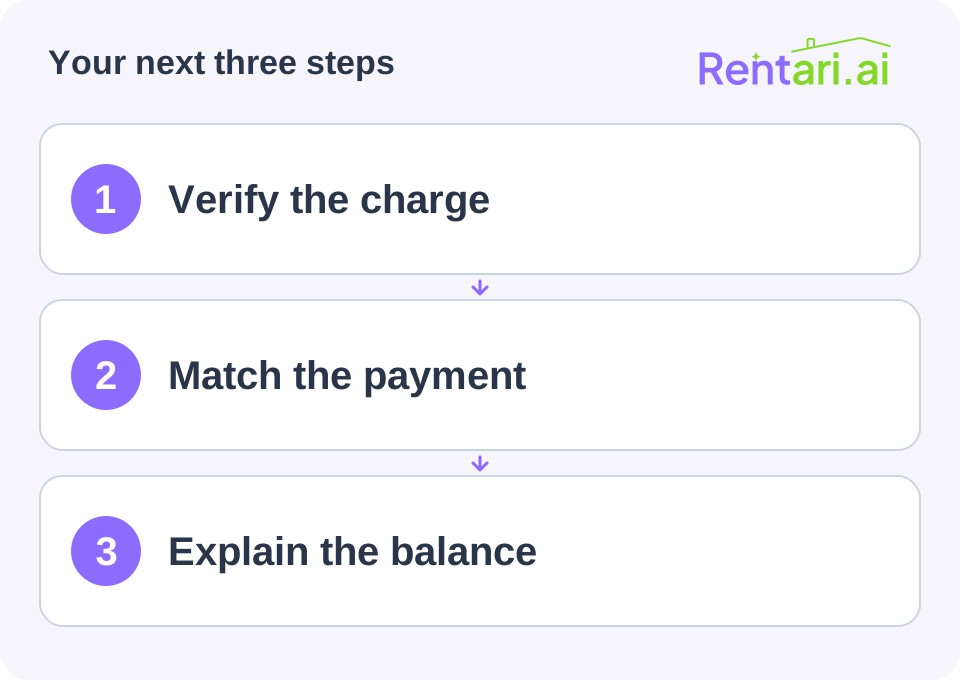
Establish the account and period
Confirm the full property address and unit, applicable agreement, charge period, due date and any documented amendment. Separate rent from other charges. Review the basis and legality of fees instead of assuming a software setting makes them valid.
Compare the opening balance with the prior closing record. If the earlier balance is unexplained, investigate it before carrying it into a new reminder. Record the date and time of the review because payment status may change afterward.
Reconcile in a repeatable order
- List the charges for the period and the agreement or approved adjustment supporting each one.
- Match posted payments to their references and confirm they belong to this account and period.
- Check credits, reversals and returns for a supporting event and an explanation.
- Review pending transactions separately, using the provider's exact current status.
- Compare the resulting balance with the displayed ledger and investigate any difference.
A bank deposit may combine multiple residents or charges. A resident's screenshot is useful evidence to investigate, but should be matched to the provider's record. Do not create a second payment entry merely because the same transaction appears in both places.
Work through a balance with a pending payment
In a hypothetical account, the reviewed opening balance is $0. The period has a $1,600 rent charge, an approved $100 credit and a posted $1,000 payment. The ledger calculation is:
$0 + $1,600 - $100 - $1,000 = $500 remaining on the ledger.
The resident also initiated a separate $500 transaction that the provider currently labels processing. That transaction has not yet been posted in this example. Keep its reference and status beside the reconciliation rather than pretending it never occurred or entering it again as a completed payment.
The next action is to check that transaction's status and the provider's expected next event. Asking immediately for another $500 could create a duplicate payment. When the original transaction reaches the relevant confirmed status, reconcile the provider event with the ledger's normal posting process. If it fails or returns, preserve the event history and review the remaining balance again.
The example assumes the listed charge and credit have already been reviewed. It does not establish a due date, fee or collection rule.
Choose the message after the check
If a transaction is unresolved, communicate that fact: The ledger currently shows $500 remaining as of [date and time]. We also see transaction [reference] for $500 marked processing and are checking its status. Please use [secure channel] to flag a missing payment or adjustment.
If the record is fully reconciled, send the factual charges, payments, adjustments and resulting balance with an as-of date. Use a secure route for the account summary and avoid including unnecessary bank information.
Record corrections with an explanation and preserve the original history. Keep a routine reminder separate from a legally required notice. Before escalation, verify the local process and obtain qualified advice where needed. Regular reconciliation makes later questions easier to resolve than rebuilding the account only after a dispute.

