

An expense total is easier to review when it connects to a receipt, business purpose, property and payment. Build that connection when the transaction occurs so an unfamiliar reviewer can tell what happened without relying on a bank description.
Create one record for the transaction
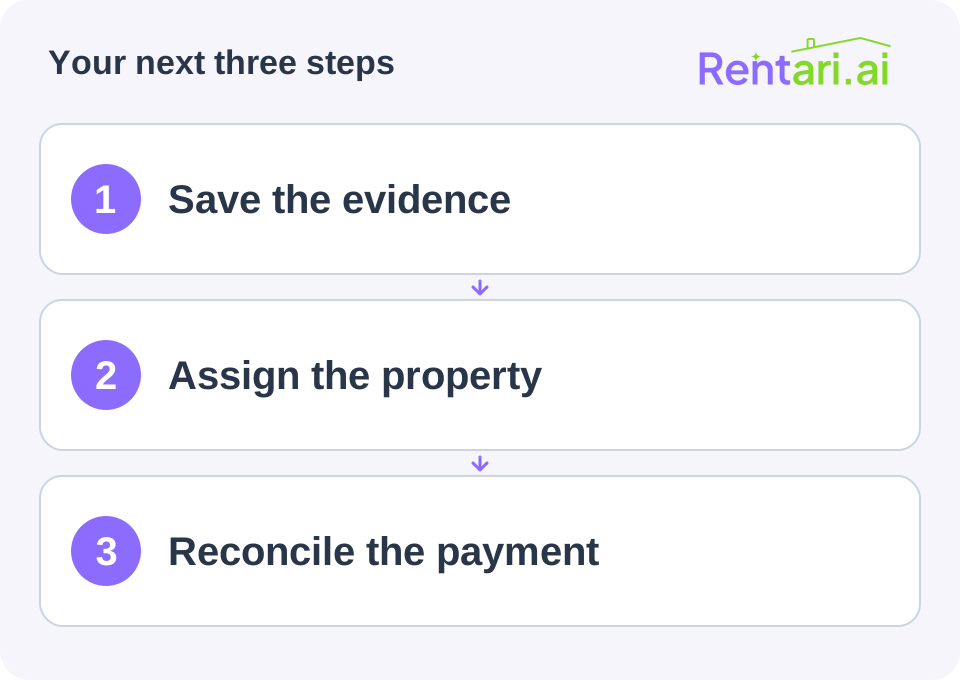
Save the invoice or receipt, vendor, transaction date, amount and description. Record the full property address and unit where relevant, plus the approval or work-order reference. Keep the original document accessible from the record.
Separate an estimate from a final invoice. Use the vendor's invoice reference to help identify duplicates, and label revised documents rather than silently replacing the original. Avoid storing unnecessary payment-card or personal information.
Describe the purpose so it can be checked
Write what was purchased or performed and which property benefited. Bathroom fixture work linked to work order M-18 is more useful than maintenance alone. A reviewer can then open the work order to understand the scope.
For shared costs, retain the allocation method, amounts and explanation instead of attaching the full total independently to every property. Ask your accountant about uncertain allocation or treatment. Do not assume every repair-looking invoice is immediately deductible or every large purchase is classified the same way. Tax treatment depends on the facts and applicable rules.
Reconcile a worked example
Suppose a hypothetical vendor invoice totals $480: $110 for a fixture, $330 for labor and $40 for disposal. The work-order reference identifies the property, unit and approved work. These figures describe record matching, not tax classification or typical repair pricing.
A later vendor credit is $35, leaving $445 due. The owner pays $300 first and $145 later. Preserve all five records: the original invoice, credit document, two payment references and the linked work-order record.
The reconciliation is:
$480 invoice - $35 credit = $445 net amount.
$300 first payment + $145 second payment = $445 paid.
The unpaid remainder is $0 once both payments are verified against the relevant records. Before the second payment, the file should show $145 still open. It should not describe the invoice as fully paid merely because the first bank transaction appeared.
Do not create another invoice when the $300 payment also appears in an imported bank feed. Match the payment to the existing transaction. If the bank amount differs, investigate fees, another invoice included in the payment or an incorrect reference instead of forcing the numbers to fit.
Review four exceptions at month-end
- Invoice with no payment match: determine whether it is unpaid, paid through another account or missing its reference.
- Payment with no support: request the invoice or receipt and establish the business purpose and property.
- Credit or refund not applied: link it to the original transaction and explain the remaining difference.
- Amount or allocation disagreement: preserve the evidence and assign the question to the responsible bookkeeper or accountant.
Keep correction notes with dates and reasons. Unpaid invoices, completed payments and refunds should remain distinguishable; the accounting treatment is a separate question for your accounting process.
The IRS explains that a recordkeeping system should clearly show income and expenses. Choose a system your team can maintain and your tax professional can review. A short recurring exception review is more dependable than trying to reconstruct a year's activity from bank descriptions alone.
Sources and further reading
Source review: September 24, 2026. Check current requirements before acting.

