- Home
- Lease agreement
- California
California residential lease agreement
State rules checked October 1, 2026 General information, not legal advice
Jump to a topic
California lease document preview
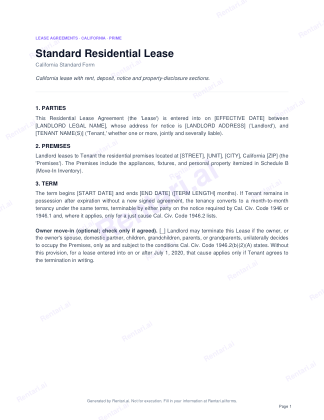
In the Rentari California lease
- Fair housing
Where the landlord accepts vouchers, the lease says all lawful sources of income are considered, and it treats an emotional support animal request as a reasonable accommodation request.
Cal. Gov. Code § 12955(a) California CRD: housing screening guidance
- Required disclosures
The lease attaches the rent cap and just cause notice or the exemption statement, the sex offender database notice, the bed bug notice and the flood notice to every California lease; adds pest control, ordnance, shared meter, contamination and mold disclosures from the landlord's answers, printing Not disclosed where a question was not answered; adds a demolition statement when a permit was applied for; and, when the landlord's answers show the rent reporting offer is required, adds the offer and election naming the reporting company the landlord must give.
Cal. Civ. Code § 1946.2(f) Cal. Civ. Code § 2079.10a(a) Cal. Civ. Code § 1954.603
- Flood disclosure
Every California lease attaches the flood hazard disclosure with all four statements.
- Owner and manager identity
The first page names the owner and any manager with a phone and street address, the payee, any in-person payment hours, the electronic payment information and the accepted forms of payment.
- Security deposit limit
The lease states the deposit and says that all security, including any pet deposit and any move-in fee, stays within one month's rent, or two months where the landlord represents that it qualifies as a small landlord and no tenant is a service member, and it treats a move-in fee as refundable security.
- Returning the deposit
The lease repeats the 21 calendar day deadline, the itemized statement, the photographs, the $125 documentation threshold, the ban on wear and tear deductions and the loss of the claim for a bad faith failure, and it promises electronic return where the tenant paid electronically.
- Move-in condition and photographs
The lease commits the landlord to take photographs at the start of the tenancy, after the unit is returned and after any repair or cleaning that will be deducted.
- Rent payments and late fees
The lease states the late charge as an agreed amount presumed to be the landlord's damage from late payment, in the words of the statute, payable after the grace period the landlord chose; its first page lists the ways to pay, including a check or money order mailed to the payee; and where the landlord bills for internet, cellular or satellite service it states the tenant's right to opt out.
- Returned payment fee
The lease caps the landlord's returned payment fee at $25 for the first returned payment and $35 for each later one, and repeats the three exceptions.
- Rent increase notice
The lease prints the statewide rent cap and just cause notice, or the exemption statement, whichever the landlord's answer calls for.
- Landlord entry
The lease repeats the written notice, business hours, notice contents, the 24-hour and six-day mailing presumptions and the no-notice cases.
- Repairs and habitability
The lease commits the landlord to provide a working stove and refrigerator, unless the tenant elects to bring a refrigerator, and to repair or replace a recalled one within 30 days of notice, and it says the tenant's repair rights are not waived.
- Tenant repair remedies
The lease states the repair and deduct remedy, its one month's rent limit and the twice in 12 months limit.
- Locks and security devices
The lease commits the landlord to change the locks within 24 hours for a protected tenant who provides the documentation, and lets the tenant change them if the landlord does not.
- Smoke alarms
The lease has the landlord confirm working detectors at move-in and remain responsible for them, and asks the tenant to test them, replace removable batteries and report problems, but says nothing about carbon monoxide devices.
- Retaliation
The lease states the 180-day protection and the damages as the section sets them.
- Lockouts and utility shutoffs
The lease says the landlord will not change the locks or exclude the tenant except through the judicial process the law requires.
- Ending a month-to-month tenancy
The lease gives the tenant a 30-day notice and the landlord a 60-day notice, or 30 days where the tenant has lived there less than a year, and notes the just cause rule.
- Ending a fixed-term lease early
The lease lets a tenant end the tenancy under the victim of abuse or violent crime section, commits the landlord to try to re-rent after an early move-out, and includes a federal service member termination clause.
- Abandoned property
The lease describes the notice of belief of abandonment and the notice and claim periods for property left behind, and says property left after an eviction judgment is handled under the eviction statute instead.
- Just cause to end a tenancy
The lease prints the statewide notice or the exemption statement from the landlord's answer, and reserves an owner move-in right only when the landlord chooses it.
California numbers the lease follows
- Security deposit limit
- 1 month's rent
- on top of the first month's rent; 2 months for a qualifying small landlord, never from a service member
- Cal. Civ. Code § 1950.5(c)(1), (c)(5)
- Deposit refund deadline
- 21 days
- calendar days after the tenant moves out, with an itemized statement
- Cal. Civ. Code § 1950.5(h)(1)
- Late fee grace period
- None set
- no state grace period or percentage; a late fee must be an agreed damages amount
- Cal. Civ. Code § 1671(d)
- Returned payment fee
- $25, then $35
- $25 for the first returned payment, $35 for each later one
- Cal. Civ. Code § 1719(a)(1)
- Rent increase notice
- 30 or 90 days
- 90 days when increases over 12 months pass 10 percent
- Cal. Civ. Code § 827(b)(2), (b)(3)
- Notice before entry
- 24 hours
- reasonable written notice; 24 hours is presumed reasonable
- Cal. Civ. Code § 1954(d)(1)
- Notice to pay rent or quit
- 3 court days
- not counting Saturdays, Sundays or judicial holidays
- Cal. Code Civ. Proc. § 1161(2)
- Notice to fix a lease breach
- 3 court days
- not counting Saturdays, Sundays or judicial holidays
- Cal. Code Civ. Proc. § 1161(3)
- Owner ending a month-to-month tenancy
- 60 or 30 days
- 30 days if any tenant or resident has lived there less than a year; just cause may also be needed
- Cal. Civ. Code § 1946.1(b), (c)
- Statewide rent cap
- 5% plus inflation, up to 10%
- over any 12 months, for covered housing, until January 1, 2030
- Cal. Civ. Code § 1947.12(a)(1)
From the California lease
CALIFORNIA RESIDENTIAL LEASE AGREEMENT
RIGHT OF ENTRY (Cal. Civ. Code 1954): Landlord shall give Tenant reasonable notice in writing of the intent to enter and shall enter only during normal business hours. The notice shall include the date, approximate time and purpose of the entry.
Right of entryCal. Civ. Code § 1954(d)(1)
REPAIR AND DEDUCT REMEDY: Pursuant to California Civil Code Section 1942, if Landlord fails to repair dilapidations rendering the Premises untenantable after reasonable notice, Tenant may repair the dilapidations and deduct the expense from the Rent, provided the cost does not exceed one month's rent, and the remedy is not used more than twice in any 12-month period.
Repair and deduct remedyCal. Civ. Code § 1942(a)
LATE CHARGE (Cal. Civ. Code 1671(d)): Landlord and Tenant agree that, from the nature of the case, it would be impracticable or extremely difficult to fix the actual damage Landlord sustains when rent is paid late, which includes the cost of processing and accounting for the late payment. They agree that [Late fee amount] is presumed to be the amount of that damage.
Late chargeCal. Civ. Code § 1671(d)
California lease types
Pick 3, 6, 12, 18 or 36 months or your own dates. At the end, the lease ends or converts to month-to-month.
Standard lease guideOwner ending a month-to-month tenancy: 60 or 30 days, 30 days if any tenant or resident has lived there less than a year; just cause may also be needed.
Cal. Civ. Code § 1946.1(b), (c)
California month-to-month leaseUpload a lease you already use: send an unsigned one for e-signature, or store one that is already signed.
Rooms use the California lease for now: add the room as its own unit and set house rules with the optional addenda.
California room rentalBefore you sign
Application screening fees
An application screening fee may not exceed your actual out-of-pocket cost of gathering information about the applicant, including a screening or credit report and the reasonable value of your time, and never more than $30 per applicant, a figure you may adjust each year by the Consumer Price Index from January 1, 1998.
Cal. Civ. Code § 1950.6(a), (b)
- You may not charge a screening fee when you know or should know that no unit is available now or within a reasonable time. Cal. Civ. Code § 1950.6(c)(1)
- You may charge the fee only if, when you collect it, you offer one of two processes: consider completed applications in the order received under written screening criteria given with the application, approve the first qualified applicant and charge only applicants actually considered; or refund the whole fee to every applicant not selected within 7 days of choosing a tenant or 30 days after the application, whichever is first. Cal. Civ. Code § 1950.6(c)(2)
- Give the applicant a receipt that itemizes your out-of-pocket costs and time. Cal. Civ. Code § 1950.6(d)
- If you do not check references or obtain a credit report, return any part of the fee not used for those purposes. Cal. Civ. Code § 1950.6(e)
- If the applicant paid a screening fee, give the applicant a copy of their consumer credit report by personal delivery, mail or email within seven days after you receive it. Cal. Civ. Code § 1950.6(f)
- From April 1, 2027, you must have a written pet policy, even one that bans pets, link it on your website and in digital ads, give a copy with every rental application, and, on written request, refund the application fee within seven business days if failing to disclose it before charging the fee left the applicant ineligible or led them to withdraw. Cal. Civ. Code § 1942.7.5 (Stats. 2026, ch. 1025, SB 1296)
- You may choose whether to accept reusable tenant screening reports. For an accepted qualifying report, charge neither an access fee nor an application screening fee. The statute specifies a report prepared within the prior 30 days at the applicant's request and expense, available to you at no cost, with the required identity, contact, employment, address, lawful eviction-history and currency information. Acceptance does not determine approval or remove other screening protections; a more protective local policy can apply. Cal. Civ. Code section 1950.1
- The CCPA can cover a qualifying for-profit business that collects personal information, determines its processing purposes and operates in California, subject to revenue or personal-data volume and sale/sharing thresholds. CPPA's coverage FAQ also describes related entities and separate service-provider duties. Review the applicable business and information exemptions before deciding which privacy duties apply. California Privacy Protection Agency, coverage FAQs4 and16
- If the CCPA covers the business and information, provide the required notice at or before collection: categories collected, purposes, sale or sharing, and the retention period or criteria, including the required sensitive-information disclosures. Keep collection, use, retention and sharing proportionate to the disclosed purposes, and retain information only as reasonably necessary for them. The section also requires appropriate reasonable security. Cal. Civ. Code section 1798.100(a), (c), (e)
- For covered information, privacy rights can include knowing, correcting or deleting information, opting out of sale/sharing, limiting sensitive-information use and equal treatment for exercising rights. The CPPA explains verification requirements and exceptions, including legal obligations and legal claims. Evaluate the applicable request and exception rather than promising automatic deletion of every application or report. California Privacy Protection Agency, rights and exceptions FAQs7 and10
Fair housing
Partly readA housing owner may not discriminate against or harass anyone because of race, color, religion, sex, gender, gender identity, gender expression, sexual orientation, marital status, national origin, ancestry, familial status, source of income, disability, veteran or military status, or genetic information. Screening policies must also follow the housing criminal-history protections described by the Civil Rights Department; a record in a report does not itself establish a lawful reason to reject an applicant.
Cal. Gov. Code § 12955(a) California CRD: housing screening guidance
- Source of income means lawful, verifiable income paid to the tenant or to the landlord for the tenant, including public assistance and housing subsidies such as Section 8 vouchers. Cal. Gov. Code § 12955(p)(1)
- CRD's housing guidance prohibits considering arrests without convictions, sealed or expunged records, and juvenile justice records, and prohibits blanket bans on everyone with a criminal history. For a permitted conviction, assess its direct relationship to tenancy, safety and property, including the nature and severity of the conduct and time elapsed. Verify the actual record and outcome; reporting eligibility alone does not establish that a housing decision is lawful. California CRD: criminal history in housing
- Government Code 12952 regulates employment screening by covered employers; its conditional job-offer procedure is not a statewide rental-offer rule. Check the actual housing regulations and any city or county fair-chance ordinance for the property before asking about or using criminal history. The local timing, notices and exceptions require a separate review. Cal. Gov. Code section 12952 California CRD: housing protections
- A screening service may combine credit, rental, eviction, criminal or reference information, or supply a risk score. Confirm the lawful housing purpose and applicable authorization and disclosure requirements before ordering, and certify housing-only use to the reporting company. Review discrepancies and outcomes instead of treating a score, a court filing, frequent moves or an unverified reference as an automatic rejection rule. Limit access and securely dispose of reports when finished with them. FTC: using consumer reports for housing
- If a consumer report influences an adverse action even partly, FTC guidance requires a notice. This includes a denial or report-based additional cosigner, deposit or rent requirement, subject to separate California limits. Identify the reporting agency with its address and telephone number, explain that it did not make the decision, and state the right to dispute inaccurate or incomplete information and request a free agency report within 60 days. Use a written notice for a clear record; a credit score used in the decision triggers additional written or electronic score disclosures. This duty is separate from California's seven-day consumer-credit-report copy rule. FTC: adverse-action notice requirements Cal. Civ. Code section 1950.6(f)
- A landlord or agent may not ask about immigration or citizenship status or require a status statement, representation or certification from a tenant, applicant, occupant or prospective occupant. Disclosing status information to harass, intimidate, retaliate, influence a move-out or recover possession is also prohibited. Cal. Civ. Code section 1940.3(b)
- Section 1940.3 permits information or documents necessary to verify an applicant's financial qualifications or an applicant's or prospective occupant's identity. It also preserves compliance with federal legal duties, including qualifying housing programs, and court subpoenas, warrants or orders. Apply these defined exceptions to the actual verification purpose. Cal. Civ. Code section 1940.3(c)
Where the landlord accepts vouchers, the lease says all lawful sources of income are considered, and it treats an emotional support animal request as a reasonable accommodation request.
Required disclosures
Partly readBesides the flood and owner identity disclosures, California requires several notices in or before the lease, depending on the property. The main statewide ones are the rent cap and just cause notice for covered housing, the registered sex offender database notice and the bed bug notice.
Cal. Civ. Code § 1946.2(f) Cal. Civ. Code § 2079.10a(a) Cal. Civ. Code § 1954.603
- For a tenancy covered by the statewide just cause and rent cap rules that began or renewed on or after July 1, 2020, give the statutory notice, in at least 12-point type, in the lease, as an addendum or as a notice signed by the tenant. Cal. Civ. Code § 1946.2(f)(1), (f)(3)
- Every lease of a single-family home, and of a property with more than four units, entered into on or after July 1, 1999 must carry the notice about the registered sex offender database, in at least 8-point type. Cal. Civ. Code § 2079.10a(a)(3)
- Before creating a new tenancy, give the prospective tenant the written bed bug notice, in at least 10-point type. You may not show or rent a vacant unit you know has a current bed bug infestation. Cal. Civ. Code § 1954.603 Cal. Civ. Code § 1954.602(a)
- If you apply for a permit to demolish the unit, tell a prospective tenant in writing before signing a lease or taking any application fee or other money, and tell current tenants before you apply; the notice must give the earliest approximate demolition date and the approximate date the tenancy will end. Cal. Civ. Code § 1940.6(a), (b)
- If you know of a former federal or state military ordnance location in the neighborhood, tell a prospective tenant in writing before the lease is signed. Cal. Civ. Code § 1940.7(b)
- If you have a contract for periodic pest control service, give each new tenant a copy of the pest control company's notice. Cal. Civ. Code § 1940.8
- If you know that a tenant's gas or electric meter also serves areas outside the unit, disclose that before the tenancy begins, or when you discover it, and make one of the arrangements for paying for that service that the section requires. Cal. Civ. Code § 1940.9(a)
- If a lease of more than one month is negotiated mainly in Spanish, Chinese, Tagalog, Vietnamese or Korean, give a translation of the whole lease in that language before it is signed. Cal. Civ. Code § 1632(b)(3)
- From January 1, 2027, a rental listing or ad that uses a digitally altered image must say so next to the image and include, or link to, the unaltered image. Cal. Civ. Code § 1940.11 (Stats. 2026, ch. 572, AB 2025)
- A landlord must offer each tenant the option of having positive rent payments reported to a consumer reporting agency, at lease signing for leases from April 1, 2025 and at least once a year, for a fee of no more than actual cost or $10 a month; a building of 15 or fewer units is exempt unless its owner is a REIT, corporation or LLC with a corporate member that owns more than one rental building. Cal. Civ. Code § 1954.07(a), (b), (g), (j)
The lease attaches the rent cap and just cause notice or the exemption statement, the sex offender database notice, the bed bug notice and the flood notice to every California lease; adds pest control, ordnance, shared meter, contamination and mold disclosures from the landlord's answers, printing Not disclosed where a question was not answered; adds a demolition statement when a permit was applied for; and, when the landlord's answers show the rent reporting offer is required, adds the offer and election naming the reporting company the landlord must give.
Flood disclosure
Every residential lease entered into on or after July 1, 2018 must disclose, in at least 8-point type, that the property is in a special flood hazard area or an area of potential flooding if you know it; that the tenant can look up hazards with the state Office of Emergency Services MyHazards tool, with its web address; that your insurance does not cover the tenant's belongings, so renter's and flood insurance are recommended; and that you need not give more flood information.
- You have actual knowledge if a public agency told you in writing, your lender requires flood insurance, or you carry flood insurance. Cal. Gov. Code § 8589.45(a)(1)
Every California lease attaches the flood hazard disclosure with all four statements.
Owner and manager identity
The lease must give the name, telephone number and usual street address for service of each person authorized to manage the property and of an owner or the owner's agent for service and notices, plus the name, phone and address of the person to whom rent is paid and the forms of payment.
Cal. Civ. Code § 1962(a)(1) to (a)(3)
- If rent may be paid in person, list the usual days and hours. You may instead give a bank account within five miles or the details for electronic funds transfer. Cal. Civ. Code § 1962(a)(2)
- Give the tenant a copy of the lease within 15 days after the tenant signs it, and once a year on request. Cal. Civ. Code § 1962(a)(4)
The first page names the owner and any manager with a phone and street address, the payee, any in-person payment hours, the electronic payment information and the accepted forms of payment.
Deposits, rent and fees
Security deposit limit
You may not demand or receive security, however it is labeled, of more than one month's rent, in addition to any rent for the first month paid on or before move-in. Security means any payment, fee, deposit or charge imposed at the start of the tenancy to cover the cost of processing a new tenant or as an advance payment of rent, used for any purpose, so a pet deposit or a move-in fee counts toward the limit; an application screening fee does not.
Cal. Civ. Code § 1950.5(b), (c)
- A landlord who is a natural person, or a limited liability company whose members are all natural persons, and who owns no more than two residential rental properties with no more than four dwelling units offered for rent in total, may take up to two months' rent. A settlor or beneficiary of a family trust counts as a natural person. Cal. Civ. Code § 1950.5(c)(5)(A), (C)
- The two-month limit never applies to a prospective tenant who is a service member, and you may not refuse to rent to a service member because of that. Cal. Civ. Code § 1950.5(c)(5)(B)
- If you charge a service member more than your standard or advertised security because of credit history, credit score, housing history or a similar factor, give a written statement of the higher amount and the reason on or before the date the lease is signed, put the return date in the lease, and return the extra after no more than six months of residency if the tenant is not behind on rent. Cal. Civ. Code § 1950.5(c)(4)
- An advance payment of at least six months' rent on a lease of six months or longer is outside the limit. Cal. Civ. Code § 1950.5(c)(2)
- The lease may not call any security nonrefundable. Cal. Civ. Code § 1950.5(n)
- The limit does not apply to security collected or demanded before July 1, 2024. Cal. Civ. Code § 1950.5(c)(6)
The lease states the deposit and says that all security, including any pet deposit and any move-in fee, stays within one month's rent, or two months where the landlord represents that it qualifies as a small landlord and no tenant is a service member, and it treats a move-in fee as refundable security.
Returning the deposit
No later than 21 calendar days after the tenant has moved out, give the tenant an itemized statement of the security received and how it was used, and return the rest. You may deduct only what is reasonably necessary for unpaid rent, damage beyond ordinary wear and tear, cleaning back to the condition at move-in, and the other purposes the section allows.
Cal. Civ. Code § 1950.5(b), (e), (h)(1)
- Subject to the multiple-adult-tenant rules, if you received security or rent electronically, return the remainder to the account the tenant designates in writing, or by an available electronic method the tenant agrees to in writing, unless you agree in writing on another return method. Give written notice of this right within a reasonable time after either side's termination notice or before the lease ends, except where a different method was already agreed in writing or the specified CCP1161(2)-(4) termination exception applies. A successor's electronic-return duty depends on receiving rent electronically from that tenant. Cal. Civ. Code § 1950.5(h)(1)(A)(ii)
- Otherwise use personal delivery or a check mailed first class, postage prepaid. With multiple adult occupants, the default refund check names all adults on the rental agreement when the tenancy ends, and the statement goes to one adult selected by the landlord. An agreement signed by the landlord and every adult tenant may specify recipients, allocation percentages, payment method and each adult's statement delivery/address. Section1950.5(h)(1)(C)(iii) separately permits another disbursement on a qualifying1946.7 terminating tenant's request where no such mutual agreement exists. Cal. Civ. Code § 1950.5(h)(1)(A)(i), (C)
- With the statement, include copies of documents for repair and cleaning charges: for your own or your employee's work, a description with the time spent and the hourly rate; for anyone else's work and for materials, the bill, invoice or receipt; plus the photographs of the unit. You may skip this when repair and cleaning deductions together are $125 or less, unless the tenant asks for the documents within 14 calendar days after receiving the statement. A timely tenant request requires compliance within 14 calendar days after receipt. A documentation waiver has specific timing, signature and text conditions; it does not remove a later timely request right. Cal. Civ. Code § 1950.5(h)(2), (h)(4), (h)(5)
- You may not deduct for damage or defects that existed before the tenancy or for ordinary wear and tear. Cal. Civ. Code § 1950.5(e)(2)
- A landlord who in bad faith fails to comply with these return duties may not claim any of the security, and bad faith retention can bring statutory damages of up to twice the amount of the security on top of actual damages. Cal. Civ. Code § 1950.5(h)(7), (m)
- A good-faith estimate is available when a repair cannot reasonably be completed within 21 calendar days or supporting third-party documents have not arrived. State the estimate in the timely itemization and identify the outside provider when documents are missing. Complete the required accounting and documents within 14 calendar days after completing the repair or receiving the documentation; the estimate does not cancel the original closeout deadline. Cal. Civ. Code § 1950.5(h)(3)-(5)
- Preserve the starting condition, resident comments, dated photographs, actual work and reasonable charge calculation. Professional cleaning must be reasonably necessary to restore the initial condition, excluding ordinary wear. A lease fee label, blanket carpet-cleaning charge or replacement invoice alone does not establish that the resident owes it. Give a disputed item its own factual review; damages above the deposit still require a lawful basis and proof. Cal. Civ. Code § 1950.5(b), (e)(2), (m)
- Send the itemized statement by personal delivery or prepaid first-class mail unless the permitted agreement changes delivery; email requires mutual agreement and an account supplied by the tenant. Check the multiple-adult rules separately. For required mailings, use the tenant's supplied address, or the vacated unit if none was supplied. Keep a delivery and refund record rather than treating a generated statement as completed delivery. Cal. Civ. Code § 1950.5(h)(1)(B)-(C), (h)(6)
The lease repeats the 21 calendar day deadline, the itemized statement, the photographs, the $125 documentation threshold, the ban on wear and tear deductions and the loss of the claim for a bad faith failure, and it promises electronic return where the tenant paid electronically.
Where the deposit is held, and interest
Not set by statuteState landlord and tenant law does not require a landlord to pay interest on a security deposit or to keep it in a separate account. The security is held for the tenant, and the tenant's claim to it comes before the claim of any of your creditors.
- When your interest in the property ends, for example on a sale, you must within a reasonable time either transfer the security to your successor and notify the tenant, or return it to the tenant after deducting lawful claims. Cal. Civ. Code § 1950.5(i)
- Check city rules separately. For San Francisco, Administrative Code49.2 requires simple interest on deposits held at least one year, with an exception where rent is government-assisted or subsidized. It provides annual payment or rent credit and qualifying move-out prorated interest within two weeks; authorized withholding and fee-recovery provisions have their own limits. Use the applicable Rent Board rate for the due date or move-out date. This city example does not establish a statewide rate or another city's requirements. San Francisco Administrative Code § 49.2
Move-in condition and photographs
For a tenancy that begins on or after July 1, 2025, you must photograph the unit immediately before, or at the start of, the tenancy. You must also photograph it within a reasonable time after it is returned to you, before any repair or cleaning you will deduct for, and again after that work is done.
- Within a reasonable time after either side gives notice to end the tenancy, or before the lease ends, tell the tenant in writing that the tenant may request an initial inspection and be present for it. If asked, inspect no earlier than two weeks before the tenancy ends, with at least 48 hours' written notice unless you both sign a waiver, so the tenant can fix problems and avoid deductions. Cal. Civ. Code § 1950.5(f)(1)
- The initial-inspection duties do not apply to terminations under CCP1161(2), (3) or (4). For a requested inspection, follow the scheduling, written notice and any signed waiver rules. Provide or leave the proposed repair/cleaning itemization with the required statutory text, and allow the resident to remedy identified issues before termination. Later damage and conditions hidden by possessions have separate treatment; the preliminary list is not permission for unsupported final charges. Cal. Civ. Code § 1950.5(f)(1)-(7)
The lease commits the landlord to take photographs at the start of the tenancy, after the unit is returned and after any repair or cleaning that will be deducted.
Rent payments and late fees
California sets no late fee percentage and no grace period. In a lease of a home, a late fee is a liquidated damages term, and it is void unless, from the nature of the case, the landlord's actual damage from late payment would be impracticable or extremely difficult to fix and the lease sets an agreed amount presumed to be that damage.
Cal. Civ. Code § 1671(c)(2), (d)
- You must let the tenant pay rent and security in at least one form that is neither cash nor electronic funds transfer, and you may not charge a fee for paying by check. Cal. Civ. Code § 1947.3(a)(1), (b)
- After a tenant's check bounces or the tenant stops payment, you may require cash for no more than three months, and only as the section allows. Cal. Civ. Code § 1947.3(a)(2)
- The lease must say to whom rent is paid and in what forms. Cal. Civ. Code § 1962(a)(2), (a)(3) See Owner and manager identity on the California page
- For a tenancy that began, renewed or continued month to month on or after January 1, 2026, you must let the tenant opt out of paying for a third-party internet, cellular or satellite subscription offered with the tenancy; if you do not, the tenant may deduct its cost from rent. Cal. Civ. Code § 1942.8(a), (c)
The lease states the late charge as an agreed amount presumed to be the landlord's damage from late payment, in the words of the statute, payable after the grace period the landlord chose; its first page lists the ways to pay, including a check or money order mailed to the payee; and where the landlord bills for internet, cellular or satellite service it states the tenant's right to opt out.
Returned payment fee
When a check or other order for payment is refused for lack of funds or credit, because there is no account, or because payment was stopped, the payee may charge a service charge of no more than $25 for the first returned payment and no more than $35 for each later one to that payee.
Cal. Civ. Code § 1719(a)(1), (a)(6)
- No service charge is due where the tenant stopped payment to resolve a good faith dispute, where the tenant's bank confirms in writing that the return was its own error, or where the tenant shows in writing that a scheduled social security or government benefit direct deposit was delayed. Cal. Civ. Code § 1719(a)(3) to (a)(5)
- Instead of the service charge, treble damages of $100 to $1,500 can be claimed if a certified mail demand meeting the section goes unpaid for 30 days. Cal. Civ. Code § 1719(a)(2)
The lease caps the landlord's returned payment fee at $25 for the first returned payment and $35 for each later one, and repeats the three exceptions.
Rent increase notice
For a month-to-month or shorter tenancy, give written notice of a rent increase at least 30 days before it takes effect, or at least 90 days if the increase, alone or combined with other increases in the 12 months before it takes effect, is more than 10 percent of the rent charged at any time in those 12 months. Deliver it personally or by mail; a mailed notice gets five more calendar days when mailed to an address in California.
Cal. Civ. Code § 827(b) Cal. Code Civ. Proc. § 1013(a)
- The 90-day rule does not apply to an increase caused by a required recertification of the tenant's income or family size; that notice is 30 days. Cal. Civ. Code § 827(b)(3)(B)
- Most housing that is more than 15 years old is also subject to a statewide cap on the size of increases. Cal. Civ. Code § 1947.12(a)(1), (d)(4) See Rent caps and local rules on the California page
- If a tenant who is not behind on rent makes a good faith repair notice or complaint, you may not raise rent within 180 days to retaliate for it; an increase for a lawful reason, stated in good faith in the notice, is allowed. Cal. Civ. Code § 1942.5(a), (f), (g) See Retaliation on the California page
The lease prints the statewide rent cap and just cause notice, or the exemption statement, whichever the landlord's answer calls for.
During the tenancy
Landlord entry
You may enter only in an emergency, to make necessary or agreed repairs or services, to show the unit to buyers, lenders, tenants, workers or contractors, for the move-out inspection, after the tenant has abandoned or surrendered the unit, under court order, or for the other purposes the section lists. Except in an emergency or with the tenant's consent at the time, give reasonable written notice and enter only during normal business hours.
Cal. Civ. Code § 1954(a), (b), (d)(1)
- The notice must state the date, approximate time and purpose of the entry. You may deliver it personally, leave it with someone of suitable age at the unit, or leave it on, near or under the usual entry door. Twenty-four hours is presumed reasonable notice; a mailed notice is presumed reasonable if mailed at least six days before entry. Cal. Civ. Code § 1954(d)(1)
- To show the unit to buyers, notice may be oral if you told the tenant in writing within the last 120 days that the property is for sale; leave written evidence of the entry inside. Cal. Civ. Code § 1954(d)(2)
- No notice is needed to respond to an emergency, if the tenant is present and consents at the time, or after the tenant has abandoned or surrendered the unit. You may not abuse the right of access or use it to harass the tenant. Cal. Civ. Code § 1954(c), (e)
The lease repeats the written notice, business hours, notice contents, the 24-hour and six-day mailing presumptions and the no-notice cases.
Repairs and habitability
A home is untenantable if it substantially lacks any of the standard characteristics the law lists, including weatherproofing, working plumbing and gas, hot and cold running water with sewage disposal, working heat and electrical lighting, clean and sanitary grounds free of vermin, adequate trash receptacles, and floors, stairways and railings in good repair.
- For a lease entered into, amended or extended on or after January 1, 2026, a working stove is also required, and so is a working refrigerator unless the tenant chooses in the lease, using the statutory statement, to bring and maintain their own. A recalled stove or refrigerator does not count. Cal. Civ. Code § 1941.1(a)(10), (a)(11)
- You may not demand or collect rent, raise the rent or serve a three-day notice to pay while the home substantially lacks those characteristics and a housing official has notified you of the conditions and they remain uncorrected, as that section sets out. Cal. Civ. Code § 1942.4(a)
The lease commits the landlord to provide a working stove and refrigerator, unless the tenant elects to bring a refrigerator, and to repair or replace a recalled one within 30 days of notice, and it says the tenant's repair rights are not waived.
Tenant repair remedies
If you do not repair conditions making the home untenantable within a reasonable time after written or oral notice, the tenant may make the repair and deduct the cost from rent, up to one month's rent, or may move out and stop owing rent. The tenant may use this remedy no more than twice in any 12 months.
- A tenant who repairs after the 30th day following notice is presumed to have waited a reasonable time; a shorter wait can be reasonable if the circumstances require it. Cal. Civ. Code § 1942(b)
- The remedy is not available if the condition was caused by the tenant's breach of the tenant's own duties under the sections it names. Cal. Civ. Code § 1942(c)
The lease states the repair and deduct remedy, its one month's rent limit and the twice in 12 months limit.
Locks and security devices
You must install and maintain an operable dead bolt lock on each main swinging entry door, operable security or locking devices on windows designed to be opened, and code-compliant locks on exterior doors to common areas in multifamily buildings.
- The tenant must tell you about an inoperable lock; you are liable only if you do not fix it within a reasonable time after notice. Cal. Civ. Code § 1941.3(b)
- On a protected tenant's written request with the required documentation, change the locks at your own expense within 24 hours and give the tenant a key. Cal. Civ. Code § 1941.5(b)
The lease commits the landlord to change the locks within 24 hours for a protected tenant who provides the documentation, and lets the tenant change them if the landlord does not.
Smoke alarms
Every dwelling unit must have approved smoke alarms installed. The owner of a rented apartment building or a rented single-family home is responsible for testing and maintaining them and must make sure they work when a new tenancy begins.
Cal. Health & Safety Code § 13113.7(a), (d)(2)
- The tenant must tell the owner or manager about an inoperable smoke alarm; the owner must fix reported problems and is not in violation for a problem it was not told about. Cal. Health & Safety Code § 13113.7(d)(2)(B)
- To install, test or repair alarms you may enter with reasonable written notice during normal business hours; 24 hours is presumed reasonable. Cal. Health & Safety Code § 13113.7(d)(2)(A)
- A unit with a fossil fuel burning heater or appliance, a fireplace or an attached garage must also have an approved carbon monoxide device, which the landlord must maintain, have working when the tenant takes possession, and repair once told of a problem. Cal. Health & Safety Code § 17926(a) Cal. Health & Safety Code § 17926.1(a), (c)
The lease has the landlord confirm working detectors at move-in and remain responsible for them, and asks the tenant to test them, replace removable batteries and report problems, but says nothing about carbon monoxide devices.
Retaliation
If a tenant who is not behind on rent has in good faith given a repair notice, reported a suspected bed bug infestation, complained to you about habitability, or complained to a government agency, you may not recover possession, force the tenant out, raise the rent or cut services within 180 days because of it.
- It is also unlawful to raise rent, cut services, force a tenant out, sue for possession, or threaten any of these, to retaliate for joining a tenants' organization or lawfully exercising any legal right. Cal. Civ. Code § 1942.5(d)
- A landlord who retaliates owes actual damages, and punitive damages of $100 to $2,000 for each retaliatory act involving fraud, oppression or malice. Cal. Civ. Code § 1942.5(h)
The lease states the 180-day protection and the damages as the section sets them.
Lockouts and utility shutoffs
You may not, with intent to force a tenant out, willfully cut off or interrupt any utility service, change the locks or otherwise block access, remove outside doors or windows, or remove the tenant's property without written consent except under the abandoned property procedure.
Cal. Civ. Code § 789.3(a), (b)
- A landlord who does so owes the tenant actual damages plus up to $100 for each day or part of a day of violation, never less than $250 for each separate cause of action, and the prevailing party recovers reasonable attorney's fees. Cal. Civ. Code § 789.3(c), (d)
- You may not use threats, force or the other conduct the section lists to influence a tenant to leave. Cal. Civ. Code § 1940.2(a)
The lease says the landlord will not change the locks or exclude the tenant except through the judicial process the law requires.
Ending a tenancy
Ending a month-to-month tenancy
To end a month-to-month tenancy, an owner must give written notice at least 60 days before the termination date, or at least 30 days if any tenant or resident has lived in the unit less than one year. A tenant must give notice at least as long as the rental period, which is 30 days for a monthly tenancy.
Cal. Civ. Code § 1946.1(b), (c) Cal. Civ. Code § 1946(a)
- An owner may give 30 days' notice to sell a separately alienable unit to a natural person who will live there for at least a year, if escrow was opened no more than 120 days before the notice and the other conditions of the section are met. Cal. Civ. Code § 1946.1(d)
- An owner's notice must include the statutory statement that former tenants may reclaim abandoned personal property, and you may not charge the tenant for serving it. Cal. Civ. Code § 1946.1(h), (i)
- After 12 months of occupancy, a covered tenancy can end only for a just cause stated in the notice. Cal. Civ. Code § 1946.2(a) See Just cause to end a tenancy on the California page
The lease gives the tenant a 30-day notice and the landlord a 60-day notice, or 30 days where the tenant has lived there less than a year, and notes the just cause rule.
Ending a fixed-term lease early
Partly readIf a tenant breaks the lease and leaves early, you can recover the rent for the rest of the term only to the extent the tenant cannot prove the loss could reasonably have been avoided, so you are expected to try to re-rent.
- A tenant may end the tenancy with written notice and supporting documentation if the tenant, a household member or an immediate family member was the victim of an act or crime listed in 1946.7. The section allows notice within 180 days of the qualifying order, report or act, or within the notice period described in 1946. The rent obligation is no more than 14 calendar days after notice, or an appropriate shorter period under 1946 or the rental agreement. Cal. Civ. Code § 1946.7(a), (d), (e)
- The written notice may attach a qualifying protective order, a law-enforcement report, documentation from a qualified third party using the statutory statement, or other documentation that reasonably verifies the listed act or crime. A police report is not the only option. Information provided under this section may be disclosed only with the tenant's written consent or when law or a court order requires it; checking the contents with the qualified third party is allowed. Cal. Civ. Code section 1946.7(b), (i)
- For a qualifying termination, rent is prorated if the home is relet before the tenant's remaining rent obligation ends. The landlord may not require forfeiture of a deposit or advance rent because of the termination, and the termination itself is not a lease breach. Other deposit rules still apply. Cal. Civ. Code section 1946.7(e), (f)
- The release covers the qualifying tenant and members of that tenant's household; it does not automatically release every other tenant who signed the lease. A household member here means a family member living in the same unit. If the qualifying immediate family member lived elsewhere and no part of the act or crime occurred in or within 1,000 feet of the tenant's home, the notice also needs the written relocation statement required by subsection (c). Cal. Civ. Code section 1946.7(c), (g), (h)
The lease lets a tenant end the tenancy under the victim of abuse or violent crime section, commits the landlord to try to re-rent after an early move-out, and includes a federal service member termination clause.
Notice for unpaid rent
Before filing an eviction for unpaid rent, serve a written notice giving the tenant three days, not counting Saturdays, Sundays and other judicial holidays, to pay or give up possession. The notice must state the amount due and the name, telephone number and address of the person to pay, and, if payment may be made in person, the usual days and hours that person is available, or instead the bank account details or an electronic funds transfer procedure already set up.
Cal. Code Civ. Proc. § 1161(2)
- Serve it by personal delivery; or, if the tenant is away from home and work, by leaving a copy with a person of suitable age there and mailing a copy; or, if neither place works, by posting it in a conspicuous place on the property, giving a copy to a resident if one can be found, and mailing a copy. Cal. Code Civ. Proc. § 1162(a)
- The notice may be served any time within one year after the rent became due. Cal. Code Civ. Proc. § 1161(2)
- For a tenancy covered by the statewide just cause rule, default in rent is an at-fault just cause. Cal. Civ. Code § 1946.2(b)(1)(A) See Just cause to end a tenancy on the California page
- You may not charge the tenant a fee for serving, posting or delivering a three-day notice. Cal. Code Civ. Proc. § 1161(6)
Notice for other lease violations
For a breach of a lease term other than rent, serve a written notice giving the tenant three days, not counting Saturdays, Sundays and other judicial holidays, to perform the term or give up possession. If the tenant performs within that time, the lease continues.
Cal. Code Civ. Proc. § 1161(3)
- A tenant who assigns or sublets against the lease, commits waste, maintains a nuisance or uses the premises for an unlawful purpose may be served a three-day notice to quit with no chance to cure. Cal. Code Civ. Proc. § 1161(4)
- For a tenancy covered by the statewide just cause rule, a curable violation first needs a notice with the chance to cure; only if it is not cured may a three-day notice to quit follow. Cal. Civ. Code § 1946.2(c) See Just cause to end a tenancy on the California page
The eviction process
Partly readEviction is a court case called unlawful detainer. After the right notice expires, you file a complaint; a tenant served with the summons has 10 days, not counting Saturdays, Sundays and other judicial holidays, to respond.
Cal. Code Civ. Proc. § 1167(a)
- You may not remove a tenant yourself; only a lawful eviction by the proper authorities can do that. Cal. Civ. Code § 789.3(b) See Lockouts and utility shutoffs on the California page
- For a covered tenancy, a termination notice that does not comply with the statewide just cause rule is void. Cal. Civ. Code § 1946.2(g) See Just cause to end a tenancy on the California page
- After the notice deadline passes without compliance, use the superior court for the county where the home is located and the courthouse that handles eviction cases. Gather the lease and amendments, notice, proof of notice delivery and supporting records. California Courts' filing guide identifies the summons, complaint and civil cover sheet; check the court's current packet for any additional forms. The court guide gives a usual filing-fee range of $240 to $450, depending on the claim; confirm the local fee and ask about a fee waiver if needed. California Courts, prepare the eviction filing California Courts, file the summons and complaint
- Serving the court summons and complaint is a separate step from serving the tenancy notice. A server must be at least 18 and not a party to the case; the landlord cannot serve these court papers personally. Each tenant must be served, and the server completes a Proof of Service of Summons (POS-010) for filing. Follow the court's rules for attempted personal service and any substituted service. Posting and mailing court papers requires the judge's permission; do not treat the tenancy-notice posting rule as permission to post a summons. California Courts, serve the summons and complaint
- The response clock depends on completed service. California Courts describes ten court days for personal service; through Safe at Home, fifteen court days; and for substituted service or permitted posting and mailing, ten calendar days for service to become complete followed by ten court days to respond. Check the actual method, completion date and court holidays before requesting a default. Section 1167 separately adds five court days for service through the Secretary of State's address-confidentiality program. California Courts, after service Cal. Code Civ. Proc. § 1167(a) to (c)
- If the tenant files an Answer, request a trial date using the court's current instructions for UD-150; filing the complaint does not by itself set the trial date. If there is no timely response, ask the court about a default judgment. A motion challenging service or the complaint needs legal guidance. Section 1170.5 generally requires trial within twenty days after the request to set trial, subject to its permitted extensions and criminal-case priority; use the court's actual notice rather than assuming a fixed hearing date. California Courts, response and trial request Cal. Code Civ. Proc. § 1170.5
- Checked October 13, 2026: after a possession judgment that can be enforced, have the court issue the writ and follow the sheriff's instructions for delivering it. California Courts explains that the sheriff's Notice to Vacate gives the tenant five days to move; the sheriff handles removal if the tenant remains after that deadline. A tenant may seek a stay or other court relief, so do not treat the judgment date as an automatic private lockout date or assume a fixed completion time. Confirm the current order and sheriff process with the court or legal counsel. California Courts, after the eviction trial decision Cal. Code Civ. Proc. § 1174(c), (d)
Abandoned property
When personal property remains after a tenancy has ended and the tenant has left, give written notice to the tenant and to anyone you reasonably believe owns it, describing the property and where and by when it can be claimed. The claim date must be at least 15 days after the notice is personally delivered, or 18 days after it is mailed.
Cal. Civ. Code § 1983(a), (b) Cal. Civ. Code § 1984(a)
- Unclaimed property must be sold at public sale after published notice, unless you reasonably believe it is worth less than $700 in total, in which case you may keep or dispose of it. Cal. Civ. Code § 1988(a), (b)
- If rent has been unpaid for at least 14 consecutive days and you reasonably believe the tenant has left, you may give a written notice of belief of abandonment; the lease ends on the date it states, at least 15 days after personal service or 18 days after mailing, unless the tenant first answers in writing or pays any of the unpaid rent between 14 days before the notice and that date. Cal. Civ. Code § 1951.3(b), (c), (f)
- Checked October 13, 2026: property left after a court eviction follows the separate post-judgment procedure in Code of Civil Procedure section 1174. Keep it in a place of safekeeping; the tenant's claim deadline is stated in the writ, while notice to another reasonably believed owner follows section 1983, subject to the section's exceptions. Section 1174 has separate rules for apparently lost property, release and unclaimed-property disposal, including cross-references to Civil Code sections 1965, 1988 and 1990. Do not reverse the ordinary 15-day personal-delivery and 18-day mailing periods or assume all belongings can immediately be discarded. Confirm the applicable procedure and costs before release or disposal. Cal. Code Civ. Proc. § 1174(e) to (i) Cal. Civ. Code § 1983(b)
The lease describes the notice of belief of abandonment and the notice and claim periods for property left behind, and says property left after an eviction judgment is handled under the eviction statute instead.
Small claims
Small claims court hears money claims up to $6,250, or up to $12,500 when the person suing is a natural person. A deposit case can be brought there if the damages claimed fit within those limits.
Cal. Code Civ. Proc. § 116.220(a)(1) Cal. Code Civ. Proc. § 116.221 Cal. Civ. Code § 1950.5(o)
- A natural person, such as an individual landlord or tenant, may sue for up to $12,500; other plaintiffs, such as a company, are limited to $6,250. Cal. Code Civ. Proc. § 116.221
More California rules
Just cause to end a tenancy
After a tenant has lawfully lived in a covered home for 12 months, the owner may end the tenancy only for a just cause stated in the written notice. If an adult tenant was added before an existing tenant reached 24 months, the rule applies once all tenants have 12 months or one tenant has 24 months. The rule applies until January 1, 2030.
- At-fault causes include unpaid rent, breach of a material lease term, nuisance, waste, refusing to sign a similar renewal, criminal activity and unlawful subletting. Cal. Civ. Code § 1946.2(b)(1)
- No-fault causes include the owner or a close relative moving in as their primary residence for at least 12 continuous months; for leases entered into from July 1, 2020, this needs the tenant's written agreement or a lease term allowing it. It is not available if the intended occupant already occupies a unit on the property or a similar unit is vacant there; the notice must name the intended occupant and their relationship to the owner and say the tenant may ask for proof; and the occupant must move in within 90 days after the tenant leaves and stay 12 consecutive months, or the owner must offer the unit back at the same rent and terms and pay reasonable moving costs. Cal. Civ. Code § 1946.2(b)(2)(A)(i) to (vi)
- For a no-fault termination, either pay relocation help equal to one month's rent within 15 calendar days of the notice or waive the final month's rent in writing, and tell the tenant about this in the notice. Cal. Civ. Code § 1946.2(d)
- Exempt are, among others, housing with a certificate of occupancy from the previous 15 years, an owner-occupied home renting no more than two units or bedrooms, and a separately sellable house or condominium not owned by a REIT, a corporation or an LLC with a corporate member, if the tenants got the statutory exemption statement, which must be in the rental agreement itself for a tenancy that began or renewed on or after July 1, 2020. Cal. Civ. Code § 1946.2(e) Cal. Civ. Code § 1946.2(e)(8)(B)
- A notice that does not comply is void, and an owner who tries to recover possession in material violation owes actual damages and can owe up to three times that for willful conduct. Cal. Civ. Code § 1946.2(g), (h)
The lease prints the statewide notice or the exemption statement from the landlord's answer, and reserves an owner move-in right only when the landlord chooses it.
Preparing your first California rental
Partly readPrepare the property, screening process, lease notices and condition record before move-in. Review both state requirements and the rules for the property’s city, including coverage or exemptions that depend on the particular home. Use the detailed guide topics for the legal conditions behind each step.
- Compare similar homes by location, size, condition and included services. Budget for taxes, insurance, utilities you pay, repairs, turnover and vacancy, with a reserve for unexpected work. Check local rental registration, inspection and safety requirements. Review applicable rent-cap and just-cause coverage before projecting future rent increases or making plans to end a tenancy. Cal. Civ. Code § 1947.12(a) See Rent caps and local rules on the California page
- Prepare consistent lawful screening criteria, the permitted application-fee process and required report or decision notices. Review the income-source and criminal-record protections before ordering reports or evaluating results. Keep the criteria, fee receipts, report information, communications and notice delivery records together with appropriate access limits. Cal. Civ. Code § 1950.6(a), (b) See Application screening fees on the California page
- Confirm the parties, home, dates, rent, utilities, payment methods, deposits and notice contacts in the lease. Review the applicable rent-cap/just-cause, bed bug, database, flood and other disclosures described in this guide. Check deposit limits and exceptions separately; the presence of furniture is not the test for the qualifying small-landlord exception. Keep signed copies and delivery records. Cal. Civ. Code § 1946.2(f) Cal. Civ. Code § 2079.10a(a) Cal. Civ. Code § 1954.603 Cal. Civ. Code § 1950.5(b), (c) See Required disclosures on the California page
- Finish repairs and safety checks, and arrange reliable repair contacts. Make the required move-in photographs for covered new tenancies and keep a dated condition record. Explain rent payments, repair reporting and urgent contacts to the resident. Organize the ledger, receipts, notices, communications and repair history, and calendar lease events and deadlines. Cal. Civ. Code § 1950.5(g) Cal. Civ. Code § 1941.1(a) See Move-in condition and photographs on the California page
Adverse possession and ownership records
Partly readFive years at a California address does not by itself establish ownership. Adverse possession requires qualifying possession and timely payment of the taxes assessed on the land for the required period. Assess a claim to title separately from an occupancy dispute and its removal procedure.
Cal. Code Civ. Proc. § 325: possession and tax requirements
- Section 325 requires five years of continuous occupation and claim, plus timely payment of all state, county and municipal taxes levied and assessed on the land during that period. Tax payment by the claimant or the relevant predecessors and grantors must be established through certified county tax collector records. A utility bill or an ordinary receipt is not a substitute for the complete statutory proof. Cal. Code Civ. Proc. § 325: possession and tax requirements
- The published Judicial Council instruction describes exclusive, continuous and observable possession, a claim of ownership under color of title or claim of right, and the tax requirement. A deed-like document is not required in every route: section 325 expressly addresses claims not based on a written instrument, judgment or decree, with substantial enclosure or usual cultivation or improvement conditions. Obtain advice on how the requirements apply to the parcel and claimed use. Cal. Code Civ. Proc. § 325: possession and tax requirements California Judicial Council: adverse possession, instruction 4900 (2023 edition)
- Keep the deed and legal description, survey or boundary plans, tax assessments and certified payment records, leases and permissions, dated condition photographs and communications together. Record who has used each area and when. Maintain secure access and lawful checks of vacant property. Investigate a competing title claim promptly rather than relying on mail delivery, landscaping or elapsed time alone. Cal. Code Civ. Proc. § 325: possession and tax requirements
- Before selecting a notice or filing, establish whether the person claims a tenancy, permission or ownership and check the applicable state and local rules. Use the guide’s eviction topic for the tenant court process. Do not use force, changed locks or utility interruption to pressure a tenant to leave, and do not assume a single three-day notice resolves every disputed occupancy. Cal. Civ. Code § 789.3(a), (b) See The eviction process on the California page
Local rules
Rent caps and local rules
For most housing, an owner may not raise rent over any 12 months by more than 5 percent plus the regional change in the cost of living, or 10 percent, whichever is lower, measured from the lowest rent charged in the prior 12 months, and in no more than two increases in that time. The rule applies until January 1, 2030.
- You may set the starting rent for a new tenancy freely when no tenant from the prior tenancy remains. Cal. Civ. Code § 1947.12(b)
- Discounts or concessions the tenant accepted do not count toward the lowest rent, and the lease must list the gross monthly rent and any owner-offered discounts, incentives, concessions or credits separately. Cal. Civ. Code § 1947.12(a)(1)
- Exempt are, among others, affordable housing under a recorded restriction, housing under a stricter local rent control, housing with a certificate of occupancy issued within the previous 15 years, and a separately sellable house or condominium not owned by a REIT, a corporation or an LLC with a corporate member, but only if the tenants were given the statutory exemption statement in writing, inside the rental agreement for any tenancy that began or renewed on or after July 1, 2020. Cal. Civ. Code § 1947.12(d) Cal. Civ. Code § 1947.12(d)(5)(B)
- Cities and counties may have their own rent control and just cause ordinances; the state just cause rule gives way to a local just cause ordinance adopted by September 1, 2019, or a later one that meets the section's test for being more protective. Cal. Civ. Code § 1946.2(i)(1) Cal. Civ. Code § 1947.12(d)(3) See Just cause to end a tenancy on the California page
- Use the applicable metropolitan-area CPI-U for all items published by the federal Bureau of Labor Statistics. The statute identifies metropolitan areas and their counties, and addresses successor or newly published regional indexes. If BLS does not publish an index for the property's metropolitan area, use the California all-items CPI-U published by the Department of Industrial Relations. Select the index for the property rather than borrowing another city's allowable increase. Cal. Civ. Code 1947.12(g)(1)
- The effective date determines the CPI comparison. For an increase before August 1, compare April of the previous year with April of the year before that. For an increase on or after August 1, compare April of the current year with April of the previous year. If April data are unavailable for the applicable area, use March for the same pair of years. Round the change to the nearest one-tenth of one percent, then apply the statutory cap and any stricter local rule. Cal. Civ. Code 1947.12(g)(3)
Many California cities and some counties have their own rent control, just cause and tenant protection ordinances, and state law defers to them in some cases: the statewide just cause rule gives way to a local just cause ordinance adopted by September 1, 2019 or a later more protective one, and the statewide rent cap does not apply to housing under a stricter local rent control. No local code was read for this page, so no local rule is listed here; check the codes of the city and county where the property is located.
Cal. Civ. Code § 1946.2(i)(1) Cal. Civ. Code § 1947.12(d)(3)
California lease renewals
Read the agreement's renewal clause and the notice rules above before choosing a new term, changing rent or ending the tenancy. A fixed end date does not override applicable renewal rights, rent regulation, just-cause rules or protections against retaliation and discrimination.
Confirm the notice, timing and delivery requirements for the rental's state and locality. Review any required new disclosures and attachments when preparing the renewal. Get the parties' agreement to changed terms in writing.
Customize an unsigned agreement or prepare an addendum to an existing lease.
How it works
- Add your California rental
Enter the property and its units.
- Set the terms
Choose the rental, add tenants, and set rent, deposit and fees.
- Review the lease
Preview and edit the California lease and its addenda.
- Send for e-signature
Tenants sign online; sending is included on paid plans.
Follow the full lease builder guide, add supporting files, or download and print the agreement.
California lease questions
Does the Rentari California lease keep the deposit within the legal limit?
Yes. It says all security, including any pet deposit and move-in fee, stays within one month's rent, or two months only where the landlord represents it is a qualifying small landlord and no tenant is a service member, and it treats a move-in fee as refundable security.
How does the lease handle late fees?
It sets the late fee as an agreed amount presumed to be the landlord's damage from late payment, which California allows in a home lease only when, from the nature of the case, the actual damage would be impracticable or extremely difficult to fix. The fee applies after the grace period you choose.
Does the lease include the rent cap and just cause notice?
Yes. It prints the statewide notice for covered housing, or the exemption statement for a qualifying house or condominium, based on your answer about whether the law covers the rental.
Cal. Civ. Code § 1946.2(e)(8), (f) Cal. Civ. Code § 1947.12(d)(5)
Which California disclosures come with the lease?
The first page gives the owner and manager identity and rent payment details, and the lease attaches the flood hazard statements, the registered sex offender database notice and the bed bug notice, plus the demolition, ordnance, pest control and shared meter disclosures when your answers call for them.
Cal. Civ. Code § 1962(a) Cal. Gov. Code § 8589.45(a) Cal. Civ. Code § 2079.10a(a) Cal. Civ. Code § 1954.603
Can I send the California lease for electronic signature?
Yes. E-signature sending is included on paid plans. California also requires that the tenant receive a copy of the signed lease within 15 days after signing it.