- Home
- Lease agreement
- Connecticut
Connecticut residential lease agreement
State rules checked September 24, 2026 General information, not legal advice
Jump to a topic
Connecticut lease document preview
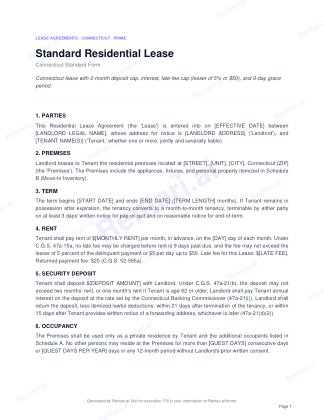
In the Rentari Connecticut lease
- Landlord identity
The Rentari Connecticut lease attaches an owner and agent identification addendum naming the landlord, at the landlord's address in the lease, for both management and notices unless the tenant is told otherwise in writing.
- Security deposit limit
The Rentari Connecticut lease states both limits, two months' rent and one month's for a tenant 62 or older, and the lease builder stops a deposit above two months' rent. The builder does not ask a tenant's age, so it cannot check the one-month limit for an older tenant.
- Rent and late fees
The Rentari Connecticut lease sets the late fee only after the nine-day grace period (four days for a weekly tenancy), caps it at the statutory lesser amount, allows one late fee per payment and bars requiring electronic payment as the only method. The lease builder stops a grace period under nine days and a late fee over $50.
Conn. Gen. Stat. § 47a-15a Conn. Gen. Stat. § 47a-4(a)(8), (a)(9)
- Rent increase notice
The Rentari Connecticut lease states the 45-day written notice, the full-term notice for a lease of a month or less, that silence is not agreement, and that the lease permits no increase during its term. Rentari's rent increase notice uses 45 days for Connecticut.
- Landlord entry
The Rentari Connecticut lease requires the tenant's consent except in the statutory cases, and the landlord promises at least 24 hours' notice.
- Repairs and habitability
The lease's general maintenance clause has the landlord keep the unit habitable and the tenant report needed repairs promptly.
- Tenant repair remedies
The lease's general clauses allow repair and deduct and rent withholding only where state law authorizes them.
Conn. Gen. Stat. § 47a-12 Conn. Gen. Stat. § 47a-13 Conn. Gen. Stat. § 47a-14h
- Locks and security
The Rentari Connecticut lease sets out the six-hour answer, the 48-hour change, the tenant's right to change the locks and the cost rules as the statute states them.
- Smoke and carbon monoxide alarms
The lease has the landlord provide working smoke and carbon monoxide detectors at move-in and bars the tenant from disabling them.
Conn. Gen. Stat. § 29-292(a)(1) Conn. Gen. Stat. § 47a-7(a)(1)
- Retaliation
The Rentari Connecticut lease lists all five protected acts and all three forbidden responses, and names the statutory grounds that rebut retaliation.
- Ending a month-to-month tenancy
The Rentari Connecticut lease says either party may end a month-to-month tenancy, that the landlord's notice to quit gives at least three days, and that Connecticut sets no separate longer notice.
- Ending a lease early
The Rentari Connecticut lease sets out the family violence and sexual assault termination as the statute states it, including the sworn statement and records, and keeps the federal servicemember clause.
- Abandoned property
The lease's abandonment clause says left property is handled as the law requires, and the Connecticut lease adds the death of tenant procedure from the statute.
Connecticut numbers the lease follows
- Deposit return deadline
- 21 days
- or 15 days after a written forwarding address, whichever is later
- Conn. Gen. Stat. § 47a-21(d)(2)
- Late fee limit
- $50 or 5%
- the lesser of $5 a day up to $50, or 5 percent of the late payment
- Conn. Gen. Stat. § 47a-15a(b)
- Screening report fee
- $50 plus inflation
- no other application fee is allowed
- Conn. Gen. Stat. § 47a-4d(c)
From the Connecticut lease
CONNECTICUT RESIDENTIAL LEASE AGREEMENT
No increase in the rent for the Premises is effective unless Landlord has given Tenant written notice of the proposed increase at least forty-five (45) days before the day it is to take effect. For a lease with a term of one month or less, that notice must be given a number of days equal to a full term of the lease. Tenant's failure to respond to such a notice is not agreement to the increase.
Notice of a rent increaseConn. Gen. Stat. § 47a-4e
Landlord shall not require electronic funds transfer as the exclusive form of payment of rent or of a security deposit. Tenant may pay by check, draft or a similar paper instrument, which is not an electronic funds transfer for the purposes of that section.
How rent may be paidConn. Gen. Stat. § 47a-4c
Only one late charge may be assessed on any delinquent rent payment, however long the rent remains unpaid. If the amount stated above exceeds the statutory cap, the statutory cap controls.
Late chargeConn. Gen. Stat. § 47a-15a(b)
Connecticut lease types
Pick 3, 6, 12, 18 or 36 months or your own dates. At the end, the lease ends or converts to month-to-month.
Standard lease guideRuns from month to month until either side gives the notice Connecticut law requires.
Connecticut month-to-month leaseUpload a lease you already use: send an unsigned one for e-signature, or store one that is already signed.
Rooms use the Connecticut lease for now: add the room as its own unit and set house rules with the optional addenda.
Connecticut room rentalBefore you sign
Application and screening fees
A landlord, a third party acting for a landlord, or a third party acting for the state may not charge for processing, reviewing or accepting a rental application. The permitted tenant screening report fee is limited to $50 plus the annual inflation adjustment determined by the Commissioner of Housing. Section 59 of Public Act 26-68 extended these rules to the named third parties effective May 26, 2026. The current adjusted dollar figure has not been read for this page.
P.A. 26-68, section 59 (effective May 26, 2026) Conn. Gen. Stat. § 47a-4d(b), (c)
- A tenant screening report is a credit, criminal background, employment history or rental history report, or any combination of them. Conn. Gen. Stat. § 47a-4d(a)
- A landlord or either of the named third parties charging a screening report fee must give the applicant the report and the screening company's receipt or invoice. Only when prohibited from supplying the report may the charging party instead give information enabling the applicant to request it from the producer. P.A. 26-68, section 59 (effective May 26, 2026) Conn. Gen. Stat. § 47a-4d(d)
- Move-in and move-out fees are not allowed. Conn. Gen. Stat. § 47a-4d(b)
- Check an eviction record's current status before using a screening report. Section 47a-26j requires the Judicial Department to remove identifying case information from its website within 30 days after withdrawal, dismissal, nonsuit or a final disposition with judgment for the defendant. Removed records are also excluded from the Department's commercial bulk sales. Conn. Gen. Stat. 47a-26j(a), (c) See Eviction process on the Connecticut page
- The same section bars commercial disclosure of records removed under subsection (a), including disclosure for consumer reports or prospective-tenant screening. Appeals or later case activity can require website retention or restoration, and formal written judicial opinions remain publishable. Website removal is therefore a specific access and disclosure rule, not a statement that every eviction record disappears. Conn. Gen. Stat. 47a-26j(b), (d), (e)
Fair housing
Connecticut bars housing discrimination based on race, creed, color, national origin, ancestry, sex, gender identity or expression, marital status, age, lawful source of income, familial status, learning, physical or mental disability, veteran status, and status as a victim of domestic violence, sexual assault or trafficking. A separate section adds sexual orientation and civil union status.
Conn. Gen. Stat. § 46a-64c(a) Conn. Gen. Stat. § 46a-81e
- The source of income rule does not stop a landlord from denying an applicant solely for insufficient income. Conn. Gen. Stat. § 46a-64c(b)(5)
- The law does not apply to renting rooms in a single-family home the owner lives in, or a unit in a two-family home where the owner lives in the other unit. The familial status rule also exempts owner-occupied buildings of up to four units. Conn. Gen. Stat. § 46a-64c(b)(1), (b)(4)
- Refusing reasonable accommodations, or reasonable modifications at the tenant's expense, for a person with a disability is discrimination. Conn. Gen. Stat. § 46a-64c(a)(6)(C)
- Violations are a class D misdemeanor, and complaints go to the Commission on Human Rights and Opportunities. Conn. Gen. Stat. § 46a-64c(f), (g)
Required notices and disclosures
Partly readSince April 1, 2026, a written lease must have as its first page a completed copy of the Department of Housing's standardized rental terms summary form. Connecticut also requires a sprinkler notice in the lease for buildings required to have sprinklers, a bed bug disclosure before renting, and, in buildings of five or more units, a notice of the protections for older and disabled tenants.
Conn. Gen. Stat. § 47a-7d(d) Conn. Gen. Stat. § 47a-3f Conn. Gen. Stat. § 47a-7a(c) Conn. Gen. Stat. § 47a-23c(e)
- The summary form states the term, the landlord, the property contact, each tenant and the total periodic rent. A landlord who violates the section owes the tenant a civil penalty of one month's rent, and the court may add attorney's fees. Conn. Gen. Stat. § 47a-7d(c), (d), (f)
- In a building required to have a fire sprinkler system, the lease must say in 12-point bold type whether an operative system exists and, if so, the date of its last maintenance and inspection. Conn. Gen. Stat. § 47a-3f
- Before renting a unit other than a detached single-family home, disclose whether it or an adjoining unit you own is currently infested with bed bugs, and on request give the last date it was inspected and found free of them. You may not rent a unit you know or suspect is infested. Conn. Gen. Stat. § 47a-7a(a)(7), (c)
- Since January 1, 2024, in a building or complex of five or more units, give each new or renewing tenant the Department of Housing's one-page notice of the good-cause and fair rent protections. Conn. Gen. Stat. § 47a-23c(e)
- Within 30 days of receiving a deposit, give written notice of the amount and the institution holding it. Conn. Gen. Stat. § 47a-21(h)(4)(A) See Deposit account and interest on the Connecticut page
- Name the person who manages the property and the person who receives notices and legal papers. Conn. Gen. Stat. § 47a-6 See Landlord identity on the Connecticut page
- A declarant renting a unit in a common interest community must say so in writing before the lease is signed. Conn. Gen. Stat. § 47a-3e
Flood disclosure
Partly readThis page did not find a flood notice rule for rentals. Connecticut's landlord and tenant laws contain none, and the state's residential condition report, which asks about flood risk, applies when a property is offered for sale, exchange or a lease with an option to buy. Other parts of the statutes were not read, so no general rule for rentals is stated here.
Landlord identity
At or before the start of the tenancy, tell the tenant in writing the name and address of the person who manages the property and the person authorized to receive notices, demands and legal papers, and keep them current. A new owner must do the same when it takes over.
- If you do not, the person who signed the lease for you is treated as your agent for legal papers and notices and for making repairs, paid from the rent. Conn. Gen. Stat. § 47a-6(b)
- A landlord who does not live in Connecticut must appoint the Secretary of the State in writing to receive legal papers. Conn. Gen. Stat. § 47a-21(f)
- A town may require a nonresident owner to file a current residential address with the assessor or another office and update it within 21 days of a change. Conn. Gen. Stat. § 47a-6a(b)
The Rentari Connecticut lease attaches an owner and agent identification addendum naming the landlord, at the landlord's address in the lease, for both management and notices unless the tenant is told otherwise in writing.
Deposits, rent and fees
Security deposit limit
A landlord may not demand a security deposit of more than two months' rent from a tenant under 62, or more than one month's rent from a tenant 62 or older. Any advance rental payment counts as a security deposit, except an advance payment of the first month's rent and a deposit for a key or special equipment.
Conn. Gen. Stat. § 47a-21(a)(11), (b)
- If a tenant turns 62 after paying a deposit larger than one month's rent, the landlord must return the part above one month's rent when the tenant asks. Conn. Gen. Stat. § 47a-21(b)(2)
- The deposit remains the tenant's property. The landlord holds only a security interest in it, and the landlord's creditors cannot attach it. Conn. Gen. Stat. § 47a-21(c)
- Apart from the deposit, the first month's rent, a key or equipment deposit and a capped screening report fee, a landlord may not demand any other payment before or at the start of the tenancy. Conn. Gen. Stat. § 47a-4d(b) See Application and screening fees on the Connecticut page
The Rentari Connecticut lease states both limits, two months' rent and one month's for a tenant 62 or older, and the lease builder stops a deposit above two months' rent. The builder does not ask a tenant's age, so it cannot check the one-month limit for an older tenant.
Returning the deposit
Return the deposit with its accrued interest within 21 days after the tenancy ends, or within 15 days after receiving the tenant's forwarding address in writing, whichever is later. If you keep any part for damages, send the balance with a written statement itemizing the nature and amount of each deduction.
- Deductions are limited to the tenant's obligations: unpaid rent or utility payments owed to the landlord, damage from the tenant's breach of their statutory duties, and the reasonable cost of a lock change the tenant asked for under the protective order section and did not pay. Conn. Gen. Stat. § 47a-21(a)(14), (d)(2)
- A landlord who breaks these rules is liable for twice the amount of the deposit. If the only failure is the interest, the liability is $10 or twice the interest, whichever is greater. Conn. Gen. Stat. § 47a-21(d)(2)
- A landlord who knowingly and wilfully fails to pay a deposit when due can be fined up to $250 per offense, unless the landlord believed in good faith that the deductions were owed. Conn. Gen. Stat. § 47a-21(k)(1)
- You may not keep any part of the deposit for a condition noted on a move-in walk-through checklist. Conn. Gen. Stat. § 47a-7c(b) See Move-in condition on the Connecticut page
- In small claims, a judge may award the double damages on a deposit claim even when the total exceeds the $5,000 small claims limit. Conn. Gen. Stat. § 51-15(d) See Small claims court on the Connecticut page
Deposit account and interest
Partly readPut the entire deposit immediately into an escrow account for the tenant at a bank, savings bank or savings and loan located in Connecticut. Within 30 days of receiving the deposit, or of moving it, tell the tenant in writing the amount held and the name and address of the institution. Pay interest each year at no less than the deposit index for that year. Checked October 13, 2026: the Department of Banking publishes 0.49% as the rental security deposit interest rate for calendar year 2026. Check its annual rate history for earlier years and the next published rate for later years; do not apply the 2026 figure to every year of a tenancy.
Conn. Gen. Stat. § 47a-21(a)(5), (h), (i) Department of Banking: 2026 deposit interest rate
- On each anniversary of the tenancy, pay the interest to the tenant or credit it toward the next rent payment, as you choose. If the tenancy ends before an anniversary, or you return the deposit early, pay the accrued interest within 21 days. Conn. Gen. Stat. § 47a-21(i)
- No interest is owed for a month in which the tenant was more than ten days late with rent, unless you charged a late fee for that month. You may not raise the rent because you must pay interest. Conn. Gen. Stat. § 47a-21(i)
- The interest rule does not apply to housing an educational institution owns or controls for its students and their families. Conn. Gen. Stat. § 47a-21(i)
- A lease term by which the tenant gives up deposit interest is unenforceable. Conn. Gen. Stat. § 47a-4(a)(4), (b)
- If the Banking Commissioner asks in writing for information about a tenant's deposit, including the institution and account number, you must answer within seven days. Conn. Gen. Stat. § 47a-21(h)(4)(B)
- A knowing and wilful escrow violation can bring a fine of up to $500, up to 30 days in jail, or both. It is a defense that the landlord leased to fewer than four tenants who paid deposits. Conn. Gen. Stat. § 47a-21(k)(2)
- When you sell the property, transfer the deposits and interest to the buyer, who becomes responsible for returning them. Conn. Gen. Stat. § 47a-21(e), (h)(3)
Move-in condition
For a lease entered into on or after January 1, 2024, offer the tenant a walk-through of the unit after signing and before move-in. If the tenant accepts, both of you use the Department of Housing's standard checklist, note every existing condition, defect or damage, sign duplicate copies and each keep one.
- You may not keep any part of the deposit, or seek payment, for a condition noted on the checklist. Conn. Gen. Stat. § 47a-7c(b)
- The checklist is admissible as evidence of the unit's condition at move-in, but it is not conclusive. Conn. Gen. Stat. § 47a-7c(b)
Rent and late fees
A late fee needs a written lease term and may be charged only on rent paid after the grace period: nine days after the due date, or four days for a weekly tenancy. The fee may not exceed the lesser of $5 a day up to $50, or 5 percent of the late payment. Only one late fee may be charged on a payment, however long it stays unpaid.
Conn. Gen. Stat. § 47a-15a Conn. Gen. Stat. § 47a-4(a)(8), (a)(9)
- Since January 1, 2026, the grace period runs five days longer in any week or month when the landlord's own online payment system prevents rent from being paid on time. Conn. Gen. Stat. § 47a-15a(a)
- Where a government or charitable program pays part of the rent, the 5 percent is figured on the tenant's share only. Conn. Gen. Stat. § 47a-15a(b)
- A lease may not charge a late fee inside the grace period, offer a discount for paying before it ends, or add a heat or utility surcharge when heat or utilities are included in the rent. Conn. Gen. Stat. § 47a-4(a)(8), (a)(10)
- You may not require electronic funds transfer as the only way to pay rent or a deposit. Conn. Gen. Stat. § 47a-4c
- Give a receipt for every cash payment, showing the date, amount and purpose. Since July 1, 2025, give a tenant a copy of the rent ledger on request. Conn. Gen. Stat. § 47a-3a(c), (d)
- Apply every payment to rent first, then to other fees and charges. Conn. Gen. Stat. § 47a-7d(e)
- An advertised rent must include every fee the tenant must pay periodically, with limited exceptions such as pet fees, a payment processing fee when a fee-free way to pay is offered, and utilities that vary from month to month. Conn. Gen. Stat. § 47a-7d(a), (b)
- Unless the lease says otherwise, rent is payable at the unit, at the start of each month. Conn. Gen. Stat. § 47a-3a(b)
The Rentari Connecticut lease sets the late fee only after the nine-day grace period (four days for a weekly tenancy), caps it at the statutory lesser amount, allows one late fee per payment and bars requiring electronic payment as the only method. The lease builder stops a grace period under nine days and a late fee over $50.
Returned payment fee
Partly readWhen a tenant's check is dishonored, you may charge a service charge of up to $20, and only one per dishonored check. No service charge is allowed if the tenant stopped payment, the check was stolen, or the tenant has a reasonable defense to the debt. This page did not find a Connecticut rule on fees for a failed electronic payment.
- The extra court damages the statute allows for a bad check, up to $400 or $750, cannot be claimed for a check given to pay rent for a home. Conn. Gen. Stat. § 52-565a(b), (c), (d)(2)
Rent increase notice
A rent increase takes effect only if you gave the tenant written notice at least 45 days before it starts. For a lease with a term of one month or less, the notice must be as long as one full term. A tenant's failure to respond is not agreement to the increase.
- The notice rule does not let a landlord raise rent during the term of a lease. Conn. Gen. Stat. § 47a-4e
- It applies to leases entered into, renewed or extended on or after October 1, 2024. Conn. Gen. Stat. § 47a-4e
- A landlord may not demand a rent increase within six months after a tenant's protected complaint or repair request, with narrow exceptions. Conn. Gen. Stat. § 47a-20 Conn. Gen. Stat. § 47a-20a(b) See Retaliation on the Connecticut page
- Tenants 62 or older or with a disability, in buildings of five or more units, may have increases limited to what is fair and equitable. Conn. Gen. Stat. § 47a-23c(c) See Rent control and local rules on the Connecticut page
- Prepare a rent-change record with the tenancy term, current rent, proposed rent, dollar difference and proposed effective date. Address the letter to the tenants at the correct unit, allow the applicable notice period and explain how they can respond or discuss a renewal. Keep the letter, delivery record and actual response together; silence is not acceptance. Check any fair-rent commission process or protected-tenancy issue separately, and record an agreed renewal before changing the payment schedule for its effective date. Conn. Gen. Stat. § 47a-4e Conn. Gen. Stat. § 7-148b(b), (c)
The Rentari Connecticut lease states the 45-day written notice, the full-term notice for a lease of a month or less, that silence is not agreement, and that the lease permits no increase during its term. Rentari's rent increase notice uses 45 days for Connecticut.
During the tenancy
Landlord entry
Enter only with the tenant's consent, except in an emergency, during the tenant's extended absence, under a court order, or after the tenant has abandoned or surrendered the unit. The tenant may not unreasonably refuse consent to inspect, make repairs, supply services or show the unit. Give reasonable written or oral notice and enter only at reasonable times.
Conn. Gen. Stat. § 47a-16 Conn. Gen. Stat. § 47a-16a
- The statute sets no number of hours for the notice; it must be reasonable. Conn. Gen. Stat. § 47a-16(c)
- A landlord may not abuse the right of entry or use it to harass the tenant. Conn. Gen. Stat. § 47a-16(c)
- Unless the lease says otherwise, a tenant must tell the landlord about an anticipated extended absence, and the landlord may then enter at reasonable times for the same purposes. Conn. Gen. Stat. § 47a-16a
- If the tenant refuses lawful entry, the landlord may seek a court order or end the lease, and recover actual damages and attorney's fees. Conn. Gen. Stat. § 47a-18
- For an unlawful entry or repeated harassing demands, the tenant may recover actual damages of at least one month's rent plus attorney's fees, and may also seek an injunction or end the lease. Conn. Gen. Stat. § 47a-18a
The Rentari Connecticut lease requires the tenant's consent except in the statutory cases, and the landlord promises at least 24 hours' notice.
Repairs and habitability
Keep the unit fit and habitable: follow the building and housing codes that affect health and safety, make all needed repairs, keep common areas clean and safe, keep electrical, plumbing, heating and other facilities you supply in good working order, provide trash receptacles and removal, and supply running water, reasonable hot water and reasonable heat.
- Where a local ordinance or code demands more than the state rule, the stricter local rule controls. Conn. Gen. Stat. § 47a-7(b)
- In a single-family home, the tenant may agree in writing, in good faith, to handle trash, heat and hot water and specified repairs. In other buildings, a written good-faith agreement may cover specified repairs, but not work needed to meet the code and habitability duties. Conn. Gen. Stat. § 47a-7(c), (d)
- A lease may not allow the landlord to collect rent for any period in which the landlord has failed these duties. Conn. Gen. Stat. § 47a-4a
- The tenant must keep their part of the unit clean and safe, use facilities reasonably, and not damage the premises or disturb neighbors. Conn. Gen. Stat. § 47a-11
- When a tenant reports suspected bed bugs in a unit other than a detached single-family home, inspect within five business days and, if they are found, take reasonable steps to treat them within five business days of the inspection. Conn. Gen. Stat. § 47a-7a(a)(7), (b)
The lease's general maintenance clause has the landlord keep the unit habitable and the tenant report needed repairs promptly.
Tenant repair remedies
If the landlord materially breaks the lease or a health and safety duty, the tenant may give written notice; if the problem is not fixed within 15 days, a lease longer than one month ends. If the landlord fails to supply heat, water, hot water, electricity, gas or another essential service, the tenant may buy it and deduct the cost from rent, or move to substitute housing while rent abates.
Conn. Gen. Stat. § 47a-12 Conn. Gen. Stat. § 47a-13 Conn. Gen. Stat. § 47a-14h
- Substitute housing is available if the service is not restored within 48 hours, or at once if the same failure recurs within six months. If the failure is wilful, the tenant may end the lease and recover up to two months' rent or double actual damages, whichever is greater, plus attorney's fees. Conn. Gen. Stat. § 47a-13(a), (b)
- If substantially the same breach recurs within six months, the tenant may end the lease on at least 14 days' written notice. Conn. Gen. Stat. § 47a-12(a)
- A tenant may sue in the housing court to enforce repairs after complaining to the local code agency at least 21 days earlier, and then pays rent to the court clerk while the case runs. No eviction for nonpayment may proceed while the clerk holds the rent. Conn. Gen. Stat. § 47a-14h(a), (b), (h)
- None of these remedies arise for a condition the tenant, their family or guests caused wilfully or negligently. Conn. Gen. Stat. § 47a-12(b) Conn. Gen. Stat. § 47a-13(c)
The lease's general clauses allow repair and deduct and rent withholding only where state law authorizes them.
Locks and security
Partly readWhen a tenant is protected by a court order that requires the other person to stay away, and gives the landlord a copy, the landlord must say within six hours whether it will change the locks or let the tenant do it. If the landlord agrees to change them, it must do so within 48 hours. This page did not find a general rekeying rule for new tenants in the sections read.
- If the landlord declines or misses the deadlines, the tenant may change the locks to equal or better quality and must give the landlord a key within two business days. Conn. Gen. Stat. § 47a-7b(b)
- The landlord pays the locksmith and may charge the tenant only the actual reasonable cost, collectible by suit or from the deposit, never by eviction. Conn. Gen. Stat. § 47a-7b(c)
- The landlord may not give the restrained person a key, and may not charge the protected tenant more rent or fees because that person is excluded. Conn. Gen. Stat. § 47a-7b(e), (f)
The Rentari Connecticut lease sets out the six-hour answer, the 48-hour change, the tenant's right to change the locks and the cost rules as the statute states them.
Smoke and carbon monoxide alarms
Partly readThe state Fire Safety Code must require smoke detection and warning equipment in residential buildings designed for one or more families, and carbon monoxide equipment in new one- and two-family homes permitted since October 1, 2005. Landlords must follow the codes that affect health and safety. The Fire Safety Code itself was not read for this page.
Conn. Gen. Stat. § 29-292(a)(1) Conn. Gen. Stat. § 47a-7(a)(1)
- No certificate of occupancy issues for a residential building without smoke detection equipment that meets the codes. Conn. Gen. Stat. § 29-292(b)(1)
The lease has the landlord provide working smoke and carbon monoxide detectors at move-in and bars the tenant from disabling them.
Retaliation
For six months after a protected act, a landlord may not bring an eviction, demand a rent increase or cut services. Protected acts are a good faith effort to fix a code violation by lawful means, including a complaint to officials or a fair rent commission; a code agency's notice or order; a good faith repair request; a repair lawsuit in housing court; and organizing or joining a tenants' union.
- An eviction may still proceed for nonpayment, illegal use or a lease violation, a good faith need to live in the unit yourself, a condition the tenant wilfully caused, or a notice to end a periodic tenancy given before the complaint. Conn. Gen. Stat. § 47a-20a(a)
- A rent increase may still proceed if the tenant carelessly caused the condition, or to pass on a prorated share of a substantial tax or operating cost increase that arose at least four months before. Conn. Gen. Stat. § 47a-20a(b)
The Rentari Connecticut lease lists all five protected acts and all three forbidden responses, and names the statutory grounds that rebut retaliation.
Lockouts and utility shutoffs
Never remove a tenant, change the locks or hold their belongings without a court order. A landlord who deprives a tenant of access to the unit or their possessions without a court order commits criminal lockout, and the tenant can ask a Superior Court judge for a quick hearing and may recover double damages.
Conn. Gen. Stat. § 53a-214 Conn. Gen. Stat. § 47a-43 Conn. Gen. Stat. § 47a-46
- A lease term letting the landlord dispossess the tenant without a court order, or seize the tenant's property for rent, is unenforceable. Conn. Gen. Stat. § 47a-4(a)(5), (a)(6), (b)
- The judge must summon the landlord to a hearing within eight days after the complaint is presented. Conn. Gen. Stat. § 47a-43(b)
- If a landlord fails to supply heat, water, electricity, gas or another essential service it must provide, the tenant has self-help and rent abatement remedies. Conn. Gen. Stat. § 47a-13 See Tenant repair remedies on the Connecticut page
Ending a tenancy
Ending a month-to-month tenancy
Partly readA tenancy without a fixed term is month to month, or week to week when rent is paid weekly. To end it, the landlord serves a notice to quit that gives at least three days before the quit date. This page did not find a longer notice period for ending a month-to-month tenancy, but not every section of the eviction chapter was read.
Conn. Gen. Stat. § 47a-3b Conn. Gen. Stat. § 47a-23(a)
- Staying after a lease ends is not by itself evidence of a new lease. Conn. Gen. Stat. § 47a-3d
- A tenant 62 or older, or with a qualifying disability, in a building or complex of five or more units can be evicted only for listed good causes, such as nonpayment or a material violation. Conn. Gen. Stat. § 47a-23c(a), (b) See Eviction process on the Connecticut page
The Rentari Connecticut lease says either party may end a month-to-month tenancy, that the landlord's notice to quit gives at least three days, and that Connecticut sets no separate longer notice.
Ending a lease early
A tenant who is a victim of family violence or sexual assault, and reasonably fears imminent harm, may end the lease without penalty by giving at least 30 days' written notice. If a tenant simply leaves, the landlord must make reasonable efforts to rerent the unit at a fair rent to reduce the loss.
Conn. Gen. Stat. § 47a-11e(a) Conn. Gen. Stat. § 47a-11a
- The notice must include a sworn statement and either a police or court record dated within 90 days, or a statement from the Office of Victim Services or the Office of the Victim Advocate dated within 30 days. Conn. Gen. Stat. § 47a-11e(b)
- The tenant still owes rent due before the termination and any damage they caused, and other tenants on the lease stay liable. Conn. Gen. Stat. § 47a-11e(c)
- If the landlord does not try to rerent, the lease is treated as ended by the landlord on the date the landlord learned of the abandonment. Conn. Gen. Stat. § 47a-11a(b)
- A tenant may also end the lease for the landlord's uncured breach, a wilful loss of essential services or unlawful entry. Conn. Gen. Stat. § 47a-12 Conn. Gen. Stat. § 47a-13 Conn. Gen. Stat. § 47a-18a See Tenant repair remedies on the Connecticut page
The Rentari Connecticut lease sets out the family violence and sexual assault termination as the statute states it, including the sworn statement and records, and keeps the federal servicemember clause.
Notice for unpaid rent
Once rent is unpaid past the nine-day grace period (four days for a weekly tenancy), you may end the tenancy with a written notice to quit. The notice must give the tenant at least three days before the quit date and must be served by a proper officer.
Conn. Gen. Stat. § 47a-15a(a) Conn. Gen. Stat. § 47a-23(a)
- Since January 1, 2026, nonpayment is not a ground for a notice to quit if your own online payment system kept the tenant from paying within the grace period. Conn. Gen. Stat. § 47a-23(a)(1)(D)
- The notice follows the statutory form: the unit's address including apartment number, the quit date and the reason in the statute's words. Conn. Gen. Stat. § 47a-23(b), (c)
- Accepting rent you know is overdue waives the right to end the lease for that nonpayment. Conn. Gen. Stat. § 47a-19
- The Judicial Branch's one-page right to counsel notice must be attached to a notice to quit, and to the summons and complaint, delivered to a tenant who is income eligible for the state's right to counsel program. Conn. Gen. Stat. § 47a-75(a)(1), (f)(2)
- For a month-to-month or weekly tenancy, a nonpayment notice ends the tenancy for the period in which it is delivered. Conn. Gen. Stat. § 47a-23(d)
Notice for lease violations
For a material lease violation, or a breach of the tenant's duties that materially affects health, safety or the premises, give written notice describing it and a termination date at least 15 days after the tenant receives it. If the breach can be fixed by repair or payment and the tenant fixes it within those 15 days, the lease does not end.
- If substantially the same breach recurs within six months, you may serve a notice to quit without a new chance to cure. Conn. Gen. Stat. § 47a-15
- For nonpayment and for serious nuisance, such as violence, threats, serious property destruction or drug sales on the premises, you may go straight to a notice to quit. Conn. Gen. Stat. § 47a-15 Conn. Gen. Stat. § 47a-23(a)(1)(G)
Eviction process
Evictions are summary process cases in Superior Court. After the notice to quit expires, the landlord files a writ, summons and complaint that can be returnable six days after service. If the tenant does not appear within two days after the return day, the court enters judgment for possession on the landlord's motion. Execution is stayed five days after judgment, not counting Sundays and legal holidays.
Conn. Gen. Stat. § 47a-23a Conn. Gen. Stat. § 47a-26 Conn. Gen. Stat. § 47a-35
- After the stay, a state marshal carries out the eviction and must try to notify the tenant at least 24 hours before. Conn. Gen. Stat. § 47a-35(a) Conn. Gen. Stat. § 47a-42(b)
- A tenant 62 or older, or with a qualifying disability, in a building or complex of five or more units may be evicted only for listed causes: nonpayment, refusing a fair and equitable rent increase, material violations, a lease made void by illegal use, permanent removal of the unit from the market, or the landlord's good faith move-in. Conn. Gen. Stat. § 47a-23c(b)
- For an income-eligible tenant, the right to counsel notice must be attached to the summons and complaint as well as the notice to quit. Conn. Gen. Stat. § 47a-75(f)(2)
- If a written lease has the tenant waive the notice to quit when the lease ends by lapse of time, the three-day notice is not needed for that ground. Conn. Gen. Stat. § 47a-25
- The return date on the summons is used for filing deadlines; it is not the date to attend a hearing. An Appearance and an Answer are different forms: the Appearance identifies the responding party, while the Answer responds to the complaint and raises any applicable defenses. Read the current forms and court notices promptly and follow the separate hearing notice when one is issued. Keep the lease, notice and service records, payment history, relevant photographs and messages in a dated file so the disputed facts are ready for the hearing. Connecticut Judicial Branch: rights and responsibilities Connecticut Judicial Branch: tenant eviction guide
Abandoned property
If all occupants have abandoned the unit, you may send notice by regular and certified mail to their last known address. If they do not contact you within ten days, you may retake the unit without an eviction. Inventory what they left, store it for at least 30 days so they can reclaim it, and only then dispose of it.
- Abandonment means the occupants left without notice and do not intend to return, shown by removal of substantially all their belongings and either more than two months' unpaid rent or an express statement that they will not stay. Conn. Gen. Stat. § 47a-11b(a)
- If you know or should know the unit was not abandoned, you must use the normal eviction process. Conn. Gen. Stat. § 47a-11b(c)
- After an eviction judgment, a state marshal removes the belongings to town storage; the town may auction what is not reclaimed within 15 days. Conn. Gen. Stat. § 47a-42(a), (c)
- When the sole occupant dies, a separate procedure runs through the emergency contact, the next of kin and the Probate Court. Conn. Gen. Stat. § 47a-11d
The lease's abandonment clause says left property is handled as the law requires, and the Connecticut lease adds the death of tenant procedure from the statute.
Small claims court
Small claims handles money claims up to $5,000. A tenant suing there to get a deposit back may be awarded the statutory double damages even if the total goes above $5,000. Evictions are summary process cases in Superior Court, not small claims.
Conn. Gen. Stat. § 51-15(d) Conn. Gen. Stat. § 47a-23a(a)
- Any person may sue in any court with jurisdiction to reclaim a deposit. Conn. Gen. Stat. § 47a-21(g)
More Connecticut rules
Adverse possession and disputed occupancy
Partly readConnecticut’s fifteen-year adverse-possession rule requires qualifying possession and proof of the legal elements. Time spent at an address, mail or an assertion of ownership does not by itself establish title. Resolve an ownership claim separately from the appropriate process for recovering possession.
Conn. Gen. Stat. § 52-575: entry upon land Connecticut Appellate Court: Pascual v. Perry
- The claimant must establish actual, open, notorious, hostile, continuous and exclusive possession for the full statutory period by clear and positive evidence. The use must be under a claim of right, as the claimant’s own property and without the owner’s consent. The court discussion also explains that connected possession by predecessors may count when the required relationship exists; do not reduce continuity to a rule that every temporary absence automatically resets the period. Connecticut Appellate Court: Pascual v. Perry
- Section 52-575 includes a formal method for disputing possession through written notice, service and recording, with an action to follow within the specified period. Obtain advice about the required steps and timing. A routine visit, casual message or ordinary tenancy notice should not be assumed to preserve every ownership right. The statute also contains exceptions that may affect the calculation. Conn. Gen. Stat. § 52-575: entry upon land
- Gather the deed and survey, boundary plans, leases and permissions, payment history, dated photographs, notices and relevant messages. Record who used which part of the property and when. Keep vacant property secure, maintain it and arrange lawful checks. If a person presents a lease, permission or competing title claim, preserve it and seek help choosing the correct response. Conn. Gen. Stat. § 52-575: entry upon land
- Identify the occupant’s status before choosing a notice or lawsuit. Follow the applicable court papers and state marshal instructions; the existing eviction topic explains the tenancy process. Do not change locks, remove belongings or interrupt required services to force a tenant out. Avoid assuming that a single three-day notice fits every disputed occupancy. Conn. Gen. Stat. § 53a-214 Conn. Gen. Stat. § 47a-43 Conn. Gen. Stat. § 47a-46 See Eviction process on the Connecticut page
Local rules
Rent control and local rules
Partly readConnecticut controls excessive rents through fair rent commissions. Every town or city of 15,000 or more people must create or join one by January 1, 2028, and any town may. A commission hears complaints and can issue orders to control and eliminate excessive rents and fees. Local ordinances were not read for this page.
Conn. Gen. Stat. § 7-148b(b), (c)
- A commission weighs listed factors, including rents for similar units, the unit's condition, services, taxes and operating costs, and how much and how often rent has gone up. Conn. Gen. Stat. § 7-148c
- Protected tenants, 62 or older or with a disability in buildings of five or more units, may have increases limited to what is fair and equitable. Conn. Gen. Stat. § 47a-23c(c)
- Since January 1, 2026, using revenue management software that relies on competitors' nonpublic data to set rents or occupancy is an unlawful practice under the state antitrust law. Conn. Gen. Stat. § 47a-4f
Many towns have fair rent commissions that hear complaints about excessive rents and fees, and every town of 15,000 or more people must create or join one by January 1, 2028. No town's ordinance or commission rules were read for this page; check the town where the property is located.
Local housing, health and fire codes can set stricter duties than state law, and those stricter duties control. None was read for this page.
Connecticut lease renewals
Read the agreement's renewal clause and the notice rules above before choosing a new term, changing rent or ending the tenancy. A fixed end date does not override applicable renewal rights, rent regulation, just-cause rules or protections against retaliation and discrimination.
Confirm the notice, timing and delivery requirements for the rental's state and locality. Review any required new disclosures and attachments when preparing the renewal. Get the parties' agreement to changed terms in writing.
Customize an unsigned agreement or prepare an addendum to an existing lease.
How it works
- Add your Connecticut rental
Enter the property and its units.
- Set the terms
Choose the rental, add tenants, and set rent, deposit and fees.
- Review the lease
Preview and edit the Connecticut lease and its addenda.
- Send for e-signature
Tenants sign online; sending is included on paid plans.
Follow the full lease builder guide, add supporting files, or download and print the agreement.
Connecticut lease questions
Does the Rentari Connecticut lease enforce the deposit limit?
The builder stops a deposit above two months' rent. The lease also states the one-month limit for a tenant 62 or older, which you must apply yourself because the builder does not ask ages.
Does it follow the late fee rules?
Yes. The builder requires a grace period of at least nine days and a late fee of no more than $50, and the lease states the lesser-of cap and the one-fee rule.
Does it include the rent increase notice rule?
Yes. The lease states the 45-day written notice and that the rent cannot rise during the term.
Does it cover lock changes for a tenant with a protective order?
Yes. It states the six-hour answer, the 48-hour change and the tenant's right to change the locks if the landlord does not.
Which addenda come with a Connecticut lease?
A fire sprinkler disclosure and an owner and agent identification addendum print with every Connecticut lease.