- Home
- Lease agreement
- Georgia
Georgia residential lease agreement
State rules checked October 1, 2026 General information, not legal advice
Jump to a topic
Georgia lease document preview
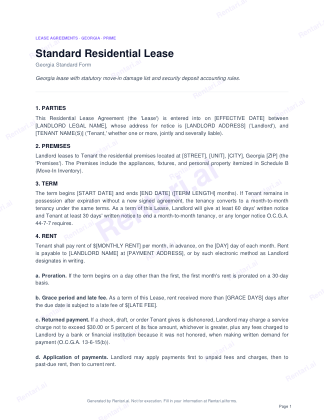
In the Rentari Georgia lease
- Fair housing
The Rentari Georgia lease says you follow the federal Fair Housing Act and state and local fair housing laws, and lets a tenant with a disability ask for a reasonable accommodation.
- Owner and manager disclosure
The Rentari Georgia lease attaches an owner and manager addendum naming, with addresses, the owner or the person authorized to receive notices and service for the owner, and the manager.
- Security deposit limit
The Rentari Georgia lease states the two-month limit and says a pet deposit is a security deposit.
- Returning the deposit
The Rentari Georgia lease promises the return within 30 days after you obtain possession, with a written statement of reasons for anything kept, and forbids deductions for ordinary wear and tear.
- Move-in and move-out damage lists
Every Rentari Georgia lease that takes a security or pet deposit attaches a move-in damage list with paper signature lines (the electronic initials on it only acknowledge receipt), a statement of dissent and the tenant's duty to sign or to dissent, and states the three-business-day move-out inspection.
- Rent and late fees
The Rentari Georgia lease charges the late fee you choose once rent stays unpaid past the grace day you choose, as a term of the lease; Rentari warns above 10 percent of rent or under 3 days' grace as its own guideline, not Georgia law.
- Returned payment fee
The Rentari Georgia lease charges the returned-payment fee you enter on any returned check or electronic payment.
- Landlord entry
The Rentari Georgia lease sets entry notice as a lease term: at least the hours you choose (24 unless you change it), with no advance notice in an emergency or when the tenant agrees at the time.
- Repairs and habitability
The Rentari Georgia lease repeats both duties, asks the tenant to report repairs in writing and says it waives no right or remedy Georgia law gives the tenant.
- Tenant repair remedies
The Rentari Georgia lease says the tenant may not withhold rent unless a state statute expressly allows it.
- Locks and security devices
The Rentari Georgia lease has you provide working exterior locks and bars the tenant from changing or rekeying them without your written permission.
- Smoke and carbon monoxide alarms
The Rentari Georgia lease has you provide working smoke and carbon monoxide detectors at move-in and bars the tenant from disabling them.
- Retaliation
The Rentari Georgia lease restates Georgia's retaliation rule, its exceptions and the tenant's remedies.
- Ending a month-to-month tenancy
The Rentari Georgia lease sets the notice as a lease term: at least 60 days from you and 30 days from the tenant, or any longer notice Georgia law requires.
O.C.G.A. section 44-7-7, official Code access via General Assembly
- Ending a lease early
The Rentari Georgia lease sets out both termination rights and the military rent cap in the statutes' terms, and otherwise holds a tenant who leaves early liable for rent while you make good-faith efforts to re-rent.
- Notice for unpaid rent
The Rentari Georgia lease states the three-business-day notice and the sealed-envelope posting.
- Lease violations and demands for possession
The Rentari Georgia lease states the sealed-envelope rule for a demand for possession and sets no cure period.
- Eviction (dispossessory) process
The Rentari Georgia lease names the courts and officers before whom a dispossessory affidavit may be made.
O.C.G.A. § 44-7-50 O.C.G.A. § 44-7-51(a) O.C.G.A. § 44-7-55(a)
- Belongings left behind
The Rentari Georgia lease states the writ rule and, if you choose a storage period for belongings left behind in other cases, promises it as a lease term.
- Squatters and intruders
The Rentari Georgia lease says only the people it lists may live in the home and that anyone else living there without your written consent is not a tenant.
Georgia numbers the lease follows
- Move-out damage list
- 3 business days
- after the tenant leaves or surrenders the home
- O.C.G.A. § 44-7-33(b)(1)
- Notice before filing for unpaid rent
- 3 business days
- posted in a sealed envelope on the door and also delivered by any other method your lease names
- O.C.G.A. § 44-7-50(c), (d)
- Returned check service charge
- $30 or 5%
- whichever is greater, plus bank fees, with a written demand
- O.C.G.A. § 13-6-15(b)
- Late fee grace period
- None found
- no grace period in the sections read; the full Code could not be read
- O.C.G.A. Title 44, Chapter 7, General Assembly site
- Entry notice
- None found
- no entry rule in the sections read; the full Code could not be read
- O.C.G.A. Title 44, Chapter 7, General Assembly site
- Ending a month-to-month tenancy
- 60 / 30 days
- landlord / tenant; tenancy at will
- O.C.G.A. section 44-7-7, official Code access via General Assembly
- Military rent cap
- 30 days' rent
- after notice and proof of new orders
- O.C.G.A. § 44-7-37 (Ga. L. 1991, p. 360), General Assembly site
From the Georgia lease
GEORGIA RESIDENTIAL LEASE AGREEMENT
No landlord shall demand or receive a security deposit in an amount that exceeds the equivalent of two months' rent (O.C.G.A. 44-7-30.1, enacted by HB 404 (2024), which applies to residential leases entered into or renewed on or after July 1, 2024). A security deposit includes damage deposits, advance rent deposits and pet deposits (O.C.G.A. 44-7-30(3)).
Security deposit limitO.C.G.A. § 44-7-30.1 O.C.G.A. § 44-7-30(3)
That notice, and any demand for possession under O.C.G.A. 44-7-50(a), is posted in a sealed envelope conspicuously on the door of the Premises and delivered by any additional method or methods agreed upon in this Lease (O.C.G.A. 44-7-50(d)).
Sealed-envelope deliveryO.C.G.A. § 44-7-50(d)
Landlord shall keep the Premises in repair (O.C.G.A. 44-7-13(a)). This Lease is deemed to include a provision that the Premises is fit for human habitation (O.C.G.A. 44-7-13(b)).
Repairs and habitabilityO.C.G.A. § 44-7-13(a), (b)
Georgia lease types
Pick 3, 6, 12, 18 or 36 months or your own dates. At the end, the lease ends or converts to month-to-month.
Standard lease guideEnding a month-to-month tenancy: 60 / 30 days, landlord / tenant; tenancy at will.
O.C.G.A. section 44-7-7, official Code access via General Assembly
Georgia month-to-month leaseUpload a lease you already use: send an unsigned one for e-signature, or store one that is already signed.
Rooms use the Georgia lease for now: add the room as its own unit and set house rules with the optional addenda.
Georgia room rentalBefore you sign
Application and screening fees
Partly readThe selected GBI and state guidance below covers criminal-record access, restriction and correction. It does not establish a limit on rental application or screening fees; that fee question remains unverified through this review.
GBI: obtaining criminal-history information
- Use the authorization process for the record source and product you actually request. GBI describes a signed consent on the prescribed form for a private person or business requesting another person's Georgia criminal-history record. Its separate public felony-conviction route has a different scope. Neither route establishes that every screening product has the same coverage or removes the separate permissible-purpose, certification and notice duties for consumer reports. GBI: private criminal-history requests FTC: landlord consumer reports
- Record restriction limits public access to specified criminal-history information; it does not permanently delete the entire record. The state's June 2026 guide describes qualifying cases, including some closed without conviction and certain misdemeanors. Check the actual disposition and restriction status rather than assuming every old conviction remains publicly reportable or every record can be restricted. The guide directs pre-July 1, 2013 arrest requests through the arresting agency and later arrests to the prosecutor. Eligibility for an individual record was not reviewed here. Georgia.gov: record restriction guide
- Keep a record error, a mistaken identity and an application for restriction distinct. GBI says a missing or inaccurate record needs appropriate documentation or authorization from the submitting agency; identity challenges use its comparison process. Direct the applicant to the official agency and reporting-company correction channels and pause reliance on the disputed item while it is checked. Editing an application does not correct the underlying criminal-history or consumer report. GBI: corrections and identity challenges
Fair housing
Partly readGeorgia DCA’s fair housing guidance identifies disability, race, sex, color, national origin, religion and familial status as protected grounds. It prohibits different housing terms or privileges on those grounds, along with discriminatory advertising, denial and interference. Review rent changes against those protections. The full state statute, federal Act and all coverage exemptions have not been independently read for this page.
Georgia DCA: fair housing protections
- When the federal Fair Housing Act covers the home, assess disability-related requests separately from ordinary pets. DOJ and HUD explain that an assistance-animal accommodation cannot be conditioned on an extra fee or deposit. Actual animal damage may still be charged consistently with the practice for other residents. A request may be oral and need not use legal terminology; evaluate the actual disability-related need and applicable coverage rather than promising automatic approval. DOJ/HUD: accommodation guidance, questions 6, 7, 11 and 12
- Request only information needed to assess the accommodation. The joint guidance says not to seek additional disability information when both the disability and related need are obvious or known. When clarification is appropriate, limit it to the necessary disability-related need, keep it confidential and avoid demanding a general medical history. This is a separate accommodation review, not an ordinary application qualification question. DOJ/HUD: accommodation guidance, questions 16-18
The Rentari Georgia lease says you follow the federal Fair Housing Act and state and local fair housing laws, and lets a tenant with a disability ask for a reasonable accommodation.
Required disclosures
Partly readThe sections read require three written items: where the deposit escrow account is, a move-in damage list before a deposit is paid, and a flood notice when flooding has damaged the living space at least three times in the five years before the lease. The section on disclosing the owner and manager (44-7-3) could not be read, and federal rules for older homes were not reviewed.
O.C.G.A. § 44-7-31 O.C.G.A. § 44-7-33(a) O.C.G.A. § 44-7-20
- Tell the tenant in writing where the deposit escrow account is. O.C.G.A. § 44-7-31 See Where the deposit is held, and interest on the Georgia page
- Give the move-in damage list before the tenant pays the deposit. O.C.G.A. § 44-7-33(a) See Move-in and move-out damage lists on the Georgia page
- Give the written flood notice before the lease is signed when the flooding trigger is met. O.C.G.A. § 44-7-20 See Flood disclosure on the Georgia page
Flood disclosure
Before entering a written lease, tell the prospective tenant in writing about the property's propensity to flood if flooding has damaged any part of the living space covered by the lease (or attachments the tenant's household uses exclusively) at least three times in the five years before the lease date. If you fail to give a required notice, you are liable to the tenant and resident family for flood damage to their personal property during the lease.
- Flooding means water covering part of the living space because a river, stream, drainage ditch or other established water source rose, or because heavy or excessive rain ponded at or near where it fell. O.C.G.A. § 44-7-20
- The rule applies to leases entered into on or after July 1, 1995. O.C.G.A. § 44-7-20
Owner and manager disclosure
Not readThe section on disclosing the owner and manager (44-7-3) could not be read, so this page does not state its terms.
The Rentari Georgia lease attaches an owner and manager addendum naming, with addresses, the owner or the person authorized to receive notices and service for the owner, and the manager.
Deposits, rent and fees
Security deposit limit
You may not demand or receive a security deposit larger than two months' rent. A security deposit includes damage deposits, advance rent deposits and pet deposits, so a pet deposit counts toward the two months.
- The two-month limit came from a 2024 Act that applies to residential leases entered into or renewed on or after July 1, 2024. HB 404 (2024), section 6
- Nonrefundable fees, and money that is not to be returned or that is to be applied to rent or to pay for services or utilities, are not a security deposit. O.C.G.A. § 44-7-30(1), (3)
- Section 44-7-36 excludes only sections 44-7-31, 32, 33 and 35 for units owned by a natural person whose units, together with a spouse's and minor children's units, total ten or fewer. Paid third-party management, including rent collection, removes that exemption. The exemption does not list the two-month cap in 44-7-30.1 or the return provision in 44-7-34. O.C.G.A. § 44-7-36
- For a property inside Atlanta, section 94-152(a) applies on a tenant request when the landlord owns or controls more than ten units and requires a deposit greater than 60 percent of monthly rent. It requires offering one of two alternatives: qualifying rental security insurance or at least three equal monthly deposit installments. Insurance must meet the carrier, approval, coverage and payment conditions; the tenant cannot simply choose an unapproved policy. Installments ordinarily fall on the rent due date and may be paid with rent unless separately agreed. Atlanta Code § 94-152(a)
- Atlanta subsection (b) separately calls for written notice of available alternatives before entering a lease requiring a deposit above 60 percent of monthly rent. Check subsection (c)'s exception for a deposit securing availability more than 60 days before the rental period begins. These city provisions do not replace the state cap or refund rules. Atlanta Code § 94-152(b)-(d)
The Rentari Georgia lease states the two-month limit and says a pet deposit is a security deposit.
Returning the deposit
Within 30 days after you obtain possession of the home, return the full deposit. If you keep any part, send the tenant a written statement of the exact reasons, including the move-out damage list when the reason is damage, together with the balance. Mailing the statement and payment by first-class mail to the tenant's last known address complies. No part may be kept for ordinary wear and tear.
- The 30 days run from your obtaining possession as the move-out inspection section describes: after the lease ends and the tenant vacates, or after surrender and acceptance, whichever comes first. No forwarding address is needed to start the clock. O.C.G.A. § 44-7-33(b) O.C.G.A. § 44-7-34(a)
- You may keep deposit money for unpaid rent or late fees, abandonment of the home, unpaid utility charges, repair or cleaning the tenant contracted for with third parties, unpaid pet fees, or actual damages from the tenant's breach, provided you attempt to mitigate those damages. O.C.G.A. § 44-7-34(a)
- If the mailed payment comes back undelivered and you cannot locate the tenant after reasonable effort, the payment becomes yours 90 days after the date it was mailed. O.C.G.A. § 44-7-34(a)
- Failing to provide the lists and written statements within these time periods forfeits your right to keep any part of the deposit or to sue the tenant for damage to the home. O.C.G.A. § 44-7-35(b)
- A landlord who fails to return deposit money that must be returned owes three times the amount improperly withheld plus reasonable attorney's fees, or only the amount withheld if the landlord proves the withholding was an unintentional bona fide error despite procedures reasonably designed to avoid such errors. O.C.G.A. § 44-7-35(c)
- The statute lists three failures, joined by 'and', under which a landlord is not entitled to keep any part of the deposit: no escrow account or surety bond, no move-in damage list, and no final damage list. O.C.G.A. § 44-7-35(a)
- Section 44-7-36's qualifying small-owner exemption includes the inspection/list and remedy sections 44-7-33 and 44-7-35; it does not list the return section 44-7-34. Check the ownership, family-unit total and paid-management conditions before applying an inspection forfeiture or treble-damages rule. O.C.G.A. § 44-7-36
- Compare dated condition records, the resident's specific objections, the actual charge and the required notice before withholding money. A routine upgrade, new replacement invoice or automatic painting charge does not by itself establish a permitted deduction. Preserve the issued itemization, supporting records, mailing and returned-payment evidence. If ownership changes, reconcile the holder and transfer or refund records; the deposit must not disappear from the tenancy account. O.C.G.A. § 44-7-33 O.C.G.A. § 44-7-34
The Rentari Georgia lease promises the return within 30 days after you obtain possession, with a written statement of reasons for anything kept, and forbids deductions for ordinary wear and tear.
Where the deposit is held, and interest
Where the statutory exemption does not apply, place a deposit held by you or your agent in an escrow account used only for deposits at a bank or lending institution regulated by Georgia or a federal agency, and tell the tenant in writing where it is. Section 44-7-32 provides a surety-bond alternative. The qualifying small-owner exemption in section 44-7-36 removes the named escrow/bond requirements; check paid third-party management and the family-unit total. No deposit section reviewed imposes an interest-payment rule.
O.C.G.A. § 44-7-31 O.C.G.A. § 44-7-32 O.C.G.A. § 44-7-36
- A deposit not placed in escrow (or covered by a surety bond) is one of the failures listed in the section on losing the right to keep the deposit. O.C.G.A. § 44-7-35(a)(1) See Returning the deposit on the Georgia page
- The bond alternative requires an effective bond maintained with the superior-court clerk in the property's county. Its amount is the total deposits held or $50,000, whichever is less, with the landlord as principal and an authorized, licensed surety. It secures statutory return duties and return on bankruptcy or foreclosure. A surety withdrawal requires 30 days' written notice under the specified methods and does not release existing liability. Check separate professional-broker trust-account obligations before choosing an alternative. O.C.G.A. § 44-7-32
Move-in and move-out damage lists
For units covered by section 44-7-33, give the tenant a comprehensive existing-damage list before the deposit is tendered, for permanent retention, and allow inspection before occupancy. Both parties sign; the list is conclusive as to accuracy except latent defects. A tenant refusing to sign must specifically identify disputed items in a signed written dissent. Check section 44-7-36's qualifying small-owner exemption and its paid-management exception before treating this procedure as universal.
O.C.G.A. § 44-7-33(a) O.C.G.A. § 44-7-36
- Within three business days after the lease ends and the tenant vacates, or after surrender and acceptance, whichever comes first, inspect the home and compile a comprehensive list of any damage you will charge against the deposit, with its estimated dollar value. On request the tenant may inspect the home and the list within five business days after that event and your inspection. O.C.G.A. § 44-7-33(b)(1)
- If the tenant leaves without telling you, inspect and compile the list within a reasonable time after discovering the home has been vacated, and sign it. O.C.G.A. § 44-7-33(b)(2)
- A tenant who was present for your move-out inspection and signs your final list, or fails to dissent specifically in writing, cannot recover the deposit or other damages over it, but only if your lists contain written notice of the tenant's duty to sign or to dissent. A tenant who was not present and did not ask for a copy may still dispute the charges. O.C.G.A. § 44-7-33(c)
- A tenant who disputes the final list may sue for the part of the deposit wrongly withheld, limited to the items the tenant specifically dissented from. O.C.G.A. § 44-7-33(c)
Every Rentari Georgia lease that takes a security or pet deposit attaches a move-in damage list with paper signature lines (the electronic initials on it only acknowledge receipt), a statement of dissent and the tenant's duty to sign or to dissent, and states the three-business-day move-out inspection.
Rent and late fees
Partly readThe sections read set no limit on a late fee and no grace period. They mention late fees only as a charge a nonpayment notice may demand and as a reason to keep deposit money. Two sections that may bear on lease charges (44-7-2 and 44-7-16) could not be read.
O.C.G.A. § 44-7-50(c) O.C.G.A. § 44-7-34(a)
- A notice to vacate or pay may demand past due rent, late fees, utilities and other charges owed. O.C.G.A. § 44-7-50(c) See Notice for unpaid rent on the Georgia page
- You may keep deposit money for unpaid rent or fees for late payment. O.C.G.A. § 44-7-34(a) See Returning the deposit on the Georgia page
The Rentari Georgia lease charges the late fee you choose once rent stays unpaid past the grace day you choose, as a term of the lease; Rentari warns above 10 percent of rent or under 3 days' grace as its own guideline, not Georgia law.
Returned payment fee
Partly readWhen a check, draft or order is dishonored, Georgia's bad check law lets the payee charge a service charge of up to $30 or 5 percent of the face amount, whichever is greater, plus any fees the payee's bank charged, when making a written demand for payment. The sections read do not settle whether this limits a returned-payment fee written into a lease.
- If the writer does not pay within 10 days after a written demand is delivered, the payee may recover the amount of the check plus damages of double that amount (no more than $500), plus court costs. O.C.G.A. § 13-6-15(a)
- The demand must be in substantially the statutory form and sent by certified mail, statutory overnight delivery, or first-class mail supported by an affidavit of service. O.C.G.A. § 13-6-15(c)
The Rentari Georgia lease charges the returned-payment fee you enter on any returned check or electronic payment.
Rent increase notice
Partly readFor a tenancy at will, the Georgia Department of Community Affairs handbook says to give 60 days’ notice before increasing rent; the new tenancy at the higher amount begins after that notice period. The Attorney General’s Consumer Ed guidance gives the same explanation for a monthly tenancy after a lease expires. Check a fixed-term lease’s agreed rent and renewal terms separately. A change may not unlawfully retaliate or discriminate.
Georgia DCA handbook: changes to lease terms, page 13 Georgia Attorney General: rent-increase notice
- Raising rent within three months after a tenant's protected action is one element of a retaliation case. O.C.G.A. § 44-7-24(c)(4) See Retaliation on the Georgia page
- Counties and cities may not regulate the amount of rent charged for private residential rentals. O.C.G.A. § 44-7-19 (Ga. L. 1984, p. 1079), General Assembly site See Rent control and local rules on the Georgia page
- The handbook says rent may increase during a lease only if the lease allows it, and that the agreed terms control whether and how often it can change. A sale of the rental generally leaves the new owner subject to existing leases. Keep the dated notice, effective date and delivery evidence; verify the permitted delivery process rather than assuming a posted letter, portal alert or email is sufficient. Georgia DCA handbook: lease changes, pages 13 to 15
During the tenancy
Landlord entry
Not readNo section read sets a notice period or other rule for entering a rented home. The full Georgia Code could not be read, so this page does not state an entry rule.
The Rentari Georgia lease sets entry notice as a lease term: at least the hours you choose (24 unless you change it), with no advance notice in an emergency or when the tenant agrees at the time.
Repairs and habitability
You must keep the premises in repair. Every agreement to rent a home as a dwelling, oral or written, is treated as including a provision that the premises is fit for human habitation.
- You are also liable for all substantial improvements placed on the premises with your consent. O.C.G.A. § 44-7-13(a)
- The 2024 Act that added the habitability provision applies to residential leases entered into or renewed on or after July 1, 2024. HB 404 (2024), section 6
The Rentari Georgia lease repeats both duties, asks the tenant to report repairs in writing and says it waives no right or remedy Georgia law gives the tenant.
Tenant repair remedies
Partly readNo section read gives a tenant a right to repair and deduct or to withhold rent. A notice to repair, or a good-faith complaint to a code enforcement agency or public utility about a problem you must repair, that relates to a life, health, safety or habitability concern can support a tenant's prima-facie case of retaliation. Sections this page could not read may give other remedies.
- Giving a notice to repair, or complaining to a building or housing code agency or a public utility about a problem you must repair, is protected action. O.C.G.A. § 44-7-24(b)(2), (3) See Retaliation on the Georgia page
The Rentari Georgia lease says the tenant may not withhold rent unless a state statute expressly allows it.
Locks and security devices
Not readNo section read sets lock or rekeying rules. The full Georgia Code could not be read.
The Rentari Georgia lease has you provide working exterior locks and bars the tenant from changing or rekeying them without your written permission.
Smoke and carbon monoxide alarms
Not readGeorgia's fire and building codes were not read for this page.
The Rentari Georgia lease has you provide working smoke and carbon monoxide detectors at move-in and bars the tenant from disabling them.
Retaliation
A tenant makes a prima-facie case of retaliation by showing a protected action about a life, health, safety or habitability concern, and that within three months you filed a dispossessory action, took away use of the home, cut services, raised the rent or ended the lease, or materially interfered with the tenant's lease rights; the exceptions below and a rebuttable defense can defeat that case. Retaliation is a defense to eviction, and the tenant may recover a civil penalty of one month's rent plus $500, court costs, and attorney's fees where the conduct is wilful, wanton or malicious, less rent and other sums the tenant owes.
- Protected actions are exercising a right or remedy in good faith, giving a notice to repair, a good-faith complaint to a code agency or public utility about a problem you must fix, and organizing or joining a tenant organization about habitability. O.C.G.A. § 44-7-24(b)
- There is no liability for rent increases under a written escalation clause for utilities, taxes or insurance, building-wide patterns of increases or service cuts, or government program terms, or for an eviction or termination because the tenant is behind on rent, intentionally damaged property or threatened the safety of you, your employees or another tenant, breached the lease by serious misconduct or criminal acts, held over after giving notice to vacate, or held over after you gave notice of termination at the end of the rental term agreed in the written lease. O.C.G.A. § 44-7-24(d)
- An inspection within the prior 12 months certifying that the home meets building and housing codes is a rebuttable defense. O.C.G.A. § 44-7-24(f)
The Rentari Georgia lease restates Georgia's retaliation rule, its exceptions and the tenant's remedies.
Lockouts and utility shutoffs
Partly readYou may not knowingly and willfully suspend a tenant's utilities (cooling, heat, light and water service) until after the final disposition of a dispossessory proceeding against that tenant. A violator can be fined up to $500 on conviction. No section read addresses changing the locks to force a tenant out; removal happens under a writ of possession.
O.C.G.A. § 44-7-14.1(a) O.C.G.A. § 44-7-14.1(b), (c) (Ga. L. 1988, p. 923), General Assembly site
- Cooling was added to the definition of utilities by a 2024 Act that applies to leases entered into or renewed on or after July 1, 2024. O.C.G.A. § 44-7-14.1(a) HB 404 (2024), section 6
- A writ of possession authorizes removing the tenant and the tenant's belongings from the home. O.C.G.A. § 44-7-55(c) See Eviction (dispossessory) process on the Georgia page
Ending a tenancy
Ending a month-to-month tenancy
For a tenancy at will, the landlord must give 60 days' notice and the tenant must give 30 days' notice to terminate the tenancy.
O.C.G.A. section 44-7-7, official Code access via General Assembly
- When no time is specified for a tenancy to end, Georgia law treats it as a tenancy at will. Check the actual tenancy before applying the at-will notice periods. O.C.G.A. section 44-7-6, official Code access via General Assembly
The Rentari Georgia lease sets the notice as a lease term: at least 60 days from you and 30 days from the tenant, or any longer notice Georgia law requires.
Ending a lease early
Georgia lets a tenant end a lease early in two situations, a service member with qualifying military orders and a tenant protected by a family violence or stalking order, and a separate section caps an active duty tenant's rent at 30 days' rent after written notice and proof of qualifying orders. The tenant gives written notice with proof and owes rent prorated to the termination date but no other rent or damages for ending early; a protected tenant also still owes rent and other sums already past due. Neither right can be waived or changed by the lease.
O.C.G.A. § 44-7-22 O.C.G.A. § 44-7-23
- A service member may end the lease on the date stated in a written notice that is at least 30 days after you receive it, if permanent change of station orders require a move of 35 miles or more, the service member is released from active duty and the home is 35 miles or more from the home of record, orders require a move into government quarters, staying would forfeit the housing allowance, temporary duty, temporary change of station or state active duty orders of more than 60 days send the service member 35 miles or more away, or, before move-in, orders change to an area 35 miles or more away. O.C.G.A. § 44-7-22(b) O.C.G.A. § 44-7-22(b)(2)
- The notice must come with a copy of the orders or a written verification signed by the commanding officer. If a service member dies on active duty, an adult member of the immediate family may end the lease the same way, adding a copy of the death certificate. O.C.G.A. § 44-7-22(c), (d)
- A tenant protected by a civil or criminal family violence order or a civil or criminal stalking order, protecting the tenant or the tenant's minor child, may end the lease effective 30 days after written notice, with a copy of the order and, for an ex parte temporary protective order, the police report. O.C.G.A. § 44-7-23(a) to (c)
- The protected tenant may stay until the termination takes effect and owes prorated rent plus anything already owed, but no other fees, rent or damages for ending early. This right applies to leases entered into, renewed, modified or extended on or after July 1, 2021. O.C.G.A. § 44-7-23(d) SB 75 (2021), section 2
- Under either section, a tenant who terminates 14 or more days before occupancy owes no damages or penalties of any kind. O.C.G.A. § 44-7-22(e) O.C.G.A. § 44-7-23(d)
- A tenant on active duty who leased the home for the tenant or the tenant's immediate family and later receives permanent change of station orders, or temporary duty orders for more than three months, owes no more than 30 days' rent after giving you written notice and proof of the assignment, plus the cost of repairing damage the tenant caused. The small-owner deposit exemption in section 44-7-36 lists sections 44-7-31, 44-7-32, 44-7-33 and 44-7-35; it does not list this military rent-cap section. O.C.G.A. § 44-7-37 (Ga. L. 1991, p. 360), General Assembly site O.C.G.A. section 44-7-36, selected deposit review
- The published DCA handbook describes three conditions for an early-termination fee: actual losses must be difficult to estimate, the parties must intend compensation rather than a penalty, and the amount must reasonably estimate those losses. A lease clause alone does not settle enforceability; the handbook says a judge may reject a fee that fails those conditions. Georgia DCA handbook, revised August 29, 2024, page 14
- The family-violence and stalking termination provision also covers a protected joint tenant, or that tenant's minor child, even when the protected tenant has no obligation to pay rent. For a non-ex-parte civil protective order, the respondent must have been present or had notice of the hearing that produced the order. O.C.G.A. section 44-7-23(a)(1)-(2), (b), SB 75 (2021)
The Rentari Georgia lease sets out both termination rights and the military rent cap in the statutes' terms, and otherwise holds a tenant who leaves early liable for rent while you make good-faith efforts to re-rent.
Notice for unpaid rent
Before you file a dispossessory affidavit for unpaid rent, late fees, utilities or other charges, give the tenant a notice to vacate or pay everything past due within three business days. Post it in a sealed envelope conspicuously on the door of the home and also deliver it by any other method your lease names. If the tenant neither pays nor leaves, you may make the affidavit.
- These rules came from a 2024 Act that applies to residential leases entered into or renewed on or after July 1, 2024. HB 404 (2024), section 6
- The affidavit may be made before a superior or state court judge or clerk, the judge or clerk of any other court with jurisdiction, a magistrate in the district where the land lies, or a notary public. O.C.G.A. § 44-7-50(c)
- A public housing authority may give the notice at the same time as the federally required notice of lease termination, in a separate writing. O.C.G.A. § 44-7-50(b)
The Rentari Georgia lease states the three-business-day notice and the sealed-envelope posting.
Lease violations and demands for possession
Partly readWhen a tenant holds over past the lease term, or is a tenant at will or at sufferance, you may demand possession; if the tenant refuses or fails to leave, you may make a dispossessory affidavit. The statute states no number of days for that demand. Post the demand in a sealed envelope conspicuously on the door and also deliver it by any other method your lease names. No section read gives a tenant a period to cure a lease violation.
- The sealed-envelope rule covers both the demand for possession and the three-business-day notice to vacate or pay. O.C.G.A. § 44-7-50(d)
The Rentari Georgia lease states the sealed-envelope rule for a demand for possession and sets no cure period.
Eviction (dispossessory) process
Partly readGeorgia evictions are dispossessory proceedings. After the required notice or demand, the landlord makes an affidavit and the court issues a summons for service on the tenant. A judgment against the tenant after trial carries a writ effective seven days after judgment, subject to the appeal provision. Failure to answer and failure to make required registry payments follow the separate rules below.
O.C.G.A. § 44-7-50 O.C.G.A. § 44-7-51(a) O.C.G.A. § 44-7-55(a) O.C.G.A. section 44-7-53, public Code access
- A sheriff, constable or approved process server serves the summons and affidavit personally; if that fails, service may be made on a competent resident. After reasonable efforts fail to find such a resident, posting on the door must be paired with first-class mailing that same day to the last known address and an entry of that action on the filed affidavit. O.C.G.A. § 44-7-51(a)
- With service by posting and mail, the court may enter a default judgment for possession, but not for money unless the tenant answers or appears. O.C.G.A. § 44-7-51(c)
- Apply to have the writ executed within 30 days after issuance unless an affidavit shows good cause for delay. This is an application deadline; section 44-7-55(e) sets no 30-day execution requirement. If the officer cannot execute within 14 days of the request, the statute permits an authorized certified off-duty officer at the landlord's cost, with written notice to the responsible officer at least five calendar days before execution. O.C.G.A. § 44-7-55(d) O.C.G.A. § 44-7-55(e)
- An appeal must be filed within seven days after judgment. A tenant who appeals and wants to stay must pay the rent found due and future rent into the court registry. O.C.G.A. § 44-7-56(b)
- From January 1, 2027, a court may on motion seal dispossessory records when the tenant won, paid the judgment in full, or seven years have passed and the judgment is paid. O.C.G.A. § 44-7-50(e)
- The tenant may answer orally or in writing within seven days of actual service. If day seven is a Saturday, Sunday or legal holiday, the deadline moves to the next day that is none of those. An oral answer is recorded on the affidavit and may include legal or equitable defenses and counterclaims. The summons must state the last answer date; the landlord need not appear on the response date. O.C.G.A. section 44-7-51(b), public Code access
- In a nonpayment case, tendering all rent allegedly owed plus the dispossessory-warrant cost within seven days of service can be a complete defense under section 44-7-52(a). A landlord must accept that post-summons tender only once per tenant in a 12-month period. For a nonresidential tenancy covered by subsection (c), an accepted partial payment is considered in damages but is not itself a defense to the action. O.C.G.A. section 44-7-52(a), (c), public Code access
- If the court finds a qualifying tender defense and the landlord refused the tender, the court orders payment of rent owed and warrant costs within three days. Failure to pay that ordered sum leads to a writ. Payment under that order does not count as the tenant's once-in-12-months tender. O.C.G.A. section 44-7-52(b), public Code access
- If no timely answer is filed, section 44-7-53(a) provides for an immediate writ and default without a further evidentiary hearing, subject to the posting-and-mail money-judgment limitation above. If the tenant answers, the issues go to trial under the applicable court procedure, with efforts to expedite it; possession pending the outcome is tied to the registry-payment provisions. O.C.G.A. section 44-7-53, public Code access O.C.G.A. section 44-7-51(c), public Code access
- If possession cannot be finally determined within two weeks after service, section 44-7-54 requires registry payments of tenant-responsible rent and utilities payable to the landlord that become due after the warrant, and amounts allegedly owed beforehand. A receipt showing payment to the landlord may be submitted instead for the claimed earlier amounts. O.C.G.A. section 44-7-54(a), public Code access
- For disputed rent, the court considers the written agreement; without one, it uses the last payment accepted without written objection. Missing a required registry payment results in a writ. The court controls release of registry funds, generally releasing undisputed amounts while holding contested sums for determination, with separate provisions during appeal. O.C.G.A. section 44-7-54(a)-(c), public Code access
The Rentari Georgia lease names the courts and officers before whom a dispossessory affidavit may be made.
Belongings left behind
Partly readBelongings removed under a writ of possession may be placed on part of your property or other property you designate and the executing officer approves. You are not a bailee of them and owe the tenant no duty for them, and after the writ is executed they are regarded as abandoned. No section read sets a procedure for belongings left behind in other cases.
- You may keep deposit money for abandonment of the home. O.C.G.A. § 44-7-34(a) See Returning the deposit on the Georgia page
The Rentari Georgia lease states the writ rule and, if you choose a storage period for belongings left behind in other cases, promises it as a lease term.
Small claims (magistrate court)
Not readMagistrate court limits and procedures were not read for this page.
More Georgia rules
Out-of-state landlords
If you do not live in Georgia and own or operate single-family or duplex rentals there, you must employ a broker licensed in Georgia. The broker need not live in Georgia, but a broker who does not must employ at least one person located in Georgia to receive, manage and respond to tenants' maintenance and other communications.
- Two exemptions in the real estate license law, paragraphs (7) and (8) of subsection (a) of Code Section 43-40-29, do not apply to such a landlord. O.C.G.A. § 44-7-25(b)
Squatters and intruders
A person who claims possession in good faith can swear an affidavit that someone with no good-faith claim is refusing to leave. The sheriff or another certified officer shows the affidavit to the occupant and removes them three days later unless they give a counteraffidavit claiming a legal right to stay; a counteraffidavit sends the case to the magistrate court for a trial without a jury.
O.C.G.A. § 44-11-30 O.C.G.A. § 44-11-32
- If the magistrate finds the occupant's claim not meritorious, the officer removes them under a writ of possession as soon as practicable, and the court may award fair market rent for the occupancy. An appeal goes directly to the appellate courts. O.C.G.A. § 44-11-32 O.C.G.A. § 44-11-33
- Knowingly living on another's property without the owner's knowledge or consent is the misdemeanor of unlawful squatting. The person gets a citation and has three business days to show the police proper documentation such as a lease or proof of rent payments. O.C.G.A. § 16-7-21.1
The Rentari Georgia lease says only the people it lists may live in the home and that anyone else living there without your written consent is not a tenant.
Preparing your first Georgia rental
Partly readPrepare the home, budget and paperwork before move-in. Check the requirements for the address, use clear rental terms, and put a reliable payment and repair process in place. Review the detailed topics in this guide before relying on a short startup checklist.
Georgia DCA: landlord-tenant handbook
- Compare similar rentals by location, size, condition and included utilities. List the property’s taxes, insurance, maintenance, utilities you pay, turnover costs and potential vacancy before choosing an asking rent. Keep a repair reserve and update the budget with actual bills. Check local licensing, zoning and inspection requirements for the address. Georgia DCA: landlord-tenant handbook
- Finish repairs and document the starting condition. Before collecting a deposit, review whether the move-in damage-list and escrow or bond procedures apply, including the qualifying small-owner exemption and paid-management exception. Use the detailed deposit topics for timing, documents and dispute procedures; do not assume that one rule covers every owner. O.C.G.A. § 44-7-33(a) O.C.G.A. § 44-7-13 See Move-in and move-out damage lists on the Georgia page
- Prepare consistent lawful criteria and review the fair-housing and screening guidance before advertising or ordering reports. Write the lease so the parties, property, dates, rent, utilities, deposits, payment methods and notice contacts are clear. Include the applicable disclosures and agree on the circumstances and notice arrangements for entry. Retain signed documents and delivery records. Georgia DCA: landlord-tenant handbook See Required disclosures on the Georgia page
- Give the resident a clear way to report routine repairs and urgent problems. Keep the rent ledger, receipts, condition records, notices, communications and repair history organized with appropriate access limits. Calendar lease events and notice deadlines from the relevant guide topics. A management system can organize tasks; it does not make decisions or complete repairs for you. O.C.G.A. § 44-7-13 See Repairs and habitability on the Georgia page
Local rules
Rent control and local rules
No county or city may enact, keep or enforce an ordinance that regulates the amount of rent for privately owned single-family or multiple-unit residential rentals. This does not stop a local government or its housing authority from regulating its own property or from making agreements with private owners that set rents.
O.C.G.A. § 44-7-19 (Ga. L. 1984, p. 1079), General Assembly site
Cities and counties may not regulate the amount of rent, but they have their own housing, building and fire codes that can add duties for rental property. Selected Atlanta section 94-152 on deposit alternatives was read separately. Other local housing, building and fire codes remain unreviewed; check the actual property location.
Georgia lease renewals
Read the agreement's renewal clause and the notice rules above before choosing a new term, changing rent or ending the tenancy. A fixed end date does not override applicable renewal rights, rent regulation, just-cause rules or protections against retaliation and discrimination.
Confirm the notice, timing and delivery requirements for the rental's state and locality. Review any required new disclosures and attachments when preparing the renewal. Get the parties' agreement to changed terms in writing.
Customize an unsigned agreement or prepare an addendum to an existing lease.
How it works
- Add your Georgia rental
Enter the property and its units.
- Set the terms
Choose the rental, add tenants, and set rent, deposit and fees.
- Review the lease
Preview and edit the Georgia lease and its addenda.
- Send for e-signature
Tenants sign online; sending is included on paid plans.
Follow the full lease builder guide, add supporting files, or download and print the agreement.
Georgia lease questions
Does the Rentari Georgia lease follow the two-month deposit limit?
Yes. It states the limit and says a pet deposit is a security deposit, so the pet deposit counts toward the two months.
Does it include the move-in damage list?
Yes. Every Georgia lease that takes a security or pet deposit attaches a move-in damage list with signature lines, a statement of dissent and the tenant's duty to sign or to dissent.
Does it tell the tenant where the deposit is held?
It prints the escrow account's bank and address when your property record has them. Rentari does not yet ask for them for Georgia, so most leases print a blank line for the location, which you must give the tenant in writing.
How does it handle a notice for unpaid rent?
It states the three-business-day notice to vacate or pay and that the notice, and any demand for possession, is posted in a sealed envelope on the door and delivered by any other method the lease names.
Are the entry and month-to-month notice periods Georgia law?
For a tenancy at will, Georgia law requires 60 days' notice from the landlord and 30 days' notice from the tenant. The entry-notice hours chosen in the lease are contract terms; this review has not verified a statutory entry period. Check the actual tenancy when applying the termination rule.
O.C.G.A. section 44-7-7, official Code access via General Assembly O.C.G.A. section 44-7-6, official Code access via General Assembly