- Home
- Lease agreement
- Indiana
Indiana residential lease agreement
State rules checked October 1, 2026 General information, not legal advice
Jump to a topic
Indiana lease document preview
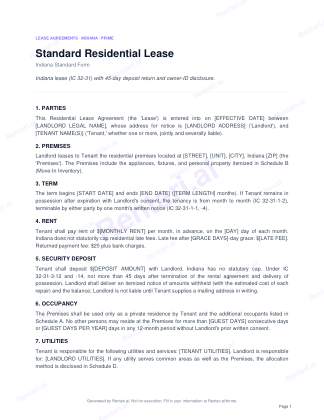
In the Rentari Indiana lease
- Fair housing
The Rentari lease includes a reasonable accommodation and modification clause.
Ind. Code § 22-9.5-5-1 Ind. Code § 22-9-1-2(a), (b) Ind. Code § 22-9-1-3(l)
- Owner and manager identity
The Rentari Indiana lease adds an owner and manager identification page that names the manager and the agent for notices and says each must reside in Indiana; an address you have not entered prints as not disclosed.
- Security deposit limit
The Rentari Indiana lease states the deposit amount and says Indiana does not cap it.
- Returning the deposit
The Rentari Indiana lease gives the 45-day itemized notice with the estimated repair cost for each item, lists the permitted uses of the deposit and states the mailing address condition.
- Move-in condition
The Rentari lease has the tenant accept the unit's condition as documented in any move-in condition report and report existing damage in writing.
- Rent and late fees
The Rentari Indiana lease charges the late fee you set after the grace period you set and says no Indiana statute sets a late fee amount.
- Rent increase notice
The Rentari Indiana lease says that, unless the lease provides otherwise, you give at least 30 days' written notice before modifying it.
Ind. Code § 32-31-5-4 Ind. Code § 32-31-1-20(b) Ind. Code § 32-31-1-20(a)
- Landlord entry
The Rentari Indiana lease states the reasonable-notice rule and, as its own term, promises at least 24 hours' notice unless you set a different period.
- Repairs and habitability
The Rentari Indiana lease restates these landlord duties and the tenant's right to sue after notice and a reasonable time to repair.
- Tenant repair remedies
The Rentari lease says the tenant may not repair and deduct unless a statute allows it, and its Indiana section restates the tenant's right to sue after notice.
- Locks and security devices
The Rentari Indiana lease restates the protection order lock change deadlines and reimbursement rules, and its general clause has you provide working exterior locks.
- Smoke alarms
The Rentari Indiana lease has the tenant acknowledge a working smoke detector, sets your seven-working-day repair duty and states the tenant's testing and battery duties.
- Retaliation
The Rentari Indiana lease restates the protected activities, the responses you may not take and the actions you may still take.
Ind. Code § 32-31-8.5-2 Ind. Code § 32-31-8.5-4 Ind. Code § 32-31-8.5-5(a)
- Lockouts and utility shutoffs
The Rentari Indiana lease promises not to take, remove, withhold or dispose of the tenant's belongings to enforce the lease.
- Ending a fixed-term lease early
The Rentari Indiana lease restates the protected-individual and servicemember termination rights, and its general clause keeps a tenant who leaves early liable for rent while you make good-faith efforts to re-rent.
- Notice for unpaid rent
The Rentari Indiana lease requires at least 10 days' notice before ending the lease for unpaid rent and says full payment within that time keeps the lease in force.
- Abandoned property
The Rentari Indiana lease uses the statute's definitions of abandonment and describes the court-ordered removal, storage and 45-day sale process.
- Small claims court
The Rentari Indiana lease sends any case to a court with jurisdiction in the county where the property is and says a deposit case may be filed on a small claims docket.
Ind. Code § 33-29-2-4 Ind. Code § 33-28-3-4 Ind. Code § 32-31-3-11
- Death or incapacity of a tenant
The Rentari Indiana lease restates these duties and lets the tenant name a representative in a written document delivered to you.
Indiana numbers the lease follows
- Deposit return deadline
- 45 days
- after the lease ends and you get possession back
- Ind. Code § 32-31-3-12Ind. Code § 32-31-3-14
- Notice for unpaid rent
- 10 days
- unless the lease says otherwise; full payment stops it
- Ind. Code § 32-31-1-6
- Entry notice
- Reasonable notice
- written or oral, at reasonable times; no set hours
- Ind. Code § 32-31-5-6(g)
- Notice to change the lease
- 30 days
- written, unless a written lease says otherwise
- Ind. Code § 32-31-5-4
- Late fee grace period
- No state rule
- the landlord-tenant law sets no late fee cap or grace period
- Ind. Code art. 32-31Ind. Code § 32-31-1-20(c)
- Returned check charge
- $20 + bank fee
- plus the bank's actual charge for each returned item
- Ind. Code § 26-1-3.1-502.5
- Lock change for a protected tenant
- 48 hours
- 24 hours if the restrained person lives in the unit
- Ind. Code § 32-31-9-9Ind. Code § 32-31-9-10
- Small claims limit
- $10,000
- also possession cases with rent due of $10,000 or less
- Ind. Code § 33-29-2-4
From the Indiana lease
INDIANA RESIDENTIAL LEASE AGREEMENT
Not more than forty-five (45) days after termination of this Lease and delivery of possession, Landlord shall deliver to Tenant a written notice itemizing the amounts withheld, including the estimated cost of repair for each damaged item, with the balance of the deposit (IC 32-31-3-12, -14). Landlord is not liable under the deposit statute until Tenant supplies a mailing address in writing.
Deposit returnInd. Code § 32-31-3-12 Ind. Code § 32-31-3-14
If Tenant does not pay rent when due, Landlord shall give Tenant not less than ten (10) days' notice before terminating this Lease, and it does not terminate if Tenant pays the rent in full before the notice period expires (IC 32-31-1-6).
Notice for unpaid rentInd. Code § 32-31-1-6
By signing this Lease Tenant acknowledges in writing that the dwelling unit is equipped with a functional smoke detector. Tenant shall keep each smoke detector functional and not disable it, replace the batteries of a battery-operated detector as necessary, test each detector at least once every six (6) months, notify Landlord in writing if a hard-wired detector is not functional, and not tamper with or remove a detector except for maintenance.
Smoke detectorsInd. Code § 32-31-5-7 Ind. Code § 22-11-18-3.5 Ind. Code § 32-31-7-5
Indiana lease types
Pick 3, 6, 12, 18 or 36 months or your own dates. At the end, the lease ends or converts to month-to-month.
Standard lease guideEnding month-to-month: One month, written notice.
Ind. Code § 32-31-1-1 Ind. Code § 32-31-1-4
Indiana month-to-month leaseUpload a lease you already use: send an unsigned one for e-signature, or store one that is already signed.
Rooms use the Indiana lease for now: add the room as its own unit and set house rules with the optional addenda.
Indiana room rentalBefore you sign
Application and screening fees
Not set by statuteIndiana's landlord-tenant law sets no limit on application or screening fees and no refund rule for them. Cities and counties may not regulate your tenant screening process, lease applications or any fees you charge unless the General Assembly authorizes it.
- The local rule does not cover privately owned property that receives government funds or benefits for the express purpose of providing reduced rents to low or moderate income tenants. Ind. Code § 32-31-1-20(a)
Fair housing
You may not refuse to rent, refuse to negotiate, make a unit unavailable, or set different terms, conditions, services or facilities because of race, color, religion, sex, familial status, disability or national origin. The Indiana Civil Rights Law also makes denying equal opportunity to rent housing because of ancestry a discriminatory practice.
Ind. Code § 22-9.5-5-1 Ind. Code § 22-9-1-2(a), (b) Ind. Code § 22-9-1-3(l)
- State fair housing law does not bar refusing a person convicted of illegally manufacturing or distributing a controlled substance. Ind. Code § 22-9.5-5-1(c)
- The Indiana Fair Housing Act's discrimination rules do not apply to renting a single-family house by an owner of no more than three such houses who uses no broker and no discriminatory advertising, or to rooms or units in a building for up to four families where the owner lives in one of them. The Indiana Civil Rights Law has no matching exemption. An owner who was not the most recent resident of the house may use the house exemption for only one sale or rental in 24 months. Ind. Code § 22-9.5-3-1 Ind. Code § 22-9-1-2
- Housing for older persons that meets the statute's tests may limit occupancy by age. Ind. Code § 22-9.5-3-4
- The landlord-tenant statutes do not stop you from refusing to rent on a reasonable occupancy standard; one that permits two people per bedroom, does not count infants under one year, and counts dens, lofts or finished basements usable for sleeping is presumed reasonable. Ind. Code § 32-31-8-7
- The Indiana Civil Rights Commission explains that housing assistance animals can include emotional support animals without task training. A necessary accommodation may require an exception to a no-pets rule, breed restriction or pet charge. The resident still has responsibility for damage and health or safety concerns. Review the individual request, including any actual threat, significant damage, undue burden or fundamental alteration, rather than automatically applying ordinary pet rules. ICRC: assistance animals in housing
- An applicant or resident may request an accommodation when applying, after moving in, or when a disability-related need arises. The commission says the request need not use legal terminology, and a family member, caregiver or other representative may make it. Consider the communicated need individually; policy adjustments can include an assistance animal, accessible communication, a live-in aide or reserved parking. ICRC: requesting an accommodation
- If the disability or related accommodation need is not obvious, the commission permits reliable documentation of the disability and the connection to the request. A knowledgeable health care professional or another reliable source may provide it. Its guidance generally bars demands for detailed medical records, a specific diagnosis or excessive information. Keep verification proportionate to the request. ICRC: accommodation documentation
The Rentari lease includes a reasonable accommodation and modification clause.
Required disclosures
If the lowest floor of the structure is at or below the 100-year flood elevation, the lease must clearly disclose that it is in a flood plain. For a lease entered into or renewed after June 30, 2023, of property in a state area of interest near a military installation, the lease must say so and that local laws may restrict use and development of the property. You must also give the tenant, in writing, the names and addresses of an Indiana manager and agent, and have the tenant acknowledge a working smoke detector at move-in.
Ind. Code § 32-31-1-21 Ind. Code § 32-31-1-21.1
- The flood plain test and the maps it relies on are covered under flood disclosure. Ind. Code § 32-31-1-21 See Flood disclosure on the Indiana page
- The manager and agent disclosure is covered under owner and manager identity. Ind. Code § 32-31-3-18 See Owner and manager identity on the Indiana page
- The smoke detector acknowledgment is covered under smoke alarms. Ind. Code § 32-31-5-7 See Smoke alarms on the Indiana page
- A lease of more than three years must be recorded in the county recorder's office within 45 days after it is signed, or it is void against a later good faith buyer, lessee or mortgage lender. Ind. Code § 32-31-2-1 Ind. Code § 32-31-2-2
Flood disclosure
If the lowest floor of the structure, including a basement, is at or below the 100-year flood elevation shown by the Department of Natural Resources, FEMA's Flood Insurance Rate Maps or FEMA-approved local flood plain maps, you must clearly disclose in the rental agreement that the structure is in a flood plain. This applies to agreements entered into or renewed after June 30, 2009.
- The rule covers residential, agricultural and commercial rental agreements. Ind. Code § 32-31-1-21(a)
Owner and manager identity
At or before the start of the rental agreement, you or the person who signs for you must give the tenant, in writing, the name and address of a person residing in Indiana who is authorized to manage the unit, and of a person residing in Indiana, reasonably accessible to the tenant, who may accept service of process and receive notices and demands for the owner. One person may fill both roles.
- A person who fails to make the disclosure becomes the landlord's agent for service and notices and for performing the landlord's obligations. Ind. Code § 32-31-3-18(c)
- If the names and addresses are not disclosed at the start, the tenant may recover the expenses reasonably incurred to find them. Ind. Code § 32-31-3-18(d)
- The duty binds any later landlord, owner or manager. Ind. Code § 32-31-3-18(b)
The Rentari Indiana lease adds an owner and manager identification page that names the manager and the agent for notices and says each must reside in Indiana; an address you have not entered prints as not disclosed.
Deposits, rent and fees
Security deposit limit
Not set by statuteIndiana does not cap the amount of a security deposit. A security deposit includes a required prepayment of rent other than the first full rental period, rent charged in any period above the average rent for the term, and any other money returnable to the tenant when the unit is returned in the condition the lease requires.
Ind. Code §§ 32-31-3-9 to 32-31-3-19
- Cities and counties may not regulate security deposits unless the General Assembly authorizes it. Ind. Code § 32-31-1-20(c) See Rent control and local rules on the Indiana page
- You may accept, but may not require, a lien on a tenant's motor vehicle as a security deposit or to secure rent. To enforce it you must record the lien and follow the security deposit chapter. Ind. Code § 32-31-3-13.5
- Money paid for an option to purchase under a lease with an option to purchase is not a security deposit, unless it is shown the intent was to evade the deposit law. Ind. Code § 32-31-3-9(c)
The Rentari Indiana lease states the deposit amount and says Indiana does not cap it.
Returning the deposit
When the rental agreement ends and you get possession back, you have 45 days to deliver a written notice that itemizes what you kept, with the amount due to the tenant. You may deduct accrued rent, damages caused by the tenant's failure to follow the law or the lease, and unpaid utility or sewer charges the tenant owed under the lease. You are not liable under the deposit law until the tenant gives you, in writing, a mailing address for the notice.
Ind. Code § 32-31-3-12 Ind. Code § 32-31-3-14
- A deduction for damage must be for actual damage to the unit or a related facility that is not ordinary wear and tear. The deposit may also cover rent in arrears, rent due because the tenant ended the lease early, the last rent payment if a written agreement says the deposit will serve as it, and utility or sewer charges the tenant owed and you paid. Ind. Code § 32-31-3-13
- Within 45 days after the tenant's occupancy ends, mail the tenant an itemized list of damages with the estimated cost of repair for each damaged item, and include a check or money order for the rest of the deposit. Ind. Code § 32-31-3-14
- If you do not send the itemized notice of damages, the law treats that as your agreement that no damages are due, and you must return the full deposit immediately. Ind. Code § 32-31-3-15
- A landlord who does not comply owes the tenant the part of the deposit withheld plus reasonable attorney's fees and court costs. Ind. Code § 32-31-3-12(b) Ind. Code § 32-31-3-16
- Unless you agree otherwise, the tenant may not apply the deposit to rent. Ind. Code § 32-31-3-12(a)
- If you sell the property, you remain liable for the deposit for one year after giving the tenant written notice of the sale, unless the buyer notifies the tenant that it has taken on that liability and you transfer the deposit to the buyer. Ind. Code § 32-31-3-19
- A protected individual who ends a lease under the domestic violence law is entitled to deposits, returns and other refunds as if the tenancy had expired under the lease. This applies even though the law otherwise lets you hold a deposit tied to a lease that other adult tenants continue until 45 days after all of their tenancies end. Ind. Code § 32-31-9-12(e) Ind. Code § 32-31-9-13
- A waiver of the deposit law by a landlord or tenant is void. Ind. Code § 32-31-3-17
The Rentari Indiana lease gives the 45-day itemized notice with the estimated repair cost for each item, lists the permitted uses of the deposit and states the mailing address condition.
Deposit account and interest
Not set by statuteIndiana does not require you to hold a security deposit in a separate or interest-bearing account, and it does not require you to pay interest on it.
Ind. Code §§ 32-31-3-9 to 32-31-3-19
- The owner of the unit when the rental agreement ends is bound by the deposit return rules. Ind. Code § 32-31-3-12(d)
Move-in condition
Not set by statuteIndiana does not require a move-in inspection, condition checklist or inventory. At the end of the tenancy the tenant must return the unit clean and in proper condition, except for ordinary wear and tear.
- Deductions from the deposit for damage are limited to actual damage that is not ordinary wear and tear. Ind. Code § 32-31-3-13(1) See Returning the deposit on the Indiana page
- When you deliver the unit, you must have the tenant acknowledge in writing that it has a functional smoke detector. Ind. Code § 32-31-5-7(a) See Smoke alarms on the Indiana page
The Rentari lease has the tenant accept the unit's condition as documented in any move-in condition report and report existing damage in writing.
Rent and late fees
Not set by statuteIndiana's landlord-tenant law sets no late fee amount, no cap and no grace period, so a late fee comes from your written lease. Unless the General Assembly authorizes it, cities and counties may not regulate the fees a landlord charges on privately owned property.
Ind. Code art. 32-31 Ind. Code § 32-31-1-20(c)
- If rent is not paid when due, you may end the lease with at least 10 days' notice, unless you and the tenant agreed otherwise or the tenant pays the rent in full before the notice period expires. Ind. Code § 32-31-1-6 See Notice for unpaid rent on the Indiana page
- Rent means every payment made to a landlord under a rental agreement except a security deposit. Ind. Code § 32-31-3-6
The Rentari Indiana lease charges the late fee you set after the grace period you set and says no Indiana statute sets a late fee amount.
Returned payment fee
When a check, draft, order or similar instrument given to you is dishonored or returned unpaid for any reason, you may charge the maker up to $20 plus the actual charge your bank made for each returned item. The section speaks of checks and like instruments; it does not say whether an electronic debit counts.
- Under the dishonored check chapter, a person who stops payment without valid cause or lets a check bounce can also owe 18 percent yearly interest on the check amount, court costs, reasonable attorney's fees (at least $100 when an outside attorney files suit) and other reasonable collection costs. Ind. Code § 26-2-7-4 Ind. Code § 26-2-7-5
- If the check writer does not pay the full amount within 30 days after you send written notice by certified mail, the court awards three times the check amount for a check of $250 or less, or the check amount plus $500 for a larger check. The exception covers a writer who reasonably believed the funds were there, and only when the shortfall was caused by a dishonored third-party check deposited to the writer's account. Ind. Code § 26-2-7-6
- The writer is not liable under that chapter if they pay the full check amount within 10 days after you give notice that it was not paid. Ind. Code § 26-2-7-8
- You must choose between a claim under the dishonored check chapter and one under IC 34-24-3-1. Ind. Code § 26-2-7-7
Rent increase notice
Indiana's rule is about changing the rental agreement: unless a written rental agreement between you and the tenant provides otherwise, you must give the tenant at least 30 days' written notice before modifying it. Indiana has no rent control, and cities and counties may not regulate rental rates for privately owned property unless the General Assembly authorizes it (property given government funds or benefits for reduced rents is outside this rule).
Ind. Code § 32-31-5-4 Ind. Code § 32-31-1-20(b) Ind. Code § 32-31-1-20(a)
- You may not raise rent in response to a tenant's protected activity, but you may raise it to the rent charged for comparable market rentals. Ind. Code § 32-31-8.5-4 Ind. Code § 32-31-8.5-5(b) See Retaliation on the Indiana page
- A waiver of the chapter that holds the 30-day rule (it also covers entry, lockouts and tenant property) by contract or otherwise is void. The 30-day rule itself still lets a written rental agreement set a different notice period. Ind. Code § 32-31-5-1(c) Ind. Code § 32-31-5-4
- Make a renewal or rent-change proposal easy to compare with the current agreement: identify the home and tenants, show the present rent, proposed rent, dollar change and proposed start date, and explain any proposed term or reply date. Keep the dated notice and delivery record with the lease. Record any negotiated change before updating recurring charges. A tenant declining the proposal is not itself a substitute for the notice needed to end a tenancy; handle acceptance, negotiation and termination as separate steps. This is a practical checklist, not a required statutory form. Ind. Code § 32-31-5-4 Ind. Code § 32-31-1-1
The Rentari Indiana lease says that, unless the lease provides otherwise, you give at least 30 days' written notice before modifying it.
During the tenancy
Landlord entry
Give the tenant reasonable written or oral notice of your intent to enter, and enter only at reasonable times. Indiana sets no fixed number of hours. The tenant may not unreasonably refuse entry to inspect, make necessary or agreed repairs, decorations, alterations or improvements, supply necessary or agreed services, or show the unit to prospective or actual buyers, mortgage lenders, tenants, workers or contractors.
- You may enter without notice in an emergency that threatens the safety of the occupants or your property. Ind. Code § 32-31-5-6(f)(1)
- You may enter without the tenant's consent under a court order or if the tenant has abandoned or surrendered the unit. Ind. Code § 32-31-5-6(f)(2)
- You may not abuse the right of entry or use it to harass a tenant. Ind. Code § 32-31-5-6(g)(1)
- A waiver of these rules by contract or otherwise is void. Ind. Code § 32-31-5-1(c)
The Rentari Indiana lease states the reasonable-notice rule and, as its own term, promises at least 24 hours' notice unless you set a different period.
Repairs and habitability
You must deliver the unit in compliance with the rental agreement and in a safe, clean and habitable condition, comply with the health and housing codes that apply, and make all reasonable efforts to keep common areas clean and proper. If they are provided when the lease is made, you must keep the electrical, plumbing, sanitary, heating, ventilating and air conditioning systems, elevators and any appliances supplied as an inducement in good and safe working condition.
- Plumbing must accommodate a reasonable supply of hot and cold running water at all times, and a heating system must supply adequate heat at all times. Ind. Code § 32-31-8-5(4)
- The tenant must follow the tenant duties in the health and housing codes, keep the areas they use reasonably clean, use the systems and appliances reasonably, not damage or remove any part of the premises, and follow reasonable rules in place when the lease was signed. Ind. Code § 32-31-7-5
- A waiver of these duties by contract or otherwise is void. Ind. Code § 32-31-8-4 Ind. Code § 32-31-7-4
- These chapters apply to rental agreements entered into after June 30, 2002. Ind. Code § 32-31-8-1 Ind. Code § 32-31-7-1
The Rentari Indiana lease restates these landlord duties and the tenant's right to sue after notice and a reasonable time to repair.
Tenant repair remedies
A tenant may sue you to enforce your repair duties only after giving you notice of the problem and a reasonable time to repair it, and only if you fail or refuse to fix it. The tenant may not block your access to make the repair. Indiana's landlord-tenant law gives no right to repair and deduct or to withhold rent.
- A tenant who wins may recover actual and consequential damages, attorney's fees and court costs, an injunction or any other remedy the court finds appropriate. Ind. Code § 32-31-8-6(d)
- Your liability for damages begins when you have notice or actual knowledge of the problem and have refused to fix it or failed to fix it within a reasonable time, whichever occurs first. Ind. Code § 32-31-8-6(e)
- A tenant's written complaint to you about a repair, entry or lockout violation is a protected activity. Ind. Code § 32-31-8.5-2(2) See Retaliation on the Indiana page
- Keep a repair log with the date and description of each problem, photos, the request and its delivery, replies, offered access times and the work completed. For an urgent loss of heat, water or another essential service, state the immediate effect clearly and use the emergency contact provided. Follow up in writing after a phone call or visit, and keep receipts for any expenses. This record helps show notice, opportunity to repair and the remaining problem if legal help or a court action becomes necessary; it does not itself authorize withholding rent or deducting a repair bill. Ind. Code § 32-31-8-6(a), (b)
The Rentari lease says the tenant may not repair and deduct unless a statute allows it, and its Indiana section restates the tenant's right to sue after notice.
Locks and security devices
Indiana's landlord-tenant law sets no general lock or rekeying requirement. Its lock rule is for a tenant protected by a court order: on the tenant's written request with a copy of the order, change the locks and give the tenant a key within 48 hours, or within 24 hours if the restrained person is a tenant of the same unit.
Ind. Code § 32-31-9-9 Ind. Code § 32-31-9-10
- The tenant reimburses your actual cost. If you miss the deadline, the tenant may change the locks, you reimburse the tenant's actual cost, and the tenant gives you a key within 24 hours. Ind. Code § 32-31-9-11
- When the restrained person is a co-tenant, you may not give that person access unless the order allows a visit to collect belongings, and you are immune from liability for excluding them under the order; they stay liable for rent and damage under the lease. Ind. Code § 32-31-9-10(c) to (e)
- Changing the locks to keep a tenant out without a court order is an unlawful lockout. Ind. Code § 32-31-5-6(c)(1) See Lockouts and utility shutoffs on the Indiana page
The Rentari Indiana lease restates the protection order lock change deadlines and reimbursement rules, and its general clause has you provide working exterior locks.
Smoke alarms
Each dwelling must have at least one functional smoke detector outside each sleeping area near the bedrooms and on each additional story, including basements and habitable attics. You, your manager or your rental agent must install the required detectors and repair or replace one within seven working days after written notice that it needs it.
Ind. Code § 22-11-18-3.5(c), (e)
- When you deliver the unit, you must have the tenant acknowledge in writing that it has a functional smoke detector, and the smoke detector law cannot be waived in the lease or a separate writing. Ind. Code § 32-31-5-7
- Detectors may be battery operated or hard wired, must be accessible for servicing, and must be tested by the occupant at least once every six months. Ind. Code § 22-11-18-3.5(d)
- The tenant must keep each detector working and not disable it, replace batteries as needed, and give you notice if a hard-wired detector is not working. Ind. Code § 32-31-7-5(6)
- No one may tamper with or remove a smoke detector except for maintenance. Ind. Code § 22-11-18-3.5(f)
- A landlord commits a Class B infraction (Class A after a prior violation) by violating the smoke detector law when delivering the unit, or by failing to repair or replace an inoperable hard-wired detector within seven days after written notice sent by certified mail, return receipt requested. Ind. Code § 22-11-18-5.5
The Rentari Indiana lease has the tenant acknowledge a working smoke detector, sets your seven-working-day repair duty and states the tenant's testing and battery duties.
Retaliation
You may not raise rent, cut or interfere with services, or bring or threaten a possession, eviction or early termination action because the tenant complained to a code enforcement agency about a violation that materially affects health or safety, complained to you in writing about a lockout, utility, entry or repair violation, sued you under the emergency possession or repair chapters, organized or joined a tenants' organization, or testified against you.
Ind. Code § 32-31-8.5-2 Ind. Code § 32-31-8.5-4 Ind. Code § 32-31-8.5-5(a)
- You may still decline to renew at the end of the term, raise rent to the level of comparable market rentals, and reduce or end a service for all tenants equally. Ind. Code § 32-31-8.5-5(b)
- You may still bring a possession action if the code violation was caused mainly by the tenant or the tenant's household or guests, the tenant has not cured a rent default in time, code compliance requires work that displaces the tenant, the tenant's breach materially affects health or safety, the tenant holds over after a fixed term, you acted in good faith before the protected activity, or you in good faith want the unit back at the end of the term to live in, to remodel or demolish, or to take it off the rental market for at least six months. Ind. Code § 32-31-8.5-5(c)
- A waiver of the retaliation chapter is void, and cities and counties may not adopt their own retaliation rules. Ind. Code § 32-31-8.5-0.5 Ind. Code § 32-31-8.5-6
- You may not end, refuse to renew or refuse to enter into a lease, or retaliate, solely because a tenant, applicant or household member is a protected victim with a protection or no contact order. Ind. Code § 32-31-9-8
The Rentari Indiana lease restates the protected activities, the responses you may not take and the actions you may still take.
Lockouts and utility shutoffs
Without a court order you may not deny or interfere with a tenant's access to or possession of the unit, for example by changing the locks, adding a device to keep the tenant out, removing doors, windows, fixtures or appliances, or interrupting, reducing or shutting off electricity, gas, water or other essential services. You may interrupt a service for an emergency, good faith repairs or necessary construction.
- You do not have to pay for these services unless you agreed to in the lease. Ind. Code § 32-31-5-6(c)(3)
- Except as the deposit and abandoned property chapters allow, you may not take, remove, deny access to or dispose of a tenant's belongings to enforce a lease obligation. A separate writing may let you hold property the tenant voluntarily offers as security in exchange for not filing an eviction. Ind. Code § 32-31-5-5
- A tenant may not shut off a service to the unit if doing so will seriously damage it. Ind. Code § 32-31-5-6(d)
- A tenant who is locked out or has services cut may petition for an emergency possessory order; the court must set a hearing within three business days and can order you to restore possession and stop the violation. Ind. Code § 32-31-6-3 Ind. Code § 32-31-6-5 Ind. Code § 32-31-6-6
- These rules do not apply once the unit is abandoned, meaning the tenants have failed to pay or offer to pay rent and a reasonable person would conclude they have surrendered possession. Ind. Code § 32-31-5-6(a), (b) See Abandoned property on the Indiana page
The Rentari Indiana lease promises not to take, remove, withhold or dispose of the tenant's belongings to enforce the lease.
Ending a tenancy
Ending a month-to-month tenancy
A month-to-month tenancy ends with one month's written notice. For any period-to-period tenancy with a rental period of three months or less, notice equal to the rental period is enough. A year-to-year tenancy ends with notice given at least three months before the end of the year.
Ind. Code § 32-31-1-1 Ind. Code § 32-31-1-4 Ind. Code § 32-31-1-3
- A tenancy where someone occupies the premises with your express or implied consent, without other terms, is a month-to-month tenancy. Ind. Code § 32-31-1-2
- A tenancy at will can only be created by an express contract. Ind. Code § 32-31-1-1(b)
- Serve the notice on the tenant. If the tenant cannot be found, serve a person residing at the premises and explain its contents. Only if no such person is found may you post it on a conspicuous part of the premises. Ind. Code § 32-31-1-9(a) to (c)
- A lease for a set period ends at its end without notice. Ind. Code § 32-31-1-8(1), (2) See Ending a fixed-term lease early on the Indiana page
Ending a fixed-term lease early
A lease for a set period ends at its end without notice, and Indiana gives tenants no general right to end it early. A tenant may end the lease by written notice given at least 30 days before the termination date if they are a victim or alleged victim of a crime involving domestic or family violence, a sex offense or stalking, and have a civil protection order or a criminal no contact order restraining the perpetrator.
Ind. Code § 32-31-1-8 Ind. Code § 32-31-9-12
- The notice must include a copy of the order and, for a victim of domestic violence or sexual assault, a safety plan from an accredited domestic violence or sexual assault program that is dated within 30 days before the notice and recommends relocation. Ind. Code § 32-31-9-12(c)
- The tenant owes rent and other expenses prorated to the termination date, payable when rent would have been due, and no rent or fee owed only because of the early termination. Notice given at least 14 days before the tenant could first move in ends the lease with no damages or penalties. Ind. Code § 32-31-9-12(d)
- Other adult tenants stay bound by the lease. Ind. Code § 32-31-9-13
- Outside the protected-individual rule, a security deposit may be applied to rent due because a tenant ended the lease early. A protected individual who ends the lease under the domestic violence law owes no rent or fee that is due only because of the early termination, and gets deposits and refunds as if the lease had expired. Ind. Code § 32-31-3-13(2) Ind. Code § 32-31-9-12(d), (e)
- Under federal law, a servicemember may end a residential lease after entering military service, or after receiving permanent change of station or deployment orders for 90 days or more, by written notice with a copy of the orders. 50 U.S.C. § 3955
- If both sides agree to an early release, put the arrangement in writing before relying on it. Identify the tenants being released, the agreed end date, key return, any rent or settlement amount and how the deposit will be accounted for. State whether a replacement tenant or approved sublet changes the original tenant's obligations; do not assume that finding someone new releases everyone named on the lease. Keep the signed agreement, move-out condition record, final ledger and receipts together. This practical agreement checklist does not replace the separate statutory protections above. Ind. Code § 32-31-1-8 Ind. Code § 32-31-9-12
The Rentari Indiana lease restates the protected-individual and servicemember termination rights, and its general clause keeps a tenant who leaves early liable for rent while you make good-faith efforts to re-rent.
Notice for unpaid rent
If a tenant refuses or neglects to pay rent when due, you may end the lease with at least 10 days' notice, unless you and the tenant agreed otherwise. The lease does not end if the tenant pays the rent in full before the notice period expires.
- The statute gives a form of notice to vacate within 10 days unless the rent is paid within 10 days. Ind. Code § 32-31-1-7
- Serve the notice on the tenant. If the tenant cannot be found, you may serve a person residing at the premises and must explain the notice to them; if no one is found, you may post it on a conspicuous part of the premises. Ind. Code § 32-31-1-9
- No notice is required when the lease expressly requires rent in advance and the tenant refuses or neglects to pay it in advance. Ind. Code § 32-31-1-8(5)
The Rentari Indiana lease requires at least 10 days' notice before ending the lease for unpaid rent and says full payment within that time keeps the lease in force.
Notice for other lease violations
Indiana sets no notice or cure period for ending a lease over a breach other than unpaid rent, so the lease terms control. Before you sue a tenant to enforce the tenant duties in the statute, such as keeping the unit reasonably clean and not damaging it, you must give notice of the problem and a reasonable time to fix it.
- If the tenant's breach caused physical damage that you repaired, your notice must specify the repairs and document their cost. Ind. Code § 32-31-7-7(c)
- No notice is needed to sue once the tenant's occupancy has ended. Ind. Code § 32-31-7-7(d)
- If you win, you may recover actual damages, attorney's fees and court costs, an injunction or another appropriate remedy. Ind. Code § 32-31-7-7(f)
- For waste, a crime by the tenant or a guest that affects others' health and safety, or materially false information given to get the lease, you may ask the court for an emergency possessory order. Ind. Code § 32-31-6-3 See Eviction process on the Indiana page
Eviction process
Partly readOnly a court can remove a tenant. You may file an action for possession, including on a small claims docket when the rent due at filing is $10,000 or less. If you file an affidavit for possession before judgment, the hearing on the order to show cause may be held no earlier than five business days after the tenant is served, and the officer may remove occupants no earlier than 48 hours after the order of possession is served. The court rules for small claims and eviction cases were not read for this page.
Ind. Code § 32-30-3-1 Ind. Code § 32-30-3-2 Ind. Code § 32-30-3-10 Ind. Code § 33-29-2-4
- You may petition for an emergency possessory order if the tenant commits or threatens waste, the tenant or a guest commits a crime affecting the health and safety of another tenant, you or your agent, or the tenant gave materially false information to get the lease. The court must set a hearing no later than three business days after the petition is filed, and on a crime or false information finding orders the tenant out within seven days of the hearing. Ind. Code § 32-31-6-3 Ind. Code § 32-31-6-5 Ind. Code § 32-31-6-7.1
- If the case settles before final judgment, you must move to dismiss it unless you are still seeking damages. Ind. Code § 32-31-10-3
- Taking part in an eviction diversion program or settlement conference is voluntary. Ind. Code § 32-31-10-5
- The court must seal an eviction case's records on its own motion when the case is dismissed, ends in a judgment for the tenant, or a judgment against the tenant is overturned on appeal. A tenant with a judgment against them may move to seal it once any money judgment is satisfied or, if there was none, seven years after the judgment. Ind. Code § 32-31-11-3(a), (b)
- A separate affidavit process lets a property owner have law enforcement remove a squatter: someone who has never had a rental agreement, the owner's permission or any other right to occupy. It does not apply to a person whose lease expired or was violated, to anyone who formerly had permission, or to an invitee. A person removed on a knowingly false affidavit may sue the person who signed it. Ind. Code § 32-31-12-2 Ind. Code § 32-31-12-3 Ind. Code § 32-31-12-8
Abandoned property
You are not liable for loss of or damage to belongings the tenant has abandoned, meaning a reasonable person would conclude the tenant has vacated and surrendered possession of them; no lease may define abandonment differently. Otherwise you may remove a tenant's belongings only under a court order after a court awards you possession, and deliver them to a warehouse or a court-approved storage facility.
- Before delivery, notice of the removal order and of the storage location must be personally served on the tenant at the tenant's last known address. Ind. Code § 32-31-4-3(a)
- Exempt property (medically necessary items, items used in the tenant's trade or business, a week's supply of seasonal clothing, blankets and items needed to care for and school a child) must be released on demand without payment. Ind. Code § 32-31-4-1 Ind. Code § 32-31-4-3(b)
- The storage company holds a lien for its charges on the property that is not exempt; the tenant may reclaim the property until sale by paying those charges, and it may be sold if not claimed within 45 days after the tenant receives the notice. Ind. Code § 32-31-4-4 Ind. Code § 32-31-4-5
- When a sole occupant dies or is believed incapacitated and absent, you must give the tenant's representative access to remove the belongings. Ind. Code § 32-31-1-23 See Death or incapacity of a tenant on the Indiana page
The Rentari Indiana lease uses the statute's definitions of abandonment and describes the court-ordered removal, storage and 45-day sale process.
Small claims court
The small claims docket of a circuit or superior court hears civil claims up to $10,000, landlord and tenant possession cases when the rent due at filing is $10,000 or less, and emergency possessory cases. A security deposit case may be filed on the small claims docket of any court with jurisdiction.
Ind. Code § 33-29-2-4 Ind. Code § 33-28-3-4 Ind. Code § 32-31-3-11
- Filing on the small claims docket waives a jury trial. A defendant may demand a jury within 10 days after service by affidavit, and the case moves to the regular docket when the defendant deposits $70. Ind. Code § 33-29-2-7
- In Marion County, township small claims courts hear contract and tort claims up to $10,000 and possession cases when the past due rent is $10,000 or less. The rule letting a case be filed in any township in the county does not apply to landlord and tenant claims. Ind. Code § 33-34-3-1 Ind. Code § 33-34-3-2 Ind. Code § 33-34-3-3
The Rentari Indiana lease sends any case to a court with jurisdiction in the county where the property is and says a deposit case may be filed on a small claims docket.
More Indiana rules
Death or incapacity of a tenant
If a tenant who was the sole occupant dies, or you believe a sole occupant is incapacitated and absent, you must notify the tenant's representative, give the representative access at a reasonable time to remove the tenant's belongings, and pay the representative the security deposit and unearned rent the tenant would have been owed. You may require a signed inventory of what is removed.
Ind. Code § 32-31-1-23(a), (b)
- The representative is, in order of priority, a person the tenant named in a written document delivered to you, a person named in the written lease, an attorney in fact, a guardian, an heir, or a person the probate court appoints. Ind. Code § 32-31-1-23(c)
- A landlord who follows the section is not liable to the tenant, the estate or anyone else claiming the belongings, rent or deposit; one who willfully violates it is liable for actual damages. Ind. Code § 32-31-1-23(f), (g)
The Rentari Indiana lease restates these duties and lets the tenant name a representative in a written document delivered to you.
Screening reports and decision records
Partly readUse a written, lawful set of rental criteria and check the information behind a screening result. A report can contain mistaken identities, duplicate entries or incomplete court records; a score or risk label is not the whole application.
FTC: tenant background checks and rights
- Match the applicant’s identifying information to the report. For any record you may lawfully consider, check its date and final outcome rather than treating a filing as a completed eviction or a charge as a conviction. Keep the applicant’s correction information with the screening file and direct report errors to the reporting company’s dispute process. Apply the fair-housing and accommodation requirements above. FTC: tenant background checks and rights See Fair housing on the Indiana page
- Federal consumer-report notice duties are separate from Indiana’s limits on local screening regulation. If a report contributes to a denial or less favorable rent, deposit or cosigner terms, give the required adverse-action notice. Identify the reporting company by name, address and phone number, explain that it did not make the decision and cannot explain your reasons, and state the rights to dispute inaccurate or incomplete information and request a free report from that company within sixty days of the notice. Additional duties can apply to credit scores and investigative reports. FTC: landlord consumer-report guidance Ind. Code § 32-31-1-20(c)
- Save the criteria, report date, decision reasons, relevant applicant communications and notice delivery record. Limit access to consumer reports and dispose of them securely when retention duties allow. A provider’s screening result does not transfer responsibility for your rental decision to the reporting company. FTC: landlord consumer-report guidance
Local rules
Rent control and local rules
Indiana has no rent control. Unless the General Assembly authorizes it, cities and counties may not regulate rental rates for privately owned property, or regulate screening, security deposits, lease applications, lease terms, disclosures, the parties' rights or landlord fees; an ordinance that does is void.
- The rule does not cover privately owned property with government funds or benefits allocated to provide reduced rents for low or moderate income tenants. Ind. Code § 32-31-1-20(a)
- Cities and counties may not adopt or enforce rules on landlord retaliation. Ind. Code § 32-31-8.5-6
- A city or county may not penalize a tenant, owner or landlord, including by eviction, for a call for police or emergency help made by or for a victim of abuse or crime or a person in an emergency, subject to exceptions in the statute. Ind. Code § 32-31-1-22
- Cities and counties may adopt smoke detector rules for dwellings that are stricter than state law and do not conflict with it. Ind. Code § 22-11-18-3.5(g) See Smoke alarms on the Indiana page
- The ban does not cover privately owned property given government funds or benefits for the express purpose of providing reduced rents to low or moderate income tenants. Ind. Code § 32-31-1-20(a)
Cities and counties have housing, building, fire and other codes that can add duties for rental property. No local code was read for this page; check the codes where the property is located.
Indiana lease renewals
Read the agreement's renewal clause and the notice rules above before choosing a new term, changing rent or ending the tenancy. A fixed end date does not override applicable renewal rights, rent regulation, just-cause rules or protections against retaliation and discrimination.
Confirm the notice, timing and delivery requirements for the rental's state and locality. Review any required new disclosures and attachments when preparing the renewal. Get the parties' agreement to changed terms in writing.
Customize an unsigned agreement or prepare an addendum to an existing lease.
How it works
- Add your Indiana rental
Enter the property and its units.
- Set the terms
Choose the rental, add tenants, and set rent, deposit and fees.
- Review the lease
Preview and edit the Indiana lease and its addenda.
- Send for e-signature
Tenants sign online; sending is included on paid plans.
Follow the full lease builder guide, add supporting files, or download and print the agreement.
Indiana lease questions
Does the Rentari Indiana lease follow the 45-day deposit rule?
Yes. It gives the 45-day itemized notice with the estimated repair cost for each item, lists the permitted uses of the deposit, and states that the landlord is not liable until the tenant supplies a mailing address in writing.
Ind. Code § 32-31-3-12 Ind. Code § 32-31-3-13 Ind. Code § 32-31-3-14
What entry notice does the lease promise?
Indiana requires reasonable written or oral notice at reasonable times. As its own term the lease promises at least 24 hours' notice unless you set a different period, and it keeps the emergency exception.
Does the lease include the disclosures Indiana requires?
It includes the flood plain statement when you mark the property as in a flood zone, an owner and manager identification page, and the tenant's smoke detector acknowledgment. It does not print the military installation statement; add it as an extra term if the property is in a state area of interest near an installation.
Ind. Code § 32-31-1-21 Ind. Code § 32-31-1-21.1 Ind. Code § 32-31-3-18 Ind. Code § 32-31-5-7
Does the lease cover domestic violence protections?
Yes. It restates the protected tenant's right to end the lease on 30 days' written notice with the order and safety plan, and the 48-hour and 24-hour lock change deadlines.
Ind. Code § 32-31-9-9 Ind. Code § 32-31-9-10 Ind. Code § 32-31-9-12
Does the lease set a late fee limit?
Indiana's landlord-tenant law sets none. The lease charges the late fee you choose after the grace period you choose and says so.