- Home
- Lease agreement
- Massachusetts
Massachusetts residential lease agreement
State rules checked September 24, 2026 General information, not legal advice
Jump to a topic
Massachusetts lease document preview
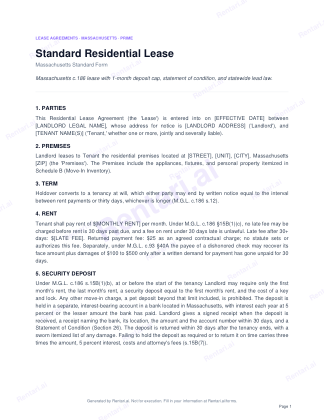
In the Rentari Massachusetts lease
- Fair housing
The lease states that the landlord follows fair housing laws and explains how to request a reasonable accommodation or modification. Unless the landlord turns it off, it also says housing vouchers and other rental assistance are considered, and Rentari warns a Massachusetts landlord who turns that off.
Mass. G.L. c. 151B, § 4(6), (7), (10), (11) Mass. G.L. c. 151B, § 4(7B)
- Security deposit limit
The Rentari Massachusetts lease states the deposit, holds all security, a pet deposit included, to the first month's rent, and lists the only payments allowed at move-in. The lease builder stops a lease whose deposits together exceed one month's rent or that adds a move-in fee.
Mass. G.L. c. 186, § 15B(1)(b) Mass. G.L. c. 186, § 15B(1)(d)
- Returning the deposit
The lease promises the deposit and interest back within 30 days after the tenancy ends, lists the only deductions allowed, requires a sworn itemized list with written evidence of cost, and states the triple damages.
Mass. G.L. c. 186, § 15B(4) Mass. G.L. c. 186, § 15B(6) Mass. G.L. c. 186, § 15B(7)
- Deposit account, receipts and interest
The lease promises both receipts, a separate interest-bearing account in a Massachusetts bank kept apart from the landlord's funds, and yearly interest at 5 percent or the lower bank amount. A security deposit interest notice is attached when there is a deposit.
Mass. G.L. c. 186, § 15B(3)(a) Mass. G.L. c. 186, § 15B(2)(b) Mass. G.L. c. 186, § 15B(3)(b)
- Statement of condition at move-in
When there is a deposit, the lease attaches a Statement of Condition that begins with the statutory notice in 12-point bold type, followed by the landlord's listing of existing damage or "None". The lease builder will not prepare or send the lease without that answer.
- Rent and late fees
The lease says no late fee, penalty or interest may be charged until rent is thirty days late, and states the late fee that applies after that. The lease builder requires a grace period of at least 30 days whenever a late fee is set.
- Returned payment fee
When the landlord sets one, the lease charges the returned payment fee stated in it.
- Repairs and habitability
The lease requires the landlord to keep the home in compliance with the State Sanitary Code at all times.
- Tenant repair remedies
The lease restates repair and deduct in the statute's terms: certification, written notice, five days to begin and fourteen to substantially complete, a cap of four months' rent in twelve months, or ending the lease.
- Smoke and carbon monoxide alarms
The lease has the landlord provide working smoke and carbon monoxide detectors at move-in and bars the tenant from disabling them.
- Retaliation
The lease bars reprisal for reporting code violations, joining a tenants' organization or using legal rights, and states the six-month presumption and the damages.
- Ending a month-to-month tenancy
The lease says a tenancy at will may be ended by either party on thirty days' written notice or one full rental period, whichever is longer.
- Ending a fixed-term lease early
The lease restates the domestic violence termination right, and otherwise keeps the tenant liable for rent through the term while the landlord makes reasonable efforts to re-rent.
- Notice for unpaid rent
The lease says a tenancy at will can be ended for unpaid rent on fourteen days' written notice.
Mass. G.L. c. 186, § 11 Mass. G.L. c. 186, § 12 Mass. G.L. c. 186, § 31
- Eviction process
The lease names the division of the Housing Court, or the District Court, for the place where the home is, and notes the tenant's right to ask the court to seal an eviction record.
Mass. G.L. c. 239, § 1 Mass. G.L. c. 239, § 2 Mass. G.L. c. 239, § 5
- Abandoned property
The lease says belongings left behind are handled only as the law requires and that nothing in it allows self-help repossession.
- Rent control and local rules
For a home in Boston, the lease adds the city's yearly rental registration by July 1 and the notice of tenant rights that goes with any notice to quit or non-renewal.
Massachusetts numbers the lease follows
- Security deposit limit
- 1 month's rent
- and first and last month's rent, a key and lock, nothing else at move-in
- Mass. G.L. c. 186, § 15B(1)(b)
- Deposit return deadline
- 30 days
- after the tenancy ends, with a sworn list for any damage
- Mass. G.L. c. 186, § 15B(4)
- Notice to quit for unpaid rent
- 14 days
- in writing, with the state's form
- Mass. G.L. c. 186, § 11Mass. G.L. c. 186, § 12Mass. G.L. c. 186, § 31
From the Massachusetts lease
MASSACHUSETTS RESIDENTIAL LEASE AGREEMENT
This is a statement of the condition of the premises you have leased or rented. You should read it carefully in order to see if it is correct. If it is correct you must sign it. This will show that you agree that the list is correct and complete.
Statement of condition noticeMass. G.L. c. 186, § 15B(2)(c)
LATE CHARGE (M.G.L. c.186 s.15B(1)(c)): Pursuant to M.G.L. c.186 s.15B(1)(c), no late fee, penalty, or interest may be charged unless rent has remained unpaid for at least thirty (30) days after the due date.
Late chargeMass. G.L. c. 186, § 15B(1)(c)
All security, a pet deposit included, may not exceed the first month's Rent, and at or before the start of the tenancy Landlord may require only the first month's rent, the last month's rent, that security deposit and the cost of a key and lock (s.15B(1)(b)).
Security depositMass. G.L. c. 186, § 15B(1)(b)
Massachusetts lease types
Pick 3, 6, 12, 18 or 36 months or your own dates. At the end, the lease ends or converts to month-to-month.
Standard lease guideEnding a tenancy at will: 30 days or one rent period, whichever is longer.
Massachusetts month-to-month leaseUpload a lease you already use: send an unsigned one for e-signature, or store one that is already signed.
Rooms use the Massachusetts lease for now: add the room as its own unit and set house rules with the optional addenda.
Massachusetts room rentalBefore you sign
Application and screening fees
At or before the start of a tenancy, a landlord or the landlord's agent may not require any payment to them beyond first month's rent, last month's rent, a security deposit equal to one month's rent and the cost of a key and lock. The list has no application fee.
Mass. G.L. c. 186, § 15B(1)(b)
- A lease term that conflicts with this rule, and any waiver of it, is void. Mass. G.L. c. 186, § 15B(8)
Fair housing
Massachusetts bars housing discrimination because of race, religious creed, color, national origin, sex, gender identity, sexual orientation, age, genetic information, ancestry, marital status, veteran or military status, or disability, and against families with children and recipients of public assistance or housing subsidies such as rental vouchers. Landlords may not ask about or record these traits or advertise a preference.
Mass. G.L. c. 151B, § 4(6), (7), (10), (11) Mass. G.L. c. 151B, § 4(7B)
- Refusing reasonable accommodations, or refusing reasonable modifications at the tenant's cost, is discrimination; in publicly assisted housing and in housing of ten or more units the owner pays for reasonable modifications, short of undue hardship. Mass. G.L. c. 151B, § 4(7A)
- Refusing to rent because a home has or may have lead paint, or to avoid lead law duties, is unlawful. Mass. G.L. c. 111, § 199A
- Narrow exceptions include renting one unit of an owner-occupied two-family home. Mass. G.L. c. 151B, § 4(7), (11)
- Distinguish a commercial screening package from access to the state CORI system. The Attorney General's housing guide says a housing provider must obtain written permission before accessing an applicant's CORI through the state system and must follow additional steps when using a private consumer reporting agency. A housing provider may not ask an applicant to supply their own CORI or arrest records; the guide separately identifies a public housing authority's ability to request court docket sheets. Verify the correct lawful request process and the actual package rather than assuming criminal information is always included or always unavailable. Massachusetts AGO: CORI and housing
- The Attorney General explains that housing providers may refuse housing based on criminal records, but blanket rejection of everyone with a record may violate civil rights law. Its guidance recommends an individual assessment of the nature and severity of the conviction, time elapsed, circumstances, age at the conduct, tenant history and rehabilitation. Public and federally assisted housing have additional admission rules. Confirm the applicable program and full CORI procedures; an agency report or screening score does not itself determine a lawful housing outcome. Massachusetts AGO: individual housing assessment
- Massachusetts protection for assistance animals continues under state law. The Massachusetts Commission Against Discrimination confirmed in July 2026 that withdrawal of federal enforcement guidance does not narrow those state protections. Assistance animals can include trained or untrained animals providing disability-related support, including emotional support; failure to meet the federal service-animal definition alone is not a sufficient basis to reject the request. MCAD: assistance animals in housing, July 31, 2026
- Assess an assistance-animal request individually through an interactive process. The commission identifies the central question as whether the accommodation is necessary for the person with a disability to have an equal opportunity to use and enjoy the home. Evaluate that disability-related need rather than treating every assistance animal as an ordinary pet. MCAD: individual accommodation review
The lease states that the landlord follows fair housing laws and explains how to request a reasonable accommodation or modification. Unless the landlord turns it off, it also says housing vouchers and other rental assistance are considered, and Rentari warns a Massachusetts landlord who turns that off.
Required disclosures and documents
Partly readBefore a tenancy begins, give the tenant the state's lead poisoning notification materials and standard form, the most recent lead inspection report, letter of interim control, letter of compliance or abatement plan, and two copies of a certification that the tenant received them. With a deposit, give the receipts and the statement of condition. Other documents may be due on request.
Mass. G.L. c. 111, § 197A(d) Mass. G.L. c. 186, § 15B(2) Mass. G.L. c. 186, § 21
- The lead form names the owner or managing agent with address and telephone number, and the owner must disclose what the owner actually knows about lead paint. Failure costs all resulting damages and a penalty of up to $1,000. Mass. G.L. c. 111, § 197A(d), (e)
- If a landlord orally agreed to a lease and got the tenant's signature, deliver a copy signed by the landlord within thirty days. Mass. G.L. c. 186, § 15D
- On written request, disclose within fifteen days the fire insurer, the amount of coverage and who would be paid for a loss. Mass. G.L. c. 186, § 21
- A clause making the tenant pay real estate tax increases must state the tenant's proportionate share, the exact percentage and the refund of any abatement. Mass. G.L. c. 186, § 15C
- A lease clause that ends the lease if the tenant has children is void. Mass. G.L. c. 186, § 16
Flood disclosure
Not set by statuteNo section of chapter 186 requires a landlord to disclose flood risk or flood history.
Landlord identity and contact
Partly readThe deposit receipt names the person who received the deposit and, for an agent, the landlord. The lead notification form names the owner or managing agent with address and telephone number. A new owner who takes over a deposit or last month's rent tells the tenant in writing within 45 days, with the owner's and any agent's name, business address and business telephone number. Posting rules in the State Sanitary Code were not read for this page.
Mass. G.L. c. 186, § 15B(2)(b) Mass. G.L. c. 186, § 15B(5) Mass. G.L. c. 111, § 197A(d)(1)
- On request, give the fire insurance details within fifteen days. Mass. G.L. c. 186, § 21
Deposits, rent and fees
Security deposit limit
A security deposit may not be more than the first month's rent. At or before the start of a tenancy, the only amounts a landlord or the landlord's agent may require the tenant to pay them are the first month's rent, the last month's rent at the same rate, a security deposit equal to the first month's rent, and the purchase and installation cost of a key and lock. No other move-in charge is allowed.
Mass. G.L. c. 186, § 15B(1)(b) Mass. G.L. c. 186, § 15B(1)(d)
- The deposit is allowed only if it is held in a separate account as the law requires and the tenant receives the statement of condition. Mass. G.L. c. 186, § 15B(1)(b)(iii)
- After the tenancy begins, a landlord or a later owner may not demand rent in advance beyond the current month's rent, or a deposit larger than the law allows. Mass. G.L. c. 186, § 15B(1)(d)
- Since August 1, 2025, the limit also covers the landlord's agent: neither the landlord nor the landlord's agent may require the tenant to pay them anything beyond these amounts, so a broker working for the landlord cannot charge the tenant a fee at or before move-in. Mass. G.L. c. 186, § 15B(1)(b)
- The statute lets the state housing office adopt rules for an optional fee in place of a deposit. Any such fee, with any deposit, may never total more than one month's rent. Whether such rules have been adopted was not checked for this page. Mass. G.L. c. 186, § 15B(1)(b)(iii)
- A lease term that conflicts with the deposit law, or a tenant's waiver of it, is void. Mass. G.L. c. 186, § 15B(8)
- The deposit rules do not apply to a vacation or recreational rental of 100 days or less. Mass. G.L. c. 186, § 15B(9)
The Rentari Massachusetts lease states the deposit, holds all security, a pet deposit included, to the first month's rent, and lists the only payments allowed at move-in. The lease builder stops a lease whose deposits together exceed one month's rent or that adds a move-in fee.
Returning the deposit
Return the deposit, or the balance, with any interest, within 30 days after a tenancy at will ends or after the end of the tenancy stated in a written lease. You may deduct only unpaid rent or water charges not lawfully withheld, a real estate tax increase owed under a tax escalation clause that meets the statute, and a reasonable amount to repair damage caused by the tenant or people under the tenant's control, never reasonable wear and tear. No other deduction is allowed.
Mass. G.L. c. 186, § 15B(4) Mass. G.L. c. 186, § 15B(6) Mass. G.L. c. 186, § 15B(7)
- To deduct for damage, give the tenant within the 30 days an itemized list of damages sworn under the pains and penalties of perjury, describing the damage and repairs in precise detail, with written evidence of the cost such as estimates, bills, invoices or receipts. Mass. G.L. c. 186, § 15B(4)(iii)
- You may not deduct for damage listed on the statement of condition, or on a tenant's list you signed, unless you repaired it afterward and can prove the new damage is unrelated and was caused by the tenant. Mass. G.L. c. 186, § 15B(4)
- You lose the right to keep any part of the deposit, and to counterclaim for damage in the tenant's suit, if you did not hold it in a proper account, did not send the itemized list on time, tried to enforce a lease term that conflicts with the deposit law, failed the rules on transfer to a new owner, or did not return the balance and interest within 30 days. Mass. G.L. c. 186, § 15B(6)
- Failing to hold the deposit as required, failing the transfer rules, or failing to return it on time costs three times the deposit or balance owed, plus 5 percent interest from the due date, court costs and reasonable attorney's fees. Mass. G.L. c. 186, § 15B(7)
- When you sell or otherwise transfer the property, transfer the deposit and interest to the new owner. The new owner must notify the tenant in writing within 45 days, with the owner's and any agent's name, business address and business telephone number. A mortgage is not a transfer. Mass. G.L. c. 186, § 15B(5)
- Keep a record of each deposit, damage, repairs and their cost, with copies of receipts and statements of condition, for two years after the tenancy ends, and let the tenant inspect it on request. Wrongly refusing inspection entitles the tenant to the immediate return of the deposit with interest. Mass. G.L. c. 186, § 15B(2)(d)
The lease promises the deposit and interest back within 30 days after the tenancy ends, lists the only deductions allowed, requires a sworn itemized list with written evidence of cost, and states the triple damages.
Deposit account, receipts and interest
Hold the deposit in a separate, interest-bearing account in a bank located in Massachusetts, on terms that keep it beyond the reach of your creditors and let it pass to a later owner. Give the tenant a signed receipt when you take the deposit, and within 30 days a second receipt naming the bank and its location, the amount and the account number. Missing the account or the 30-day receipt entitles the tenant to the immediate return of the deposit.
Mass. G.L. c. 186, § 15B(3)(a) Mass. G.L. c. 186, § 15B(2)(b) Mass. G.L. c. 186, § 15B(3)(b)
- The first receipt shows the amount, the date, the name of the person receiving it (and the landlord's name if an agent takes it) and a description of the home, and is signed by the person receiving it. Mass. G.L. c. 186, § 15B(2)(b)
- The deposit remains the tenant's property and may not be mixed with the landlord's assets. Mass. G.L. c. 186, § 15B(1)(e)
- If you hold the deposit for a year or more, pay interest from the first day at 5 percent a year, or the lower amount the bank paid. At the end of each year of the tenancy send a statement with the bank's name and address, the amount, the account number and the interest owed, and pay the interest or tell the tenant to deduct it from the next rent. If the tenancy ends before an anniversary, pay the accrued interest within 30 days. Mass. G.L. c. 186, § 15B(3)(b)
- If a tenant does not receive the interest or the notice within 30 days after a year ends, the tenant may deduct the interest from the next rent. Mass. G.L. c. 186, § 15B(3)(b)
- Last month's rent collected in advance also needs a receipt at the time of payment, earns interest at 5 percent a year or the lower bank amount from the first day (none for the last month itself), and is paid or credited each year. Failing to pay that interest within 30 days after the tenancy ends costs three times the interest, plus costs and fees. Mass. G.L. c. 186, § 15B(2)(a)
The lease promises both receipts, a separate interest-bearing account in a Massachusetts bank kept apart from the landlord's funds, and yearly interest at 5 percent or the lower bank amount. A security deposit interest notice is attached when there is a deposit.
Statement of condition at move-in
A landlord who takes a security deposit must give the tenant a separate written statement of the home's present condition, when the deposit is received or within ten days after the tenancy begins, whichever is later. It lists any damage then existing, including sanitary or building code violations certified by a board of health or building official or found by a court, is signed by the landlord or agent, and carries the statutory notice in twelve-point bold-face type at the top of the first page.
Mass. G.L. c. 186, § 15B(2)(c)
- The notice tells the tenant to sign the statement if it is correct, or attach a signed list of damage, and return it within fifteen days after receiving it or after moving in, whichever is later. Mass. G.L. c. 186, § 15B(2)(c)
- If the tenant returns a list of damage, the landlord has fifteen days to return a copy with a signed agreement or a clear statement of disagreement. Mass. G.L. c. 186, § 15B(2)(c)
- Damage listed on the statement cannot later be deducted from the deposit, unless you repaired it and can prove the new damage is unrelated and was caused by the tenant. Mass. G.L. c. 186, § 15B(4)
- A deposit may be required only if the tenant is given the statement. Mass. G.L. c. 186, § 15B(1)(b)(iii)
When there is a deposit, the lease attaches a Statement of Condition that begins with the statutory notice in 12-point bold type, followed by the landlord's listing of existing damage or "None". The lease builder will not prepare or send the lease without that answer.
Rent and late fees
No lease or rental agreement may charge interest or a penalty for late rent until thirty days after the rent was due. Chapter 186 sets no dollar or percentage limit on the amount.
Mass. G.L. c. 186, § 15B(1)(c)
- After the tenancy begins, you may not demand rent in advance beyond the current month's rent. Mass. G.L. c. 186, § 15B(1)(d)
The lease says no late fee, penalty or interest may be charged until rent is thirty days late, and states the late fee that applies after that. The lease builder requires a grace period of at least 30 days whenever a late fee is set.
Returned payment fee
Partly readChapter 186 sets no returned check fee. Under a separate law, a person whose check is dishonored for no account or insufficient funds, and who does not pay within thirty days after a written demand in the statutory form sent by regular and certified mail, owes the face amount plus damages set by the court of at least $100 and at most $500. Other rules on returned electronic payments were not read for this page.
- The demand must be printed in at least ten-point type in English and Spanish. Mass. G.L. c. 93, § 40A
When the landlord sets one, the lease charges the returned payment fee stated in it.
Rent increase notice
Chapter 186 sets no separate notice period for a rent increase. For a tenancy at will, the written notice that ends the tenancy may offer a new tenancy on different terms, such as a higher rent. The chapter has no provision for raising rent during a fixed lease term, apart from tax escalation clauses that meet section 15C.
Mass. G.L. c. 186, § 12 Mass. G.L. c. 186, § 15C
- A rent increase within six months after a tenant's protected activity, such as reporting a code violation, is presumed to be a reprisal. Mass. G.L. c. 186, § 18
- You may not raise rent because a tenant made repairs under the repair and deduct law, except under a court order. Mass. G.L. c. 111, § 127L
- Before proposing a new rent, identify the tenancy type, review the current lease and check any housing-program restrictions. Make the proposal clear: name the tenants and unit, compare current and proposed rent, state the dollar difference and proposed start date, and explain any offered term and reply instructions. Keep the proposal, delivery record and any agreed revision together. A reply date in your letter does not replace the notice required to end a tenancy, and a proposed amount is not proof that the tenant accepted new terms. This is a practical planning checklist, not a prescribed statutory form. Mass. G.L. c. 186, § 12 Mass. G.L. c. 186, § 15C
During the tenancy
Landlord entry
A residential lease may allow the landlord to enter before it ends only to inspect, make repairs, or show the home to a prospective tenant, purchaser, mortgagee or their agents. The landlord may also enter under a court order, if the home appears abandoned, or within the last thirty days of the tenancy (or after either side gives notice to end it) to inspect for damage that could be deducted from the deposit. Chapter 186 sets no advance notice period.
Mass. G.L. c. 186, § 15B(1)(a)
- A landlord who interferes with a tenant's quiet enjoyment faces a fine and damages of at least three months' rent. Mass. G.L. c. 186, § 14
Repairs and habitability
Partly readThe Department of Public Health's State Sanitary Code sets the minimum standards of fitness for human habitation, and local boards of health enforce it. The code itself was not read for this page. Chapter 186 adds that, after a tenant's written notice of an unsafe condition sent by registered or certified mail, a landlord must use reasonable care to correct it within a reasonable time, or be liable in tort to anyone injured.
Mass. G.L. c. 111, § 127A Mass. G.L. c. 186, § 19
- The notice of an unsafe condition is not needed for parts of the property outside the tenant's control, and a board of health or code agency violation notice counts as notice. An owner-occupied two- or three-family home is excluded. Mass. G.L. c. 186, § 19
- An owner may not defend an injury claim from a common area defect by saying the defect existed when the property was let, if it violates the local building code. Mass. G.L. c. 186, § 15E
- A lease term that makes the tenant hold the landlord harmless for the landlord's own negligence is void. Mass. G.L. c. 186, § 15
- If the landlord knew of code violations before the tenant fell behind, the tenant may raise them as a defense or counterclaim in an eviction for nonpayment. Mass. G.L. c. 239, § 8A
The lease requires the landlord to keep the home in compliance with the State Sanitary Code at all times.
Tenant repair remedies
When a board of health, code enforcement agency or court certifies a violation that may endanger or materially impair the tenant's health, safety or well-being, and the owner, after written notice, fails to begin repairs (or contract for them in writing) within five days and to substantially complete them within fourteen days, the tenant may make the repairs and deduct the cost from rent, or end the tenancy, pay only the fair value of use and vacate within a reasonable time.
Mass. G.L. c. 111, § 127L Mass. G.L. c. 239, § 8A
- A tenant may deduct no more than four months' rent in any twelve-month period, or the period of occupancy if shorter. The owner may recover any excess or unreasonable amount in a contract action, not in an eviction. Mass. G.L. c. 111, § 127L
- The remedy does not cover conditions caused by the tenant, household or guests, or a tenant who unreasonably refused access for repairs. A shorter period ordered by a board of health, code agency or court governs. Mass. G.L. c. 111, § 127L
- In an eviction for nonpayment, or after a no-fault termination, the tenant may raise the landlord's breach of warranty or of the rental agreement, or a violation of law, as a defense or counterclaim, including repair costs spent under the repair and deduct law. No possession is awarded if the tenant's claim equals or exceeds the rent owed. Mass. G.L. c. 239, § 8A
- A lease waiver of these rights is void, except a lease of two years in which the tenant agrees to make defined repairs for substantially lower rent. Mass. G.L. c. 111, § 127L
The lease restates repair and deduct in the statute's terms: certification, written notice, five days to begin and fourteen to substantially complete, a cap of four months' rent in twelve months, or ending the lease.
Locks and security devices
Partly readChapter 186 has no general rekeying rule. When a tenant or adult household member reasonably believes they face an imminent threat of domestic violence, rape, sexual assault or stalking at the home and asks for a lock change, the owner must within 2 business days make a good faith effort to change the locks, or allow the tenant to, and to give a new key. The State Sanitary Code was not read for this page.
- If the owner does not act within 2 business days, the tenant may change the locks, with locks of similar or better quality, and must try to give the owner a key within 2 business days if the lease requires one. Mass. G.L. c. 186, § 26(e)
- The owner may charge no more than the customary price for changing locks in the community, and may deny a key to an alleged perpetrator who is a household member when shown a protective order or court or police record. Mass. G.L. c. 186, § 26(c), (d)
- An owner who blocks a permitted lock change or fails to try to give a key owes actual damages or three months' rent, whichever is greater, plus fees, unless acting in good faith. Mass. G.L. c. 186, § 26(g)
- The cost of buying and installing a key and lock is one of the few amounts a landlord may charge at move-in. Mass. G.L. c. 186, § 15B(1)(b)(iv)
Smoke and carbon monoxide alarms
Partly readOne- and two-family homes need approved smoke detectors on each level of habitation and the basement, at the base of each stairway and outside each sleeping area. Buildings of three to five units need them outside each sleeping area plus interconnected hard-wired detectors in common hallways and basements. Homes with fossil-fuel equipment or enclosed parking need working carbon monoxide alarms, installed so they work at the start of each rental period and maintained each year, with batteries or alarms replaced when necessary. Rules for larger buildings were not read for this page.
Mass. G.L. c. 148, § 26E Mass. G.L. c. 148, § 26F1/2
- A seller must equip a residential building with approved smoke detectors on sale or transfer. Mass. G.L. c. 148, § 26F
- The fire department inspects carbon monoxide alarms on sale or transfer. Mass. G.L. c. 148, § 26F1/2(c)
The lease has the landlord provide working smoke and carbon monoxide detectors at move-in and bars the tenant from disabling them.
Retaliation
A landlord who threatens or takes reprisal against a tenant for enforcing housing laws, reporting code violations to a board of health or other agency, complaining in writing to the landlord, or joining a tenants' union owes damages of one to three months' rent, or actual damages if greater, plus costs and attorney's fees.
Mass. G.L. c. 186, § 18 Mass. G.L. c. 239, § 2A
- A termination notice (except for nonpayment), rent increase or substantial change in terms within six months after that activity is presumed to be a reprisal. Only clear and convincing evidence of independent justification rebuts it. Mass. G.L. c. 186, § 18
- Reprisal is also a defense to an eviction, with the same six-month presumption, and covers a tenant's use of the domestic violence protections. Mass. G.L. c. 239, § 2A
- Evicting families with children does not satisfy the lead law and is itself a reprisal and an unfair practice; refusing to renew their lease does not satisfy it either. Mass. G.L. c. 111, § 199A(c)
The lease bars reprisal for reporting code violations, joining a tenants' organization or using legal rights, and states the six-month presumption and the damages.
Lockouts and utility shutoffs
A landlord may recover possession only through a court eviction. A landlord who willfully fails to furnish required water, hot water, heat, light, power, gas or other listed services, interferes with them, shifts utility bills to the tenant without knowledge or consent, interferes with quiet enjoyment, or tries to regain possession by force faces a fine of $25 to $300 or up to six months in jail, and owes actual damages or three months' rent, whichever is greater, plus costs and attorney's fees.
Mass. G.L. c. 184, § 18 Mass. G.L. c. 186, § 14 Mass. G.L. c. 186, § 15F
- A tenant removed or kept out without a valid court order may recover possession or end the tenancy, and recover three months' rent or three times the damages, plus costs and fees. Mass. G.L. c. 186, § 15F
- A lease clause waiving a jury trial or saying nothing the landlord does is a constructive eviction is void. Mass. G.L. c. 186, § 15F
- A lease may not waive these protections, except for service limits imposed by government and not caused by the landlord, and interruptions for necessary repairs or from natural causes beyond the landlord's control. Mass. G.L. c. 186, § 14
Ending a tenancy
Ending a month-to-month tenancy
Either side may end a tenancy at will by written notice. Where rent is paid at intervals shorter than three months, the notice must be at least as long as the interval between rent days or thirty days, whichever is longer; otherwise it is three months. The notice may offer a new tenancy on different terms.
- When a landlord ends a tenancy at will without fault of the tenant, no eviction may be brought until that same period has run from the tenant's receipt of the written notice, and the tenant pays rent at the old rate while staying. Mass. G.L. c. 186, § 13
- A sale, transfer or foreclosure does not by itself end a tenancy at will of a home. Mass. G.L. c. 186, § 13
The lease says a tenancy at will may be ended by either party on thirty days' written notice or one full rental period, whichever is longer.
Ending a fixed-term lease early
Chapter 186 has no general early-termination rule for tenants. A tenant or co-tenant may end a lease by written notice that a household member is a victim of domestic violence, rape, sexual assault or stalking, given within three months of the most recent act or while a household member is reasonably in fear of imminent serious physical harm. The tenant must move out within three months of the notice, or the notice is void.
- The tenant owes rent for 30 days or one full rental period after the quitting date, whichever is later, gets back any prepaid rent after that, and gets the deposit statement and refund within 30 days after all occupants deliver possession. Mass. G.L. c. 186, § 24(c)
- You may ask for proof: a protective order, a court or police record, or a written verification from a qualified third party. Keep it confidential. Mass. G.L. c. 186, § 24(e), (f)
- Other tenants on the lease stay bound. Mass. G.L. c. 186, § 24(d)
- You may not refuse to rent to someone because they ended a lease this way or asked for a lock change. Mass. G.L. c. 186, § 25
- On foreclosure, a tenant under an unexpired lease becomes a tenant at will, but a subsidized tenant's lease continues. Mass. G.L. c. 186, § 13A
- An agreed early termination is separate from the statutory protections above. If you negotiate a release, record the agreed end date, key return, rent and other amounts remaining, treatment of prepaid rent and the deposit, and whether every tenant or only a named tenant is released. Keep a signed copy and the final accounting. A conversation about moving, permission to look for a replacement or a proposed fee does not clearly establish all of those terms. Check the lease and applicable protections before treating a payment as the price of release. Massachusetts Attorney General: landlord and tenant rights
The lease restates the domestic violence termination right, and otherwise keeps the tenant liable for rent through the term while the landlord makes reasonable efforts to re-rent.
Notice for unpaid rent
For unpaid rent, fourteen days' written notice to quit ends a written lease or a tenancy at will. Under a written lease the tenant can still keep the tenancy by paying all rent due, with interest and costs, by the day the answer is due in the eviction case. A tenant at will who has not received a similar notice in the past twelve months can keep the tenancy by paying the full rent due within ten days after receiving the notice.
Mass. G.L. c. 186, § 11 Mass. G.L. c. 186, § 12 Mass. G.L. c. 186, § 31
- A notice to end a tenancy at will for nonpayment must include the statutory sentence about the tenant's ten-day right to pay. If it is missing, the tenant may pay up to the day the answer is due. Mass. G.L. c. 186, § 12
- A notice to quit for nonpayment to a residential tenant must come with the state housing office's form, which prominently states that the notice is not an eviction. A court will not accept an eviction for nonpayment without proof the form was delivered. Mass. G.L. c. 186, § 31
- A lease term that waives these notices is void. Mass. G.L. c. 186, § 15A
- If the nonpayment was caused by a delayed government payment, the court continues the hearing at least seven days and treats the tenancy as not ended if everything due is paid in that time. Mass. G.L. c. 186, § 11 Mass. G.L. c. 186, § 12
The lease says a tenancy at will can be ended for unpaid rent on fourteen days' written notice.
Notice for other lease violations
Chapter 186 sets no cure period or notice length for a lease violation other than unpaid rent. A tenancy at will may be ended on the ordinary notice for ending a tenancy at will, and section 12 does not require that notice to state a reason. For a fixed-term lease, chapter 186 has no provision on ending it for a breach other than nonpayment, so the lease's own terms matter. The eviction case then goes to court.
Mass. G.L. c. 186, § 12 Mass. G.L. c. 239, § 1
- In a rooming house where rent is paid daily or weekly, seven days' written notice ends a tenancy for a nuisance, substantial damage or substantial interference, and the notice must name the problem. Mass. G.L. c. 186, § 17
- A termination notice, other than for nonpayment, given within six months after protected tenant activity is presumed to be a reprisal. Mass. G.L. c. 186, § 18
- Checked October 13, 2026: chapter 186A concerns tenant protections in foreclosed properties. Its defined foreclosing owner generally may not evict a covered tenant without just cause, subject to the section 2 exception for a binding purchase-and-sale agreement with a bona fide third-party buyer. This chapter is not a statewide just-cause rule for every landlord or every fixed-term lease. Check the foreclosure history and the chapter's owner, tenant and bona fide tenancy definitions before choosing a notice; ordinary tenancy rules, anti-retaliation protections and applicable federal or local rules still need separate review. Mass. G.L. c. 186A, § 1 Mass. G.L. c. 186A, § 2
- For a covered foreclosing owner, sections 3 and 4 require owner/contact/payment information and disclosure of the tenant's right to a court hearing. Section 4 distinguishes grounds that require thirty days after the required notice is posted and delivered from listed grounds that require the notice first; a material tenancy violation also has its specified thirty-day cure condition. Do not turn those provisions into a universal fourteen-day notice for all lease violations, or treat the absence of rent control as permission to evict privately. Have counsel check the applicable ground, notices and court procedure. Mass. G.L. c. 186A, § 3 Mass. G.L. c. 186A, § 4
Eviction process
A landlord recovers possession through a summary process case after the tenancy ends by its terms or by notice to quit. The case may be brought in the district court where the property is, or in the superior court when more than $25,000 in money damages is sought, and chapter 239 also provides for appeals from Housing Court judgments in these cases. Only a court order can remove a tenant.
Mass. G.L. c. 239, § 1 Mass. G.L. c. 239, § 2 Mass. G.L. c. 239, § 5
- No execution for possession issues until 10 days after judgment, and appeals are filed within those 10 days. Mass. G.L. c. 239, § 5
- The officer gives at least 48 hours' written notice before removing the tenant, and may not do so before 9 a.m., after 5 p.m., or on a weekend or legal holiday. Once a nonpayment judgment and later use and occupancy are fully paid, the landlord may not levy on the execution, though the landlord need not accept that payment. Mass. G.L. c. 239, § 3
- After a no-fault termination, the court may stay execution up to six months, or twelve for a person with a disability or aged 60 or older. Mass. G.L. c. 239, § 9
- When a tenant fell behind because of financial hardship and has a pending application for emergency rental assistance, the court continues the nonpayment case and enters no judgment or execution until the application is decided. Mass. G.L. c. 239, § 15
- Tenants may later petition to seal eviction records: no-fault cases at any time, nonpayment cases after four years and fault cases after seven, with conditions. Mass. G.L. c. 239, § 16
- Under a signed written lease of at least six months with a set end date, a landlord who shows substantial grounds that the tenant will hold over may file early, but not before thirty days before the end date or the lease's last renewal notice date, whichever is later. No execution issues before the day after the end date. Mass. G.L. c. 239, § 1A
The lease names the division of the Housing Court, or the District Court, for the place where the home is, and notes the tenant's right to ask the court to seal an eviction record.
Abandoned property
Partly readAfter an eviction, the officer who removes the tenant's belongings stores them with a licensed, bonded public warehouse in Massachusetts within 20 miles, which may be one the tenant chooses in writing. The landlord pays the moving cost and may recover it from the tenant. The warehouse may not sell unclaimed property until it has been stored at least six months. Chapter 186 has no general procedure for belongings left behind outside an eviction.
Mass. G.L. c. 239, § 4 Mass. G.L. c. 239, § 3
- Within 3 days after you knew or should have known a home was vacated, inspect it for abandoned animals and notify animal control or the police at once. Penalties are up to $500, then $1,000. Mass. G.L. c. 186, § 30 Mass. G.L. c. 239, § 14
- Belongings left by a tenant who ends a lease as a domestic violence victim are deemed abandoned unless the tenant says otherwise in writing. Mass. G.L. c. 186, § 24(d)
- The tenant may visit the stored property once free, to inspect it or take items of personal or sentimental value. Mass. G.L. c. 239, § 4(f)
The lease says belongings left behind are handled only as the law requires and that nothing in it allows self-help repossession.
Small claims
The district courts and the Boston Municipal Court have a simple, informal small claims procedure for contract and tort claims up to $7,000. A case may start there if the claim is $7,000 or less even when the court may award double or treble damages.
- A tenant's case against a landlord about the rental may also be filed where the property is located. Mass. G.L. c. 218, § 21
More Massachusetts rules
Adverse possession and disputed occupancy
Partly readA long stay does not by itself establish ownership. Massachusetts adverse possession generally requires twenty years of qualifying use, and registered land is protected against acquiring title this way. Assess an ownership claim separately from the process for recovering possession.
Massachusetts Trial Court Law Libraries: adverse possession Mass. G.L. c. 185, § 53: registered land
- The claimant must prove actual, open, notorious, exclusive and adverse use without permission for the required twenty-year period. The character of the land and how it was used matter. A boundary strip, driveway or other land-use dispute can raise the issue as well as occupation of a building; receiving mail alone does not establish all the elements. Massachusetts Trial Court Law Libraries: adverse possession
- Check the property’s title status first. Chapter 185, section 53 prevents acquisition by adverse possession of rights against the registered owner’s title to registered land. The court library also identifies special rules for Commonwealth, railroad and conservation land. Do not apply a general twenty-year statement to every parcel. Massachusetts Trial Court Law Libraries: adverse possession Mass. G.L. c. 185, § 53: registered land
- Keep the deed or certificate of title, survey and boundary plans, leases and written permissions, payment records, dated photographs and communications together. Record when a disputed use began and any interruptions. Arrange lawful checks and maintenance of vacant property, and seek advice promptly when someone asserts an ownership interest or the boundaries are uncertain. Massachusetts Trial Court Law Libraries: adverse possession
- For an occupancy dispute, establish whether the person had permission, a tenancy or a claimed ownership interest before choosing notices and court papers. Follow the applicable court process and officer instructions. Do not use changed locks, force or interruption of required utilities to pressure a tenant to leave. The existing eviction and lockout topics explain the tenancy safeguards. Mass. G.L. c. 184, § 18 Mass. G.L. c. 186, § 14 Mass. G.L. c. 186, § 15F See Eviction process on the Massachusetts page
Local rules
Rent control and local rules
Partly readNo Massachusetts city or town may enact, maintain or enforce rent control, except a voluntary program under strict limits in a town that accepts the state law: after six months owners may opt out, it cannot regulate occupancy, services or evictions, it cannot cover owners of fewer than ten units or units with a fair market rent over $400, and the town pays owners the difference from market rent. City and town rules other than rent control were not read for this page.
Mass. G.L. c. 40P, § 4 Mass. G.L. c. 40P, § 3
- Publicly owned, publicly subsidized and federally assisted housing and mobile homes are outside this definition of rent control. Mass. G.L. c. 40P, § 3
- The statewide rule overrides conflicting state or local law. Mass. G.L. c. 40P, § 5
For a home in Boston, the lease adds the city's yearly rental registration by July 1 and the notice of tenant rights that goes with any notice to quit or non-renewal.
Boston requires yearly registration of rental units with Inspectional Services and a notice of tenant rights with any notice to quit or non-renewal. The city's pages could not be read automatically for this page; check them directly.
City of Boston, Housing Stability Notification Act City of Boston, rental registration
Many cities and towns run their own rental registration, inspection or condominium conversion rules, and local boards of health enforce the State Sanitary Code. None was read for this page; check the city or town where the property is located.
Massachusetts lease renewals
Read the agreement's renewal clause and the notice rules above before choosing a new term, changing rent or ending the tenancy. A fixed end date does not override applicable renewal rights, rent regulation, just-cause rules or protections against retaliation and discrimination.
Confirm the notice, timing and delivery requirements for the rental's state and locality. Review any required new disclosures and attachments when preparing the renewal. Get the parties' agreement to changed terms in writing.
Customize an unsigned agreement or prepare an addendum to an existing lease.
How it works
- Add your Massachusetts rental
Enter the property and its units.
- Set the terms
Choose the rental, add tenants, and set rent, deposit and fees.
- Review the lease
Preview and edit the Massachusetts lease and its addenda.
- Send for e-signature
Tenants sign online; sending is included on paid plans.
Follow the full lease builder guide, add supporting files, or download and print the agreement.
Massachusetts lease questions
Does the Rentari Massachusetts lease include the statement of condition?
Yes. When you take a deposit, the lease attaches the statement with the statutory notice in 12-point bold type at the top, followed by your list of existing damage or None, which the builder requires before the lease can be sent.
Does it enforce the deposit limit?
Yes. The builder stops a lease whose deposits together exceed one month's rent or that adds a move-in fee.
Does it follow the late fee rule?
Yes. The lease allows no late fee until rent is thirty days late, and the builder requires a grace period of at least 30 days whenever a late fee is set.
Does it cover deposit interest and the bank receipt?
The lease and its attached notice promise a separate interest-bearing account in a Massachusetts bank, the receipts and yearly interest. You still give the receipts yourself: Rentari does not generate them or ask for the bank.
Does it include the lead paint form?
No. For a home built before 1978 the lease refers to the state's Tenant Lead Law Notification and Certification form, which you must provide before the tenancy begins.