- Home
- Lease agreement
- Nebraska
Nebraska residential lease agreement
State rules checked October 1, 2026 General information, not legal advice
Jump to a topic
Nebraska lease document preview
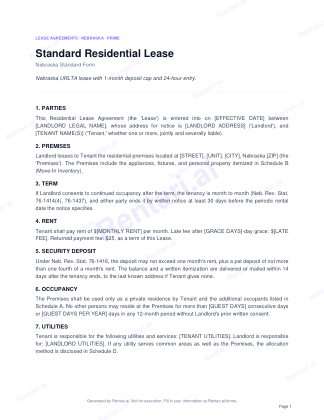
In the Rentari Nebraska lease
- Application and screening fees
The Rentari Nebraska lease makes a material misstatement or omission in the rental application a breach of the lease.
- Required disclosures
The Rentari Nebraska lease names the manager and the owner or agent for notices and service, with their addresses, and attaches the federal lead-based paint disclosure when you mark the home as built before 1978.
- Owner and manager identity
The Rentari Nebraska lease names the manager and the owner or agent for service and notices, with their addresses, and says you keep that information current.
- Security deposit limit
The Rentari Nebraska lease states the deposit amount and says it may not exceed one month's rent, plus a pet deposit of not more than one-fourth of a month's rent where appropriate, and it exempts service and assistance animals from pet deposits and fees.
- Returning the deposit
The Rentari Nebraska lease says the balance and a written itemization go to the tenant within 14 days after the tenancy ends, to the address or instructions the tenant gives or by first-class mail to the last known address, and states the liquidated damages for a willful failure.
- Move-in condition report
The Rentari Nebraska lease says the tenant accepts the home in its present condition as documented in any move-in condition report, without limiting your duty to keep it habitable.
- Rent and late fees
The Rentari Nebraska lease charges the late fee amount you set once rent stays unpaid past the grace day you choose, as a term of the lease.
- Returned payment fee
The Rentari Nebraska lease charges the returned payment fee you set, if any, due on notice as additional rent.
Neb. Rev. Stat. §§ 76-1401 to 76-1449 Neb. Rev. Stat. § 28-611(5)
- Landlord entry
The Rentari Nebraska lease gives at least 24 hours' written notice delivered to the unit with the purpose and a reasonable entry period (or the longer notice you set), and enters only at reasonable times.
- Repairs and habitability
The Rentari Nebraska lease restates your duties to follow housing codes, make repairs, keep common areas safe, maintain supplied facilities, remove waste and supply water, hot water and heat.
- Tenant repair remedies
The Rentari Nebraska lease describes the tenant's 14-day notice remedy and the right to buy essential services and deduct the cost, recover reduced rental value or obtain substitute housing.
- Locks and security devices
The Rentari Nebraska lease says you provide working exterior locks and the tenant may not change locks without your written consent except as the law allows, including the domestic violence lock change.
Neb. Rev. Stat. § 76-1431.03(3) Neb. Rev. Stat. § 76-1431.04(1)
- Retaliation
The Rentari Nebraska lease states the retaliation ban, the permitted reasonable rent increases and the cases where you may still sue for possession.
- Ending a month-to-month tenancy
The Rentari Nebraska lease says either party ends a month-to-month tenancy by written notice at least 30 days before the periodic rental date the notice specifies, and states the holdover damages.
- Ending a fixed-term lease early
The Rentari Nebraska lease includes the domestic violence release and the federal servicemember termination right.
- Notice for unpaid rent
The Rentari Nebraska lease says you may give written notice of the nonpayment and of your intention to end the lease if the rent is not paid within seven calendar days.
- Notice for other lease violations
The Rentari Nebraska lease states the 14-day cure with a termination date at least 30 days after receipt, the 14-day notice for a repeat within six months, and the five-day notice for dangerous activity with its exception.
- Eviction process
The Rentari Nebraska lease says an action for possession proceeds under the Act's eviction sections.
- Abandonment and property left behind
The Rentari Nebraska lease defines abandonment as absence without notice for one full rental period or 30 days, whichever is less, and says you give the written property notice with a claim date at least 7 days after personal delivery or 14 days after mailing.
Neb. Rev. Stat. § 76-1432(3) Neb. Rev. Stat. § 69-2303 Neb. Rev. Stat. § 69-2304
- Lease terms Nebraska does not allow
The Rentari Nebraska lease contains no attorney's fee term and says fees are awarded only where the Act or another statute provides for them.
- Domestic violence protections
The Rentari Nebraska lease states the release on 14 to 30 days' notice, the perpetrator removal, and the 24-hour lock change at the tenant's reasonable cost.
Nebraska numbers the lease follows
- Security deposit limit
- 1 month's rent
- plus a pet deposit of up to one-fourth of a month's rent when appropriate; no added deposit for a service animal
- Neb. Rev. Stat. § 76-1416(1)Neb. Rev. Stat. § 20-131.04
- Deposit refund deadline
- 14 days
- after the tenancy terminates, with a written itemization
- Neb. Rev. Stat. § 76-1416(2)
- Notice for unpaid rent
- 7 calendar days
- written notice of the nonpayment and your intention to terminate
- Neb. Rev. Stat. § 76-1431(2)
- Time to fix other violations
- 14 days
- with a termination date at least 30 days after receipt
- Neb. Rev. Stat. § 76-1431(1)
- Notice for dangerous activity
- 5 days
- written notice of termination with no right to cure
- Neb. Rev. Stat. § 76-1431(4)
- Ending a month-to-month tenancy
- 30 days
- written notice before the periodic rental date it names
- Neb. Rev. Stat. § 76-1437(2)
- Entry notice
- 24 hours
- written, with the purpose and an entry period; none needed in an emergency
- Neb. Rev. Stat. § 76-1423(3)
- Late fee grace period
- None set
- the Act sets no grace period and no late fee limit
- Neb. Rev. Stat. §§ 76-1401 to 76-1449
- Rent increase notice
- None set
- the Act sets none, so the lease governs
- Neb. Rev. Stat. §§ 76-1401 to 76-1449
- Lockout or retaliation damages
- 3 months' rent
- liquidated damages, plus a reasonable attorney's fee
- Neb. Rev. Stat. § 76-1430
From the Nebraska lease
NEBRASKA RESIDENTIAL LEASE AGREEMENT
ATTORNEY'S FEES (Neb. Rev. Stat. 76-1415(1)(c)): A lease term by which Tenant agrees to pay Landlord's or Tenant's attorney's fees is unenforceable in Nebraska, so this Lease contains none. Fees are awarded only where the Uniform Residential Landlord and Tenant Act or another statute provides for them.
Attorney's feesNeb. Rev. Stat. § 76-1415(1)(c)
ACCEPTING RENT (Neb. Rev. Stat. 76-1433): Landlord's acceptance of rent with knowledge of Tenant's default, or of performance that varies from this Lease or its rules, waives Landlord's right to terminate this Lease for that breach, unless the parties agree otherwise after the breach occurs.
Accepting rentNeb. Rev. Stat. § 76-1433
TERMINATION AND NOTICES (Neb. Rev. Stat. 76-1431, 76-1437): Either party ends a month-to-month tenancy by written notice given at least thirty (30) days before the periodic rental date the notice specifies. If rent is unpaid when due, Landlord may give written notice of the nonpayment and of Landlord's intention to terminate this Lease if the rent is not paid within seven (7) calendar days.
Termination and noticesNeb. Rev. Stat. § 76-1431(2) Neb. Rev. Stat. § 76-1437(2)
Nebraska lease types
Pick 3, 6, 12, 18 or 36 months or your own dates. At the end, the lease ends or converts to month-to-month.
Standard lease guideEnding a month-to-month tenancy: 30 days, written notice before the periodic rental date it names.
Nebraska month-to-month leaseUpload a lease you already use: send an unsigned one for e-signature, or store one that is already signed.
Rooms use the Nebraska lease for now: add the room as its own unit and set house rules with the optional addenda.
Nebraska room rentalBefore you sign
Application and screening fees
Not set by statuteThe Act, read whole, sets no limit or rule for rental application or screening fees. Your screening must still follow the Nebraska Fair Housing Act.
Neb. Rev. Stat. §§ 76-1401 to 76-1449
- You may not refuse to rent to, or set different terms for, a person because of race, color, religion, national origin, disability, familial status, sex, or military or veteran status. Neb. Rev. Stat. § 20-318(1), (2)
- For property in Lincoln, review the city's lawful-source-of-income protection before setting screening criteria. The Human Rights Commission's guidance includes housing vouchers, public assistance, Social Security, pensions, alimony, child support and foster-care subsidies. Confirm current local coverage and program requirements for the property. Lincoln Human Rights Commission, source of income guidance
The Rentari Nebraska lease makes a material misstatement or omission in the rental application a breach of the lease.
Fair housing
Partly readUnder the Nebraska Fair Housing Act you may not refuse to rent, refuse to negotiate, set different terms, or advertise a preference because of race, color, religion, national origin, disability, familial status, sex, or military or veteran status. Only the sections cited here were read.
- For covered housing, allow necessary reasonable disability accommodations in rules, policies, practices and services, and reasonable modifications paid for by the resident. When reasonable, permission for a modification may require an agreement to restore the interior, except for reasonable wear and tear. Review the statutory exemptions and the direct-threat or substantial-property-damage limits, with independent federal duties, for the particular request. Neb. Rev. Stat. 20-319(1), (2), (8) Neb. Rev. Stat. 20-322
- Narrow exemptions cover certain religious organizations, private clubs, and renting rooms in your own home, with limits. Neb. Rev. Stat. § 20-322
- The federal Fair Housing Act (42 U.S.C. 3601 et seq.) also applies; it was not read for this page. 42 U.S.C. 3601 et seq.
Required disclosures
At or before the start of the tenancy, disclose in writing the name and address of the person authorized to manage the premises and of an owner or agent who accepts service of process and notices. Give a tenant who will occupy the unit for a month or more a notice with instructions for testing the smoke detector.
Neb. Rev. Stat. § 76-1417(1) Neb. Rev. Stat. § 81-5,144(2)
- Keep the owner and manager information current; the duty binds any successor landlord, owner or manager. Neb. Rev. Stat. § 76-1417(2)
- Apart from the owner and manager disclosure, the Act requires disclosures only if you will deliver notices electronically: before the tenant consents, give the statements the law lists. The federal lead-based paint disclosure rules were not read for this page. Neb. Rev. Stat. §§ 76-1401 to 76-1449 Neb. Rev. Stat. § 76-1413(7)
The Rentari Nebraska lease names the manager and the owner or agent for notices and service, with their addresses, and attaches the federal lead-based paint disclosure when you mark the home as built before 1978.
Flood disclosure
Not set by statuteThe Act, read whole, requires no flood zone or flood history disclosure. Its only disclosure due at the start of every tenancy is the owner and manager identity disclosure.
Neb. Rev. Stat. §§ 76-1401 to 76-1449 Neb. Rev. Stat. § 76-1417
- No other Nebraska statute requiring a flood disclosure to tenants was found among the sections read for this page. Neb. Rev. Stat. §§ 76-1401 to 76-1449
Owner and manager identity
Disclose in writing, at or before the start of the tenancy, the name and address of the person authorized to manage the premises and of an owner or a person authorized to act for the owner for service of process and for receiving notices and demands. Keep the information current.
Neb. Rev. Stat. § 76-1417(1), (2)
- Anyone who fails to make the disclosure becomes the landlord's agent for service of process and notices, and for carrying out the landlord's duties, including spending collected rent for that purpose. Neb. Rev. Stat. § 76-1417(3)
- The duty extends to any successor landlord, owner or manager. Neb. Rev. Stat. § 76-1417(2)
The Rentari Nebraska lease names the manager and the owner or agent for service and notices, with their addresses, and says you keep that information current.
Deposits, rent and fees
Security deposit limit
You may not demand or receive security, however it is labeled, of more than one month's periodic rent. When appropriate you may also take a pet deposit of up to one-fourth of one month's periodic rent, but you may not charge an added deposit or fee for a service animal of a tenant with a disability (the tenant stays liable for damage the animal causes). The limit does not apply to housing agencies under the Nebraska Housing Agency Act.
Neb. Rev. Stat. § 76-1416(1) Neb. Rev. Stat. § 20-131.04
- The cap covers security "however denominated", so giving a charge another name does not take it outside the one-month limit. Neb. Rev. Stat. § 76-1416(1)
- Prepaid rent is treated alongside the deposit at move-out: both may be applied to unpaid rent and damages. Neb. Rev. Stat. § 76-1416(2)
- A tenant with a disability who has a service animal may not be charged an additional deposit or extra compensation for the animal, but is liable for any damage it does to the premises. Neb. Rev. Stat. § 20-131.04
The Rentari Nebraska lease states the deposit amount and says it may not exceed one month's rent, plus a pet deposit of not more than one-fourth of a month's rent where appropriate, and it exempts service and assistance animals from pet deposits and fees.
Returning the deposit
When the tenancy ends you may apply prepaid rent and the deposit to unpaid rent and to damages caused by the tenant's noncompliance with the lease or with the tenant's duties under 76-1421. Deliver or mail the balance, with a written itemization, within 14 days after the tenancy terminates.
Neb. Rev. Stat. § 76-1416(2) Neb. Rev. Stat. § 76-1421
- The clock runs from the date the tenancy terminates. The tenant's address only decides where the refund goes: if the tenant gave no mailing address or instructions, mail the balance and the itemization by first-class mail to the tenant's last-known mailing address. Neb. Rev. Stat. § 76-1416(2)
- If the mailing comes back undeliverable, or the refunded balance is still outstanding after one year, it becomes abandoned property that you report and pay to the State Treasurer under the Uniform Disposition of Unclaimed Property Act. Neb. Rev. Stat. § 76-1416(2)
- If you do not follow these rules, the tenant may recover the money due, court costs and reasonable attorney's fees. If your failure was willful and not in good faith, the tenant may also recover liquidated damages of one month's periodic rent or twice the deposit, whichever is less. Neb. Rev. Stat. § 76-1416(3)
- A tenant is not liable for damages directly related to being removed by a government order because the home was unfit due to your negligence or neglect. Neb. Rev. Stat. § 76-1416(4)
- Whoever holds the landlord's interest when the tenancy ends is bound by these rules. If you sell, you stay liable for the deposit and prepaid rent unless you assign them to the buyer and give the tenant written notice of the assignment. Neb. Rev. Stat. § 76-1416(5) Neb. Rev. Stat. § 76-1420(1)
- If the tenant lawfully ends the lease because of your noncompliance, a fire or casualty, or an unlawful ouster, you must return all prepaid rent and recoverable security. Neb. Rev. Stat. § 76-1425(4) Neb. Rev. Stat. § 76-1429(2) Neb. Rev. Stat. § 76-1430
The Rentari Nebraska lease says the balance and a written itemization go to the tenant within 14 days after the tenancy ends, to the address or instructions the tenant gives or by first-class mail to the last known address, and states the liquidated damages for a willful failure.
Deposit account and interest
Not set by statuteNebraska does not require you to keep deposits in a separate account or to pay interest on them. The Act, read whole, sets neither rule.
Neb. Rev. Stat. §§ 76-1401 to 76-1449
- The deposit section sets only the amount limit, the uses at move-out, the 14-day return and the penalties. Neb. Rev. Stat. § 76-1416
Move-in condition report
Not set by statuteThe Act, read whole, does not require a move-in inspection or a written condition checklist. At move-out the tenant must leave the unit as clean as it was when the tenancy began, except for ordinary wear and tear, so a dated record of the starting condition helps you prove deductions.
Neb. Rev. Stat. §§ 76-1401 to 76-1449
- The tenant must keep the part of the premises the tenant uses as clean and safe as its condition permits and must not deliberately or negligently damage the premises. Neb. Rev. Stat. § 76-1421(2) Neb. Rev. Stat. § 76-1421(6)
- Make the starting-condition record useful at move-out: label photos by room and date, note existing marks or broken items, and keep the checklist with any repair requests and replies. Give both sides a chance to record differences promptly. A photo file helps explain a later claim; it does not make ordinary wear chargeable or replace the required deposit accounting. Neb. Rev. Stat. § 76-1416(2) Neb. Rev. Stat. § 76-1421
The Rentari Nebraska lease says the tenant accepts the home in its present condition as documented in any move-in condition report, without limiting your duty to keep it habitable.
Rent and late fees
Rent is payable without demand or notice at the time and place you and the tenant agree. Unless the lease says otherwise, rent is payable at the unit, in advance for a term of one month or less, and otherwise in equal monthly installments at the start of each month. The Act sets no late fee limit and no grace period.
- If the lease sets no rent, the tenant owes the fair rental value for the use and occupancy of the unit. Neb. Rev. Stat. § 76-1414(2)
- Unless agreed otherwise, rent is apportioned from day to day. Neb. Rev. Stat. § 76-1414(3)
- No section of the Act mentions late fees, so the amount and timing come from the lease. The lease may include terms the Act or another rule of law does not prohibit. Neb. Rev. Stat. § 76-1414(1) Neb. Rev. Stat. §§ 76-1401 to 76-1449
The Rentari Nebraska lease charges the late fee amount you set once rent stays unpaid past the grace day you choose, as a term of the lease.
Returned payment fee
Partly readThe Act sets no fee for a returned check or failed payment, and no Nebraska statute read for this page caps one in a lease. A criminal statute requires a person who issued a bad check and makes voluntary restitution to also pay the injured party $10 and any reasonable handling fee a financial institution charged; other chapters were not searched for a lease fee rule.
Neb. Rev. Stat. §§ 76-1401 to 76-1449 Neb. Rev. Stat. § 28-611(5)
- Issuing a check knowing there are not enough funds to cover it is a crime whose class depends on the amount. Neb. Rev. Stat. § 28-611(1)
- On request and payment of $10, the county attorney mails the check writer a notice; failing to make the check good within 10 days after notice supports the presumption that the writer knew the funds were short. Neb. Rev. Stat. § 28-611(6)
The Rentari Nebraska lease charges the returned payment fee you set, if any, due on notice as additional rent.
Rent increase notice
Partly readThe Act, read whole, sets no notice period and no limit for rent increases, so during a fixed term the rent is what the lease says. You may not raise rent to retaliate against a tenant for a housing code complaint or for joining a tenants' union.
Neb. Rev. Stat. §§ 76-1401 to 76-1449 Neb. Rev. Stat. § 76-1439(1)
- To end a month-to-month tenancy, either side gives written notice at least 30 days before the periodic rental date named in the notice. Neb. Rev. Stat. § 76-1437(2)
- Reasonable rent increases remain permitted even after a protected complaint or union activity. Neb. Rev. Stat. § 76-1439(2)
- Keep the separate Mobile Home Landlord and Tenant Act distinct from the ordinary residential Act. Section 76-1490 requires written notice of any rent increase, by actual notice or United States mail, at least 60 days before it takes effect. That Act defines a tenant as a mobile-home owner renting space in a mobile home park, and expressly excludes a person renting the mobile home itself. Do not treat this as a universal 60-day rule for every house, apartment or monthly room rental. Confirm coverage and the actual lease before choosing a notice period. Neb. Rev. Stat. 76-1450 Neb. Rev. Stat. 76-1490 Neb. Rev. Stat. 76-1471
During the tenancy
Landlord entry
Except in an emergency or where it is impracticable, give the tenant at least 24 hours' written notice of your intent to enter, delivered to each individual unit and stating the purpose and a reasonable period when you expect to enter. Enter only at reasonable times, and never use access to harass the tenant.
- The tenant may not unreasonably refuse entry to inspect, make necessary or agreed repairs or improvements, supply services, or show the unit to buyers, lenders, tenants, workers or contractors. Neb. Rev. Stat. § 76-1423(1)
- You may enter without the tenant's consent in an emergency. Neb. Rev. Stat. § 76-1423(2)
- Otherwise you have no right of access except by court order, during a tenant absence of more than seven days at times reasonably necessary, or after the tenant abandons or surrenders the unit. Neb. Rev. Stat. § 76-1423(4) Neb. Rev. Stat. § 76-1432(2)
- If the tenant refuses lawful access, you may get a court order compelling access or end the lease, and recover actual damages and reasonable attorney's fees. Neb. Rev. Stat. § 76-1438(1)
- An unlawful entry, a lawful entry made unreasonably, or repeated harassing demands for entry let the tenant get an injunction or end the lease, and recover actual damages of at least one month's rent plus reasonable attorney's fees. Neb. Rev. Stat. § 76-1438(2)
The Rentari Nebraska lease gives at least 24 hours' written notice delivered to the unit with the purpose and a reasonable entry period (or the longer notice you set), and enters only at reasonable times.
Repairs and habitability
After written or actual notice, you must substantially comply with the minimum housing codes materially affecting health and safety, and make the repairs needed to put and keep the premises fit and habitable. You must also keep common areas clean and safe, keep the electrical, plumbing, heating, ventilating, air conditioning and other facilities and appliances you supply in good working order, provide trash receptacles and removal, and supply running water, reasonable hot water and reasonable heat.
- Where a minimum housing code applies to the premises, that code sets the most your repair duty under this section can require. Neb. Rev. Stat. § 76-1419(1)
- The heat and hot water duty does not apply where the building is not required by law to have them, or where the tenant controls the installation and it is supplied by a direct public utility connection. Neb. Rev. Stat. § 76-1419(1)(f)
- In a single-family home, you and the tenant may agree in writing, for good consideration and in good faith, that the tenant handles trash, water and heat, and specified repairs or alterations. Neb. Rev. Stat. § 76-1419(2)
- In other units, an agreement that the tenant does specified repairs or alterations must be a separate signed writing, in good faith, supported by adequate consideration, and may not reduce your duties to other tenants. Neb. Rev. Stat. § 76-1419(3)
- The tenant must follow the housing code duties placed on tenants, keep the unit clean and safe, dispose of waste properly, use facilities reasonably, not damage the premises, and not disturb neighbors. Neb. Rev. Stat. § 76-1421
The Rentari Nebraska lease restates your duties to follow housing codes, make repairs, keep common areas safe, maintain supplied facilities, remove waste and supply water, hot water and heat.
Tenant repair remedies
If you materially break the lease, or break the repair duties in a way that materially affects health and safety, the tenant may give written notice that the lease will end on a date at least 30 days after you receive it unless you fix the problem within 14 days. The Act's only rent-deduction remedy covers water, hot water, heat and essential services.
Neb. Rev. Stat. § 76-1425(1) Neb. Rev. Stat. § 76-1427(1)
- If you fix the breach before the date in the notice, the lease does not end. If substantially the same problem recurs within six months, the tenant may end the lease on at least 14 days' written notice. Neb. Rev. Stat. § 76-1425(1)
- The tenant may also recover damages and get a court order for any noncompliance, plus reasonable attorney's fees if your noncompliance is willful. Neb. Rev. Stat. § 76-1425(2)
- If you deliberately or negligently fail to supply running water, hot water, heat or essential services, after written notice the tenant may buy them and deduct the actual and reasonable cost from rent, recover damages for the reduced rental value, or move to substitute housing and owe no rent for that period. Neb. Rev. Stat. § 76-1427(1)
- If the failure is deliberate, the tenant may also recover substitute housing costs up to the periodic rent, and in any case under that section reasonable attorney's fees. Neb. Rev. Stat. § 76-1427(1)
- In an eviction for nonpayment, the tenant may counterclaim, and the court may order rent paid into court while it sorts out what each side owes. Neb. Rev. Stat. § 76-1428(1)
- After a fire or casualty that substantially impairs the home, the tenant may move out and end the lease by written notice within 14 days, or vacate the unusable part and pay reduced rent. Neb. Rev. Stat. § 76-1429(1)
- The tenant may not end the lease, or use the water, heat and essential services remedies, for a condition the tenant, a family member or a guest caused deliberately or negligently. Neb. Rev. Stat. § 76-1425(1) Neb. Rev. Stat. § 76-1427(3)
The Rentari Nebraska lease describes the tenant's 14-day notice remedy and the right to buy essential services and deduct the cost, recover reduced rental value or obtain substitute housing.
Locks and security devices
The Act sets no general duty to provide particular locks or to rekey between tenants. It does require a lock change for a domestic violence victim: within 24 hours after the tenant's written request with the required documentation, you must replace the locking mechanism or, if the lock works, rekey it or reset the code.
Neb. Rev. Stat. § 76-1431.03(3) Neb. Rev. Stat. § 76-1431.04(1)
- If you do not change the locks as required, the tenant may change them with locks of similar or better quality, must tell you promptly and give you a key or code; a lease term to the contrary does not apply. Neb. Rev. Stat. § 76-1431.04(2)
- You may keep a key or code to the new lock and may require the tenant to pay the actual and reasonable cost of the change. Neb. Rev. Stat. § 76-1431.04(3), (4)
The Rentari Nebraska lease says you provide working exterior locks and the tenant may not change locks without your written consent except as the law allows, including the domestic violence lock change.
Smoke and carbon monoxide alarms
Every unit built or remodeled since January 1, 1982 must have working smoke detectors meeting the State Fire Marshal's rules; an older unit needs them when it is remodeled or sold. In rental property you supply, install, maintain and test the detectors, but a tenant who occupies the unit for a month or more performs the manufacturer's recommended tests, reports problems to you in writing and replaces the battery, which must work at move-in. Give that tenant a notice with testing instructions.
Neb. Rev. Stat. § 81-5,142 Neb. Rev. Stat. § 81-5,144
- You must fix reported smoke detector problems, and you are not in violation for a problem you were not told about. A worn battery is not a deficiency you must fix. Neb. Rev. Stat. § 81-5,144(2)
- When an existing rental gets a new tenant on or after January 1, 2017, ensure a working carbon monoxide alarm is installed on each habitable floor, or where the building code requires. The same applies after a permitted alteration, repair, fuel-fired appliance replacement or addition in a unit with a fuel-fired heater or appliance, a fireplace or an attached garage. Neb. Rev. Stat. § 76-606(1), (2)
- Before each new tenancy, replace any carbon monoxide alarm that is missing or not working and provide the batteries it needs. During the tenancy, replace any alarm the tenant reports stolen, removed, missing or not working, and fix any reported deficiency the tenant cannot correct. Neb. Rev. Stat. § 76-606(3)
- The tenant must keep, test and maintain the carbon monoxide alarms and report a missing or broken alarm. No one may remove the batteries or disable an alarm except to inspect, maintain, repair or replace it. Neb. Rev. Stat. § 76-606(4), (5)
Retaliation
You may not retaliate by raising rent, cutting services, or bringing or threatening an eviction because the tenant complained to a government code enforcement agency about a violation materially affecting health and safety, or organized or joined a tenants' union. The Act sets no time window, so the protection is not limited to a set number of months.
- A tenant who suffers retaliation may recover possession or end the lease and collect three months' periodic rent as liquidated damages plus a reasonable attorney's fee, and has a defense to your eviction case. Neb. Rev. Stat. § 76-1439(2) Neb. Rev. Stat. § 76-1430
- Reasonable rent increases or changes in services remain permitted. Neb. Rev. Stat. § 76-1439(2)
- You may still sue for possession if the tenant or the tenant's household or guests mainly caused the code violation through lack of reasonable care, the tenant is behind on rent, or the code repairs would require work that deprives the tenant of the unit. Neb. Rev. Stat. § 76-1439(3)
The Rentari Nebraska lease states the retaliation ban, the permitted reasonable rent increases and the cases where you may still sue for possession.
Lockouts and utility shutoffs
You may not take possession by removing or locking out the tenant or by willfully cutting off electricity, gas, water or another essential service. You may recover possession only through the eviction process, or after abandonment or surrender.
- If you unlawfully remove or exclude the tenant or willfully cut essential services, the tenant may recover possession or end the lease, and in either case recover three months' periodic rent as liquidated damages plus a reasonable attorney's fee. Neb. Rev. Stat. § 76-1430
- A landlord's lien or security interest in the tenant's household goods is not enforceable, and seizing property for rent (distraint) is abolished. Neb. Rev. Stat. § 76-1434
Ending a tenancy
Ending a month-to-month tenancy
Either you or the tenant may end a month-to-month tenancy by written notice given at least 30 days before the periodic rental date named in the notice. A week-to-week tenancy ends on written notice given at least seven days before the termination date named in the notice.
Neb. Rev. Stat. § 76-1437(1), (2)
- Unless the lease sets a definite term, a tenancy is week to week for a roomer who pays weekly and month to month in all other cases. Neb. Rev. Stat. § 76-1414(4)
- If the tenant stays after the tenancy ends without your consent, you may sue for possession. If the holdover is willful and not in good faith, you may also recover up to three months' periodic rent or three times your actual damages, whichever is greater, plus reasonable attorney's fees. Neb. Rev. Stat. § 76-1437(3)
The Rentari Nebraska lease says either party ends a month-to-month tenancy by written notice at least 30 days before the periodic rental date the notice specifies, and states the holdover damages.
Ending a fixed-term lease early
The Act gives a tenant no general right to leave a fixed-term lease early, but it limits what you can collect. If the tenant abandons the unit, you must take possession and make reasonable efforts to rent it at a fair rental; if you re-rent for a term starting before the lease ends, the old lease ends when the new tenancy begins.
- A party claiming damages under the Act has a duty to mitigate them. Neb. Rev. Stat. § 76-1405(1)
- A tenant who is a victim of domestic violence, with a protective order or a qualified third-party certification, may be released on 14 to 30 days' written notice; see the domestic violence topic. Neb. Rev. Stat. § 76-1431.01
- A tenant may end the lease for your uncured material noncompliance, or after a fire or casualty that substantially impairs the home. Neb. Rev. Stat. § 76-1425(1) Neb. Rev. Stat. § 76-1429(1)
- Under federal law, a tenant who enters military service after signing the lease, or who signs while in service and then receives permanent change of station orders or orders to deploy for 90 days or more, may end the lease by written notice with a copy of the orders; with monthly rent, the termination takes effect 30 days after the next rent due date following the notice. 50 U.S.C. § 3955
The Rentari Nebraska lease includes the domestic violence release and the federal servicemember termination right.
Notice for unpaid rent
If rent is unpaid when due, give the tenant written notice of the nonpayment and of your intention to end the lease if the rent is not paid within seven calendar days. If the tenant does not pay within those seven calendar days, you may end the lease.
- A notice reaches the tenant when it is handed to the tenant or mailed to the place the tenant designated (or the tenant's last-known residence). Email or other electronic delivery counts only if the tenant affirmatively consented after getting the statements the law lists. You may not make that consent a lease condition, and if you have reason to believe an electronic notice was not received, deliver it another way. Neb. Rev. Stat. § 76-1413(2)(c), (4) Neb. Rev. Stat. § 76-1413(7), (9), (15) Neb. Rev. Stat. § 76-1410(18)
- Accepting rent while knowing of a default waives your right to end the lease for that breach, unless you and the tenant agree otherwise after the breach. Neb. Rev. Stat. § 76-1433
- Your eviction complaint must show that you complied with the Act's notice rules. Neb. Rev. Stat. § 76-1441(1)
The Rentari Nebraska lease says you may give written notice of the nonpayment and of your intention to end the lease if the rent is not paid within seven calendar days.
Notice for other lease violations
For a material lease violation, or a breach of the tenant's duties that materially affects health and safety, give written notice naming the breach and saying the lease will end on a date at least 30 days after the tenant receives it unless the breach is fixed within 14 days. If substantially the same breach recurs within six months, you may end the lease on at least 14 days' written notice.
- If the breach can be fixed by repairs, paying damages or otherwise, and the tenant fixes it before the date in the notice, the lease does not end. Neb. Rev. Stat. § 76-1431(1)
- For violent criminal activity, the illegal sale of a controlled substance, or other activity that threatens the health or safety of other tenants, you or your staff, you may give five days' written notice of termination with no right to cure, then sue for possession. Neb. Rev. Stat. § 76-1431(4)
- You may not use the five-day notice against a tenant when someone other than the tenant or a household member did it and the tenant or household member sought a protective order, reported it to police, or, for domestic violence, obtained a qualified third-party certification. Neb. Rev. Stat. § 76-1431(5)
- You may also recover damages and get a court order for any tenant noncompliance, plus reasonable attorney's fees if it was willful. Neb. Rev. Stat. § 76-1431(3)
The Rentari Nebraska lease states the 14-day cure with a termination date at least 30 days after receipt, the 14-day notice for a repeat within six months, and the five-day notice for dangerous activity with its exception.
Eviction process
An action for possession is filed as a complaint for restitution with the clerk of the district or county court. The complaint must state the statute you rely on, the facts in detail, a reasonably accurate description of the premises and your compliance with the Act's notice rules.
Neb. Rev. Stat. § 76-1440 Neb. Rev. Stat. § 76-1441(1)
- The summons must be served within three days after it issues and is returnable within five days, not counting nonjudicial days. Neb. Rev. Stat. § 76-1442
- Trial is held 10 to 14 days after the summons issues, before a judge without a jury. Neb. Rev. Stat. § 76-1446
- If you win, the court declares the lease forfeited and, at your request, issues a writ directing the sheriff or constable to restore possession on a date not more than 10 days after the writ issues. Neb. Rev. Stat. § 76-1446
- When you get possession back, follow the property act for anything left in the unit. Neb. Rev. Stat. § 76-1446
- A tenant's appeal stays the writ only if the tenant deposits the judgment and costs or posts a bond, and pays the monthly rent into court while the appeal runs. Neb. Rev. Stat. § 76-1447
- For a five-day dangerous activity case, the complaint must describe the incident or incidents. Neb. Rev. Stat. § 76-1441(2)
- If diligent efforts to serve the summons fail, it may be posted on the unit's front door and mailed first-class to the tenant's last-known address, with an affidavit describing the efforts. A case served this way can restore possession, but the court will not enter a money judgment for you. Neb. Rev. Stat. § 76-1442 Neb. Rev. Stat. § 76-1442.01 Neb. Rev. Stat. § 76-1446
- Prepare a dated case file before the hearing: the lease and amendments, the notice and delivery record, a rent ledger showing payments and credits, and photographs or messages relevant to the stated reason. Put the events in date order and identify what each document supports. Read the summons for the hearing instructions and keep any later payment or move-out agreement with the file. A prepared file supports the case; it does not replace the required notice, service or court order. Neb. Rev. Stat. § 76-1440 Neb. Rev. Stat. § 76-1441(1)
The Rentari Nebraska lease says an action for possession proceeds under the Act's eviction sections.
Abandonment and property left behind
Total absence without notice to you for one full rental period or 30 days, whichever is less, is abandonment. When personal property remains after the tenancy ends and the tenant has vacated, give written notice to the tenant and anyone you reasonably believe owns the property, describing it and stating that reasonable storage costs may be charged, where it can be claimed and the claim deadline: at least 7 days after personal delivery or 14 days after mailing. The notice must also contain, word for word, one of the two statements the law prescribes: the public sale statement or, if you believe the property is worth less than $2,000, the statement that it may be kept, sold or destroyed without further notice.
Neb. Rev. Stat. § 76-1432(3) Neb. Rev. Stat. § 69-2303 Neb. Rev. Stat. § 69-2304
- Deliver the notice personally or by first-class mail to the last-known address, and to any other address where you know the person is likely to get it. Give it within six months after the lease expires or you discover the abandonment, whichever is later. Neb. Rev. Stat. § 69-2303(2)(d), (3)
- You may leave the property in the unit or store it in a safe place, using reasonable care; you are liable for loss only if you caused it intentionally or negligently. Neb. Rev. Stat. § 69-2306
- Release the property to the tenant or owner who pays the reasonable storage and advertising costs and takes it by the deadline. Neb. Rev. Stat. § 69-2307
- Unclaimed property must be sold at a public sale after published notice, unless you reasonably believe it is worth less than $2,000 in total, in which case you may keep it or dispose of it as you choose. Neb. Rev. Stat. § 69-2308(1), (2)
- Sale proceeds left after storage, advertising and sale costs go to the State Treasurer within 30 days after the sale if not claimed. Neb. Rev. Stat. § 69-2308(4)
- If a tenant dies, you must try within 10 days to contact the person the tenant named to collect belongings, if any; that person then has set periods to claim and remove the property before you may dispose of it under the property act. Neb. Rev. Stat. § 76-1414(5)
- If the tenant asks in writing within 14 days after vacating, describing the property and giving a mailing address, surrender any property you still hold. A demand for removal and storage costs must be written, itemized, and mailed or handed to the tenant within five days after you receive the request, and the tenant must remove the property within 72 hours after paying. Keeping property in violation of the property act makes you liable for actual damages up to its value plus reasonable attorney's fees. Neb. Rev. Stat. § 69-2311 Neb. Rev. Stat. § 69-2312
The Rentari Nebraska lease defines abandonment as absence without notice for one full rental period or 30 days, whichever is less, and says you give the written property notice with a claim date at least 7 days after personal delivery or 14 days after mailing.
Small claims court
Small Claims Court hears civil claims of up to $7,500, not counting interest and costs, beginning July 1, 2025. You can file there when the defendant lives or does business in the county, or the claim arose there.
Neb. Rev. Stat. § 25-2802(1), (3), (4)
- The limit was $6,000 from July 1, 2024 through June 30, 2025. Other small claims rules in the sections around this one were not read for this page. Neb. Rev. Stat. § 25-2802(4)
More Nebraska rules
Lease terms Nebraska does not allow
A lease may not make the tenant waive rights or remedies under the Act, authorize a confession of judgment, agree to pay your or the tenant's attorney's fees, or excuse or limit your liability for your own active and actionable negligence, or indemnify you for that liability or its costs. Such a term is unenforceable.
Neb. Rev. Stat. § 76-1415(1), (2)
- If you deliberately use a lease with a term you know is prohibited, the tenant may recover actual damages and reasonable attorney's fees. Neb. Rev. Stat. § 76-1415(2)
- Attorney's fees can still be awarded where a section of the Act provides for them, for example a willful tenant breach or a bad-faith counterclaim. Neb. Rev. Stat. § 76-1431(3) Neb. Rev. Stat. § 76-1428(1)
The Rentari Nebraska lease contains no attorney's fee term and says fees are awarded only where the Act or another statute provides for them.
Domestic violence protections
A tenant who is a victim of domestic violence, or whose household member is, and who has a protective order or a qualified third-party certification, may be released from the lease by giving you the documentation and written notice of a release date 14 to 30 days later. The tenant owes rent for the month in which the tenant ended the lease, but no rent or damages after the release date and no fee solely for ending it.
- Other tenants on the lease, apart from released household members, stay bound. A perpetrator cannot get a release. Neb. Rev. Stat. § 76-1431.01(5), (6)
- When the perpetrator is a cotenant or occupant, the victim may have the perpetrator removed: you serve the five-day notice on the perpetrator on the date the tenant chooses, change the locks if the perpetrator leaves, or sue the perpetrator alone if not. Neb. Rev. Stat. § 76-1431.02(1) to (4)
- You are not liable for actions taken in good faith under the removal procedure. Neb. Rev. Stat. § 76-1431.02(6)
- When the perpetrator is not a cotenant or occupant, the tenant may require a lock change within 24 hours; see the locks topic. Neb. Rev. Stat. § 76-1431.03
The Rentari Nebraska lease states the release on 14 to 30 days' notice, the perpetrator removal, and the 24-hour lock change at the tenant's reasonable cost.
Local rules
Rent control and local rules
Partly readNebraska law generally bars cities, villages, counties and their agencies or subdivisions from imposing rent controls on private property. Section 13-331 preserves other express state-law permissions and exceptions for affordable-housing land-use or inclusionary requirements and voluntary contractual programs. Check those exceptions before assuming a property has no rent restrictions.
- The Act sets no rent amount limit; rent is set by the lease, or is the fair rental value if the lease sets none. Neb. Rev. Stat. § 76-1414(1), (2)
- The restriction applies despite a home-rule charter, and a conflicting ordinance is void. It does not apply to an ordinance increasing affordable-housing supply through land-use or inclusionary housing requirements, or a program that an owner voluntarily agrees by contract to join and that restricts rent or increases. Review the actual program agreement and local rules; this selected statute review did not examine any city or county code. Neb. Rev. Stat. 13-331(2) to (5)
The city Human Rights Commission reports that voters adopted lawful-source-of-income protection on May 6, 2025. Its guidance includes income from lawful work and housing vouchers or other public assistance. This review read the agency guidance; the full current Title 11, exemptions and program-specific requirements still need checking for a particular property.
Cities and counties, including Omaha and Lincoln, have housing, building and fire codes that can add duties. Lincoln agency income guidance is noted here; no municipal code was read, and no other local rule is stated. Check the current codes where the property is located.
Nebraska lease renewals
Read the agreement's renewal clause and the notice rules above before choosing a new term, changing rent or ending the tenancy. A fixed end date does not override applicable renewal rights, rent regulation, just-cause rules or protections against retaliation and discrimination.
Confirm the notice, timing and delivery requirements for the rental's state and locality. Review any required new disclosures and attachments when preparing the renewal. Get the parties' agreement to changed terms in writing.
Customize an unsigned agreement or prepare an addendum to an existing lease.
How it works
- Add your Nebraska rental
Enter the property and its units.
- Set the terms
Choose the rental, add tenants, and set rent, deposit and fees.
- Review the lease
Preview and edit the Nebraska lease and its addenda.
- Send for e-signature
Tenants sign online; sending is included on paid plans.
Follow the full lease builder guide, add supporting files, or download and print the agreement.
Nebraska lease questions
Does the Rentari Nebraska lease include an attorney's fee clause?
No. Nebraska makes a lease term requiring the tenant to pay attorney's fees unenforceable, so the lease contains none and says fees are awarded only where a statute provides for them.
What unpaid rent notice does the lease describe?
Written notice of the nonpayment and of your intention to end the lease if rent is not paid within seven calendar days, as Nebraska requires.
How does the lease handle the security deposit?
It caps the deposit at one month's rent plus a pet deposit of up to one-fourth of a month's rent, charges no pet deposit or fee for a service or assistance animal, and returns the balance with a written itemization within 14 days after the tenancy ends.
Neb. Rev. Stat. § 76-1416(1), (2) Neb. Rev. Stat. § 20-131.04
Does the lease include the owner and manager disclosure?
Yes. It names the person authorized to manage the property and the owner or agent for service and notices, with their addresses, and says you keep that information current.
Does the lease cover domestic violence protections?
Yes. It states the tenant's release on 14 to 30 days' notice with documentation, removal of a perpetrator cotenant, and the 24-hour lock change.
Neb. Rev. Stat. § 76-1431.01 Neb. Rev. Stat. § 76-1431.02 Neb. Rev. Stat. § 76-1431.03(3)