- Home
- Lease agreement
- New York
New York residential lease agreement
State rules checked October 1, 2026 General information, not legal advice
Jump to a topic
New York lease document preview
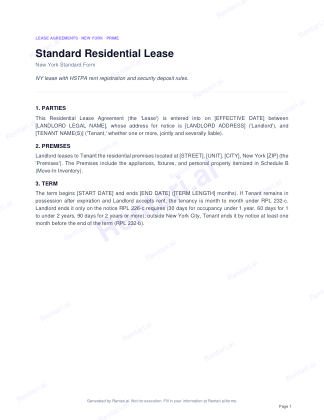
In the Rentari New York lease
- Fair housing
The lease's occupants clause follows the statute: immediate family, one more occupant and dependent children, with notice of the occupant's name within 30 days.
- Flood disclosure
The lease prints the flood notice on its first page, marks the floodplain and flood history answers you gave, leaves the others blank to fill in, and quotes the NFIP sentence word for word.
- Security deposit limit
The Rentari New York lease states the deposit amount and says it may not exceed one month's rent.
- Returning the deposit
The lease promises the itemized statement and the balance within 14 days after the tenant vacates, lists the four permitted kinds of deduction and states the forfeiture rule.
N.Y. Gen. Oblig. Law § 7-108(1-a)(b) N.Y. Gen. Oblig. Law § 7-108(1-a)(e)
- Deposit account and interest
The lease says the deposit is held in trust, requires a New York bank and written notice of it, requires an interest-bearing account at six or more units and states the 1 percent allowance.
- Move-in condition
The lease states the move-in inspection offer and your duty to tell the tenant in writing of the right to a move-out inspection.
- Rent payments and late fees
The lease states the five-day rule, caps the fee at $50 or 5 percent of the rent, whichever is less, and states the certified-mail notice.
N.Y. Real Prop. Law § 238-a(2) N.Y. Real Prop. Law § 235-e(d)
- Rent increase notice
The lease sets out the 30, 60 and 90 day notice ladder, says the Good Cause notice is attached and states that late notice keeps the tenancy running on its existing terms.
- Landlord entry
As a term of the lease, you enter only on at least 24 hours' written notice and at reasonable times, except in an emergency.
N.Y. Real Prop. Law art. 7 N.Y. Real Prop. Law art. 6-A N.Y. Gen. Oblig. Law § 7-108(1-a)(d)
- Repairs and habitability
The lease restates the warranty of habitability in the statute's terms and says a waiver is void.
- Retaliation
The lease restates the retaliation protections, the one-year presumption and the owner-occupied exception, and the tenants' group right.
- Lockouts and utility shutoffs
The lease says nothing in it lets you change the locks or exclude the tenant except through the court process.
- Ending a month-to-month tenancy
The lease applies the 30, 60 or 90 day notice to a landlord ending a month-to-month tenancy and the one-month notice for a tenant outside New York City.
N.Y. Real Prop. Law § 226-c(2) N.Y. Real Prop. Law § 232-a N.Y. Real Prop. Law § 232-b
- Notice for unpaid rent
The lease says a fourteen-day rent demand carries the Good Cause notice, and its late-charge clause states the certified-mail notice.
N.Y. Real Prop. Actions & Proc. Law § 711(2) N.Y. Real Prop. Law § 231-c N.Y. Real Prop. Actions & Proc. Law § 735
- Good Cause Eviction Law
An addendum carries the Good Cause notice word for word and marks your answers on whether the law covers the unit and why it is exempt.
- Rent control and local rules
An addendum states whether the unit is rent stabilized, the Good Cause notice marks whether that law covers the unit, and a lease for a New York City unit adds a New York City disclosures section and a right to counsel notice.
N.Y. Real Prop. Law § 212 N.Y. Real Prop. Law § 213 N.Y. Mult. Dwell. Law § 3
New York numbers the lease follows
- Security deposit limit
- 1 month's rent
- includes any advance, such as last month's rent
- N.Y. Gen. Oblig. Law § 7-108(1-a)(a)
- Deposit refund deadline
- 14 days
- after the tenant vacates, with an itemized statement
- N.Y. Gen. Oblig. Law § 7-108(1-a)(e)
- Late fee allowed after
- 5 days
- only if rent has not been paid within five days of the due date
- N.Y. Real Prop. Law § 238-a(2)
- Rent demand before a nonpayment case
- 14 days
- written demand to pay or give up possession
- N.Y. Real Prop. Actions & Proc. Law § 711(2)
- Ending a month-to-month tenancy
- 30, 60 or 90 days
- landlord notice, by length of occupancy or lease term
- N.Y. Real Prop. Law § 226-c(2)N.Y. Real Prop. Law § 232-a
- Rent increase notice
- 30, 60 or 90 days
- for a renewal with an increase of 5% or more
- N.Y. Real Prop. Law § 226-c
- Entry notice
- None set
- no state statute sets a fixed period, so the lease should
- N.Y. Real Prop. Law art. 7
- Returned check fee
- $20 or actual cost
- whichever is greater, and only if the lease provides for it
- N.Y. Real Prop. Law § 238-a(2-a)N.Y. Gen. Oblig. Law § 5-328(3)
- Application fee
- Up to $20
- background and credit check cost only, or less if the cost is less
- N.Y. Real Prop. Law § 238-a(1)
From the New York lease
NEW YORK RESIDENTIAL LEASE AGREEMENT
"Flood insurance is available to renters through the Federal Emergency Management Agency's (FEMA's) National Flood Insurance Program (NFIP) to cover your personal property and contents in the event of a flood. A standard renter's insurance policy does not typically cover flood damage. You are encouraged to examine your policy to determine whether you are covered."
Flood insurance noticeN.Y. Real Prop. Law § 231-b(2)
Landlord may not restrict occupancy to the named Tenants and their immediate family. A single Tenant may share the Premises with immediate family, one additional occupant and the occupant's dependent children, if Tenant or Tenant's spouse occupies the Premises as a primary residence;
OccupantsN.Y. Real Prop. Law § 235-f
Landlord may not serve a notice to quit, start an action to recover possession, or substantially alter the tenancy (including refusing to renew or offering a renewal at an unreasonable increase) in retaliation for Tenant's good faith complaint of a health, safety or habitability violation to Landlord or a government authority, Tenant's good faith action to enforce rights under this Lease or housing law, or Tenant's participation in a tenants' organization.
RetaliationN.Y. Real Prop. Law § 223-b
New York lease types
Pick 3, 6, 12, 18 or 36 months or your own dates. At the end, the lease ends or converts to month-to-month.
Standard lease guideEnding a month-to-month tenancy: 30, 60 or 90 days, landlord notice, by length of occupancy or lease term.
N.Y. Real Prop. Law § 226-c(2) N.Y. Real Prop. Law § 232-a
New York month-to-month leaseUpload a lease you already use: send an unsigned one for e-signature, or store one that is already signed.
Rooms use the New York lease for now: add the room as its own unit and set house rules with the optional addenda.
New York room rentalBefore you sign
Application and screening fees
Before or at the start of a tenancy you may not charge any application, processing or other fee except to cover a background check and credit check. That charge may not exceed the actual cost or $20, whichever is less. You must waive it if the applicant gives you a background or credit check done in the past 30 days, and you may not collect it unless you give the applicant a copy of the check and the screening company's receipt or invoice.
N.Y. Real Prop. Law § 238-a(1)
- A lease or agreement that waives these fee limits is void. N.Y. Real Prop. Law § 238-a(3)
- You may not refuse to rent to someone because they were involved in a past or pending landlord and tenant case. Pulling a screening report or court records and then refusing to rent is presumed to violate this rule, and the Attorney General may seek a penalty of $500 to $1,000 for each violation. N.Y. Real Prop. Law § 227-f
- You may not refuse to rent to someone, or set different terms, because of their status as a victim of domestic violence. N.Y. Real Prop. Law § 227-d N.Y. Exec. Law § 296(5)(a)
- An application form or inquiry that expresses a limitation based on a protected class is itself unlawful. N.Y. Exec. Law § 296(5)(a)(3)
- Special cooperative rules apply when an applicant will become a unit owner or shareholder: screening charges may exceed $20 up to actual cost, with reasonable, agency-approved charges for cooperatives subject to the listed Private Housing Finance Law articles. Certain other cooperatives may also recover necessary managing or transfer-agent application-processing charges. Check the corporation and transaction before using these exceptions for a rental. N.Y. Real Prop. Law § 238-a(1)(a), (b)
- In New York City, covered providers choosing a criminal check must first assess noncriminal eligibility, commit a unit through a written conditional offer, and give the Commission's rights notice. Housing with at most two rooms or units where the provider or family lives in one is exempt; legally authorized checks in funded housing have limited exceptions. NYC Commission on Human Rights: Fair Chance Housing coverage and offers
- City review is limited to qualifying felonies within five years of release (or sentencing without incarceration), misdemeanors within three, and convictions requiring current sex-offender registration. Excluded records include arrests, pending cases, and sealed or expunged matters. Consult the city's full exclusions before ordering a report. NYC Commission on Human Rights: reviewable history
- Before revoking an offer based on reviewable history, give the reviewed information, allow five business days for a response, keep the unit available, and assess the applicant's individual information. Revocation requires a written explanation connecting that history and circumstances to a specific legitimate business interest. NYC Commission on Human Rights: Fair Chance Housing process
Fair housing
New York's Human Rights Law bars refusing to rent, or setting different terms, because of race, creed, color, national origin, citizenship or immigration status, sexual orientation, gender identity or expression, military status, sex, age, disability, marital status, status as a victim of domestic violence, lawful source of income or familial status.
- Ads, application forms and inquiries may not express a limitation based on these traits. An owner-occupied two-family building must follow this rule too and loses its exemption from the refusal and terms rules if it breaks it; rooms limited to one sex, rooms rented by a resident owner or occupant and qualifying senior housing are exempt from it. N.Y. Exec. Law § 296(5)(a)(3) N.Y. Exec. Law § 296(5)(a)(4)
- The refusal and terms rules do not apply to an owner-occupied two-family building, to rooms rented by a resident owner or occupant, to rooms limited to one sex, or, for age and familial status only, to qualifying senior housing. N.Y. Exec. Law § 296(5)(a)(4)
- You may not restrict occupancy to the tenant and immediate family. For a lease entered by one tenant, section 235-f permits the tenant, immediate family, one additional occupant and that occupant's dependent children, provided the tenant or the tenant's spouse occupies the home as a primary residence. An occupant under this section is someone there with the tenant's consent who is neither a tenant nor the tenant's immediate family. N.Y. Real Prop. Law section 235-f(1)-(3)
- Refusing to rent because of a past or pending landlord and tenant case is prohibited. N.Y. Real Prop. Law § 227-f
- A lease clause requiring tenants to stay childless or not to have children during the term is a violation of law. N.Y. Real Prop. Law § 237
- For a lease entered by two or more tenants, section 235-f(4) permits tenants, immediate family, occupants and occupants' dependent children. The combined number of tenants and occupants, excluding occupants' dependent children, may not exceed the number of tenants named in the current lease, and at least one tenant or a tenant's spouse must use the home as a primary residence. N.Y. Real Prop. Law section 235-f(4)
- The tenant must give the landlord an occupant's name within 30 days after that person begins occupying the home or within 30 days after the landlord requests it. This identification duty is separate from the statute's protection against an unlawful occupancy restriction. N.Y. Real Prop. Law section 235-f(5)
- An occupant or the occupant's dependent child does not gain continued occupancy after the tenant leaves, or other tenancy rights, under section 235-f without the landlord's express written permission. The section preserves previously accrued rights and remedies; separate succession and lawful-occupant protections require their own review. This rule does not authorize a lockout. N.Y. Real Prop. Law section 235-f(6) N.Y. Real Prop. Actions & Proc. Law section768 See Lockouts and utility shutoffs on the New York page
- A lease cannot waive section 235-f. Its protections do not invalidate federal, state or local occupancy laws or codes, and an aggrieved person may seek an injunction, actual damages and court costs. Check the applicable occupancy rules rather than using the roommate statute alone as a capacity limit. N.Y. Real Prop. Law section 235-f(7)-(9)
The lease's occupants clause follows the statute: immediate family, one more occupant and dependent children, with notice of the occupant's name within 30 days.
Required disclosures
Every New York residential lease must state, conspicuously and in bold, whether the home has a maintained and operative sprinkler system, and if it does, the date it was last maintained and inspected. Every lease must also carry the flood history and risk notice and the Good Cause Eviction Law notice, which says whether that law covers the unit and, if not, why. If the property has three or fewer rental units, you must state in bold before signing whether any required certificate of occupancy is currently valid for the unit.
N.Y. Real Prop. Law § 231-a N.Y. Real Prop. Law § 231-b N.Y. Real Prop. Law § 231-c N.Y. Real Prop. Law § 235-bb
- The Good Cause Eviction Law notice must be appended to or included in every initial lease and renewal lease, and in the rent increase and non-renewal notice, the 14-day rent demand and an eviction petition. N.Y. Real Prop. Law § 231-c(1)
- Giving the tenant a copy of the valid certificate of occupancy satisfies the certificate rule, and a tenant cannot waive it. N.Y. Real Prop. Law § 235-bb
- Within 72 hours of learning of a bed bug infestation, notify the tenants directly above, below and next to the unit in writing, or post a notice for a common area. N.Y. Real Prop. Law § 235-j
- For the flood notice itself, see the flood disclosure topic. N.Y. Real Prop. Law § 231-b See Flood disclosure on the New York page
Flood disclosure
Every residential lease must say whether any part of the premises is in a FEMA floodplain, in the 100-year floodplain, or in the 500-year floodplain on FEMA's current maps, and describe any prior flood damage from a natural flood that you know or reasonably should know about. It must also include, word for word, the statute's notice that flood insurance is available to renters through FEMA's National Flood Insurance Program (NFIP).
- The prior damage answer covers damage from heavy rainfall, coastal storm surge, tidal inundation or river overflow, and the nature of that damage. N.Y. Real Prop. Law § 231-b(1)(d)
- The required renter's insurance sentence must appear in the lease exactly as the statute sets it out. N.Y. Real Prop. Law § 231-b(2)
The lease prints the flood notice on its first page, marks the floodplain and flood history answers you gave, leaves the others blank to fill in, and quotes the NFIP sentence word for word.
Landlord identity disclosure
Partly readNo statute read requires a lease to name the owner or a managing agent. Owners of multiple dwellings covered by the Multiple Dwelling Law must file a registration notice giving their name, address and a description of the building. In New York City, which requires registration by local law, an unregistered owner cannot recover rent until it registers. When you sell or assign a property, you must tell each tenant by registered or certified mail the name and address of whoever now holds the deposit.
N.Y. Mult. Dwell. Law § 325 N.Y. Gen. Oblig. Law § 7-105 N.Y. Mult. Dwell. Law § 325(2)
- A small landlord claiming the Good Cause exemption in an eviction case must give the tenant the names of all owners and the units they own. N.Y. Real Prop. Law § 214(1) See Good Cause Eviction Law on the New York page
- A buyer with no record of a deposit must tell the tenant within 30 days of closing, and the tenant then has 30 days to show proof of it. N.Y. Gen. Oblig. Law § 7-108(2)(c)
Deposits, rent and fees
Security deposit limit
A security deposit or advance may not be more than one month's rent. The limit covers any money deposited or paid in advance, so last month's rent collected at signing counts toward it. The exceptions are a registered seasonal use unit and an owner-occupied cooperative apartment; the section also does not reach units under the city rent and rehabilitation law or emergency rent control, or licensed care and senior retirement communities.
N.Y. Gen. Oblig. Law § 7-108(1-a)(a)
- Rent stabilized units and units under the Emergency Tenant Protection Act have the same one-month limit and the same return and inspection rules under their own section. N.Y. Gen. Oblig. Law § 7-107
- A seasonal use unit qualifies only if the lease states its registration with the local registry, limits occupancy to 120 days or less and gives the tenant's primary residence address, and the unit is not rented seasonally for more than 120 days a year. N.Y. Gen. Oblig. Law § 7-108(4) N.Y. Gen. Oblig. Law § 7-108(5)
- Any lease term waiving these deposit rights is void. N.Y. Gen. Oblig. Law § 7-108(3)
The Rentari New York lease states the deposit amount and says it may not exceed one month's rent.
Returning the deposit
Within 14 days after the tenant vacates, give the tenant an itemized statement showing the basis for any amount you keep, and return the rest. If you miss the 14 days, you lose the right to keep any part of the deposit. You may keep only reasonable, itemized costs for unpaid rent, damage by the tenant beyond normal wear and tear, unpaid utility charges payable to you under the lease, and moving and storing the tenant's belongings.
N.Y. Gen. Oblig. Law § 7-108(1-a)(b) N.Y. Gen. Oblig. Law § 7-108(1-a)(e)
- You may not keep anything for ordinary wear and tear or for damage caused by a prior tenant. N.Y. Gen. Oblig. Law § 7-108(1-a)(b)
- In a dispute over the deposit, you must prove that the amount kept was reasonable. N.Y. Gen. Oblig. Law § 7-108(1-a)(f)
- A violation makes you liable for actual damages; a willful violation adds punitive damages of up to twice the deposit. N.Y. Gen. Oblig. Law § 7-108(1-a)(g)
- When you sell or assign the property, turn the deposit over to the new owner within five days and tell the tenant by registered or certified mail the new holder's name and address. Until you do, you stay liable, and failing to comply is a misdemeanor. N.Y. Gen. Oblig. Law § 7-105
- A buyer who knew of a deposit, for example because the lease in effect at closing acknowledges it, is also liable for returning it. N.Y. Gen. Oblig. Law § 7-108(2)
- You may not withhold any part of the deposit because a tenant ended the lease under the domestic violence termination right. N.Y. Real Prop. Law § 227-c
The lease promises the itemized statement and the balance within 14 days after the tenant vacates, lists the four permitted kinds of deduction and states the forfeiture rule.
Deposit account and interest
A deposit stays the tenant's money. Hold it in trust and never mix it with your own funds. If you put it in a bank, the bank must have a place of business in New York, and you must tell each tenant in writing the bank's name and address and the amount deposited. For a property with six or more family dwelling units, the deposit must go into an interest-bearing account at a New York bank earning the prevailing local rate. In any building, interest the deposit earns belongs to the tenant, less 1 percent a year you may keep as an administration fee from an interest-bearing account.
- From an interest-bearing account you may keep an amount equal to 1 percent a year of the deposit as administration expenses, in place of all other custodial charges. The rest of the interest belongs to the tenant, held in trust or paid to the tenant each year. N.Y. Gen. Oblig. Law § 7-103(2)
- If the lease ends between the bank's interest dates, pay the tenant whatever interest you can collect at that point. N.Y. Gen. Oblig. Law § 7-103(2-b)
- A lease term waiving any of these rules is void. N.Y. Gen. Oblig. Law § 7-103(3)
The lease says the deposit is held in trust, requires a New York bank and written notice of it, requires an interest-bearing account at six or more units and states the 1 percent allowance.
Move-in condition
After the lease is signed and before the tenant moves in, you must offer the tenant a joint inspection. If the tenant asks for it, you both sign a written agreement before move-in noting any existing defects or damage, and you cannot deduct from the deposit for anything it lists.
N.Y. Gen. Oblig. Law § 7-108(1-a)(c)
- The move-in agreement can be used as evidence of the starting condition only in a dispute over the deposit. N.Y. Gen. Oblig. Law § 7-108(1-a)(c)
- Within a reasonable time after either side gives notice to end the tenancy, tell the tenant in writing of the right to ask for an inspection before moving out and to be present, unless the tenant gave less than two weeks' notice. N.Y. Gen. Oblig. Law § 7-108(1-a)(d)
- A requested move-out inspection happens no earlier than two weeks and no later than one week before the tenancy ends, on at least 48 hours' written notice. Afterward, give the tenant an itemized statement of the repairs or cleaning you propose to deduct, and the tenant may fix them before moving out. N.Y. Gen. Oblig. Law § 7-108(1-a)(d)
The lease states the move-in inspection offer and your duty to tell the tenant in writing of the right to a move-out inspection.
Rent payments and late fees
You may not charge a late fee unless the rent has not been paid within five days of the date it was due, and the fee may not exceed $50 or 5 percent of the monthly rent, whichever is less. If you have not received the rent within five days of the due date, you must send the tenant a written notice by certified mail saying so. A tenant can use your failure to send it as a defense in a nonpayment eviction.
N.Y. Real Prop. Law § 238-a(2) N.Y. Real Prop. Law § 235-e(d)
- For rent paid in cash or by anything other than the tenant's personal check, give a written receipt with the date, the amount, the premises and period paid for, and the signature and title of the person receiving it. N.Y. Real Prop. Law § 235-e(a)
- A tenant may ask in writing for receipts for personal checks, and the request lasts for the whole tenancy. Keep records of cash receipts for at least three years. N.Y. Real Prop. Law § 235-e(b)
- Rent handed over in person needs a receipt immediately; rent sent indirectly needs one within 15 days after you receive it. N.Y. Real Prop. Law § 235-e(c)
- You may not require electronic billing or payment as the only way to pay rent, or charge a fee to a tenant who does not use it. N.Y. Real Prop. Law § 235-g
- A lease term that waives or limits the late fee rules is void. N.Y. Real Prop. Law § 238-a(3)
- Monthly maintenance owed by a cooperative shareholder has a separate qualification. Under section 238-a(2), a cooperative corporation outside the listed Private Housing Finance Law articles may charge its dwelling-unit owner or shareholder up to 8 percent of monthly maintenance for late payment if the proprietary lease or occupancy agreement provides for it. Do not apply that shareholder-maintenance qualification to ordinary tenant rent or assume that every cooperative qualifies. N.Y. Real Prop. Law 238-a(2)
The lease states the five-day rule, caps the fee at $50 or 5 percent of the rent, whichever is less, and states the certified-mail notice.
Returned payment fee
You may charge a fee for a rent check that bounces only if the lease provides for it. The fee may not exceed your actual costs for the returned check or $20, whichever is greater. If you charge more than $20, you must give the tenant, on request, evidence that the fee matches your actual costs.
N.Y. Real Prop. Law § 238-a(2-a) N.Y. Gen. Oblig. Law § 5-328(3)
- The rule covers a check, draft or like instrument given for rent and dishonored for insufficient funds; money orders, cashier's checks and certified checks are outside the landlord fee rule. N.Y. Real Prop. Law § 238-a(2-a) N.Y. Gen. Oblig. Law § 5-328(3)
- It does not apply to a cooperative shareholder, but it does protect that shareholder's own tenant or subtenant. N.Y. Real Prop. Law § 238-a(2-a)(d)
Rent increase notice
New York has no statewide rent cap for units outside rent regulation and the Good Cause Eviction Law. If you plan to renew with a rent increase of 5 percent or more, or not to renew at all, give written notice: at least 30 days if the tenant has lived there less than one year and has no lease of at least one year, 60 days for one to two years of occupancy or a lease of one to two years, and 90 days for more than two years of occupancy or a lease of two years or more. Whichever of occupancy or lease term is longer decides the period.
- If your notice is late, the tenancy continues on its existing terms from the day you gave actual written notice until the full notice period has passed. N.Y. Real Prop. Law § 226-c(1)(a)
- The notice must append or contain the Good Cause Eviction Law notice, stating whether the unit is covered and, for a covered unit, the lawful basis for a non-renewal or the reason for an increase above the local rent standard. N.Y. Real Prop. Law § 226-c(1)(a) N.Y. Real Prop. Law § 231-c
- Where the Good Cause Eviction Law applies, an increase above the local rent standard in a calendar year is presumed unreasonable, and nonpayment of an unreasonable increase is not grounds for eviction. N.Y. Real Prop. Law § 216(1)(a) N.Y. Real Prop. Law § 211(8) See Good Cause Eviction Law on the New York page
- Offering a renewal at an unreasonable increase in retaliation for a tenant's complaint is unlawful retaliation. N.Y. Real Prop. Law § 223-b(2)
- A cooperative corporation need not give this notice to a tenant who is a shareholder of the cooperative. N.Y. Real Prop. Law § 226-c(1)(b)
The lease sets out the 30, 60 and 90 day notice ladder, says the Good Cause notice is attached and states that late notice keeps the tenancy running on its existing terms.
During the tenancy
Landlord entry
Not set by statuteNo New York statute sets a fixed notice period before a landlord enters a rented home, so the lease should set one. Statutes do require 48 hours' written notice for a move-out inspection the tenant asked for and, in a manufactured home park, entry to a rented home only at reasonable hours on reasonable notice.
N.Y. Real Prop. Law art. 7 N.Y. Real Prop. Law art. 6-A N.Y. Gen. Oblig. Law § 7-108(1-a)(d) N.Y. Real Prop. Law § 233(j)
- A requested move-out inspection needs at least 48 hours' written notice of its date and time. N.Y. Gen. Oblig. Law § 7-108(1-a)(d)
- A manufactured home park owner may enter a home it rents to the tenant only during reasonable hours on reasonable notice, and may enter a home the occupant owns without consent only in an emergency. N.Y. Real Prop. Law § 233(j)
- Where the Good Cause Eviction Law applies, a tenant's unreasonable refusal of access for repairs or improvements required by law, or to show the home to a buyer or lender, is good cause for eviction. N.Y. Real Prop. Law § 216(1)(f) See Good Cause Eviction Law on the New York page
- New York City's own housing code was not read for this page. N.Y. Real Prop. Law art. 7
As a term of the lease, you enter only on at least 24 hours' written notice and at reasonable times, except in an emergency.
Repairs and habitability
Every written or oral residential lease carries a warranty that the home and the common areas are fit for human habitation and for the uses the parties intended, and that occupants will not face conditions dangerous, hazardous or detrimental to their life, health or safety. A condition caused by the misconduct of the tenant or people under the tenant's direction or control is not a breach. A tenant cannot waive this warranty.
- A court can award the tenant damages for a breach without requiring expert testimony. N.Y. Real Prop. Law § 235-b(3)(a)
- Willfully failing to supply water, heat, light, power, elevator service or another service the lease requires, when it is needed, is a violation of law, as is willfully interfering with the tenant's quiet enjoyment. N.Y. Real Prop. Law § 235(1)
- When you learn of a bed bug infestation in a unit, give written notice within 72 hours to the tenants directly above, below and next to it, without naming the unit or its tenants; for a common area, post a notice where all tenants can see it. N.Y. Real Prop. Law § 235-j
- A lease clause that exempts you from liability for your own negligence in operating or maintaining the building is void. N.Y. Gen. Oblig. Law § 5-321
The lease restates the warranty of habitability in the statute's terms and says a waiver is void.
Tenant repair remedies
Partly readA tenant can recover damages for a breach of the warranty of habitability. No statute read gives a tenant a general right to make repairs and deduct the cost from rent. A tenant who lawfully pays a utility for gas, electric, steam or water service that you were responsible for but failed to pay may deduct that payment from future rent. The special repair proceedings in article 7-A of the Real Property Actions and Proceedings Law were not read.
N.Y. Real Prop. Law § 235-b N.Y. Real Prop. Law § 235-a
- A tenant who lawfully pays a utility for gas, electric, steam or water service you failed to pay for may deduct that payment from future rent, and an owner of a multiple dwelling whose nonpayment causes a shutoff is liable to the tenants for compensatory and punitive damages. N.Y. Real Prop. Law § 235-a(1) N.Y. Real Prop. Law § 235-a(2)
- If the lease lets you recover attorneys' fees from the tenant, the law implies the same right for a tenant who wins against you, and you cannot recover attorneys' fees on a default judgment. N.Y. Real Prop. Law § 234(1)
- Where the Good Cause Eviction Law applies and a vacate order is issued, if you do not undertake to cure the violation, the tenant may pay to cure it in a manner the court approves and apply that cost against rent. N.Y. Real Prop. Law § 216(1)(d) See Good Cause Eviction Law on the New York page
Security devices and keys
Partly readNo statute read requires particular locks in every rental. In multiple dwellings covered by the Multiple Dwelling Law, a tenant may install an extra lock on the unit's entrance door, no more than three inches around, without paying any fee, and must give you a duplicate key if you ask. Newer apartment buildings under that law need self-closing, self-locking entrance doors, and an intercom at eight or more apartments.
N.Y. Mult. Dwell. Law § 51-c N.Y. Mult. Dwell. Law § 50-a
- You may not charge more than 110 percent of the actual cost for copies of the keys to a home, unless the tenant needs copies more than three times in a calendar year. N.Y. Real Prop. Law § 235-i
- The entrance door and intercom rules apply to class A multiple dwellings built or converted after January 1, 1968, and to older class A multiple dwellings once tenants of a majority of the apartments request or consent in writing; failing to install and maintain them is a misdemeanor. N.Y. Mult. Dwell. Law § 50-a(1) N.Y. Mult. Dwell. Law § 50-a(2) N.Y. Mult. Dwell. Law § 50-a(3) N.Y. Mult. Dwell. Law § 50-a(5)
Smoke and carbon monoxide alarms
Partly readState law directs the building code to require an operable smoke alarm in every one or two-family home and in condominium and cooperative homes, placed so it can be heard in each bedroom with the doors closed, and alarms in common areas shared by three or more units. It also requires an operable carbon monoxide detector in homes and multiple dwellings that have a fuel-burning appliance or an attached garage. The building code's own detailed rules were not read.
N.Y. Exec. Law § 378(5-a) N.Y. Exec. Law § 378(5-b)
- Battery-operated smoke alarms are allowed. N.Y. Exec. Law § 378(5-b)
- In New York City, disabling an installed smoke detector can, after a court order and inspection, become grounds for eviction with a ten-day cure period. N.Y. Real Prop. Actions & Proc. Law § 711(6)
Retaliation
You may not serve a notice to quit, start an eviction or substantially change the tenancy in retaliation for a tenant's good faith complaint about a health, safety or habitability violation, good faith action to enforce the lease or housing law, or participation in a tenants' organization. Refusing to renew, or offering a renewal at an unreasonable increase, counts as a substantial change, though you never have to offer a renewal longer than one year.
- An eviction notice, case or change in terms within one year after the complaint or action is presumed retaliatory, and you must show a non-retaliatory reason by a preponderance of the evidence. N.Y. Real Prop. Law § 223-b(5)
- If the court finds retaliation, judgment goes to the tenant, though the tenant still owes rent; the tenant can also sue for damages, attorneys' fees and costs. N.Y. Real Prop. Law § 223-b(3) N.Y. Real Prop. Law § 223-b(4)
- A lease fee or penalty for filing a good faith complaint about conditions is void, and trying to collect it costs three times the amount. N.Y. Real Prop. Law § 223-b(5-a)
- The section covers all rental housing except owner-occupied dwellings with fewer than four units, and it does not apply when the tenant or the tenant's household or guest caused the condition. N.Y. Real Prop. Law § 223-b(6)
- You may not interfere with a tenant's right to form, join or take part in a tenants' group. N.Y. Real Prop. Law § 230
The lease restates the retaliation protections, the one-year presumption and the owner-occupied exception, and the tenants' group right.
Lockouts and utility shutoffs
You may not force out an occupant who has lawfully occupied the home for 30 consecutive days or more, or who has a lease, except under a court warrant or order or a government vacate order. That rules out force or threats, cutting off or interrupting essential services, removing the tenant's belongings or the entry door, and disabling or changing the lock without giving the tenant a key.
N.Y. Real Prop. Actions & Proc. Law § 768
- An intentional unlawful eviction is a class A misdemeanor and carries a civil penalty of $1,000 to $10,000 for each violation. N.Y. Real Prop. Actions & Proc. Law § 768(2)
- You must take all reasonable steps to restore an occupant who was unlawfully put out, on request; failing to do so adds up to $100 a day, for up to six months. N.Y. Real Prop. Actions & Proc. Law § 768(1)(b) N.Y. Real Prop. Actions & Proc. Law § 768(2)(b)
- Willfully failing to supply water, heat, light, power or another service the lease requires is a separate violation. N.Y. Real Prop. Law § 235
The lease says nothing in it lets you change the locks or exclude the tenant except through the court process.
Ending a tenancy
Ending a month-to-month tenancy
To end a month-to-month tenancy, you must give the same written notice that applies to a non-renewal: at least 30, 60 or 90 days depending on how long the tenant has lived there or the lease term, whichever is longer. In New York City, the notice must say that you elect to end the tenancy and will start eviction proceedings if the tenant has not left by the date named, and it must be served the way a notice of petition is served. Outside the city, a month-to-month tenant may end the tenancy with notice at least one month before the end of a term.
N.Y. Real Prop. Law § 226-c(2) N.Y. Real Prop. Law § 232-a N.Y. Real Prop. Law § 232-b
- If you accept rent after a lease of more than one month ends, the tenancy becomes month to month from the day after the term ended, unless you agree otherwise. N.Y. Real Prop. Law § 232-c
- A late notice keeps the tenancy going on its existing terms until the full notice period has passed. N.Y. Real Prop. Law § 226-c(1)(a)
- Where the Good Cause Eviction Law applies, you may not end or refuse to renew a tenancy without good cause, and the notice must state the lawful basis. N.Y. Real Prop. Law § 215 N.Y. Real Prop. Law § 226-c(1)(a) See Good Cause Eviction Law on the New York page
- A tenancy at will or by sufferance ends on written notice of at least 30 days, served on the tenant, on a suitable person at the home or, if neither can be found, posted on the premises. N.Y. Real Prop. Law § 228
The lease applies the 30, 60 or 90 day notice to a landlord ending a month-to-month tenancy and the one-month notice for a tenant outside New York City.
Ending a lease early
A tenant who leaves early in breach of the lease can still owe you, but you must in good faith take reasonable and customary steps to re-rent the home at fair market value or the lease rate, whichever is lower. A new tenant's lease ends the old one and reduces what the departing tenant owes, and a lease clause excusing you from this duty is void. Several statutes let a tenant, or a deceased tenant's estate, end a lease early.
- A tenant may use the domestic-violence termination right when the tenant or a household member is a qualifying victim and the tenant reasonably fears remaining because of potential further violence. Written notice must name a termination date at least 30 days after delivery, with documentation provided within 25 days. Knowing or intentional landlord violations can result in up to $1,000 in liquidated damages, plus actual damages, costs and attorneys' fees. N.Y. Real Prop. Law § 227-c
- A tenant aged 62 or older, or with a disability, may end the lease to move in with family on a physician's certification or to enter an adult care facility, residential health care facility or subsidized housing. N.Y. Real Prop. Law § 227-a
- A tenant who enters military service after signing may end the lease by written notice. For a lease with monthly rent, it ends 30 days after the next rent due date following the notice. N.Y. Mil. Law § 310(2)
- The executor, administrator or legal representative of a deceased tenant may end the lease by notice to you, effective when the estate gives notice and surrenders the home, with the written consent of any co-tenant or guarantor. The estate still owes rent and debts up to that date, and notices go by registered or certified mail. N.Y. Real Prop. Law § 236-a
- The estate may instead ask you to consent to an assignment or sublet. You may ask for more information within ten days and must answer within 30 days; silence is consent, and if you elect to terminate or unreasonably refuse, the lease ends and the estate is released as of the last day of the month in which your answer was due. N.Y. Real Prop. Law § 236
- If you unreasonably refuse consent to an assignment, you must release the tenant from the lease on 30 days' notice at the tenant's request. In a building with four or more units, a tenant may sublet with your advance written consent, which you may not unreasonably withhold. N.Y. Real Prop. Law § 226-b
- If the home is destroyed or made unfit to live in without the tenant's fault, and no written agreement says otherwise, the tenant may move out and owes no rent after surrendering possession. N.Y. Real Prop. Law § 227
- The written notice must state that domestic violence has occurred and that remaining is reasonably believed unsafe. Deliver it to the owner or agent and to co-tenants other than the perpetrator. First-class mailed notice is deemed delivered five days after mailing. If the tenant identifies the owner as the perpetrator, an authorized person may deliver notice on the tenant's behalf. N.Y. Real Prop. Law section 227-c(2)(a)-(b)
- Documentation options include a temporary or final protection order, a law-enforcement record, complaint or report, a related health-care treatment record, or written verification from a qualified third party. The statute lists eligible officials, professionals, service providers and clergy; a sworn or notarized statement can satisfy that verification route. Its sample forms are optional. N.Y. Real Prop. Law section 227-c(2)(c)-(d)
- Rent is prorated through the effective termination date. If the tenant has vacated, section 227-c(3)(b) provides for refund of prepaid amounts covering the later period within ten days after delivery of the written notice. A deposit may cover otherwise lawful items, but no part may be kept because the tenant used this termination right. The statutory defense does not excuse rent for the period before vacating and giving the required notice. N.Y. Real Prop. Law section 227-c(3)
- When other tenants remain on the lease, the landlord needs their consent to terminate or sever their co-tenancy and must give them at least 30 days from the termination date to decide. A sole leaseholder must deliver the home free of other occupants as the statute provides, but is not responsible for ensuring that the abusive household member is absent. N.Y. Real Prop. Law section 227-c(4)
- Keep the nature of the termination, domestic-violence status and supporting information confidential. Disclosure requires the tenant's written authorization or an applicable legal requirement or court order. Section 227-c(5)(b) also bars describing the termination to a prospective landlord or another third party as an early termination. N.Y. Real Prop. Law section 227-c(5)
- Section 227-e places the burden of proof on the party seeking damages. Keep dated records of marketing, offers and reletting efforts to support an explanation of the steps taken. N.Y. Real Prop. Law section 227-e
Notice for unpaid rent
Before starting a nonpayment eviction, serve a written demand giving the tenant at least 14 days' notice to pay the rent or give up possession, served as the law requires: by personal delivery, or by delivery to a suitable person at the property or posting there, followed within one day by certified or registered mail and first class mail. The demand must append or contain the Good Cause Eviction Law notice. Separately, if you have not received rent within five days of the due date, send the certified-mail notice of non-receipt, or the tenant may raise its absence as a defense.
N.Y. Real Prop. Actions & Proc. Law § 711(2) N.Y. Real Prop. Law § 231-c N.Y. Real Prop. Actions & Proc. Law § 735
- No tenant or lawful occupant may be removed except through a court proceeding. N.Y. Real Prop. Actions & Proc. Law § 711
- The certified-mail notice of non-receipt is due when rent has not been received within five days of the date the lease names. N.Y. Real Prop. Law § 235-e(d)
- After a judgment for unpaid rent, the court must vacate the warrant if the tenant tenders or deposits the full rent due before it is executed, unless you prove the tenant withheld it in bad faith. N.Y. Real Prop. Actions & Proc. Law § 749(3)
- Where the Good Cause Eviction Law applies, unpaid rent is good cause unless it results from an unreasonable rent increase. N.Y. Real Prop. Law § 216(1)(a) See Good Cause Eviction Law on the New York page
The lease says a fourteen-day rent demand carries the Good Cause notice, and its late-charge clause states the certified-mail notice.
Notice for other lease violations
Partly readFor a unit covered by the Good Cause Eviction Law, violating a substantial lease obligation is good cause only if the tenant fails to stop after written notice giving ten days from receipt to cure, and any house rules must be reasonable and accepted in writing or part of the lease from the start. No other statute read sets a notice period before a lease-violation case, so outside Good Cause the lease's own terms govern. After a judgment based on a lease breach, the court must stay the warrant for 30 days so the tenant can correct the breach.
N.Y. Real Prop. Law § 216(1)(b) N.Y. Real Prop. Actions & Proc. Law § 753(4)
- The obligation cannot have been imposed to get around the Good Cause Eviction Law. N.Y. Real Prop. Law § 216(1)(b) See Good Cause Eviction Law on the New York page
- A lease term waiving the 30-day cure stay is void. N.Y. Real Prop. Actions & Proc. Law § 753(5)
- A holdover case can be brought against a tenant who stays after the lease term ends. N.Y. Real Prop. Actions & Proc. Law § 711(1)
Eviction process
Only a court can remove a tenant. You start a summary proceeding after the required notice, such as the 14-day rent demand, and, unless court rules for nonpayment cases provide otherwise, the notice of petition and petition must be served 10 to 17 days before the hearing. After a judgment, the court issues a warrant, and the sheriff, marshal or constable must give the household at least 14 days' written notice and carry it out on a business day between sunrise and sunset.
N.Y. Real Prop. Actions & Proc. Law § 711 N.Y. Real Prop. Actions & Proc. Law § 733 N.Y. Real Prop. Actions & Proc. Law § 749
- A court may stay a warrant for up to one year when the tenant cannot find similar housing nearby or would suffer extreme hardship, on condition that the tenant deposits the rent. N.Y. Real Prop. Actions & Proc. Law § 753(1) N.Y. Real Prop. Actions & Proc. Law § 753(2)
- In a case based on a lease breach, the court must give the tenant 30 days after judgment to correct it. N.Y. Real Prop. Actions & Proc. Law § 753(4)
- In a nonpayment case, tendering the full rent before the warrant is executed vacates it, unless the rent was withheld in bad faith. N.Y. Real Prop. Actions & Proc. Law § 749(3)
- A squatter is not a tenant for these proceedings. N.Y. Real Prop. Actions & Proc. Law § 711
- Where the Good Cause Eviction Law applies, the court may order removal only on one of that law's grounds. N.Y. Real Prop. Law § 216(1) See Good Cause Eviction Law on the New York page
- Prepare evidence for the issues actually disputed. The New York courts suggest bringing original documents where possible: the lease and renewals, notices, service information, rent records and relevant photographs. Landlords may need ownership and registration records, plus witnesses who can explain repairs or access attempts. Tenants should keep payment proof, condition photos and receipts for claimed expenses. If service is disputed, the process server may be an important witness. Confirm the local court's instructions rather than assuming an uploaded ledger or a written account replaces the evidence needed at the hearing. New York Courts: what to bring to court
Abandoned property
Partly readNo statute read sets a procedure or storage period for belongings a tenant leaves behind. Removing a lawful occupant's belongings to force the occupant out is an unlawful eviction. A deposit may cover the reasonable, itemized cost of moving and storing the tenant's belongings.
N.Y. Real Prop. Actions & Proc. Law § 768 N.Y. Gen. Oblig. Law § 7-108(1-a)(b)
- Before executing an eviction warrant, the officer must check for companion animals and arrange for their care. N.Y. Real Prop. Actions & Proc. Law § 749(2)(b)
- Holding the belongings of a tenant who lawfully ended a lease on entering military service, to secure later rent, is a misdemeanor. N.Y. Mil. Law § 310(3)
Small claims
Small claims limits depend on the court: up to $10,000 in the New York City Civil Court, $5,000 in city courts outside New York City and in district courts, and $3,000 in town and village justice courts. The limits exclude interest and costs.
N.Y.C. Civ. Ct. Act § 1801 N.Y. Uniform City Ct. Act § 1801 N.Y. Uniform Dist. Ct. Act § 1801 N.Y. Uniform Just. Ct. Act § 1801
- In a town or village justice court, the defendant must live, work or do business in that town or village, unless the claim is by the defendant's tenant or former tenant about a rental located there; each small claims court has the same tenant rule for its area. N.Y. Uniform Just. Ct. Act § 1801 N.Y.C. Civ. Ct. Act § 1801 N.Y. Uniform City Ct. Act § 1801 N.Y. Uniform Dist. Ct. Act § 1801
More New York rules
Good Cause Eviction Law
The Good Cause Eviction Law applies in New York City and in any village, town or city outside it that adopts it by local law. Where it applies and the unit is not exempt, you may not evict a tenant or refuse to renew a lease except for good cause proved in court, such as unpaid rent, an uncured breach, nuisance, illegal use, refused access or your own or a close relative's good faith move-in. A rent increase above the local rent standard is presumed unreasonable. The law is set to end on June 15, 2034.
N.Y. Real Prop. Law art. 6-A (§§ 210 to 218)
- Exemptions include a small landlord who owns no more than 10 units in the state (or a local figure), an owner-occupied building of no more than 10 units, units already under rent regulation or income limits, condominiums and cooperatives, buildings first certified for occupancy on or after January 1, 2009 for 30 years, seasonal units, and units renting above 245 percent of fair market rent (or a local percentage). N.Y. Real Prop. Law § 214 N.Y. Real Prop. Law § 211(3)
- The local rent standard is the lower of 10 percent or 5 percent plus the regional consumer price index change, published each year by the state housing agency. N.Y. Real Prop. Law § 211(7) N.Y. Real Prop. Law § 211(8)
- For a violation of a substantial lease obligation, the tenant must first get written notice with ten days from receipt to cure. N.Y. Real Prop. Law § 216(1)(b)
- A tenant's refusal of reasonable lease changes at renewal, including a rent increase that is not unreasonable, is good cause only if you gave written notice of the changes at least 30 and no more than 90 days before the current lease expires. N.Y. Real Prop. Law § 216(1)(j)
- The owner move-in ground requires clear and convincing proof and does not apply against a tenant aged 65 or older or with a disability. N.Y. Real Prop. Law § 216(1)(g)
- A small landlord who claims the exemption in an eviction case must disclose the owners and the units they own. N.Y. Real Prop. Law § 214(1)
- Statewide, whether or not the law covers the unit, its notice stating whether the unit is covered and why it is exempt must be attached to leases, renewals, rent increase and non-renewal notices, rent demands and eviction petitions. N.Y. Real Prop. Law § 231-c
- A lease term waiving these rights is void. N.Y. Real Prop. Law § 218
An addendum carries the Good Cause notice word for word and marks your answers on whether the law covers the unit and why it is exempt.
Screening records and federal notices
Partly readDo not refuse a New York rental because the applicant was involved in a past or pending landlord-and-tenant case. A report is not permission to use information that housing law prohibits. Federal consumer-report notices are additional obligations; giving a notice does not make an otherwise prohibited decision lawful.
N.Y. Real Prop. Law § 227-f FTC: landlord consumer-report guidance
- Before ordering or charging for a report, review the application-fee limit, recent-report waiver and copy/receipt duties above. For covered New York City criminal checks, keep the noncriminal review, conditional offer, rights notice, permitted records and response opportunity in their proper sequence. Match report information to the applicant and preserve any correction or dispute evidence. Keep the criteria, report date, communications and required notices together with access limited to authorized people. N.Y. Real Prop. Law § 238-a(1) NYC Commission on Human Rights: Fair Chance Housing coverage and offers FTC: tenant background checks and rights See Application and screening fees on the New York page
- If a consumer report contributes to an unfavorable decision, such as a denial or less favorable rent, deposit or cosigner terms, give the required adverse-action notice. Provide the reporting company's name, address and phone number; explain that it did not make the decision and cannot explain your reasons; and state the rights to dispute inaccurate or incomplete information and request a free report from that company within sixty days of the notice. Review extra duties for credit scores or investigative reports, and continue to follow the separate New York restrictions. FTC: landlord consumer-report guidance
Local rules
Rent control and local rules
Partly readNew York has no statewide cap on rent. Rent stabilization and rent control, under the Emergency Tenant Protection Act and related laws, apply in New York City and in localities that have declared a housing emergency; their wider statutes and regulations were not read for this page. The selected NYC apartment and loft order below was reviewed separately. The Good Cause Eviction Law applies in New York City and in localities that opt in. The Multiple Dwelling Law applies in cities of 325,000 or more people, and in localities that adopt it.
N.Y. Real Prop. Law § 212 N.Y. Real Prop. Law § 213 N.Y. Mult. Dwell. Law § 3
- A locality that opts in to the Good Cause Eviction Law may set its own fair market rent percentage for the rent exemption and its own small landlord unit count. N.Y. Real Prop. Law § 213(2)
- Rent stabilized and Emergency Tenant Protection Act units follow their own deposit section, with the same one-month limit. N.Y. Gen. Oblig. Law § 7-107
- Owners of multiple dwellings covered by the Multiple Dwelling Law must file a registration notice with their name and address. In New York City, which requires registration by local law, an unregistered owner cannot recover rent until it registers. N.Y. Mult. Dwell. Law § 325 N.Y. Mult. Dwell. Law § 325(2)
- Identify the unit's regulatory status and lease start date before choosing an increase. NYC Apartment and Loft Order 58 applies to covered rent-stabilized apartment leases and loft increase periods commencing October 1, 2026 through September 30, 2027. Its annual guideline adjustment is 0 percent for both one-year and two-year apartment leases and corresponding covered loft periods, together with further adjustments authorized by law. This is a dated NYC guideline, not a statewide cap or a determination that a particular home is covered. NYC RGB Apartment and Loft Order 58 (2026-27)
- Use the order for the relevant commencement period rather than carrying an earlier year's percentages forward. Check the lawful base rent, prior adjustments, escalator provisions and any separately authorized increase before calculating a regulated rent. The selected order preserves lawful adjustments under prior orders and has separate special and decontrolled-unit rules. County board orders, the full stabilization code and any specific apartment's rent history were not reviewed for this addition. NYC RGB Order 58: scope and adjustments
An addendum states whether the unit is rent stabilized, the Good Cause notice marks whether that law covers the unit, and a lease for a New York City unit adds a New York City disclosures section and a right to counsel notice.
Review the city or county below for additional lease documents, limits and notices. These checklists do not mean every local requirement is automatically included in your generated agreement. Check the preview and add the applicable documents before signing.
New York City lease requirements
Check the building's age, occupancy and regulatory status to identify the city notices that accompany a New York lease.
- For covered housing, provide the lease or commencement-of-occupancy lead notice, the applicable lead pamphlet and the required turnover certification. Review the city guidance for lease renewals too.
- Review the required window-guard notice, bedbug notices, indoor-allergen information and other tenant notices. Their applicability depends on the building and tenancy; use the city's forms and instructions.
- Give tenants and prospective tenants the required gas-leak procedures notice with the lease or renewal, and post it in the required common area.
- For a building with rent-stabilized apartments, review registration and tenant-notice obligations. Check the unit's regulatory status before setting rent, renewal terms or an end-of-term option.
New York lease renewals
Read the agreement's renewal clause and the notice rules above before choosing a new term, changing rent or ending the tenancy. A fixed end date does not override applicable renewal rights, rent regulation, just-cause rules or protections against retaliation and discrimination.
Confirm the notice, timing and delivery requirements for the rental's state and locality. Review any required new disclosures and attachments when preparing the renewal. Get the parties' agreement to changed terms in writing.
Customize an unsigned agreement or prepare an addendum to an existing lease.
How it works
- Add your New York rental
Enter the property and its units.
- Set the terms
Choose the rental, add tenants, and set rent, deposit and fees.
- Review the lease
Preview and edit the New York lease and its addenda.
- Send for e-signature
Tenants sign online; sending is included on paid plans.
Follow the full lease builder guide, add supporting files, or download and print the agreement.
New York lease questions
Does the Rentari New York lease include the Good Cause Eviction Law notice?
Yes. It is attached word for word as an addendum and marks your answers on whether the law covers the unit and, if not, why it is exempt, as the statute requires for every lease and renewal.
How does the lease handle the security deposit?
It limits the deposit to one month's rent, says it is held in trust and banked in New York with written notice to the tenant, offers the move-in inspection and promises an itemized statement and the balance within 14 days after the tenant vacates.
What late fee does the lease allow?
Only after rent has not been paid within five days of the due date, and no more than $50 or 5 percent of the monthly rent, whichever is less. It also states that you send a certified-mail notice when rent has not arrived within five days.
N.Y. Real Prop. Law § 238-a(2) N.Y. Real Prop. Law § 235-e(d)
Does the lease include the flood and sprinkler notices?
Yes. The flood history and risk notice is on the first page with the statute's insurance sentence word for word, and the sprinkler system notice is attached as an addendum.
Does the lease cover renewals and rent increases?
Yes. It sets out the 30, 60 or 90 day notice for a non-renewal or an increase of 5 percent or more, based on occupancy or lease term, and says late notice keeps the tenancy running on its existing terms.