- Home
- Lease agreement
- North Carolina
North Carolina residential lease agreement
State rules checked October 1, 2026 General information, not legal advice
Jump to a topic
North Carolina lease document preview
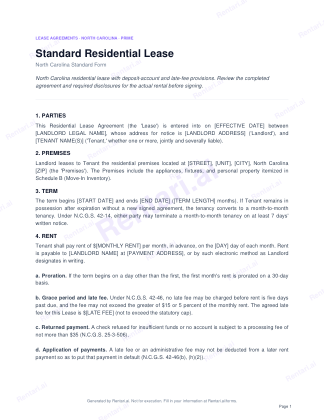
In the Rentari North Carolina lease
- Required disclosures
The lease includes the deposit location promise; for homes built before 1978 it attaches the federal lead-based paint disclosure.
- Flood disclosure
The lease includes a voluntary flood box that says only whether you reported flood damage to the home.
- Security deposit return
The lease repeats the 30-day itemized return, the interim and final accounting, the unknown-address rule and the bar on deducting for normal wear and tear.
- Deposit account and interest
The lease commits you to the trust account or bond and to telling the tenant where the deposit is held within 30 days; you send that notice yourself.
- Move-in condition report
The lease asks the tenant to report pre-existing damage in writing within seven days of move-in.
N.C. Gen. Stat. §§ 42-38 to 42-46 N.C. Gen. Stat. §§ 42-50 to 42-56
- Rent and late fees
The lease sets the late fee you choose and states the five-day rule, the greater of $15 or 5 percent cap, the once-per-payment limit and the water and sewer exclusion; its fee clause follows the statute's list of allowed eviction fees and costs.
- Returned payment fee
The lease includes a returned-payment fee only if you choose one, in the amount you set.
- Landlord entry
The lease promises at least 24 hours' written notice (or the period you set) before non-emergency entry, at reasonable times.
- Repairs and habitability
The lease restates the code, repair, common area, alarm and imminently dangerous condition duties and says the tenant's acceptance does not release them.
- Tenant repair remedies
The lease says the tenant may enforce these duties by civil action but may not withhold rent before a court decides, and that no North Carolina statute provides a repair-and-deduct remedy.
- Locks and security devices
The lease restates the 48-hour and 72-hour lock change rules; otherwise the tenant may not add or rekey a lock without your written consent.
- Smoke and carbon monoxide alarms
The lease restates the alarm duties, the 15-day repair rule and the battery rule, and the tenant may not disable an alarm.
- Retaliation
The lease restates the 12-month defense, the protected acts, your defenses and the no-waiver rule.
- Lockouts and utility shutoffs
The lease says the tenant may be removed only through summary ejectment and that distress and distraint are not permitted.
- Ending a month-to-month tenancy
The lease states the seven-day, two-day and one-month notices to quit.
- Ending a fixed-term lease early
The lease restates the protected tenant termination right, the federal and North Carolina servicemember rights and the military technician right.
N.C. Gen. Stat. § 42-45.1 50 U.S.C. § 3955 N.C. Gen. Stat. § 127B-28
- Notice for unpaid rent
The lease says the term is forfeited if rent is not paid within 10 days after you demand all past-due rent, and that the tenant may be removed only through summary ejectment.
- Eviction process
The lease says any action belongs in a court with jurisdiction in the county where the home is, with summary ejectment heard by a magistrate in small claims court and appeal to district court.
- Abandoned property
The lease says you have rights in property left behind only as the statute provides, restates the nonprofit and writ of possession routes, and adds your promise to store property for at least 30 days (or the period you set) where the statute allows less.
N.C. Gen. Stat. § 42-25.7 N.C. Gen. Stat. § 42-25.9(d), (e) N.C. Gen. Stat. § 42-36.3
North Carolina numbers the lease follows
- Security deposit limit
- 2 months' rent
- for a term longer than month to month; 1.5 months month to month, 2 weeks week to week
- N.C. Gen. Stat. § 42-51(b)
- Deposit refund deadline
- 30 days
- after the tenancy ends and you get possession back; final accounting by 60 days if needed
- N.C. Gen. Stat. § 42-52
- Late fee waiting period
- 5 days
- no late fee until rent is five calendar days or more late
- N.C. Gen. Stat. § 42-46(a)
- Unpaid rent
- 10 days
- after you demand all past-due rent, the term is forfeited
- N.C. Gen. Stat. § 42-3
- Ending month to month
- 7 days
- notice before the end of the current monthly period
- N.C. Gen. Stat. § 42-14
- Entry notice
- No state rule
- chapter 42 sets no notice period for entry
- N.C. Gen. Stat. §§ 42-38 to 42-46
- Rent increase notice
- No state rule
- chapter 42 sets no notice period for an increase
- N.C. Gen. Stat. ch. 42
From the North Carolina lease
NORTH CAROLINA RESIDENTIAL LEASE AGREEMENT
North Carolina allows a late fee only when a rent payment is five (5) calendar days or more late, counting from the day after it was due, of not more than $15 or 5% of the monthly rent, whichever is greater, charged only once for each late payment
Late chargeN.C. Gen. Stat. § 42-46(a) N.C. Gen. Stat. § 42-46(b)
TERMINATION (N.C. Gen. Stat. 42-3, 42-14, 42-25.6): A month-to-month tenancy ends by a notice to quit given at least seven (7) days before the end of the current monthly period; a week-to-week tenancy, two (2) days; a year-to-year tenancy, one month before the end of the year (42-14). If Rent is not paid within ten (10) days after Landlord demands all past-due rent, the term is forfeited (42-3).
Notice to quit and unpaid rentN.C. Gen. Stat. § 42-14 N.C. Gen. Stat. § 42-3
Landlord shall mail or deliver an itemized statement of damages with the balance no later than thirty (30) days after termination of the tenancy and delivery of possession; if the claim cannot be determined by then, an interim accounting within thirty days and a final accounting within sixty (60) days. If Tenant's address is unknown, Landlord applies the deposit after thirty days and holds the balance for Tenant for at least six months (42-52).
Deposit returnN.C. Gen. Stat. § 42-52
North Carolina lease types
Pick 3, 6, 12, 18 or 36 months or your own dates. At the end, the lease ends or converts to month-to-month.
Standard lease guideEnding month to month: 7 days, notice before the end of the current monthly period.
North Carolina month-to-month leaseUpload a lease you already use: send an unsigned one for e-signature, or store one that is already signed.
Rooms use the North Carolina lease for now: add the room as its own unit and set house rules with the optional addenda.
North Carolina room rentalBefore you sign
Application and screening fees
North Carolina's landlord and tenant chapter sets no limit on rental application or screening fees. You have no duty to screen applicants for a criminal record, and you may use a criminal background check as a ground for refusing to rent.
- A tenant's or applicant's criminal record does not make a future injury foreseeable to you for liability purposes. N.C. Gen. Stat. § 42-14.5
- Screening must still follow the State Fair Housing Act. N.C. Gen. Stat. § 41A-4 See Fair housing on the North Carolina page
- If you act as a North Carolina real estate broker, keep rental transaction records for three years after the transaction concludes or all funds you hold for it are disbursed to the proper parties, whichever is later. If the agency agreement ends first, use the later of that termination or disbursement of the transaction funds held by or paid to you. The Commission includes applicant background information in its retention guidance; identify the applicable start date before scheduling disposal. This is a brokerage record rule, not a blanket three-year rule for every property owner. 21 NCAC 58A .0108(a), (b) NCREC, tenant background information (2015)
- For brokerage files stored in the cloud, set clear policies for authorized access, security and continued availability when a broker leaves the firm. Once the applicable retention period and any other preservation duty are satisfied, dispose of consumer reports and information taken from them so unauthorized people cannot read or reconstruct it; ordinary deletion or moving a file to shared storage may not accomplish that. NCREC, March 2026 digital record guidance FTC, disposing of tenant consumer reports
Fair housing
Partly readThe State Fair Housing Act makes it unlawful to refuse to rent, set different terms, misrepresent availability or advertise a preference because of race, color, religion, sex, national origin, handicapping condition or familial status.
- The rental rules do not apply to a building with four or fewer families where you or a family member live, or to renting rooms in a private home you live in, but the advertising ban still applies. N.C. Gen. Stat. § 41A-6
- You must let a tenant with a disability make reasonable modifications at the tenant's expense (where reasonable you may require the interior to be restored at move-out, reasonable wear and tear excepted) and make reasonable accommodations in your rules, policies, practices or services. N.C. Gen. Stat. § 41A-4(f)
- You may not end, refuse to renew or refuse to rent because someone is a victim of domestic violence, sexual assault or stalking. N.C. Gen. Stat. § 42-42.2 See Retaliation on the North Carolina page
Required disclosures
North Carolina's main lease-stage disclosure is the deposit notice: within 30 days after the lease term begins, tell the tenant where the deposit is held or which insurer provides the bond.
- If you charge for water or sewer service and know the water exceeds a maximum contaminant level, you must give notice of that. N.C. Gen. Stat. § 42-42(a)(6)
- A prior occupant's death or serious illness, or a registered sex offender living in or near the home, is not a material fact you must disclose, but you may not knowingly make a false statement about it. N.C. Gen. Stat. § 42-14.2
- When you sell or transfer your interest, you must transfer the deposit and mail the tenant the new owner's name and address, or return the deposit, within 30 days. N.C. Gen. Stat. § 42-54 See Security deposit return on the North Carolina page
- Before signing, put the practical terms in one place: the people and unit covered, rental dates, rent and payment instructions, deposit handling, utility responsibilities, repair contacts, entry arrangements and any attached rules. Compare those terms with the required disclosures and statutory limits on this page. This checklist helps prevent conflicting expectations; it is not a list of terms that North Carolina requires in every lease. N.C. Gen. Stat. § 42-50
The lease includes the deposit location promise; for homes built before 1978 it attaches the federal lead-based paint disclosure.
Flood disclosure
Not set by statuteNorth Carolina's landlord and tenant chapter does not require a flood disclosure for a residential lease.
N.C. Gen. Stat. §§ 42-38 to 42-46
- Standing water, sewage or flooding from plumbing leaks or poor drainage that feeds mosquitoes or mold is an imminently dangerous condition you must repair. N.C. Gen. Stat. § 42-42(a)(8) See Repairs and habitability on the North Carolina page
The lease includes a voluntary flood box that says only whether you reported flood damage to the home.
Landlord identity disclosure
North Carolina's landlord and tenant chapter does not require you to give the tenant your name and address at the start of a lease. A broker managing the property is not personally liable in a landlord-tenant suit just because the lease does not identify the landlord.
- You must tell the tenant within 30 days after the term begins where the deposit is held, and on a sale you must give the tenant the new owner's name and address if you transfer the deposit. N.C. Gen. Stat. § 42-50 N.C. Gen. Stat. § 42-54 See Required disclosures on the North Carolina page
Deposits, rent and fees
Security deposit limit
A security deposit may not exceed two weeks' rent for a week-to-week tenancy, one and one-half months' rent for a month-to-month tenancy, or two months' rent for a term longer than month to month.
- The deposit may cover only the uses the statute lists: unpaid rent and certain utility charges you bill, damage to the premises (including smoke and carbon monoxide alarms), damages for not completing the rental period, unpaid bills that become a lien on the property, the costs of re-renting after the tenant's breach, removal and storage after a summary ejectment, court costs, and any fee the fee statute permits (late fees and the eviction administrative fees). N.C. Gen. Stat. § 42-51(a) N.C. Gen. Stat. § 42-46
- You may also charge a reasonable, nonrefundable fee for pets. A refundable pet deposit is part of the security deposit and counts toward the cap. N.C. Gen. Stat. § 42-53 N.C. Gen. Stat. § 42-51(b)
- These deposit rules apply to anyone in the business of renting or managing residential units on a weekly, monthly or annual basis, except single rooms. N.C. Gen. Stat. § 42-56
- You may not keep any part of a deposit as damages for not completing the rental period when the tenant ended the lease under the military or domestic violence early termination laws, or left because you violated the lockout law or the fit premises duty. N.C. Gen. Stat. § 42-51(a)(3) See Ending a fixed-term lease early on the North Carolina page
Security deposit return
Within 30 days after the tenancy ends and you get possession back, you must mail or deliver the balance of the deposit with a written, itemized list of any damage you deducted.
- If you cannot work out your full claim within 30 days, send an interim accounting within 30 days and a final accounting within 60 days after the tenancy ends and you get possession back. N.C. Gen. Stat. § 42-52
- If you do not know the tenant's address, you may apply the deposit as the statute allows after 30 days, and you must hold the balance for the tenant to collect for at least six months. N.C. Gen. Stat. § 42-52
- You may not deduct for normal wear and tear or keep more than your actual damages. N.C. Gen. Stat. § 42-52
- When your interest in the unit ends (a sale, assignment, death or receivership), within 30 days you must either transfer the remaining deposit to your successor and mail the tenant the successor's name and address, or return it to the tenant. N.C. Gen. Stat. § 42-54
- A tenant can sue for an accounting and the balance. A willful failure to follow the deposit, bond or notice rules voids your right to keep any part of the deposit, and on a finding of willful noncompliance the court may award attorney's fees. N.C. Gen. Stat. § 42-55
The lease repeats the 30-day itemized return, the interim and final accounting, the unknown-address rule and the bar on deducting for normal wear and tear.
Deposit account and interest
You must hold security deposits in a trust account with a licensed, federally insured depository institution or a trust institution authorized to do business in North Carolina, or instead furnish a bond from an insurance company licensed in North Carolina. North Carolina's deposit law does not require you to pay interest on the deposit.
- A trust account outside North Carolina is allowed only if you give the tenant an adequate bond in the amount of the deposits. N.C. Gen. Stat. § 42-50
- Within 30 days after the lease term begins, you or your agent must tell the tenant the name and address of the bank or institution holding the deposit, or the name of the insurance company providing the bond. N.C. Gen. Stat. § 42-50
- A willful failure to follow the deposit, bond or notice rules voids your right to keep any part of the deposit. N.C. Gen. Stat. § 42-55 See Security deposit return on the North Carolina page
The lease commits you to the trust account or bond and to telling the tenant where the deposit is held within 30 days; you send that notice yourself.
Move-in condition report
Not set by statuteNorth Carolina's residential rental statutes do not require a move-in inspection or condition checklist. A written record still helps you show damage beyond normal wear and tear when you itemize deposit deductions.
N.C. Gen. Stat. §§ 42-38 to 42-46 N.C. Gen. Stat. §§ 42-50 to 42-56
- Deductions are limited to actual damages and may not cover normal wear and tear. N.C. Gen. Stat. § 42-52 See Security deposit return on the North Carolina page
The lease asks the tenant to report pre-existing damage in writing within seven days of move-in.
Rent and late fees
A lease may set a late fee only for rent that is five calendar days or more late, counting from the day after it was due. For monthly rent the fee may not exceed $15 or 5 percent of the monthly rent, whichever is greater; for weekly rent, $4 or 5 percent of the weekly rent, whichever is greater.
- You may charge a late fee only once for each late payment, and you may not deduct it from a later rent payment so as to put that payment in default. N.C. Gen. Stat. § 42-46(b)
- You may not charge a late fee because the tenant did not pay for water or sewer service you bill. N.C. Gen. Stat. § 42-46(d)
- If the rent is subsidized by a government program or housing authority, any fee is figured on the tenant's share of the rent only. N.C. Gen. Stat. § 42-46(h)(5)
- Unless the tenant says otherwise, a payment goes first to rent and then to electric, water or sewer charges you bill, and unpaid utility charges cannot be the basis for ending the lease. N.C. Gen. Stat. § 42-26(b)
- Under a written lease you may charge only one administrative fee for an eviction or money-owed case: a complaint-filing fee of up to the greater of $15 or 5 percent of the monthly rent if the tenant cures and you dismiss before judgment, a court-appearance fee of 10 percent of the monthly rent if you win in small claims court, or a second-trial fee of up to 12 percent of the monthly rent if you win after an appeal. You may not deduct that fee from a later rent payment or treat its nonpayment as a default. N.C. Gen. Stat. § 42-46(e) to (h)
- Besides that fee you may recover court filing fees, service costs and reasonable attorneys' fees actually paid or owed under a written lease, capped at 15 percent of the amount owed (or of the monthly rent when the eviction is for a reason other than unpaid rent). If the tenant appeals a summary ejectment to district court and you prevail, you may recover all actual reasonable attorneys' fees when the court finds the tenant knew or should have known the appeal was frivolous, unreasonable, in bad faith or solely for delay. Any other lease term for fees or litigation costs of an eviction or money-owed case is void. N.C. Gen. Stat. § 42-46(h), (i)
- If the lease requires renters insurance, you may not require a particular carrier or agent. You may charge your actual cost of buying the coverage plus an administrative fee of up to $50 a year only if the tenant does not show proof of coverage within three business days after you ask. N.C. Gen. Stat. § 42-46(l)
The lease sets the late fee you choose and states the five-day rule, the greater of $15 or 5 percent cap, the once-per-payment limit and the water and sewer exclusion; its fee clause follows the statute's list of allowed eviction fees and costs.
Returned payment fee
A person who accepts a check in payment for goods or services may charge a processing fee of up to $35 for a check the bank refuses for insufficient funds or because the writer had no account there. The statute speaks to checks; it does not address electronic rent payments.
- A collection agency collecting a returned check may collect only the amount of the check and the processing fee, stated separately on its notice. N.C. Gen. Stat. § 25-3-506
The lease includes a returned-payment fee only if you choose one, in the amount you set.
Rent increase notice
Not set by statuteNorth Carolina's landlord and tenant chapter sets no notice period for a rent increase, and cities and counties may not regulate the amount of rent on private rental property.
- An increase made substantially in response to a tenant's protected complaint or repair request can support a retaliation defense if you later file for eviction. N.C. Gen. Stat. § 42-37.1 See Retaliation on the North Carolina page
During the tenancy
Landlord entry
Not set by statuteNorth Carolina's landlord and tenant chapter sets no notice period or rule for when you may enter a rented home. Your lease terms govern entry.
N.C. Gen. Stat. §§ 42-38 to 42-46
- The fit premises and repair duties still apply, and a tenant must give written notice of needed repairs to the facilities and appliances you supply, except in an emergency. N.C. Gen. Stat. § 42-42(a)(4) See Repairs and habitability on the North Carolina page
The lease promises at least 24 hours' written notice (or the period you set) before non-emergency entry, at reasonable times.
Repairs and habitability
You must comply with the applicable building and housing codes, make all repairs needed to put and keep the home fit and habitable, keep common areas safe, and keep the electrical, plumbing, sanitary, heating, ventilating, air conditioning and other facilities and appliances you supply in good and safe working order.
- You must promptly repair the facilities and appliances you supply once the tenant notifies you in writing, except in an emergency. N.C. Gen. Stat. § 42-42(a)(4)
- You must repair or remedy an imminently dangerous condition within a reasonable time for its severity after you learn of it. The list includes unsafe wiring, floors, steps, ceilings, roofs, chimneys or flues, no potable water, no operable locks on exterior doors, broken windows or ground-level windows without operable locks, no heat able to reach 65 degrees when it is 20 degrees outside (November 1 to March 31), no operable toilet or tub or shower, rat infestation from structural defects, and standing water or sewage that feeds mosquitoes or mold. N.C. Gen. Stat. § 42-42(a)(8)
- You may recover the actual and reasonable cost of repairing an imminently dangerous condition the tenant caused. N.C. Gen. Stat. § 42-42(a)(8)
- A tenant's acceptance of the home's condition does not release you from these duties. A later written contract for the tenant to do specified work is allowed only if it has separate consideration and is not meant to evade your duties. N.C. Gen. Stat. § 42-42(b)
- The tenant must keep the unit clean and safe, dispose of waste properly, not damage the premises or disable an alarm, and pay for damage inside the unit in the tenant's exclusive control unless it came from ordinary wear and tear, you or your agent, defective products you supplied or repairs you authorized, third parties who are not the tenant's invitees, or natural forces. You must notify the tenant in writing of a breach of these duties except in an emergency. N.C. Gen. Stat. § 42-43
- The tenant's duty to pay rent and your duty to provide fit premises are mutually dependent. N.C. Gen. Stat. § 42-41
The lease restates the code, repair, common area, alarm and imminently dangerous condition duties and says the tenant's acceptance does not release them.
Tenant repair remedies
A tenant may enforce your repair duties by a civil action, but may not withhold rent on their own before a court decides they have the right to. North Carolina's landlord and tenant chapter contains no repair-and-deduct remedy.
N.C. Gen. Stat. § 42-44(a), (c)
- A violation of the residential rental agreements law is not negligence per se. N.C. Gen. Stat. § 42-44(d)
- If a tenant is constructively evicted because you failed to provide fit premises, you may not keep the deposit as damages for the unfinished term. N.C. Gen. Stat. § 42-51(a)(3) See Security deposit limit on the North Carolina page
The lease says the tenant may enforce these duties by civil action but may not withhold rent before a court decides, and that no North Carolina statute provides a repair-and-deduct remedy.
Locks and security devices
Lack of operable locks on all exterior doors, and broken windows or unlockable ground-floor windows, are imminently dangerous conditions you must fix within a reasonable time after you learn of them.
- When a protected tenant reports being a victim of domestic violence, sexual assault or stalking by someone who does not live in the unit, you must change the locks or let the tenant change them within 48 hours, with no documentation required. N.C. Gen. Stat. § 42-42.3(a)
- If the perpetrator lives in the same unit, the tenant must first give you a court order requiring the perpetrator to stay away, and the lock change is due within 72 hours. N.C. Gen. Stat. § 42-42.3(b)
- The tenant pays for the lock change, may change the locks if you do not act in time, and must give you a key within 48 hours. N.C. Gen. Stat. § 42-42.3(c)
The lease restates the 48-hour and 72-hour lock change rules; otherwise the tenant may not add or rekey a lock without your written consent.
Smoke and carbon monoxide alarms
You must provide operable, listed smoke alarms installed to the standards the statute names, and at least one operable carbon monoxide alarm per level in any unit with a fossil-fuel heater, appliance or fireplace or an attached garage.
N.C. Gen. Stat. § 42-42(a)(5), (7)
- At the start of each tenancy the alarms must work, and unless you agree otherwise in writing you put in new batteries; the tenant replaces batteries during the tenancy. N.C. Gen. Stat. § 42-42(a)(5), (7) N.C. Gen. Stat. § 42-43(a)(7)
- A new or replacement smoke alarm must be a tamper-resistant 10-year lithium battery alarm, unless the unit has hardwired alarms with battery backup or a qualifying combination smoke and carbon monoxide alarm. N.C. Gen. Stat. § 42-42(a)(5a)
- You must repair or replace an alarm within 15 days after the tenant's written notice. Failing to do so within 30 days after written notice is an infraction with a fine of up to $250. N.C. Gen. Stat. § 42-42(a)(5) N.C. Gen. Stat. § 42-44(a1)
- A tenant who disables or damages an alarm must reimburse your reasonable cost within 30 days after written notice. N.C. Gen. Stat. § 42-44(a2)
The lease restates the alarm duties, the 15-day repair rule and the battery rule, and the tenant may not disable an alarm.
Retaliation
In an eviction case a tenant may raise retaliation as a defense and show that your action was substantially in response to a protected act within 12 months before you filed. This is a defense the tenant must support with evidence, not a presumption.
- Protected acts are a good faith complaint or repair request to you, a good faith complaint to a government agency, a government's formal complaint to you, a good faith attempt to enforce rights under the lease or law, and involvement with a tenants' rights organization. N.C. Gen. Stat. § 42-37.1(a)
- You may still win if the tenant's breach of the rent covenant or another substantial covenant is the reason for the eviction, the tenant held over after a fixed term with no renewal option, the tenant's household or guests willfully or negligently caused the condition, code compliance requires displacing the household, your good faith notice to quit came before the protected act, or at the end of the tenant's term you in good faith seek the home for your own residence, for work that requires displacing the household, or to take it off the rental market for at least six months. N.C. Gen. Stat. § 42-37.1(c)
- If the court finds the eviction retaliatory, it denies possession but may still award rent due. A tenant cannot waive these rights. N.C. Gen. Stat. § 42-37.2 N.C. Gen. Stat. § 42-37.3
- You also may not end, refuse to renew or refuse to rent because someone is a victim of domestic violence, sexual assault or stalking, or used the victim early termination right. N.C. Gen. Stat. § 42-42.2 See Fair housing on the North Carolina page
The lease restates the 12-month defense, the protected acts, your defenses and the no-waiver rule.
Lockouts and utility shutoffs
You may remove a residential tenant only through the court process. Changing the locks, removing the tenant or taking the tenant's belongings yourself is not allowed, and a lease term to the contrary is void.
N.C. Gen. Stat. § 42-25.6 N.C. Gen. Stat. § 42-25.8
- A tenant removed or locked out unlawfully may recover possession or end the lease, and may recover actual damages (not punitive or treble damages or damages for emotional distress). N.C. Gen. Stat. § 42-25.9(a)
- Distress and distraint are prohibited: you have rights in a tenant's personal property only as the statutes allow, and interfering with it unlawfully makes you liable for its return or value plus actual damages. N.C. Gen. Stat. § 42-25.7 N.C. Gen. Stat. § 42-25.9(b)
- If you bill the tenant for electric, water, sewer or natural gas service, you may not disconnect or cut off that service because the tenant has not paid for it. N.C. Gen. Stat. § 42-42.1(b)
The lease says the tenant may be removed only through summary ejectment and that distress and distraint are not permitted.
Ending a tenancy
Ending a month-to-month tenancy
A month-to-month tenancy may be ended by a notice to quit given at least seven days before the end of the current monthly period.
- A week-to-week tenancy takes two days' notice, and a year-to-year tenancy takes one month's notice before the end of the current year. N.C. Gen. Stat. § 42-14
- A tenancy for only a manufactured home space takes at least 60 days' notice before the end of the current rental period. N.C. Gen. Stat. § 42-14
- A good faith notice to quit given before a tenant's protected activity remains a defense to a retaliation claim. N.C. Gen. Stat. § 42-37.1(c)(5) See Retaliation on the North Carolina page
The lease states the seven-day, two-day and one-month notices to quit.
Ending a fixed-term lease early
North Carolina lets certain tenants end a lease early by written notice: victims of domestic violence, sexual assault or stalking, servicemembers protected by federal law (extended by state law to some National Guard duty), dual-status military technicians, and tenants in some foreclosed properties.
N.C. Gen. Stat. § 42-45.1 50 U.S.C. § 3955 N.C. Gen. Stat. § 127B-28 N.C. Gen. Stat. § 42-45 N.C. Gen. Stat. § 42-45.2
- A protected tenant may end the lease by written notice effective at least 30 days after you receive it, with a non-ex-parte protective order, a criminal no-contact order or an Address Confidentiality Program card. A victim of domestic violence or sexual assault must also give a safety plan from a qualifying program, dated during the tenancy, that recommends relocation. The tenant owes prorated rent only, other tenants' tenancy continues, and these rights cannot be waived. N.C. Gen. Stat. § 42-45.1
- Under federal law a servicemember may end a lease after entering military service or on orders for a permanent change of station or a deployment of 90 days or more; with monthly rent, termination takes effect 30 days after the next rent due date following delivery of the notice. 50 U.S.C. § 3955
- North Carolina applies the federal protections to National Guard members on State active duty for more than 30 consecutive days, and lets a Guard member whose lease expires during State active duty extend it to 10 days after that duty ends if current on rent. N.C. Gen. Stat. § 127B-27 N.C. Gen. Stat. § 127B-28 N.C. Gen. Stat. § 127B-32
- A dual-status military technician may end the lease by written notice with the orders after permanent change of station orders (50 miles or more), an early discharge, or a deployment of 90 days or more; if you suffered actual damages, you may claim liquidated damages of up to one month's rent if less than six months were completed, or half a month's rent if six to nine months were completed. These rights cannot be waived. N.C. Gen. Stat. § 42-45
- A tenant in a building with fewer than 15 rental units being sold in foreclosure may end the lease with notice effective 10 to 90 days after the sale date in the notice of sale. N.C. Gen. Stat. § 42-45.2
- If the building is destroyed or damaged beyond repair costing more than a year's rent without the tenant's fault, and the lease says nothing about it, the tenant may surrender in writing within 10 days. N.C. Gen. Stat. § 42-12
- If you negotiate an early release, put the agreed move-out date, key return, rent or other amounts remaining, deposit accounting and the names of the tenants released in a signed document. Distinguish permission to sublet or introduce a replacement from an express release of the original tenant. Keep the lease, notice, agreement, payment record and final account together. Review any statutory protection first, and do not assume a proposed fee, a conversation about moving or the handover of keys settles every remaining obligation. North Carolina Judicial Branch: landlord-tenant issues
The lease restates the protected tenant termination right, the federal and North Carolina servicemember rights and the military technician right.
Notice for unpaid rent
If the tenant does not pay within 10 days after you demand all past-due rent, the lease term is forfeited. You must then remove the tenant only through the court's summary ejectment process.
N.C. Gen. Stat. § 42-3 N.C. Gen. Stat. § 42-25.6
- Self-help removal is not allowed: a residential tenant may be removed only through the summary ejectment procedure (or the expedited drug-crime procedure). N.C. Gen. Stat. § 42-25.6 See Lockouts and utility shutoffs on the North Carolina page
- Before filing, the tenant must be holding over after you have demanded that they surrender the home. N.C. Gen. Stat. § 42-26(a)
- If, before judgment, the tenant pays or tenders the rent due and the costs of the action, a case based on unpaid rent stops. N.C. Gen. Stat. § 42-33
The lease says the term is forfeited if rent is not paid within 10 days after you demand all past-due rent, and that the tenant may be removed only through summary ejectment.
Notice for lease violations
North Carolina sets no cure period for a lease violation other than unpaid rent. If the lease says the tenancy ends on a particular breach, you may seek summary ejectment once the tenant holds over after you demand possession.
- You must notify the tenant in writing of a breach of the tenant's statutory maintenance duties, except in an emergency. N.C. Gen. Stat. § 42-43(b)
- The lease may provide that accepting partial rent or a partial housing subsidy payment does not waive the breach. N.C. Gen. Stat. § 42-26(c)
Eviction process
Partly readEvictions are summary ejectment cases. After you file, the clerk issues a summons for a hearing within seven days, not counting weekends and legal holidays, usually before a magistrate in small claims court.
N.C. Gen. Stat. § 42-28 N.C. Gen. Stat. § 42-30
- The sheriff mails the summons and complaint and tries to deliver them in person; if that fails, copies may be posted on the premises. N.C. Gen. Stat. § 42-29
- A party may appeal the magistrate's judgment for a new trial in district court, orally in court or by written notice within 10 days after judgment. N.C. Gen. Stat. § 7A-228
- A tenant who appeals can stay the eviction by paying the undisputed rent in arrears the magistrate found (an indigent appellant need not) and paying rent into the clerk's office as it comes due. If a payment is more than five business days late, the clerk issues execution on your application, and within five business days of your written request the clerk must pay you rent paid in that the tenant has not claimed. N.C. Gen. Stat. § 42-34(b) to (f)
- The sheriff must execute a writ of possession within five days of receiving it and must first give the tenant notice of the approximate time. N.C. Gen. Stat. § 42-36.2(a)
- Before executing a judgment for possession more than 30 days old, you must sign an affidavit that you have not made a new lease with the tenant or accepted rent for any period after the judgment. N.C. Gen. Stat. § 42-36.1A
- Prepare for the hearing with a dated file: the lease and amendments, notices and delivery records, a rent ledger showing payments and credits, relevant messages, and photographs or repair records that explain the disputed issue. Keep the amount requested clear and update it when a payment arrives. Read the hearing papers carefully and check the court's instructions for attending and presenting evidence. A payment discussion or proposed move-out agreement does not by itself cancel a scheduled hearing. The North Carolina Judicial Branch landlord/tenant guide provides an official starting point for court procedures and help. North Carolina Judicial Branch: Landlord/Tenant Issues
The lease says any action belongs in a court with jurisdiction in the county where the home is, with summary ejectment heard by a magistrate in small claims court and appeal to district court.
Abandoned property
Without an eviction, the only way to deal with property a tenant leaves behind is to give property worth $750 or less to a qualifying nonprofit. For that route, property counts as abandoned if you find evidence that clearly shows the tenant voluntarily left after the paid rental period and you have no notice that a disability caused it, and abandonment is presumed 10 or more days after you post a notice of suspected abandonment inside and outside the home without a response. Anything else may be removed or disposed of only after a writ of possession is executed, or under the estate affidavit procedure when a sole tenant has died.
N.C. Gen. Stat. § 42-25.7 N.C. Gen. Stat. § 42-25.9(d), (e) N.C. Gen. Stat. § 42-36.3
- If abandoned property is worth $750 or less, you may give it to a nonprofit that provides clothing and furnishings to people in need, if it agrees to store it separately for 30 days and release it free to the tenant. You must post a notice naming the recipient at the home and for 30 days where rent is paid, and mail it to the tenant. N.C. Gen. Stat. § 42-25.9(d)
- After the sheriff executes a writ of possession, you may move property for storage but must not dispose of it for seven days, and must release it to the tenant on request during that time. After seven days you may dispose of or sell it; a sale needs seven days' written notice by first-class mail, and surplus proceeds go to the tenant on request or to the county. N.C. Gen. Stat. § 42-25.9(g) N.C. Gen. Stat. § 42-36.2(b)
- If everything left at the time of the writ is worth less than $500, it is deemed abandoned five days after execution. N.C. Gen. Stat. § 42-25.9(h)
The lease says you have rights in property left behind only as the statute provides, restates the nonprofit and writ of possession routes, and adds your promise to store property for at least 30 days (or the period you set) where the statute allows less.
Small claims court
Small claims cases are heard by a magistrate and cover money claims up to $10,000, summary ejectment, recovery of specific personal property, or a mix of these.
- A magistrate's judgment may be appealed for a new trial in district court within 10 days. N.C. Gen. Stat. § 7A-228 See Eviction process on the North Carolina page
More North Carolina rules
Screening reports and local housing policies
Partly readState screening provisions do not replace fair-housing duties, consumer-report requirements or an applicable housing-funding agreement. Set clear, lawful criteria for the actual property and review the information that supports them. A report entry or score should be checked for identity, dates and context before it becomes part of a rental decision.
Charlotte-Mecklenburg: source-of-income policy CFPB: rental denial and screening reports
- Charlotte and Mecklenburg County describe source-of-income protections for qualifying city- or county-supported housing. The policy addresses refusing lawful income, discriminatory advertising and different terms based on income source. Verify whether the development received covered support and which agreement applies; this funding-based policy is not a rule covering every private rental simply because it is in Charlotte. Other local or program requirements may still apply. Charlotte-Mecklenburg: source-of-income policy
- If you deny an application or offer less favorable terms based partly on a consumer report, give the required adverse-action notice. Identify the reporting company by name, address and telephone, state the right to dispute inaccuracies and request a free copy within sixty days of the notice, and explain that the company did not make the decision and cannot explain your reasons. Keep a written notice record even where federal law permits another format, and check any additional applicable requirements. CFPB: rental denial and screening reports FTC: landlord consumer-report guidance
- Read court entries for their outcome rather than treating a filing as proof of an eviction. Match the report to the applicant and review duplicate, outdated or incomplete information. If an error is raised, preserve the relevant documents and direct the applicant to the reporting company's dispute process. Keep the criteria and facts reviewed with the authorization, report date, communications and notice record; use the separate broker-record guidance when it applies. CFPB: review a rental background check See Application and screening fees on the North Carolina page
Unauthorized occupants and ownership claims
Partly readFirst establish the person’s relationship to the property. North Carolina has a limited court procedure for qualifying unauthorized occupants; tenants, including tenants who stay after a lease ends, are different. A claim to ownership by adverse possession is also separate from recovering possession.
North Carolina: expedited removal of unauthorized persons
- Check every eligibility condition before using expedited removal. The person must have entered after the owner acquired the property, been directed to leave and have no tenancy, ownership or qualifying agreement. The property must not have been offered to the general public as accommodation at entry. Related litigation and any rent or other occupancy payment demanded or received by the owner or representative can exclude this route. A former owner’s valid rental agreement or contract for deed also matters. North Carolina: expedited removal of unauthorized persons
- The expedited process starts with a complaint and summons in the property’s county, followed by sheriff service and a magistrate’s hearing. A favorable order specifies when to leave; appeal and wrongful-removal remedies also exist. Follow the court’s instructions rather than assuming a police call or a standard ten-day notice completes the process. For a tenant, use the applicable tenancy procedure instead. North Carolina: expedited removal of unauthorized persons See Eviction process on the North Carolina page
- The ownership statutes describe seven years under color of title and twenty years of adverse possession, with known and visible boundaries and other requirements and exceptions. These are not automatic ownership deadlines for anyone staying in a vacant home. A claimed deed, boundary dispute, permission or shared ownership needs assessment of the actual facts and title history. N.C. Gen. Stat. § 1-38: possession under color of title N.C. Gen. Stat. § 1-40: twenty years adverse possession
- Keep deeds and surveys, leases and permissions, payment demands and receipts, dated photographs, communications and court papers together. Secure vacant property and arrange lawful checks. If someone asserts permission or ownership, preserve the evidence and obtain advice on the appropriate process. Keep tenant protections against personal lockouts, removal of belongings and unlawful utility shutoffs in place. N.C. Gen. Stat. § 42-25.6 N.C. Gen. Stat. § 42-25.8 See Lockouts and utility shutoffs on the North Carolina page
Local rules
Rent control and local rules
Cities and counties may not enact or enforce any ordinance regulating the amount of rent on privately owned residential rental property.
- Cities and counties also may not bar a landlord from refusing to rent because the tenant's rent would come partly from a federal housing assistance program. N.C. Gen. Stat. § 42-14.1(b)
- Local governments may still regulate their own property, rent limits in subsidized or grant-assisted housing, and owners who accept local funding or incentives. N.C. Gen. Stat. § 42-14.1(c)
Cities and counties may not regulate rent amounts on private rental property, but their housing, building and fire codes can add duties for rental homes. No city or county code was read for this page; check the codes where the property is located.
North Carolina lease renewals
Read the agreement's renewal clause and the notice rules above before choosing a new term, changing rent or ending the tenancy. A fixed end date does not override applicable renewal rights, rent regulation, just-cause rules or protections against retaliation and discrimination.
Confirm the notice, timing and delivery requirements for the rental's state and locality. Review any required new disclosures and attachments when preparing the renewal. Get the parties' agreement to changed terms in writing.
Customize an unsigned agreement or prepare an addendum to an existing lease.
How it works
- Add your North Carolina rental
Enter the property and its units.
- Set the terms
Choose the rental, add tenants, and set rent, deposit and fees.
- Review the lease
Preview and edit the North Carolina lease and its addenda.
- Send for e-signature
Tenants sign online; sending is included on paid plans.
Follow the full lease builder guide, add supporting files, or download and print the agreement.
North Carolina lease questions
Does the Rentari North Carolina lease follow the state late-fee cap?
Yes. It states that a late fee may be charged only when rent is five calendar days or more late, of no more than the greater of $15 or 5 percent of the monthly rent, once per late payment, and never for unpaid water or sewer charges.
N.C. Gen. Stat. § 42-46(a) N.C. Gen. Stat. § 42-46(b) N.C. Gen. Stat. § 42-46(d)
How does the lease handle the security deposit?
It states the three deposit caps, the trust account or bond rule, your promise to tell the tenant within 30 days where the deposit is held, and the 30-day itemized return with interim and final accounting. You send the deposit location notice yourself.
N.C. Gen. Stat. § 42-50 N.C. Gen. Stat. § 42-51(b) N.C. Gen. Stat. § 42-52
Does the lease include North Carolina's domestic violence protections?
Yes. It restates the protected tenant's early termination right, the 48-hour and 72-hour lock change rules and the bar on retaliating against a victim, and says these rights cannot be waived.
N.C. Gen. Stat. § 42-42.2 N.C. Gen. Stat. § 42-42.3 N.C. Gen. Stat. § 42-45.1
What does the lease say about attorney's fees?
It limits what you recover in an eviction or money-owed case to what the statute allows: one administrative fee, filing and service costs, and reasonable attorneys' fees of up to 15 percent of the amount owed under the written lease.
Does the lease cover servicemember rights?
Yes. It restates the federal right to end a lease on entering service or on qualifying orders, North Carolina's extension of that right to National Guard members on State active duty for more than 30 consecutive days, the Guard lease extension, and the military technician right. You can send it for e-signature on paid plans.
50 U.S.C. § 3955 N.C. Gen. Stat. § 127B-28 N.C. Gen. Stat. § 127B-32 N.C. Gen. Stat. § 42-45