- Home
- Lease agreement
- Ohio
Ohio residential lease agreement
State rules checked September 24, 2026 General information, not legal advice
Jump to a topic
Ohio lease document preview
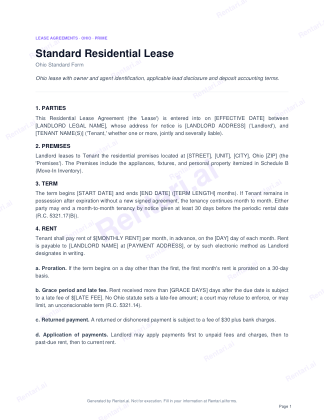
In the Rentari Ohio lease
- Fair housing
The lease says the landlord complies with federal, state and local fair housing law and will respond in good faith, within a reasonable time, to requests for reasonable accommodations and modifications, written or not.
Ohio Rev. Code § 4112.02(H) Ohio Rev. Code § 4112.01 Ohio Rev. Code § 4112.024
- Security deposit limit
The Rentari Ohio lease states the deposit amount and says no Ohio statute caps it.
Ohio Rev. Code ch. 5321 Ohio Rev. Code § 5321.01(E) Ohio Rev. Code § 5321.16
- Returning the deposit
The lease promises the itemized notice and the amount due within 30 days after termination and delivery of possession, requires the tenant to give a forwarding address in writing, and restates the damages and attorney's fees rule.
- Deposit interest and accounts
The lease states the 5 percent interest on the part of the deposit above $50 or one month's rent, whichever is greater, if the tenant remains in possession six months or more, computed and paid annually.
Ohio Rev. Code § 5321.16(A) Ohio Rev. Code § 4735.18(A)(27) Ohio Rev. Code § 4735.01(A)(5)
- Move-in condition
The lease's condition clause refers to any move-in condition report and, as a lease term, asks the tenant to report pre-existing damage in writing within seven days of move-in.
- Rent payments and late fees
The lease charges the late fee the landlord sets after the grace period the landlord chooses, and says no Ohio statute sets a late-fee amount and a court may refuse to enforce an unconscionable term.
Ohio Rev. Code ch. 5321 Ohio Rev. Code § 5321.06 Ohio Rev. Code § 5321.14
- Returned payment fee
Unless the landlord changes or removes it, the lease sets a $35 returned-payment fee, due on notice and treated as additional rent, and lets the landlord require certified funds after repeated returns.
Ohio Rev. Code ch. 5321 Ohio Rev. Code § 1319.16 Ohio Rev. Code § 5321.14
- Landlord entry
The lease restates the reasonable-notice rule and the 24-hour presumption, promises at least the stated number of hours' notice, 24 by default, lists the purposes a tenant may not unreasonably refuse, and states the tenant's remedies for unlawful entry.
Ohio Rev. Code § 5321.04(A)(8) Ohio Rev. Code § 5321.05(B) Ohio Rev. Code § 5321.04(B)
- Repairs and habitability
The lease's Ohio tenant-rights box restates the 5321.04 duties, including the four-unit waste receptacle rule and the heat and hot water exception, and says no provision of chapter 5321 can be waived by agreement; its condition clause lists who handles six routine items, with light bulbs and furnace filters on the tenant by default.
Ohio Rev. Code § 5321.04 Ohio Rev. Code § 5321.05 Ohio Rev. Code § 5321.13
- Tenant repair remedies
The lease describes the written notice, the reasonable-time-or-30-days rule and the three remedies, and says it gives no three-or-fewer-units notice, so the remedies apply.
Ohio Rev. Code § 5321.07 Ohio Rev. Code § 5321.08 Ohio Rev. Code § 5321.09
- Locks and security devices
The lease says the landlord provides functioning exterior locks and keys at move-in, bars the tenant from changing or adding locks without written consent, charges a reasonable cost for lost or unreturned keys, and says nothing in it lets the landlord change locks or exclude the tenant except through the judicial process.
Ohio Rev. Code ch. 5321 Ohio Rev. Code § 5321.04(A)(1) Ohio Rev. Code § 5321.04(A)(2)
- Smoke alarms
The lease requires the landlord to provide working smoke and carbon monoxide detectors at the start of the tenancy and bars the tenant from disabling or tampering with them; its Ohio disclosures section has the tenant acknowledge working alarms at the start of the term and report a fault in writing, and says the landlord maintains them as 5321.04 and the applicable codes require.
- Retaliation
The lease restates the three protected acts, the barred actions, the tenant's remedies, the cost-increase exception and the 5321.03 exceptions.
- Lockouts and utility shutoffs
The lease's keys clause says nothing in it lets the landlord change locks or exclude the tenant except through the judicial process, and its Ohio tenant-rights box restates the bar on utility shutoffs, lockouts, threats and seizing belongings.
- Ending a month-to-month tenancy
The lease restates the rule of notice 30 days before the periodic rental date for month-to-month tenancies and seven days for week-to-week tenancies.
- Ending a fixed-term lease early
The lease says chapter 5321 gives no statutory domestic violence termination right and, as a contractual term, lets a tenant end the lease early by delivering a protection order or a domestic violence agency's written certification; it restates the federal servicemember termination right, keeps a tenant who leaves early liable for rent subject to the landlord's good-faith efforts to re-rent, and, when the landlord offers one, adds an early termination option on the notice and fee the landlord sets.
Ohio Rev. Code § 5321.04(B) Ohio Rev. Code § 5321.07(B) Ohio Rev. Code § 5321.02(B)
- Notice for unpaid rent
The lease requires a written notice to leave at least three days before filing, by certified mail with return receipt requested, in person, or at the tenant's usual place of abode or the premises, containing the language 1923.04(A) requires.
- Notice for other lease violations
The lease states the 30-day notice for a health-and-safety failure and the three-day drug-activity notice, and requires the three-day notice to leave, with the 1923.04(A) language, before any eviction.
Ohio Rev. Code § 5321.11 Ohio Rev. Code § 1923.02(A)(8) Ohio Rev. Code § 1923.02(A)(9)
- Eviction process
The lease says an eviction is brought under chapter 1923 after the three-day notice to leave, that an action under the lease may be brought in any Ohio court with jurisdiction, and that it contains no attorney's fees clause.
Ohio Rev. Code § 1923.01 Ohio Rev. Code § 1923.04 Ohio Rev. Code § 1923.06
- Property left behind
The lease's abandonment clause promises to handle property left behind as the law requires and, as a lease term, to store it for at least the number of days the lease states, 30 by default, and says nothing in it authorizes self-help.
Ohio Rev. Code § 5321.15(B) Ohio Rev. Code ch. 5321 Ohio Rev. Code ch. 1923
- Lease terms Ohio will not enforce
The lease contains no confession of judgment, attorney's fees, exculpation or indemnity clause and says why, while keeping the tenant responsible, as the law otherwise provides, for damage caused by the negligence or willful misconduct of the tenant, occupants or guests.
Ohio numbers the lease follows
- Security deposit limit
- No limit
- chapter 5321 sets no maximum
- Ohio Rev. Code ch. 5321Ohio Rev. Code § 5321.16
- Deposit refund deadline
- 30 days
- after the rental agreement ends and the tenant delivers possession
- Ohio Rev. Code § 5321.16(B)
- Interest on a larger deposit
- 5% a year
- on the part above $50 or one month's rent, whichever is greater, if the tenant remains in possession six months or more
- Ohio Rev. Code § 5321.16(A)
- Late fee limit
- None set
- chapter 5321 sets no amount or grace period; a court may refuse an unconscionable term
- Ohio Rev. Code ch. 5321Ohio Rev. Code § 5321.14
- Rent increase notice
- None set
- chapter 5321 sets no notice period, and cities may not impose rent control
- Ohio Rev. Code ch. 5321Ohio Rev. Code § 5321.19
- Notice before entry
- 24 hours
- presumed reasonable; the rule is reasonable notice, except in an emergency or where impracticable
- Ohio Rev. Code § 5321.04(A)(8)
- Notice to leave before filing
- 3 days
- served at least three days before an eviction is filed, with the statutory language
- Ohio Rev. Code § 1923.04(A)
- Health and safety breach notice
- 30 days
- after the tenant receives it, for a tenant duty that materially affects health and safety
- Ohio Rev. Code § 5321.11
- Ending a month-to-month tenancy
- 30 days
- before the periodic rental date; 7 days for week-to-week
- Ohio Rev. Code § 5321.17
- Small claims limit
- $6,000
- money claims only, not counting interest and costs
- Ohio Rev. Code § 1925.02(A)(1)
From the Ohio lease
OHIO RESIDENTIAL LEASE AGREEMENT
Tenant deposits [Security deposit]. No Ohio statute caps the amount. Any part of the deposit in excess of $50 or one month's periodic rent, whichever is greater, bears interest on the excess at five percent (5%) a year if Tenant remains in possession for six months or more, computed and paid by Landlord to Tenant annually.
Deposit interestOhio Rev. Code § 5321.16(A)
Before bringing an eviction (forcible entry and detainer) action, Landlord must give Tenant a written notice to leave the Premises at least three (3) days before filing, by certified mail, return receipt requested, by handing it to Tenant in person, or by leaving it at Tenant's usual place of abode or at the Premises, and the notice must contain the language R.C. 1923.04(A) requires.
Notice to leave before an evictionOhio Rev. Code § 1923.04(A)
Under Ohio Rev. Code 5321.13(C), an agreement in a residential lease to pay the landlord's or the tenant's attorney's fees is not enforceable. This Lease contains no attorney's-fees provision. Each party bears its own attorney's fees, except where an Ohio statute independently authorizes a court to award fees.
Attorney's feesOhio Rev. Code § 5321.13(C)
Ohio lease types
Pick 3, 6, 12, 18 or 36 months or your own dates. At the end, the lease ends or converts to month-to-month.
Standard lease guideEnding a month-to-month tenancy: 30 days, before the periodic rental date; 7 days for week-to-week.
Ohio month-to-month leaseUpload a lease you already use: send an unsigned one for e-signature, or store one that is already signed.
Rooms use the Ohio lease for now: add the room as its own unit and set house rules with the optional addenda.
Ohio room rentalBefore you sign
Application and screening fees
Not set by statuteNo section of chapter 5321 caps or regulates rental application or screening fees. Ohio's fair housing law still governs screening: do not ask about, record, or use an application form with questions on race, color, religion, sex, military status, familial status, ancestry, disability or national origin, and do not ask whether an applicant has a disability or how severe it is, except as that law allows.
Ohio Rev. Code ch. 5321 Ohio Rev. Code § 4112.02(H)(8) Ohio Rev. Code § 4112.02(H)(17)
- Questions you may ask every applicant include whether the applicant can meet the requirements of the tenancy, currently uses a controlled substance illegally, or has ever been convicted of or pleaded guilty to an offense involving the illegal sale, manufacture or distribution of a controlled substance. Ohio Rev. Code § 4112.02(H)(17)
- Anyone may make inquiries and keep records about those characteristics for the purpose of monitoring compliance with the fair housing law. Ohio Rev. Code § 4112.02(H)(8)
- Reasonable occupancy standards based on the number and size of bedrooms and the overall size of the unit are allowed if they are not used to get around the fair housing law. Ohio Rev. Code § 4112.024(C)
- In Columbus, an operator may not knowingly reject or discourage a prospective tenant, misstate availability, or impose different rental prices, terms or fees because of the person's source of income. The city includes lawful income that can be verified, such as wages, Social Security, rent vouchers, child support and public assistance. Check the property's city before choosing criteria; the state list alone does not describe every local protection. Columbus City Code 4551.03(a) Columbus City Code 4501.378
- For a Columbus income threshold, subtract a rent voucher or subsidy from the total monthly rent before testing whether the income requirement is met. Record the subsidy and tenant-paid portions separately so a full-rent income multiplier does not screen out an otherwise qualified voucher applicant. This city-specific calculation does not decide the applicant's overall eligibility or establish another city's rules. Columbus City Code 4551.03(b)
Fair housing
Ohio's fair housing law bars refusing to rent or to negotiate, otherwise making housing unavailable, and setting different terms, conditions, facilities or services because of race, color, religion, sex, military status, familial status, ancestry, disability or national origin, and it bars discriminatory statements and advertising. You must make reasonable accommodations in rules, policies, practices and services when needed for a person with a disability to have equal opportunity to use and enjoy a dwelling, and permit reasonable modifications at the tenant's expense.
Ohio Rev. Code § 4112.02(H) Ohio Rev. Code § 4112.01 Ohio Rev. Code § 4112.024 Ohio Rev. Code § 4112.055
- Familial status covers a child under 18 living with a parent or guardian who has legal custody of the child, or living, with that parent's or guardian's written permission, with a designee of the parent or guardian, and anyone who is pregnant or securing legal custody of a child under 18. Ohio Rev. Code § 4112.01(A)(15)
- Military status means a person's status in service in the uniformed services. Ohio Rev. Code § 4112.01(A)(22)
- For a modification, you may ask for a description and assurances of workmanlike work and permits, a restoration agreement where reasonable, and in some cases payments into an interest-bearing escrow for restoration whose interest goes to the tenant; you may not require a larger security deposit than you customarily require of all tenants. Ohio Rev. Code § 4112.02(H)(18)
- The exemptions are narrow: a religious organization, or a nonprofit charitable or educational organization run by or in connection with one, may limit housing it owns or operates for other than a commercial purpose to persons of the same religion or give them preference, unless membership in the religion is restricted by race, color or national origin; a bona fide private or fraternal organization may limit its noncommercial lodgings to its members or give them preference; and, for familial status only, qualifying housing for older persons is exempt. Reasonable occupancy standards are allowed, and no one must rent to a person whose tenancy would be a direct threat to others' health or safety or cause substantial physical damage to others' property. Ohio Rev. Code § 4112.024
- Source of income is not among the characteristics the state law lists. Ohio Rev. Code § 4112.02(H)
- A charge with the Ohio Civil Rights Commission must be in writing and under oath: within one year for housing discrimination under 4112.02(H), which includes coercing or interfering with anyone exercising fair housing rights, and within six months for retaliation under 4112.02(I) against someone who opposed discrimination or took part in a charge, investigation or hearing. An aggrieved person may also sue over a housing violation in the court of common pleas within one year. Ohio Rev. Code § 4112.05(B)(1) Ohio Rev. Code § 4112.02(H)(12) Ohio Rev. Code § 4112.02(I) Ohio Rev. Code § 4112.055(A)(1)
The lease says the landlord complies with federal, state and local fair housing law and will respond in good faith, within a reasonable time, to requests for reasonable accommodations and modifications, written or not.
Required disclosures and lease language
Every written rental agreement must contain the name and address of the owner and the name and address of the owner's agent, if any. For an owner or agent that is a corporation, partnership, limited partnership, association, trust or other entity, the address must be its principal place of business in the county where the property is located, or its principal place of business in Ohio if it has none in that county, and the lease must give the name of the person in charge of it. For an oral rental agreement, deliver this information to the tenant in a written notice at the start of the tenancy.
Ohio Rev. Code § 5321.18 Ohio Rev. Code § 5321.07(C) Ohio Rev. Code § 5321.13
- If you do not provide it, you waive the tenant's written notice to you under the rent deposit remedy and the clerk's notice to you of a rent deposit. Ohio Rev. Code § 5321.18(C)
- A landlord of three or fewer units keeps the rent deposit remedies from applying only by saying so in the written rental agreement, or in a written notice at the start of an oral tenancy. Ohio Rev. Code § 5321.07(C) See Tenant repair remedies on the Ohio page
- Terms Ohio does not recognize in a lease: any waiver of chapter 5321, a warrant of attorney to confess judgment, an agreement to pay attorney's fees, and an agreement to excuse, limit or indemnify the landlord's legal liability. Ohio Rev. Code § 5321.13 See Lease terms Ohio will not enforce on the Ohio page
- A lease may not restrict displaying the United States flag, the POW/MIA flag, the Ohio flag or an approved service flag, within the limits the section sets. Ohio Rev. Code § 5321.131
- In a county of more than 200,000 people, the owner must also file owner and property information with the county auditor. Ohio Rev. Code § 5323.02 See Owner and manager identity on the Ohio page
Flood disclosure
Not set by statuteNo section of chapter 5321 requires a landlord to disclose flood risk or flood history to a tenant.
- The lease disclosure chapter 5321 does require is the owner and agent names and addresses. Ohio Rev. Code § 5321.18(A) See Required disclosures and lease language on the Ohio page
Owner and manager identity
Put the name and address of the owner, and of the owner's agent if any, in every written rental agreement. For an entity, give its principal place of business in the county where the property is located, or in Ohio if it has none there, and the name of the person in charge. For an oral agreement, give the tenant this information in a written notice at the start of the tenancy. If you do not, you waive the tenant's written notice under the rent deposit remedy and the clerk's notice of a rent deposit.
Ohio Rev. Code § 5321.18 Ohio Rev. Code § 5323.02
- In a county with more than 200,000 people according to the most recent decennial census, the owner of residential rental property must file with the county auditor the owner's name, address and telephone number, the same details for a designated person such as a trustee, general partner, member, manager or officer when a trust, estate or business entity owns it, and the property's street address and parcel number, and must update them within 60 days after a change. Ohio Rev. Code § 5323.01 Ohio Rev. Code § 5323.02(A) Ohio Rev. Code § 5323.02(C)
- In those same counties, an owner who lives outside Ohio must designate an Ohio resident to accept service of process and file that agent's name, address and telephone number with the county auditor, unless the owner keeps a statutory agent with the Secretary of State and files a certified copy of that designation. Ohio Rev. Code § 5323.01(E) Ohio Rev. Code § 5323.03
- The county auditor may impose a special assessment of $50 to $150 on the property for a failure to file or update. Ohio Rev. Code § 5323.99
- An agent the owner designates to manage the property may file or update the information for the owner. Ohio Rev. Code § 5323.02(F)
Deposits, rent and fees
Security deposit limit
Not set by statuteChapter 5321 does not cap the amount of a security deposit. A security deposit is any deposit of money or property to secure the tenant's performance under a rental agreement.
Ohio Rev. Code ch. 5321 Ohio Rev. Code § 5321.01(E) Ohio Rev. Code § 5321.16
- The part of a deposit above $50 or one month's periodic rent, whichever is greater, earns interest if the tenant remains in possession six months or more. Ohio Rev. Code § 5321.16(A) See Deposit interest and accounts on the Ohio page
- Fair housing law bars conditioning a disability-related modification on a security deposit larger than the one customarily required of all tenants of that housing. Ohio Rev. Code § 4112.02(H)(18)(b)
The Rentari Ohio lease states the deposit amount and says no Ohio statute caps it.
Returning the deposit
When the rental agreement ends, you may apply the deposit to past-due rent and to damages you suffered because the tenant did not comply with the tenant duties in 5321.05 or with the rental agreement. Itemize and identify every deduction in a written notice and deliver it to the tenant, together with the amount due, within 30 days after the rental agreement ends and the tenant delivers possession. The 30 days run from those two events, not from the day you receive a forwarding address.
Ohio Rev. Code § 5321.16(B) Ohio Rev. Code § 5321.16(C)
- The tenant must give you a forwarding or new address in writing for the notice and payment. A tenant who does not give one cannot recover the damages or attorney's fees described next. Ohio Rev. Code § 5321.16(B)
- If you do not comply, the tenant may recover the property and money due, plus damages equal to the amount wrongfully withheld and reasonable attorney's fees. Ohio Rev. Code § 5321.16(C)
- One of the tenant duties in 5321.05 is to refrain from, and to forbid anyone on the premises with the tenant's permission from, intentionally or negligently destroying, defacing, damaging or removing any fixture, appliance or other part of the premises. Ohio Rev. Code § 5321.05(A)(6) Ohio Rev. Code § 5321.16(B)
- The statute requires the notice to be delivered within the 30 days and has no rule that the mailing date counts as delivery. Ohio Rev. Code § 5321.16(B)
The lease promises the itemized notice and the amount due within 30 days after termination and delivery of possession, requires the tenant to give a forwarding address in writing, and restates the damages and attorney's fees rule.
Deposit interest and accounts
Any part of a security deposit above $50 or one month's periodic rent, whichever is greater, bears interest at 5 percent a year if the tenant stays in possession six months or more; you compute that interest and pay it to the tenant every year. Chapter 5321 does not require an owner-landlord to hold deposits in a separate or trust account. Licensing law is different for a real estate broker who manages property for its owners: failing to keep all rents and security deposits received in managing the property in a special or trust account at a state or federally chartered institution in Ohio, separate from the broker's other accounts, is grounds for license discipline.
Ohio Rev. Code § 5321.16(A) Ohio Rev. Code § 4735.18(A)(27) Ohio Rev. Code § 4735.01(A)(5)
- Example: with rent of $1,000 and a $1,500 deposit, interest runs on the $500 excess, which is $25 for a full year, if the tenant stays in possession six months or more. Ohio Rev. Code § 5321.16(A)
- A deposit no larger than one month's rent, or $50 if that is greater, has no excess, so no interest is owed on it. Ohio Rev. Code § 5321.16(A)
- Renting or managing buildings for others for a fee is real estate broker activity under Ohio licensing law; acting for Ohio real estate you own is not. Ohio Rev. Code § 4735.01(A)(5) Ohio Rev. Code § 4735.01(I)(1)(a)
- A broker's account for managed property may earn interest, which is paid to the property owners pro rata, and a broker must keep complete records of transactions, including funds received, for three years. Ohio Rev. Code § 4735.18(A)(27) Ohio Rev. Code § 4735.18(A)(24)
The lease states the 5 percent interest on the part of the deposit above $50 or one month's rent, whichever is greater, if the tenant remains in possession six months or more, computed and paid annually.
Move-in condition
Not set by statuteNo section of chapter 5321 requires a move-in inspection, checklist or photo record. Because the deposit may be applied to past-due rent and to damages from the tenant's noncompliance with 5321.05 or the rental agreement, a dated record of the unit's condition at move-in is useful evidence if a deduction is disputed.
Ohio Rev. Code ch. 5321 Ohio Rev. Code § 5321.16(B)
- The tenant must keep the part of the premises the tenant occupies and uses safe and sanitary, and must refrain from, and forbid anyone on the premises with the tenant's permission from, intentionally or negligently destroying, defacing, damaging or removing any part of the premises. Ohio Rev. Code § 5321.05(A)(1) Ohio Rev. Code § 5321.05(A)(6)
- You may recover actual damages from a tenant's violation of those duties, together with reasonable attorney's fees. Ohio Rev. Code § 5321.05(C)(1)
The lease's condition clause refers to any move-in condition report and, as a lease term, asks the tenant to report pre-existing damage in writing within seven days of move-in.
Rent payments and late fees
Not set by statuteNo section of chapter 5321 sets a late-fee amount, cap or grace period, so the late fee is what the rental agreement says. A lease may include any rent term that is not inconsistent with chapter 5321 or other law. If a court finds a lease term was unconscionable when it was made, it may refuse to enforce the lease, enforce the rest of the lease without that term, or limit the term, after giving the parties a reasonable opportunity to present evidence.
Ohio Rev. Code ch. 5321 Ohio Rev. Code § 5321.06 Ohio Rev. Code § 5321.14
- A lease clause making the tenant pay your attorney's fees, including for collecting rent, is not recognized. Ohio Rev. Code § 5321.13(C)
- A warrant of attorney to confess judgment for rent or damages is not recognized in any rental agreement. Ohio Rev. Code § 5321.13(B)
- A claim for past-due rent may be tried together with the eviction, or brought on its own in small claims up to $6,000. Ohio Rev. Code § 1923.081 Ohio Rev. Code § 1925.02(A)(1) See Small claims and local courts on the Ohio page
The lease charges the late fee the landlord sets after the grace period the landlord chooses, and says no Ohio statute sets a late-fee amount and a court may refuse to enforce an unconscionable term.
Returned payment fee
Not set by statuteNo section of chapter 5321 sets a fee for a returned check or electronic payment, so the rental agreement governs it, subject to a court's power to refuse an unconscionable term. Ohio's check collection charge section addresses a collection agency designated to collect a dishonored check or other negotiable instrument: the agency may charge up to $30 or 10 percent of the face amount, whichever is greater, plus any charge a financial institution imposed on the holder. It does not address a fee a landlord charges directly.
Ohio Rev. Code ch. 5321 Ohio Rev. Code § 1319.16 Ohio Rev. Code § 5321.14
- A collection agency that imposes the charge must send the debtor written notice by regular mail stating the charge and that the debtor owes it as well as the value of the check. Ohio Rev. Code § 1319.16(B)
Unless the landlord changes or removes it, the lease sets a $35 returned-payment fee, due on notice and treated as additional rent, and lets the landlord require certified funds after repeated returns.
Rent increases
Not set by statuteNo section of chapter 5321 sets a notice period or a limit for rent increases, and counties, townships, cities and other political subdivisions may not impose rent control or rent stabilization. During a fixed term, the rental agreement governs the rent. For a month-to-month tenancy, the only notice period in chapter 5321 is the one for ending or not renewing the tenancy: at least 30 days before the periodic rental date.
Ohio Rev. Code ch. 5321 Ohio Rev. Code § 5321.06 Ohio Rev. Code § 5321.19
- You may not raise the rent to retaliate because the tenant complained to a government agency about a code violation that materially affects health and safety, complained to you about your 5321.04 duties, or joined with other tenants to negotiate collectively. Ohio Rev. Code § 5321.02(A) See Retaliation on the Ohio page
- Raising the rent to reflect the cost of improvements you installed, or an increase in other operating costs, is not barred by the retaliation section. Ohio Rev. Code § 5321.02(C)
- Ending or not renewing a month-to-month tenancy takes notice at least 30 days before the periodic rental date. Ohio Rev. Code § 5321.17(B) See Ending a month-to-month tenancy on the Ohio page
During the tenancy
Landlord entry
Except in an emergency or where it is impracticable, give the tenant reasonable notice of your intent to enter and enter only at reasonable times. Twenty-four hours is presumed to be reasonable notice unless evidence shows otherwise. The tenant may not unreasonably withhold consent for you to enter to inspect, make ordinary, necessary or agreed repairs, decorations, alterations or improvements, deliver parcels too large for the tenant's mail facilities, supply necessary or agreed services, or show the unit to prospective or actual purchasers, mortgagees, tenants, workers or contractors.
Ohio Rev. Code § 5321.04(A)(8) Ohio Rev. Code § 5321.05(B) Ohio Rev. Code § 5321.04(B)
- Do not abuse this right of access. Ohio Rev. Code § 5321.04(A)(7)
- If you enter without the required notice, make a lawful entry in an unreasonable manner, or make repeated demands for entry that harass the tenant, the tenant may recover actual damages, get an injunction against a repeat and a judgment for reasonable attorney's fees, or end the rental agreement. Ohio Rev. Code § 5321.04(B)
- If a tenant unreasonably refuses entry, you may recover actual damages and reasonable attorney's fees and may seek an injunction to compel access, in addition to any right to end the rental agreement or seek possession. Ohio Rev. Code § 5321.05(C)(1)
The lease restates the reasonable-notice rule and the 24-hour presumption, promises at least the stated number of hours' notice, 24 by default, lists the purposes a tenant may not unreasonably refuse, and states the tenant's remedies for unlawful entry.
Repairs and habitability
A landlord who is a party to a rental agreement must comply with the building, housing, health and safety codes that materially affect health and safety; make all repairs and do whatever is reasonably necessary to put and keep the premises fit and habitable; keep common areas safe and sanitary; keep in good and safe working order the electrical, plumbing, sanitary, heating, ventilating and air conditioning fixtures and appliances, and elevators, that you supply or are required to supply; and supply running water, reasonable amounts of hot water and reasonable heat at all times.
Ohio Rev. Code § 5321.04 Ohio Rev. Code § 5321.05 Ohio Rev. Code § 5321.13
- Heat and hot water are not owed where the building is not required by law to be equipped for them, or where they come from an installation within the tenant's exclusive control supplied by a direct public utility connection. Ohio Rev. Code § 5321.04(A)(6)
- If you are a party to rental agreements covering four or more units in the same structure, provide and maintain waste receptacles and arrange for removal. Ohio Rev. Code § 5321.04(A)(5)
- No agreement can modify or waive these duties, and a lease may not let anyone receive rent free of them; you may agree to take on a tenant duty. Ohio Rev. Code § 5321.13(A) Ohio Rev. Code § 5321.13(E) Ohio Rev. Code § 5321.13(F)
- The tenant must keep the tenant's part of the premises safe and sanitary, dispose of waste properly, keep plumbing fixtures clean, use electrical and plumbing fixtures properly, comply with code requirements that apply to tenants, not damage the premises, maintain appliances the written lease makes the tenant responsible for, and not disturb the neighbors' peaceful enjoyment. Ohio Rev. Code § 5321.05(A)
- During an eviction case the court may order a government inspection. If violations of 5321.04 are found, it may forbid re-renting until they are corrected or order them corrected, and may award you the reasonable cost of correcting conditions the tenant caused. Ohio Rev. Code § 1923.15
The lease's Ohio tenant-rights box restates the 5321.04 duties, including the four-unit waste receptacle rule and the heat and hot water exception, and says no provision of chapter 5321 can be waived by agreement; its condition clause lists who handles six routine items, with light bulbs and furnace filters on the tenant by default.
Tenant repair remedies
If you fail to meet a 5321.04 duty other than division (A)(9), or an obligation in the rental agreement, if the tenant reasonably believes you have, or if a government agency has found a code violation that could materially affect health and safety, the tenant may give you written notice specifying the problem, sent to the person or place where rent is normally paid. If you do not remedy the condition within a reasonable time considering its severity and the time needed, or within 30 days, whichever is sooner, and the tenant is current in rent, the tenant may deposit rent with the clerk of the municipal or county court, ask that court to order the condition remedied, or end the rental agreement. Chapter 5321 does not let a tenant repair and deduct on the tenant's own.
Ohio Rev. Code § 5321.07 Ohio Rev. Code § 5321.08 Ohio Rev. Code § 5321.09 Ohio Rev. Code § 5321.10
- With a court application, the tenant may deposit rent, ask for a rent reduction until the condition is remedied, and ask for an order to use the deposited rent to remedy it. Ohio Rev. Code § 5321.07(B)(2)
- These remedies do not apply to a landlord who is a party to rental agreements covering three or fewer dwelling units and says so in the written rental agreement, or, for an oral tenancy, in a written notice at the start of occupancy. They also do not apply to a unit occupied by a student tenant in college or university housing. Ohio Rev. Code § 5321.07(C) Ohio Rev. Code § 5321.07(D)
- The clerk gives you written notice of the deposit, holds the rent in a separate escrow account, and may charge 1 percent of the rent deposited as court costs. Ohio Rev. Code § 5321.08
- You may apply for release of the rent because the condition was remedied, the tenant did not give the required notice or was not current in rent, or there was no violation; the court holds a trial within 60 days after your complaint unless it continues the case for good cause. Ohio Rev. Code § 5321.09
- While your release action is pending, the court may release part of the rent for mortgage payments, insurance, real estate taxes, utilities, repairs and other customary operating costs. Ohio Rev. Code § 5321.10
- If the condition resulted from the tenant's act or omission, or the tenant intentionally acted in bad faith, the tenant owes your damages and costs, plus reasonable attorney's fees for intentional bad faith. Ohio Rev. Code § 5321.09(D)
- If your lease, or your written notice for an oral tenancy, did not give the owner and agent names and addresses, you waive the tenant's written notice to you and the clerk's notice to you of a rent deposit. Ohio Rev. Code § 5321.18(C) See Owner and manager identity on the Ohio page
The lease describes the written notice, the reasonable-time-or-30-days rule and the three remedies, and says it gives no three-or-fewer-units notice, so the remedies apply.
Locks and security devices
Partly readNo section of chapter 5321 requires particular locks or security devices, or rekeying between tenants. The general duties still apply: comply with the building, housing, health and safety codes that materially affect health and safety, and keep the premises fit and habitable. Those state and local codes were not read for this page, so check the ones that apply to the property.
Ohio Rev. Code ch. 5321 Ohio Rev. Code § 5321.04(A)(1) Ohio Rev. Code § 5321.04(A)(2)
- You may not change the locks or otherwise exclude a tenant to recover possession. Ohio Rev. Code § 5321.15(A) See Lockouts and utility shutoffs on the Ohio page
The lease says the landlord provides functioning exterior locks and keys at move-in, bars the tenant from changing or adding locks without written consent, charges a reasonable cost for lost or unreturned keys, and says nothing in it lets the landlord change locks or exclude the tenant except through the judicial process.
Smoke alarms
Partly readChapter 5321 has no smoke alarm or carbon monoxide alarm section. It requires you to comply with the building, housing, health and safety codes that materially affect health and safety; those state and local codes were not read for this page, so check the ones that apply to the property.
Ohio Rev. Code ch. 5321 Ohio Rev. Code § 5321.04(A)(1)
- Tenants must comply with the requirements that state and local housing, health and safety codes impose on tenants. Ohio Rev. Code § 5321.05(A)(5)
The lease requires the landlord to provide working smoke and carbon monoxide detectors at the start of the tenancy and bars the tenant from disabling or tampering with them; its Ohio disclosures section has the tenant acknowledge working alarms at the start of the term and report a fault in writing, and says the landlord maintains them as 5321.04 and the applicable codes require.
Retaliation
You may not retaliate against a tenant by increasing the rent, decreasing services due to the tenant, or bringing or threatening to bring an eviction because the tenant complained to an appropriate government agency about a building, housing, health or safety code violation that materially affects health and safety, complained to you about a violation of your 5321.04 duties, or joined with other tenants to negotiate or deal collectively with you on the terms of a rental agreement. Section 5321.02 sets no time window or presumption.
Ohio Rev. Code § 5321.02 Ohio Rev. Code § 5321.03
- A tenant facing retaliation may use it as a defense to an eviction, recover possession, or end the rental agreement, and may also recover actual damages and reasonable attorney's fees. Ohio Rev. Code § 5321.02(B)
- You may still raise the rent to reflect the cost of improvements you installed or an increase in other operating costs. Ohio Rev. Code § 5321.02(C)
- You may still bring an eviction if the tenant is in default in rent; if the tenant, the household or the tenant's guests primarily caused the code violation complained of; if compliance would require alteration, remodeling or demolition that would effectively deprive the tenant of the unit; if the tenant is holding over; or in the sex offender registry case the section describes. Ohio Rev. Code § 5321.03(A)
- Bringing such an action does not stop the tenant from recovering damages for your violation of the rental agreement or of 5321.04. Ohio Rev. Code § 5321.03(B)
- Every eviction summons tells the tenant that no one may be evicted in retaliation for exercising lawful rights. Ohio Rev. Code § 1923.06(B)
- Fair housing law separately bars coercing, intimidating, threatening or interfering with anyone for exercising fair housing rights or helping others exercise them, and discriminating against anyone for opposing discrimination or for taking part in a civil rights charge, investigation or hearing. Ohio Rev. Code § 4112.02(H)(12) Ohio Rev. Code § 4112.02(I) See Fair housing on the Ohio page
The lease restates the three protected acts, the barred actions, the tenant's remedies, the cost-increase exception and the 5321.03 exceptions.
Lockouts and utility shutoffs
To recover possession, you may not terminate utilities or services, exclude the tenant from the premises, or threaten any unlawful act against the tenant, even after the tenant's right to possession has ended; possession is recovered only through the procedures in chapters 1923, 5303 and 5321. You also may not seize a tenant's furnishings or possessions to recover rent except under a court order. A landlord who violates these rules is liable for all damages caused to the tenant, together with reasonable attorney's fees.
- Supplying running water, reasonable amounts of hot water and reasonable heat at all times is one of your ongoing duties. Ohio Rev. Code § 5321.04(A)(6) See Repairs and habitability on the Ohio page
- After an eviction judgment, a sheriff, police officer, constable or bailiff executes the writ and restores you to possession. Ohio Rev. Code § 1923.13(A) Ohio Rev. Code § 1923.14(A) See Eviction process on the Ohio page
The lease's keys clause says nothing in it lets the landlord change locks or exclude the tenant except through the judicial process, and its Ohio tenant-rights box restates the bar on utility shutoffs, lockouts, threats and seizing belongings.
Ending a tenancy
Ending a month-to-month tenancy
Either you or the tenant may end or decline to renew a month-to-month tenancy by notice given at least 30 days before the periodic rental date, and a week-to-week tenancy by notice given at least seven days before the termination date the notice states.
- Section 5321.17 requires notice to be given but does not say it must be in writing. Ohio Rev. Code § 5321.17(A) Ohio Rev. Code § 5321.17(B)
- A tenant who holds over after the tenancy ends can be evicted after the three-day notice to leave. Ohio Rev. Code § 1923.02(A)(1) Ohio Rev. Code § 1923.04(A)
- You may not bring or threaten an eviction to retaliate for a protected complaint or collective negotiation, but you may still bring one against a tenant holding over the tenant's term. Ohio Rev. Code § 5321.02(A) Ohio Rev. Code § 5321.03(A)(4)
- These notice periods do not apply to a termination for breach, except the drug-activity notice. Ohio Rev. Code § 5321.17(D)
The lease restates the rule of notice 30 days before the periodic rental date for month-to-month tenancies and seven days for week-to-week tenancies.
Ending a fixed-term lease early
Chapter 5321 gives a tenant no general right to end a fixed-term lease early, and no right tied to domestic violence. A tenant may end the rental agreement after certain landlord failures: unlawful or harassing entry, a condition left unremedied under the rent deposit remedy, and retaliation. Chapter 5321 also requires landlords to comply with the rights of tenants under the federal Servicemembers Civil Relief Act; that federal law was not read for this page.
Ohio Rev. Code § 5321.04(B) Ohio Rev. Code § 5321.07(B) Ohio Rev. Code § 5321.02(B) Ohio Rev. Code § 5321.04(A)(10)
- A domestic violence civil protection order may grant the petitioner or another family or household member possession of a residence leased solely by them, by evicting the respondent, or may order a respondent who jointly leases the residence to vacate it. Where the respondent is the sole lessee and has a duty to support the petitioner or another family or household member living there, the order may grant possession to the petitioner or that family or household member and order the respondent to vacate. Ohio Rev. Code § 3113.31(E)(1)(b) Ohio Rev. Code § 3113.31(E)(1)(c)
- After an unlawful entry, a lawful entry made in an unreasonable manner, or repeated harassing demands for entry, the tenant may end the rental agreement. Ohio Rev. Code § 5321.04(B)
- After written notice and the reasonable-time-or-30-days period, a tenant who is current in rent may end the rental agreement. Ohio Rev. Code § 5321.07(B)(3) See Tenant repair remedies on the Ohio page
- A tenant who suffers retaliation may end the rental agreement. Ohio Rev. Code § 5321.02(B)(3) See Retaliation on the Ohio page
- A college or university may end a student tenant's rental agreement early only after a hearing, preceded by written notice, that finds a violation of the agreement or of its code of conduct or other policies. Ohio Rev. Code § 5321.031
- Chapter 5321 does not state the reletting duty. In Frenchtown Square (2003), the Ohio Supreme Court discussed Dennis v. Morgan and explained that landlords must make reasonable efforts to re-rent after a tenant's breach, with reasonableness decided at trial. Frenchtown itself concerned a commercial lease and did not set a fixed reletting deadline. Frenchtown Square Partnership v. Lemstone, 2003-Ohio-3648, paragraphs 15-21
- The opinion qualifies its broader statement about all leases for contrary contract provisions. Whether a particular clause is enforceable requires separate review; this selected case is not a review of every residential lease term or later decision. Frenchtown Square, paragraph 20 and footnote 6
- As a practical way to document reletting efforts, keep dated advertisements, inquiries, showing records, offers and the replacement lease. Keep a clear account of rent received and the amounts claimed, so a court can assess the losses and the steps taken. Frenchtown Square, paragraphs 15 and 19-21
The lease says chapter 5321 gives no statutory domestic violence termination right and, as a contractual term, lets a tenant end the lease early by delivering a protection order or a domestic violence agency's written certification; it restates the federal servicemember termination right, keeps a tenant who leaves early liable for rent subject to the landlord's good-faith efforts to re-rent, and, when the landlord offers one, adds an early termination option on the notice and fee the landlord sets.
Notice for unpaid rent
Before filing an eviction for unpaid rent, notify the tenant to leave the premises at least three days before filing, by certified mail with return receipt requested, by handing a written copy to the tenant in person, or by leaving it at the tenant's usual place of abode or at the premises. Every notice a landlord gives to recover residential premises must contain this language, printed or written in a conspicuous manner: "You are being asked to leave the premises. If you do not leave, an eviction action may be initiated against you. If you are in doubt regarding your legal rights and obligations as a tenant, it is recommended that you seek legal assistance."
Ohio Rev. Code § 1923.04(A) Ohio Rev. Code § 1923.02(A)(9)
- Neither chapter 1923 nor chapter 5321 gives a tenant a general right to cure by paying after the notice is served. In a nonpayment case, though, the tenant may counterclaim for amounts owed under the lease or chapter 5321, and if no rent remains due after the court applies them, judgment on possession goes to the tenant. Ohio Rev. Code ch. 1923 Ohio Rev. Code § 1923.061(B)
- Periods set by Ohio law are counted by excluding the first day and including the last; when the last day falls on a Sunday or a legal holiday, the act may be done on the next day that is not a Sunday or legal holiday. Ohio Rev. Code § 1.14
- For an oral tenancy, a tenant in default in rent forfeits the right of occupancy, and you may end the tenancy by the same notice to leave. Ohio Rev. Code § 1923.02(B)
- A tenant in default in rent can be evicted even after making a protected complaint. Ohio Rev. Code § 5321.03(A)(1) See Retaliation on the Ohio page
The lease requires a written notice to leave at least three days before filing, by certified mail with return receipt requested, in person, or at the tenant's usual place of abode or the premises, containing the language 1923.04(A) requires.
Notice for other lease violations
If a tenant fails to meet a duty under 5321.05 that materially affects health and safety, other than the drug provision, you may deliver a written notice specifying the act or omission and stating that the rental agreement will end on a date the notice names, at least 30 days after the tenant receives it; if the tenant does not remedy the condition, the agreement ends on that date. That notice must come before an eviction on that ground. For a breach of an obligation in a written rental agreement, chapter 1923 allows an eviction after the three-day notice to leave and sets no cure period.
Ohio Rev. Code § 5321.11 Ohio Rev. Code § 1923.02(A)(8) Ohio Rev. Code § 1923.02(A)(9) Ohio Rev. Code § 1923.04(A)
- Drug activity: when you have actual knowledge of, or reasonable cause to believe, a controlled substance violation connected with the premises by the tenant, a household member or a guest, you must give a notice ending the tenancy three days after it is given, and must promptly file an eviction if the tenant does not leave. The statute ties that knowledge to a specific chain: a search warrant issued on an affidavit naming or describing the person and particularly describing the premises was executed, the officer found the controlled substance the affidavit described, and a law enforcement officer then told you of the violation. Ohio Rev. Code § 5321.17(C) Ohio Rev. Code § 5321.04(A)(9) Ohio Rev. Code § 1923.02(A)(6)
- Serving that drug-activity notice also counts as the three-day notice to leave. Ohio Rev. Code § 1923.04(B)
- You may end the tenancy of the tenant and all other occupants when a person on the state sex offender registry, of the kind these sections describe, lives in premises within 1,000 feet of a school, child care center or other premises the sections list. Ohio Rev. Code § 5321.051 Ohio Rev. Code § 1923.02(C)
- The notice periods of 5321.17 do not apply to a termination for breach, except the drug-activity notice. Ohio Rev. Code § 5321.17(D)
- You may also recover actual damages from a tenant's violation of 5321.05, other than the drug provision, with reasonable attorney's fees. Ohio Rev. Code § 5321.05(C)(1)
The lease states the 30-day notice for a health-and-safety failure and the three-day drug-activity notice, and requires the three-day notice to leave, with the 1923.04(A) language, before any eviction.
Eviction process
An eviction, called forcible entry and detainer in Ohio, is heard by a municipal court, county court or court of common pleas with jurisdiction where the property is located, must be brought within two years after the cause of action accrues, and follows the three-day notice to leave. The summons must be served at least seven days before the trial, and the hearing on possession cannot be sooner than the seventh day after service is complete. The court decides possession and may try claims for past-due rent and other damages at the same trial. The tenant's answer day on money claims filed with the possession claim is 28 days after service is complete, and the court may continue the trial on those claims for good cause, which includes the tenant's request to file an answer or counterclaim or for discovery.
Ohio Rev. Code § 1923.01 Ohio Rev. Code § 1923.04 Ohio Rev. Code § 1923.06 Ohio Rev. Code § 1923.06(H)(2) Ohio Rev. Code § 1923.081 Ohio Rev. Code § 1923.14
- The summons must tell the tenant, in required language printed conspicuously, that no one may be evicted unless their right to possession has ended, that no one may be evicted in retaliation for exercising lawful rights, that a tenant depositing rent with the court must keep doing so, that the tenant may ask for a jury trial, and where to find legal help. Ohio Rev. Code § 1923.06(B)
- The clerk mails the summons by ordinary mail and, as you request, also has it served at the premises by a bailiff, sheriff or court-appointed person, with posting only if it cannot be handed to the tenant or left with a person of suitable age and discretion there, or sends it by certified mail, or both. Ohio Rev. Code § 1923.06(C) Ohio Rev. Code § 1923.06(D) Ohio Rev. Code § 1923.06(E)
- In a nonpayment case the tenant may counterclaim for amounts owed under the lease or chapter 5321, and the court may order the tenant to pay past-due and accruing rent into court while the case is pending. Ohio Rev. Code § 1923.061(B)
- No continuance longer than eight days is allowed unless you ask for it and the tenant consents, or the tenant asks for it and gives a bond for the rent that may accrue. Ohio Rev. Code § 1923.08
- If the tenant does not appear after proper service, the court tries the case as though the tenant were present. Ohio Rev. Code § 1923.07
- After a judgment for restitution, the court issues a writ at your request, and the sheriff, police officer, constable or bailiff must execute it within ten days after receiving it. Ohio Rev. Code § 1923.13(A) Ohio Rev. Code § 1923.14(A)
- Do not name a minor tenant as a defendant when a parent or adult guardian is also named; the court dismisses such a case and orders you to pay the minor tenant's reasonable attorney's fees. Ohio Rev. Code § 1923.05(B) Ohio Rev. Code § 1923.05(C)
- If the tenant or an immediate family member is deployed on active duty and that materially affects the tenant's ability to pay, the court may, and on the tenant's motion must, stay the case for 90 days or another period justice requires, or adjust the rent obligation, for leases signed on or after May 18, 2005; this does not apply to landlords operating fewer than four residential premises. Ohio Rev. Code § 1923.062
- Either side may demand a jury; in county court, the party demanding one first deposits the jury fee. Ohio Rev. Code § 1923.10 Ohio Rev. Code § 1923.101
The lease says an eviction is brought under chapter 1923 after the three-day notice to leave, that an action under the lease may be brought in any Ohio court with jurisdiction, and that it contains no attorney's fees clause.
Property left behind
Not set by statuteNo section of chapter 5321 or chapter 1923 sets a notice, storage period or sale procedure for belongings a tenant leaves in a rented apartment or house; the removal and sale procedures in chapter 1923 are for manufactured homes, mobile homes and recreational vehicles in a manufactured home park. Chapter 5321 does bar seizing a tenant's furnishings or possessions to recover rent, even after the right to possession has ended, except under a court order.
Ohio Rev. Code § 5321.15(B) Ohio Rev. Code ch. 5321 Ohio Rev. Code ch. 1923
- The officer executing a writ of restitution must restore you to possession within ten days after receiving the writ. Ohio Rev. Code § 1923.14(A) See Eviction process on the Ohio page
The lease's abandonment clause promises to handle property left behind as the law requires and, as a lease term, to store it for at least the number of days the lease states, 30 by default, and says nothing in it authorizes self-help.
Small claims and local courts
Every municipal and county court has a small claims division for civil claims for money only, up to $6,000 not counting interest and costs. A lawyer is allowed but not required, filing waives your right to a jury trial, and the trial is set 15 to 40 days after you file.
Ohio Rev. Code § 1925.01 Ohio Rev. Code § 1925.02 Ohio Rev. Code § 1925.04
- The division cannot hear a claim brought by an assignee or agent, or claims for punitive damages, libel, slander, replevin, malicious prosecution or abuse of process. Ohio Rev. Code § 1925.02(A)(2)
- A corporation may file and present its claim through a bona fide officer or salaried employee, who may not cross-examine, argue or otherwise advocate unless a lawyer represents the corporation. Ohio Rev. Code § 1925.17
- A counterclaim over $6,000 moves the case to the court's regular docket, and a counterclaim must be filed and served at least seven days before trial. Ohio Rev. Code § 1925.10(A) Ohio Rev. Code § 1925.02(C)
- Municipal and county courts hear civil cases up to $15,000; the municipal court limit does not apply to a housing or environmental division. Ohio Rev. Code § 1901.17 Ohio Rev. Code § 1907.03(A)
- A claim for past-due rent and damages can also be tried together with the eviction. Ohio Rev. Code § 1923.081 See Eviction process on the Ohio page
More Ohio rules
Lease terms Ohio will not enforce
No oral or written agreement can modify or waive any provision of chapter 5321, except that you may agree to take on a tenant duty under 5321.05 other than the drug provision. Ohio does not recognize, in any rental agreement or other landlord-tenant agreement, a warrant of attorney to confess judgment for rent or damages, an agreement to pay the landlord's or the tenant's attorney's fees, or a tenant's agreement to excuse or limit the landlord's legal liability or to indemnify the landlord for it. A court may also refuse to enforce a term it finds was unconscionable when made.
Ohio Rev. Code § 5321.13 Ohio Rev. Code § 5321.14
- A lease may include any other terms that are not inconsistent with chapter 5321 or other law. Ohio Rev. Code § 5321.06
- Attorney's fees can still be awarded where a statute provides them, for example to a tenant for a deposit violation, retaliation or unlawful entry, and to you for a tenant's violation of the tenant duties in 5321.05. Ohio Rev. Code § 5321.16(C) Ohio Rev. Code § 5321.02(B) Ohio Rev. Code § 5321.04(B) Ohio Rev. Code § 5321.05(C)(1)
- A term restricting the display of the United States, POW/MIA, Ohio or service flags within the limits of the section is unenforceable and is an unconscionable term. Ohio Rev. Code § 5321.131(D)
- In any action under chapter 5321, any party may recover damages for breach of contract or of a duty imposed by law. Ohio Rev. Code § 5321.12
The lease contains no confession of judgment, attorney's fees, exculpation or indemnity clause and says why, while keeping the tenant responsible, as the law otherwise provides, for damage caused by the negligence or willful misconduct of the tenant, occupants or guests.
Tenant screening and consumer reports
Partly readStart with lawful criteria for the actual rental and confirm the report belongs to the applicant. A screening score or recommendation does not establish that every underlying item is accurate or permitted for use. Federal consumer-report duties apply alongside Ohio fair-housing rules and any additional local or program requirements.
CFPB: rental denial and screening reports CFPB: review a rental background check
- Review dates, duplicate records and the final outcome of court entries. A filed case is not the same as a judgment or completed eviction. Preserve corrective information the applicant provides and direct report errors to the reporting company's dispute process. Keep a secure record of the criteria, authorization, report date and relevant facts considered rather than relying on an unexplained risk label. CFPB: review a rental background check
- If report information helps cause a denial or less favorable rental terms, give an adverse-action notice. Name the reporting company and provide its address and phone number, explain that it did not decide the application and cannot explain your reasons, and describe the right to dispute inaccuracies and obtain a free report from that company within sixty days of the notice. Written records are useful even where federal law permits an oral or electronic notice; review additional duties if using investigative reports or credit scores. CFPB: rental denial and screening reports FTC: landlord consumer-report guidance
- Check the property's municipality before finalizing criteria. The Columbus source-of-income protections and subsidy-adjusted income calculation are explained under application and screening fees; they are a city-specific example. Keep the subsidy and applicant-paid amounts clear and review applicable accommodation requests rather than assuming a statewide summary answers every local or individual issue. Columbus City Code 4551.03(a) Columbus City Code 4501.378 See Application and screening fees on the Ohio page
Preparing your first Ohio rental
Partly readPrepare the home, rental documents and management records before move-in. Check requirements for the property’s address, use lawful screening criteria, and organize payments, repairs and notices around the detailed Ohio topics in this guide.
- Compare similar homes by location, size, condition and included utilities. Budget for taxes, insurance, utilities you pay, maintenance, turnover and vacancy, with a reserve for unexpected work. Check local registration, inspection, zoning and safety requirements for the address. Record your assumptions and update the budget using actual receipts and bills. Ohio Rev. Code § 5321.04 Ohio Rev. Code § 5321.05 Ohio Rev. Code § 5321.13
- Complete repairs and safety checks, arrange reliable repair contacts and take dated condition photos. Give the tenant clear instructions for ordinary maintenance and urgent problems. Track requests, access arrangements, completed work and follow-up communications so the property’s condition and your response are documented. Ohio Rev. Code § 5321.04 Ohio Rev. Code § 5321.05 Ohio Rev. Code § 5321.13 See Repairs and habitability on the Ohio page
- Prepare the application and lawful criteria before advertising or ordering reports. Review prohibited questions, fair-housing protections, selected local requirements and federal report notices. Confirm the home, parties, dates, rent, utilities, deposits, entry arrangements and payment methods in the lease, including the required owner and agent information. Keep signed copies and delivery records. Ohio Rev. Code § 5321.18 See Application and screening fees on the Ohio page
- Maintain a rent ledger and a separate record of deposit money, deductions and any interest owed. Review the owner-landlord and managing-broker distinctions in the account topic instead of assuming every deposit must be held in the same type of account. Organize receipts, notices, condition records and communications with appropriate access limits, and calendar lease events and deadlines. Ohio Rev. Code § 5321.16(A) Ohio Rev. Code § 4735.18(A)(27) Ohio Rev. Code § 4735.01(A)(5) See Deposit interest and accounts on the Ohio page
Local rules
Rent control and local rules
No county, township, city or other political subdivision may enact, keep or enforce a measure that imposes rent control or rent stabilization on private residential rentals, that conflicts with chapter 5321, or that regulates the rights and obligations of parties to a rental agreement that chapter 5321 regulates. Local housing, building, health and safety codes are not preempted.
Ohio Rev. Code § 5321.19 Ohio Rev. Code § 5321.20 Ohio Rev. Code § 5321.01(O)
- Also not preempted: local drug ordinances of the kind 5321.04(A)(9) describes, rent rules for housing a political subdivision itself owns or operates, and voluntary incentives or agreements, such as tax abatements, tax credit or bond financing, loans or grants, to increase or maintain the housing supply or improve its quality. Ohio Rev. Code § 5321.19(B)
- Rent control includes requiring below-market rents or controlling rents in any manner, such as limiting increases or regulating rent changes between tenancies; rent stabilization means allowing increases of a fixed amount or on a fixed schedule set by a political subdivision. Ohio Rev. Code § 5321.01(O) Ohio Rev. Code § 5321.01(P)
- The General Assembly declared chapter 5321 a statewide and comprehensive law regulating all aspects of the residential landlord-tenant relationship. Ohio Rev. Code § 5321.20
Cities, counties and other political subdivisions may not regulate rent or the rights and obligations of parties to a rental agreement that chapter 5321 regulates, but their housing, building, health and safety codes are not preempted and can add duties for rental property. Selected Columbus source-of-income screening rules were read and are described under Application and screening fees. Other city and county applicant rules and local housing codes remain unreviewed; check the rules for the property's location.
Ohio lease renewals
Read the agreement's renewal clause and the notice rules above before choosing a new term, changing rent or ending the tenancy. A fixed end date does not override applicable renewal rights, rent regulation, just-cause rules or protections against retaliation and discrimination.
Confirm the notice, timing and delivery requirements for the rental's state and locality. Review any required new disclosures and attachments when preparing the renewal. Get the parties' agreement to changed terms in writing.
Customize an unsigned agreement or prepare an addendum to an existing lease.
How it works
- Add your Ohio rental
Enter the property and its units.
- Set the terms
Choose the rental, add tenants, and set rent, deposit and fees.
- Review the lease
Preview and edit the Ohio lease and its addenda.
- Send for e-signature
Tenants sign online; sending is included on paid plans.
Follow the full lease builder guide, add supporting files, or download and print the agreement.
Ohio lease questions
What does the Rentari Ohio lease say about deposit interest?
It states the statute's rule: the part of the deposit above $50 or one month's periodic rent, whichever is greater, earns 5 percent a year if the tenant stays six months or more, computed and paid to the tenant annually.
Does the lease include the notice to leave rules?
Yes. It requires a written notice to leave at least three days before you file, delivered by certified mail with return receipt requested, in person, or at the tenant's home or the rental, and carrying the warning language Ohio law requires.
How much notice does the lease promise before I enter?
The number of hours you set, 24 by default. It restates that 24 hours is presumed reasonable and lists the reasons for entry the tenant may not unreasonably refuse, such as inspections, repairs and showings.
Can an Ohio lease make the tenant pay my attorney's fees?
No. Ohio makes a residential lease clause to pay either side's attorney's fees unenforceable, as it does a confession of judgment, and the Rentari Ohio lease contains neither.
Can I e-sign an Ohio lease with Rentari?
Yes. Send the lease for e-signature from your Rentari account; sending for e-signature is included on paid plans.