- Home
- Lease agreement
- Oregon
Oregon residential lease agreement
State rules checked September 24, 2026 General information, not legal advice
Jump to a topic
Oregon lease document preview
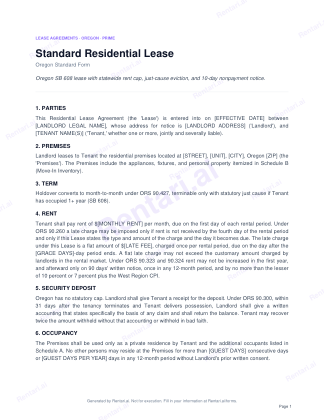
In the Rentari Oregon lease
- Application and screening fees
The lease's Oregon tenant rights section repeats the limit on the screening charge and the duty to give a receipt and written notice of the charge and criteria before accepting payment.
- Fair housing
The lease's Oregon tenant rights section says you may not refuse to rent to, or treat differently, a tenant because of a lawful source of income, including housing assistance.
- Required disclosures and lease language
The lease prints exactly one of the three smoking statements, names any smoking areas, and adds addenda naming the manager and the owner or agent, stating the foreclosure duty, recycling information and shared utilities. It does not include written alarm testing instructions.
- Flood disclosure
When you answer that the home is in a 100-year flood plain, the lease adds a flood plain notice.
- Owner and manager identity
Every Oregon lease adds an addendum naming the manager and the owner or agent with an address, and stating the tenant's right to inspect and copy the agreement.
- Security deposit limit
The Rentari Oregon lease states the deposit amount and promises a receipt. It says Oregon does not cap the deposit, except that a Portland lease states Portland's cap instead.
- Returning the deposit
The lease promises a written accounting and the balance within 31 days after the tenancy ends and the tenant delivers possession, limits claims to defaults and damage beyond ordinary wear and tear, and states the double-damages penalty.
- Deposit account and interest
The Rentari Oregon lease does not name a bank for the deposit or promise interest, which state law does not require. A Portland lease adds Portland's separate account rule with blanks for the bank's name and address and whether the account earns interest.
- Move-in condition
The lease has the tenant accept the home as documented in any move-in condition report and report existing damage in writing within seven days of move-in. A Portland lease adds Portland's signed condition report with photos and the final inspection within a week after move-out.
- Rent increases
The lease's front page and Oregon tenant rights section state the first-year bar, the 90 days' notice, one increase in 12 months, and the lesser of 10 percent or 7 percent plus the index, and say the 15-year exemption is judged on the date of each notice.
- Landlord entry
The lease requires at least 24 hours' actual notice and entry at reasonable times, respects a tenant's denial of consent, covers emergencies and written repair requests, and bars harassment.
- Repairs and habitability
The lease's Oregon tenant rights section and its habitability clause commit you to keep the home habitable, listing the main statutory items.
- Tenant repair remedies
The lease describes the tenant's 30-day termination notice with the seven- and 30-day cure periods, damages, and the $300 minor repair remedy with seven days' written notice.
- Locks and security devices
The lease has you provide keys or access devices at move-in, lets the tenant change locks without consent where the law allows, and includes the victim lock change rule.
- Smoke alarms
The lease says you provide working smoke and carbon monoxide detectors at the start of the tenancy and that the tenant may not disable them. It does not include the written testing instructions.
- Retaliation
The lease lists the protected acts and states that a tenant who is retaliated against has the unlawful ouster remedies and a defense to eviction. It creates no presumption period.
- Lockouts and utility shutoffs
The lease says nothing in it lets you change the locks or keep the tenant out except through the court process the law requires.
- Ending a month-to-month tenancy
The lease states the tenant's 30 days, your 30 days during the first year, and after that only a tenant cause or a qualifying reason on at least 90 days' notice with one month's rent unless you own four or fewer units.
- Ending a fixed-term lease early
The lease includes the victim release on 14 days' notice and the service member termination. The builder stops an early termination fee above one and a half months' rent.
- Notice for unpaid rent
The lease's notice clause says a mailed notice adds three days and that days are counted as calendar days, not counting the day of service.
- Notice for other lease violations
The lease says you waive termination for a violation only as the waiver statute provides, after accepting rent with knowledge of it for three or more rental periods, unless one of the statute's exceptions applies.
- Property left behind
The lease says you will handle anything left behind as Oregon law requires, including any notice and storage period.
- Rent control and local rules
For a Portland address the lease adds a Portland section covering relocation assistance and its amounts, the 90-day notices, and the deposit account, deduction and condition report rules, and the deposit clause states Portland's deposit cap.
Oregon numbers the lease follows
- Deposit refund deadline
- 31 days
- after the tenancy ends and the tenant delivers possession
- ORS 90.300(12)ORS 90.300(13)
- Late charge only if rent is unpaid by
- Day 4
- of the rental period, and the written agreement sets the charge
- ORS 90.260(1)
- Notice for unpaid rent
- 10 days
- served from the 8th day, or 13 days served from the 5th
- ORS 90.394(2)
- Ending a month-to-month tenancy
- 30 days
- by the tenant any time, by you only in the first year
- ORS 90.427(3)
From the Oregon lease
OREGON RESIDENTIAL LEASE AGREEMENT
RENT INCREASES (ORS 90.323, 90.324): Landlord may not increase the rent during the first year after the tenancy begins. After the first year, Landlord must give at least 90 days' written notice of an increase, may not increase the rent more than once in any 12-month period, and may not increase it by more than the maximum the Oregon Department of Administrative Services publishes each year, which is the lesser of 10 percent or 7 percent plus the Consumer Price Index.
Rent increasesORS 90.323 ORS 90.324
After the first year of occupancy Landlord may end the tenancy only for a tenant cause under ORS chapter 90 or for a qualifying landlord reason: demolishing or converting the dwelling unit, repairs or renovations that make it unsafe or unfit to occupy, occupancy by Landlord or Landlord's immediate family as a primary residence, or an accepted offer from a buyer who will occupy it as a primary residence.
Ending the tenancyORS 90.427
SMOKING POLICY DISCLOSURE (ORS 90.220, ORS 479.305): Smoking is prohibited on the premises.
Smoking policy disclosure (one of three versions)ORS 90.220(4) ORS 479.305
Oregon lease types
Pick 3, 6, 12, 18 or 36 months or your own dates. At the end, the lease ends or converts to month-to-month.
Standard lease guideEnding a month-to-month tenancy: 30 days, by the tenant any time, by you only in the first year.
Oregon month-to-month leaseUpload a lease you already use: send an unsigned one for e-signature, or store one that is already signed.
Rooms use the Oregon lease for now: add the room as its own unit and set house rules with the optional addenda.
Oregon room rentalBefore you sign
Application and screening fees
You may charge an applicant screening charge only to cover the cost of screening, no more than your average actual cost or the customary amount screening companies charge, and only one charge in any 60-day period no matter how many of your units the applicant applies for. Before accepting it, adopt written screening criteria and tell the applicant in writing the amount, your criteria and process, the rent and deposits, any renter's insurance requirement, the applicant's dispute and refund rights, and your nondiscrimination policy.
ORS 90.295 ORS 90.297 ORS 90.303 ORS 90.304
- Give a receipt for the charge, and promptly after a screening company or credit agency screens the applicant, give confirmation with a copy of its receipt. ORS 90.295(1)(a)
- Refund the charge within 30 days if you fill the unit before screening the applicant, or if the applicant withdraws in writing before you screen. Do not take a charge when you know no unit is or soon will be available. A violation costs twice the charge plus $250. ORS 90.295(4) ORS 90.295(5) ORS 90.295(6)
- A deposit to hold a unit may be taken only after you approve the applicant and before the rental agreement is signed, with a written statement of the terms. If the agreement is not signed because of your failure or because of habitability defects, return it within five business days. ORS 90.297
- When evaluating an applicant you may not consider an eviction case that was dismissed or won by the applicant, or a judgment against the applicant entered five or more years earlier; criminal history is limited to convictions and certain pending charges in listed categories, and marijuana possession convictions and medical marijuana status are off limits. ORS 90.303
- If you deny an application after screening, give a written statement of reasons within 14 days. Before denying for criminal history, let the applicant submit supplemental evidence and make an individualized assessment. A violation costs $100. The statement must identify reporting companies not already disclosed, explain why any supplemental evidence considered did not overcome the reasons for rejection, and describe any available appeal right. The state statement does not replace applicable federal consumer-report notices. ORS 90.304
- You may not ask about immigration or citizenship status, and if you verify identity you must accept the documents the statute lists, including expired government identification. ORS 90.306 ORS 90.303(6)
- Since June 5, 2026, a landlord who takes applications through a tenant portal must also offer a printable application, process applications made outside the portal, and not force an applicant who asks in writing to use the portal alone to verify identity or sign documents. Or. Laws 2026, ch. 23, § 2
- Through January 1, 2028, the current version of ORS 90.303 also excludes possession judgments on claims arising April 1, 2020 through February 28, 2022, and unpaid rent accrued during that period, including collection referrals and judgments. Check the accrual or claim date rather than treating every collection entry alike. The Legislature publishes a different version operative January 2, 2028; do not apply that future version early. ORS 90.303(1), (5) and operative-date note
- For a covered Portland application, first identify whether the landlord uses low-barrier criteria or more restrictive criteria. The low-barrier criminal criteria include three-year misdemeanor and seven-year felony sentencing windows and exclude the listed juvenile, invalidated and other records. These are not universal permission to reject everything within those windows. More restrictive criteria require the city individual assessment before denial on any proposed basis, alongside the state protections. Check the section G exemptions and any conflicting funding requirements for the actual tenancy. Portland City Code 30.01.086(D)-(G)
- Portland requires a 30-day opportunity to appeal a covered application denial and to correct, refute or explain negative information. If the appeal is approved, the city rule provides three months of prequalification for the landlord's Portland properties and a screening-fee waiver for that period, subject to the permitted self-certification that conditions have not materially changed. Keep the appeal route and decision record separate from a reporting company's dispute process. Portland City Code 30.01.086(D)(8)
- Licensed property managers and managing principal brokers have a separate professional-record duty under ORS 696.280. Covered rental-management records must be kept for at least six years after expiration, replacement, termination or otherwise ceasing to be in effect; other record categories have different starting dates. Identify the applicable record category and licensing rules. This provision does not by itself establish a six-year rule for every private owner's rejected application. ORS 696.280(1), (4)
The lease's Oregon tenant rights section repeats the limit on the screening charge and the duty to give a receipt and written notice of the charge and criteria before accepting payment.
Fair housing
Oregon bars refusing to rent, setting different terms, discouraging applicants or advertising a preference because of race, color, religion, sex, sexual orientation, gender identity, national origin, marital status, familial status or source of income. Source of income includes federal rent subsidy payments and other local, state or federal housing assistance. Discrimination because of a disability is barred by a separate statute.
ORS 659A.421 ORS 90.390 ORS 659A.145
- You may still refuse based on an applicant's past conduct, or inability to pay rent after counting the value of their housing assistance, if that is consistent with fair housing law. ORS 659A.421(2)(a)
- Renting space within your own home, where you live and share common space, is exempt from the sex, sexual orientation, gender identity and familial status rules, except for advertising. ORS 659A.421(8)
- You may not discriminate against a tenant or applicant for being a victim of domestic violence, sexual assault, bias crime or stalking. A violation costs up to two months' rent or twice actual damages, whichever is greater. ORS 90.449
- You may not ask about immigration or citizenship status or discriminate based on it. ORS 90.306
- A tenant who proves discrimination has a defense to eviction unless behind on rent, and may prove it through a neutral policy's disparate impact. ORS 90.390
- Since June 5, 2026, you may not disclose a tenant's or applicant's confidential information, such as date of birth, Social Security number, contact details, income or immigration status, except as the statute allows; a knowing violation costs twice the monthly rent. Or. Laws 2026, ch. 61, § 2
The lease's Oregon tenant rights section says you may not refuse to rent to, or treat differently, a tenant because of a lawful source of income, including housing assistance.
Required disclosures and lease language
The rental agreement must state the smoking policy: smoking prohibited on the premises, allowed on the entire premises, or allowed only in named areas. In writing at or before the start of the tenancy, disclose the manager and owner or agent with their addresses, and any utility the tenant pays that also serves you or other units. Give the tenant a copy of the agreement and every amendment.
ORS 90.220(4) ORS 479.305 ORS 90.305 ORS 90.315(2) ORS 90.220(3)
- For premises with four or fewer units, disclose in writing before signing any notice of default or trustee's sale, pending foreclosure, forfeiture or tax lien foreclosure. If the tenant moves because of an undisclosed proceeding, the tenant may recover twice the actual damages or twice the monthly rent, whichever is greater, and all prepaid rent. ORS 90.310
- An agreement that requires renter's liability insurance must describe your own comparable insurance and your duty to show proof on request; the requirement cannot apply to low-income households or publicly subsidized units the statute describes. ORS 90.222
- Give written testing instructions for smoke alarms and, where required, carbon monoxide alarms when the tenant first takes possession. ORS 479.270(1) ORS 90.317(2)
- Each fee must be described in the written agreement, and a written agreement must list any deposit. ORS 90.302(1) ORS 90.300(3)
- With five or more units in an area with multifamily recycling service, notify new tenants of the opportunity to recycle and give yearly notice. ORS 90.318
- Charges for common-area utilities must be described separately from unit charges, with how they are assessed and split. ORS 90.315(4)
- From January 1, 2027, smoking in the disclosure means inhaling or possessing a lit tobacco product. A landlord of a unit that shares a wall with another may change the policy to bar smoking inside units and indoor common areas on 180 days' written notice, if the unit is not an accessible unit, a posted smoking area remains on the premises, and a fixed term is not changed until it ends. Or. Laws 2026, ch. 60, § 1 Or. Laws 2026, ch. 60, § 2
The lease prints exactly one of the three smoking statements, names any smoking areas, and adds addenda naming the manager and the owner or agent, stating the foreclosure duty, recycling information and shared utilities. It does not include written alarm testing instructions.
Flood disclosure
If the unit is in a 100-year flood plain as mapped by the National Flood Insurance Program, the rental agreement must say so. If you leave the notice out and the tenant suffers an uninsured flood loss, the tenant may recover the actual loss or two months' rent, whichever is less.
When you answer that the home is in a 100-year flood plain, the lease adds a flood plain notice.
Owner and manager identity
At or before the start of the tenancy, tell the tenant in writing the name and address of the person authorized to manage the premises, and of an owner or a person authorized to accept legal papers and notices for the owner. Keep the information current.
- A manager who fails to make the disclosure becomes the landlord's agent for legal papers and notices. ORS 90.305(3)
- Keep a copy of each rental agreement at the manager's office or disclosed address, let the tenant inspect it within a reasonable time, and provide a copy for no more than 25 cents a page or the actual copying cost, whichever is less. ORS 90.305(4)
- The duty binds any later landlord, owner or manager. ORS 90.305(2)
Every Oregon lease adds an addendum naming the manager and the owner or agent with an address, and stating the tenant's right to inspect and copy the agreement.
Deposits, rent and fees
Security deposit limit
Not set by statuteOregon state law does not cap the amount of a security deposit. A written rental agreement must list any deposit the tenant paid or the landlord requires, and you must give the tenant a receipt for it. A last month's rent deposit counts as a security deposit.
- You may not charge a pet deposit for a service or companion animal that a tenant with a disability needs as a reasonable accommodation. ORS 90.300(4)
- During the first year of the tenancy you may not change the agreement to require a new or larger deposit, except an added deposit tied to an agreed change such as allowing a pet. After the first year, give the tenant at least three months to pay a new or increased deposit. ORS 90.300(5)
- Apply a last month's rent deposit to the last month's rent when either side gives a termination notice (other than a nonpayment notice), when you both agree to end the tenancy, or when a fixed term ends under the written agreement. ORS 90.300(9)
- Portland limits deposits to one month's rent, or half a month on top of a last month's rent deposit, plus up to half a month more when you conditionally approve an applicant, which the tenant may pay in installments over up to three months. Portland City Code 30.01.087(A) See Rent control and local rules on the Oregon page
The Rentari Oregon lease states the deposit amount and promises a receipt. It says Oregon does not cap the deposit, except that a Portland lease states Portland's cap instead.
Returning the deposit
Within 31 days after the tenancy ends and the tenant delivers possession, give the tenant a written accounting that states specifically the basis of any claim against the deposit or prepaid rent, and return the rest. Give separate accountings for the deposit and for prepaid rent. You may keep only the amount reasonably necessary to cover the tenant's defaults under the agreement, including unpaid rent, and to repair damage the tenant caused, not ordinary wear and tear.
ORS 90.300(12) ORS 90.300(13) ORS 90.300(7) ORS 90.300(16)
- Deliver the accounting or the refund in person or by first class mail, or by e-mail only if a signed e-mail addendum allows it. A refund may go electronically to the tenant's bank only under an addendum signed after the tenancy began and the tenant moved in. ORS 90.300(13) ORS 90.300(14) ORS 90.155(1)(d)
- If you miss the deadline, or withhold in bad faith, the tenant may recover twice the amount withheld without a written accounting or withheld in bad faith. ORS 90.300(16)
- You need not make a repair before charging for it. Labor must be billed at a reasonable hourly rate, and you may charge a reasonable rate for your own cleaning or repair work. ORS 90.300(7)(b)
- Machine carpet cleaning may be deducted only if the carpet was cleaned or replaced before the tenant moved in and the written agreement says the cost may be deducted whether or not the tenant cleans it. ORS 90.300(7)(c)
- Whoever holds the landlord's interest when the tenancy ends is responsible for the deposit, including a new owner. ORS 90.300(2)(b)
- Possession is delivered back when the tenant gives actual notice of giving up the unit (returning the keys can show it), or when you reasonably believe the tenant has left after a notice or term expires, or you reasonably know the unit was abandoned. ORS 90.147(2)
- A deposit may not be forfeited for failing to stay a minimum number of months in a month-to-month tenancy. ORS 90.300(8)
The lease promises a written accounting and the balance within 31 days after the tenancy ends and the tenant delivers possession, limits claims to defaults and damage beyond ordinary wear and tear, and states the double-damages penalty.
Deposit account and interest
Not set by statuteOregon state law does not require you to keep deposits in a separate account or to pay interest on them. You must hold the deposit for the tenant, and the tenant's claim to it comes ahead of your creditors, including a bankruptcy trustee.
- A deposit or prepaid rent in the landlord's hands cannot be garnished by the landlord's creditors. ORS 90.300(17)
- Portland requires deposits in a separate account within two weeks, pays any interest earned to the tenant, and requires the rental agreement to name the bank. Portland City Code 30.01.087(B) See Rent control and local rules on the Oregon page
The Rentari Oregon lease does not name a bank for the deposit or promise interest, which state law does not require. A Portland lease adds Portland's separate account rule with blanks for the bank's name and address and whether the account earns interest.
Move-in condition
Not set by statuteOregon's residential landlord and tenant law does not require a move-in inspection or a written condition checklist. Because you may deduct only for damage the tenant caused beyond ordinary wear and tear, a dated record of the home's condition at move-in is your best evidence.
- To deduct carpet cleaning, the carpet must have been cleaned or replaced before this tenant took possession. ORS 90.300(7)(c)(A)
- The buildings and grounds must be safe, clean and free of debris, rodents and vermin when the rental agreement begins. ORS 90.320(1)(f)
- Portland requires a signed condition report with photos before move-in, a seven-day window for the tenant to add to it, and a final walk-through within a week after the tenancy ends. Portland City Code 30.01.087(D) See Rent control and local rules on the Oregon page
The lease has the tenant accept the home as documented in any move-in condition report and report existing damage in writing within seven days of move-in. A Portland lease adds Portland's signed condition report with photos and the final inspection within a week after move-out.
Rent payments and late fees
A late charge is allowed only if the rent is not received by the fourth day of the weekly or monthly rental period, and only if a written rental agreement states the tenant's duty to pay it, its type and amount, the rent due date and the day the charge becomes due. The charge may be a reasonable flat amount (the customary amount in that rental market) once per rental period, a daily charge from the fifth day of up to 6 percent of that flat amount, or 5 percent of the periodic rent for each five-day period the rent stays late, beginning on the fifth day.
- Daily and five-day charges run only through the end of that rental period. In a periodic tenancy you may change the type or amount of the late charge with 30 days' written notice. ORS 90.260(2) ORS 90.260(3)
- You may not deduct an earlier late charge from a later rent payment to make that payment late. Nonpayment of a late charge alone is not grounds for a nonpayment eviction, only for a 30-day termination for cause. ORS 90.260(4) ORS 90.260(6)
- Apply payments in this order: past rent, current rent, utility or service charges, late charges, then other fees and damage claims, whatever the agreement says. ORS 90.220(9)
- Rent is due without demand at the agreed time and place, and never before the first day of the rental period. A tenant who asks is entitled to a receipt or other written evidence of each payment. ORS 90.220(7)(a) ORS 90.140(2)
- Since June 5, 2026, you must let tenants pay by check or another commercially reasonable method, may not require card, electronic check, tenant portal or other electronic payment, and may not charge a late fee or terminate for nonpayment if you refused such a payment. Or. Laws 2026, ch. 23, § 3 Or. Laws 2026, ch. 23, § 7
- A processing fee for a card or electronic payment may be passed to the tenant only if the processor allows it, the tenant may pay by non-electronic means, and you share the fee records on written request. Or. Laws 2026, ch. 23, § 5
Returned payment fee
For a dishonored check you may charge a fee of up to $35, plus any amount your bank charged you for processing it, if the fee is described in the written rental agreement. The dishonored check statute covers a check, draft or order for the payment of money.
ORS 90.302(1) ORS 90.302(2)(b) ORS 30.701(5) ORS 30.701(7)(a)
- A fee is not rent. Nonpayment of a fee is not grounds for a nonpayment eviction, only for a termination for cause. ORS 90.302(6) ORS 90.100(41)(b)
- A rent check that is dishonored does not count as accepting rent for waiver purposes. ORS 90.412(3)(b)
Rent increases
Except in a week-to-week tenancy, you may not raise the rent during the first year of the tenancy. After that, give at least 90 days' written notice, raise it no more than once in any 12-month period, and stay within the maximum the Oregon Department of Administrative Services publishes each year by September 30: the lesser of 10 percent or 7 percent plus the West Region consumer price index. In a week-to-week tenancy, give at least seven days' written notice.
- The notice must state the amount of the increase, the new rent, the date it takes effect and, if the increase is above the cap, the facts supporting the exemption. ORS 90.323(3)
- The percentage cap does not apply when the unit's first certificate of occupancy was issued less than 15 years before the date of the increase notice, or to certain regulated affordable housing. The first-year bar, the 90 days and the once-a-year limit still apply. ORS 90.323(5)
- An increase above the cap costs three months' rent plus the tenant's actual damages. ORS 90.323(6)
- If you end a tenancy without cause during the first year, the next tenant's rent may not exceed what the cap would have allowed for the old tenancy. ORS 90.323(4)
- The rent in a fixed term tenancy may not be changed by one side alone during the term. ORS 90.220(2)
- Portland adds relocation assistance when a tenant receives an increase of 10 percent or more within 12 months and asks for it in writing within 45 days. Portland City Code 30.01.085(C) See Rent control and local rules on the Oregon page
- For tenancies subject to ORS 90.323 and its percentage cap, DAS published a 9.5 percent maximum for calendar year 2026 and a 10 percent maximum for calendar year 2027. Use the percentage for the calendar year of the increase, together with the notice, timing and exemption rules above. Manufactured-dwelling and marina space tenancies governed by ORS 90.600 follow a separate regime. DAS: corrected 2026 percentages DAS: 2027 percentages, published September 28, 2026 ORS 90.323(7), 90.324
The lease's front page and Oregon tenant rights section state the first-year bar, the 90 days' notice, one increase in 12 months, and the lesser of 10 percent or 7 percent plus the index, and say the 15-year exemption is judged on the date of each notice.
During the tenancy
Landlord entry
Give the tenant at least 24 hours' actual notice of your intent to enter, and enter only at reasonable times, unless you and the tenant agree otherwise about a specific entry. You may not enter if the tenant, after receiving the notice, denies consent, but the tenant may not unreasonably withhold consent, and you may not abuse the right of access or use it to harass.
- In an emergency you may enter without notice at any time. If the tenant was absent, give actual notice within 24 hours stating the entry, its date and time, the emergency and who entered. ORS 90.322(1)(b)
- A written repair request lets you enter to make that repair without further notice; the authority lasts seven days unless the repair is in progress. ORS 90.322(1)(c)
- Entry without notice to show a home for sale needs a separate signed agreement, made while you are actively selling, with separate payment to the tenant. ORS 90.322(1)(d)
- During a tenant absence of more than seven days you may enter at times reasonably necessary. ORS 90.410(2)
- For an unlawful or harassing entry the tenant may get a court order, end the agreement, and recover at least one month's rent (one week's in a week-to-week tenancy). If a tenant refuses lawful access, you may get a court order or terminate for cause and recover damages. ORS 90.322(7) ORS 90.322(8)
The lease requires at least 24 hours' actual notice and entry at reasonable times, respects a tenant's denial of consent, covers emergencies and written repair requests, and bars harassment.
Repairs and habitability
Keep the dwelling unit habitable at all times during the tenancy. A unit is not habitable if it substantially lacks weatherproofing, working plumbing, safe hot and cold running water, adequate heating, safe electrical wiring and lighting, safe and clean buildings and grounds, garbage receptacles, floors, walls, stairs and railings in good repair, working locks and window latches, required smoke and carbon monoxide alarms, or appliances and air conditioning you supply kept in good repair.
- A unit in a building permitted on or after April 1, 2024 must have adequate cooling in at least one room other than a bathroom. ORS 90.320(1)(n)
- A tenant may agree in writing to do specified repairs or maintenance only if the agreement is made in good faith, not to evade your duties, does not reduce your duties to other tenants, and states adequate consideration. ORS 90.320(2)
- The tenant must keep the unit clean and sanitary, dispose of waste properly, use facilities reasonably and not damage the premises. ORS 90.325
- Provide a route of exit from each bedroom, and a secondary route where required, that meets the law in effect when the building was occupied or last renovated. ORS 90.460
- You may not bar a tenant's portable air conditioner or cooler except for the safety, code and installation reasons the statute lists, and restrictions must be in writing. ORS 90.355
The lease's Oregon tenant rights section and its habitability clause commit you to keep the home habitable, listing the main statutory items.
Tenant repair remedies
If you materially fail to keep the home habitable or to follow the rental agreement, the tenant may give written notice that the agreement will end on a date at least 30 days later unless you fix the breach within seven days for an essential service or 30 days in other cases. The tenant may also recover damages and get a court order, but not for a condition the tenant caused.
ORS 90.360 ORS 90.365 ORS 90.368
- If the same breach recurs within six months, the tenant may end the agreement on 14 days' written notice. In a week-to-week tenancy these periods are seven days. ORS 90.360(1)(a) ORS 90.360(1)(c)
- For a minor habitability defect that can be fixed for $300 or less, after written notice giving at least seven days, the tenant may have the repair done by others and deduct up to $300 from rent. Mold, radon, asbestos and lead-based paint are excluded, and the tenant may not do the work personally. ORS 90.368
- If you intentionally or negligently fail to supply an essential service, after written notice and a reasonable time the tenant may buy the service and deduct its cost, or recover reduced rental value; if the failure makes the unit unsafe or unfit to live in, the tenant may instead move to substitute housing and pay no rent meanwhile. ORS 90.365(1)
- Where the lack of an essential service is an imminent and serious threat to health, safety or property, the tenant may give notice ending the agreement in not less than 48 hours unless you fix it. ORS 90.365(2)
- If the agreement ends under these sections, return the deposit and prepaid rent as the deposit statute requires. ORS 90.360(5)
The lease describes the tenant's 30-day termination notice with the seven- and 30-day cure periods, damages, and the $300 minor repair remedy with seven days' written notice.
Locks and security devices
Provide working locks on all dwelling entrance doors and latches on all windows through which the unit can be reached, and a means of unlocking them and of reaching every common area the tenant may use, such as a code, fob, key card or key. Since June 5, 2026, at least one of those means must be something other than a tenant portal.
ORS 90.320(1) Or. Laws 2026, ch. 23, § 6
- Locks for exterior doors and window latches are essential services, so failing to supply them triggers the tenant's essential services remedies. ORS 90.100(15) ORS 90.365
- A tenant who gives actual notice of being a victim of domestic violence, sexual assault, bias crime or stalking may ask you to change the locks, with no proof needed. Change them promptly at the tenant's expense or let the tenant do it; if you do not act promptly, the tenant may change them and must give you a key. ORS 90.459
- Chapter 90 does not require rekeying between tenants. ORS 90.320
The lease has you provide keys or access devices at move-in, lets the tenant change locks without consent where the law allows, and includes the victim lock change rule.
Smoke alarms
Supply, install and maintain the required smoke alarms or detectors, with working batteries, before every new tenancy, and give the tenant written testing instructions when the tenant first takes possession. During the tenancy, your duty to maintain them arises when the tenant gives written notice of a problem other than dead batteries.
- Where the unit contains a carbon monoxide source, or connects by a door, duct or shaft to a room that does, you may not start a new tenancy without working carbon monoxide alarms, and you must supply batteries and written testing instructions and repair a reported deficiency. ORS 90.316 ORS 90.317
- The tenant must test alarms at least every six months, replace batteries as needed and report problems in writing. ORS 90.325(1)(f)
- You may charge a fee of up to $250 for removing or tampering with a working alarm, unless the State Fire Marshal assesses a civil penalty for it. ORS 90.302(2)(c)
- Supplying and maintaining the alarms is part of keeping the unit habitable. ORS 479.270(3) ORS 90.320(1)(j)
The lease says you provide working smoke and carbon monoxide detectors at the start of the tenancy and that the tenant may not disable them. It does not include the written testing instructions.
Retaliation
You may not retaliate by raising rent, decreasing services, serving a termination notice, or bringing or threatening an eviction because the tenant complained to a government agency about a health or safety code violation, made a good faith complaint to you about the tenancy, organized or joined a tenants' union, testified against you, successfully defended an eviction you brought in the previous six months, or asserted any right tenants have under federal, state or local law.
- Decreasing services includes unreasonably restricting common areas for tenant meetings and intentionally interfering with the tenant's use of the home. ORS 90.385(2)
- A tenant who is retaliated against has the remedies for unlawful ouster and a defense to eviction. ORS 90.385(3) ORS 90.375
- You may still evict if the complaint was made unreasonably or to harass, the tenant caused the code violation, the tenant was behind on rent when the notice was served, or code compliance requires work that makes the unit unusable. ORS 90.385(4)
- A complaint made by someone else on the tenant's behalf counts as the tenant's complaint. ORS 90.385(5)
- Using the home as a family child care home under the statute is also protected. ORS 90.385(1)(f)
The lease lists the protected acts and states that a tenant who is retaliated against has the unlawful ouster remedies and a defense to eviction. It creates no presumption period.
Lockouts and utility shutoffs
You may not remove or exclude a tenant, or willfully cut off heat, running water, hot water, electricity or another essential service, or seriously attempt or threaten to. The tenant may get a court order to recover possession, or end the agreement and recover up to two months' rent or twice the actual damages, whichever is greater. Recover possession only through a court action.
- Entry onto property must be lawful and peaceable, never by force. ORS 105.105
- Essential services include heat, plumbing, hot and cold water, gas, electricity, light fixtures, locks for exterior doors, window latches, and any cooking appliance or refrigerator you supply. ORS 90.100(15)
- If a utility you are responsible for is shut off for unpaid bills, the tenant may pay it and deduct the amount from rent, or end the agreement on 72 hours' notice unless service is restored; you then return prepaid rent within four days and the deposit. ORS 90.315(7)
- If the tenant cannot get service in their own name because a prior occupant or the owner owes the provider, the tenant may pay and deduct, or end the agreement. ORS 90.315(5) ORS 90.315(6)
- Apart from the entry statute, you have no right of access except by court order, during an extended absence, or after the tenant abandons or gives up the unit. ORS 90.322(5)
The lease says nothing in it lets you change the locks or keep the tenant out except through the court process the law requires.
Ending a tenancy
Ending a month-to-month tenancy
A tenant may end a month-to-month tenancy at any time with at least 30 days' written notice. You may end one without cause with 30 days' written notice only during the first year of occupancy. After the first year, you may end it only for a tenant cause under the statute, or for a qualifying landlord reason with at least 90 days' written notice stating the reason and supporting facts: demolition or conversion, repairs that make the unit unsafe or unfit to live in, occupancy by you or an immediate family member when you have no comparable unit in the building, or a sale to a buyer who will live there.
- With a qualifying-reason notice, pay the tenant one month's rent when you deliver the notice, unless you have an ownership interest in four or fewer dwelling units. ORS 90.427(6)
- For a sale to a buyer who will live there, the notice may be 60 days if you give written evidence of the accepted offer and also pay one month's rent at the time of the notice. ORS 90.427(5)(b)
- The first year of occupancy lasts while any tenant in the unit has lived there one year or less. ORS 90.427(1)(a)
- If you live in the same building or on the same property and it has no more than two units, after the first year you may end a month-to-month tenancy without cause on 60 days' notice, or 30 days for a sale to a buyer who will live there. ORS 90.427(8)
- A week-to-week tenancy ends on 10 days' written notice from either side. ORS 90.427(2)
- Ending a tenancy in violation of the qualifying-reason or three-violation rules costs three months' rent plus actual damages, and gives the tenant a defense to eviction. ORS 90.427(9)
The lease states the tenant's 30 days, your 30 days during the first year, and after that only a tenant cause or a qualifying reason on at least 90 days' notice with one month's rent unless you own four or fewer units.
Ending a fixed-term lease early
During a fixed term you may end the tenancy only for cause. If the term ends within the first year of occupancy, you may end it without cause with 30 days' written notice before the end date. A term that ends after the first year becomes month-to-month unless you agree to a new term, the tenant gives 30 days' notice, or you have a qualifying landlord reason and give the required notice.
- A written agreement may set a fee for a tenant who abandons the unit during a fixed term without cause, up to one and a half times the monthly rent. If you charge it, you may not recover later rent or re-renting costs. Any other liquidated damages are barred. ORS 90.302(2)(e) ORS 90.302(5) ORS 90.245(1)(d)
- If the tenant abandons the unit, make reasonable efforts to re-rent it at a fair rent; the agreement ends when a new tenancy begins. ORS 90.410(3)
- A victim of domestic violence, sexual assault, bias crime or stalking may be released on 14 days' written notice with verification, with no fee and no rent after the release date. ORS 90.453
- A service member who enlists, is ordered to active service outside the area for more than 90 days, or leaves active service may end the agreement with proof of orders, with no penalty, fee or loss of deposit. ORS 90.475
- You may decline to renew a fixed term after three written warnings for violations within 12 months, with 90 days' notice before the end of the term. ORS 90.427(7)
- Since June 5, 2026, if a natural disaster destroys the unit, the tenancy ends at once unless you and the tenant agree otherwise afterward; you return the deposit and prepaid rent, including rent prorated from the date of the disaster, under the deposit statute, and no rent is owed while the unit is inaccessible. Or. Laws 2026, ch. 108, § 21
- For example, with monthly rent of $1,600, one and a half months is $2,400. That is the ceiling for the lease-break fee described above when a valid written provision and the circumstances allow it, not an automatic charge for every early move. If that fee is charged, do not add later rent or re-renting costs. Keep any separately owed earlier rent or damage items identified in the final accounting, and check whether a protected termination or agreed release applies first. ORS 90.302(2)(e): fixed-term abandonment fee
The lease includes the victim release on 14 days' notice and the service member termination. The builder stops an early termination fee above one and a half months' rent.
Notice for unpaid rent
To end a month-to-month or fixed-term tenancy for unpaid rent, deliver either at least 10 days' written notice served no sooner than the eighth day of the rental period, or at least 13 days' written notice served no sooner than the fifth day, counting the rent due date as day one. The notice must state the amount to pay and the date and time by which paying it cures the nonpayment. In a week-to-week tenancy the notice is 72 hours, served no sooner than the fifth day.
- With every nonpayment termination notice, include a copy of the rental assistance notice the Oregon Judicial Department posts. A court dismisses the case if you did not, if you caused the tenant not to pay, or if rental assistance or other payment covering the amount was tendered. ORS 90.395
- Every termination notice must also include the information for veterans that ORS 408.515 requires. ORS 90.391
- A notice sent only by first class mail adds three days to the period, and the notice must include them. Days are counted as consecutive calendar days, not counting the day of service, through 11:59 p.m. of the last day. ORS 90.155(2) ORS 90.160(1)
- You may note a late charge on the notice only if it makes clear the tenant can cure by paying the rent alone. ORS 90.260(6)
- Accepting part of the rent waives termination for nonpayment unless the statute's conditions are met, such as a written agreement made after the notice. ORS 90.417(4)
The lease's notice clause says a mailed notice adds three days and that days are counted as calendar days, not counting the day of service.
Notice for other lease violations
For a material violation of the rental agreement or the tenant's statutory duties, give written notice describing the violation and ending the tenancy on a date at least 30 days after delivery. If the tenant can cure it, the notice must say so, describe a way to cure, and give a cure date at least 14 days after delivery; a cured violation does not end the tenancy. For a separate, one-time act that is not ongoing, the cure date may be the day the notice is delivered.
- If substantially the same violation recurs within six months after an earlier notice, a new notice may end the tenancy on at least 10 days' notice, with no right to cure. This does not apply when the only violation is failing to pay the current month's rent. ORS 90.392(5)
- In a week-to-week tenancy the periods are seven days to terminate, four days to cure and four days for a repeat. ORS 90.392(6)
- For serious acts, such as seriously threatening or inflicting substantial personal injury, intentionally causing substantial damage, or acts outrageous in the extreme, 24 hours' written notice is enough. ORS 90.396
- You waive the right to terminate for a violation if you accept rent with knowledge of it during three or more rental periods, unless you gave the written warning notice the statute describes or another listed exception applies. ORS 90.412
The lease says you waive termination for a violation only as the waiver statute provides, after accepting rent with knowledge of it for three or more rental periods, unless one of the statute's exceptions applies.
Eviction process
Partly readAfter a valid termination notice expires, recover possession through a forcible entry and detainer action in the circuit court, or before a justice of the peace, of the county where the property is. The filing fee is $88, and the first appearance is set seven days after the judicial day following payment of the fee, or 15 days for a nonpayment case. A possession judgment requires a separate restitution notice, the applicable move-out period and, if necessary, a court-issued writ enforced by the sheriff. A landlord cannot remove a tenant merely because the termination notice or court hearing has ended.
ORS 105.110 ORS 105.130 ORS 105.135 ORS 105.151 ORS 105.159 ORS 105.161
- The clerk mails the summons and complaint to the tenant at the premises, and the process server delivers them in person or attaches them to the main entrance, by the end of the next judicial day. ORS 105.135(3)
- In a nonpayment case the summons includes the rental assistance notice, and the court dismisses the case if the notice was not delivered with the termination notice or payment covering the amount was tendered. ORS 105.135(2)(d) ORS 90.395(3)
- A landlord may appear through an attorney or through a nonattorney agent or employee. ORS 105.130(4)
- A tenant may get more than a two-day continuance only by paying the rent into court as it comes due or giving security. ORS 105.140
- A defendant may not bring a counterclaim unless a statute allows it. ORS 105.132
- When both parties appear and have not settled, the ordinary trial window is 15 to 30 days after the appearance for a nonpayment claim, and as soon as practicable within 15 days for another claim. Follow the actual court schedule and any applicable exception. An unrepresented tenant files and serves an answer on the first-appearance day; the answer does not necessarily limit the defenses at trial. ORS 105.137(6)-(9)
- A temporary provision permits qualifying new parents receiving medical assistance and approved health-related social needs housing supports to seek a rescheduled nonpayment trial. It requires a supported motion, documentation delivered to the landlord and the stated filing deadline. The court determines eligibility; the compiled provision provides a 90-to-104-day window from the motion and repeal on September 28, 2027. ORS 105.137 note (2025 c.598 sections 1-3)
- A tenant missing first appearance does not itself establish every requirement for a default possession judgment. The court also checks the complaint and the landlord's sworn statement about continuing possession. A landlord missing first appearance while the tenant appears faces dismissal. Preserve notices, service proof, the agreement and admissible evidence; neither a ledger nor a missed hearing substitutes for the court's decision. ORS 105.137(1)-(3) ORS 105.145
- For a court-approved performance or payment agreement, follow the order and the separate noncompliance procedure. A tenant may request a hearing contesting a landlord's declaration before a writ issues; a timely hearing request prevents issuance pending the hearing. If the tenant appears and the court rules for the landlord, the statute requires at least 24 hours before the writ may issue. ORS 105.146 ORS 105.148 ORS 105.149
- After judgment or a later possession date in it, request the clerk's restitution notice and arrange statutory service by the sheriff or a qualifying process server. The notice gives at least four days to move out. Its clock begins the day after both mailing and service, and the final-day weekend or holiday rule matters. Unless the judgment provides otherwise, the clerk cannot issue the notice or writ more than 60 days after the later of judgment entry or its possession date. ORS 105.151 ORS 105.158 ORS 105.159
- Only after the restitution period expires may the landlord request the writ. The sheriff serves and enforces it, returning possession under the judgment. An unserved and unenforced writ expires after 30 days unless the court grants the specified extension. A new rental agreement, or accepting rent for occupancy beginning after judgment, bars enforcing that judgment. Confirm any stay, settlement or changed payment facts before requesting enforcement; remaining belongings require their separate statutory process. ORS 105.159 ORS 105.161
- Start with the Oregon Judicial Department's current residential eviction forms and landlord instructions, then check the property county's court page for additional local forms. Statewide forms are accepted in circuit courts, but they do not cover every situation. Keep the termination notice, service records, rental agreement and payment history together so dates and amounts stay consistent across the filing and hearing materials. Court staff can explain filing steps but cannot choose the legal form for you. Oregon Judicial Department: landlord-tenant help
Property left behind
Before you store, sell or dispose of property a tenant left after the tenancy ended, give written notice in person or by first class mail to the premises, any known post office box and any forwarding address. The notice gives the tenant a date to contact you, at least five days after personal delivery or eight days after mailing, and says the property is stored and may be sold or disposed of if not claimed.
- The process applies when the tenancy has ended and you reasonably believe the tenant does not intend to claim the property, when the tenant has been gone seven days after a court-ordered termination that was not carried out, or after the sheriff returns possession to you. ORS 90.425(2)
- Store the property in a place of safekeeping with reasonable care; rotting food may be thrown out promptly. You may charge reasonable storage and removal costs, but after a sheriff returns possession to you, you may not require storage charges before releasing the property. ORS 90.425(7) ORS 90.425(5)(f) ORS 90.425(5)(g)
- If the tenant responds in time, make the property available by appointment for 15 days. If no one responds or removes it, you may sell it, or dispose of it if it is worth $1,000 or less or storage and sale would cost more than it would bring. ORS 90.425(8) ORS 90.425(10)
- After the tenancy ends, or within seven days before, you and the tenant may agree in writing, in good faith, to a different arrangement. ORS 90.425(26)
- If you do not follow the statute, the tenant is relieved of liability for unpaid rent and for damage that was not deliberate, intentional or grossly negligent, and may recover up to twice actual damages. ORS 90.425(17)
The lease says you will handle anything left behind as Oregon law requires, including any notice and storage period.
Small claims
A claim for money or property of $750 or less generally must be brought in the small claims department of the circuit court, and one of up to $10,000 may be. A claim of $750 or less under a statute that allows attorney fees, such as the landlord and tenant law, may be filed in either small claims or the regular circuit court. Hearings are informal, and no attorney may appear for a party without the judge's consent.
ORS 46.405 ORS 46.405(5) ORS 46.415 ORS 90.255
- A business or other entity may appear in small claims without an attorney. ORS 46.415(5)
- Class actions may not be brought in small claims. ORS 46.405(4)(a)
- In any case on a rental agreement or under the landlord and tenant statutes, reasonable attorney fees may be awarded to the prevailing party, whatever the agreement says. ORS 90.255
More Oregon rules
Preparing your first Oregon rental
Partly readBefore handing over keys, bring the property, application process, lease and management records into one workable plan. Use the detailed topics in this guide for Oregon’s specific requirements and check the rules for the property’s city before advertising.
- Build the budget before choosing an asking rent. Compare similar homes by location, size, condition and included services, then list the costs you will actually pay: taxes, insurance, utilities, repairs, turnover and vacancy. Keep an allowance for unexpected work and distinguish a listing’s asking rent from collected income. Review Oregon’s rent-increase rules before assuming future increases will cover a shortfall. ORS 91.225 See Rent increases on the Oregon page
- Check local rental registration, inspections and safety requirements for the address. Finish habitability work, check required alarms and locks, arrange a repair contact and document the starting condition with dated photos. Tell the resident how to report routine maintenance and urgent problems, and retain requests, responses and completion records. ORS 90.320 ORS 90.325 See Repairs and habitability on the Oregon page
- Before charging for screening, prepare the written criteria, process, charges and required applicant disclosures described above. Review the permitted records, refund duties and any applicable local screening rules. Prepare the lease with clear rent, deposits, utilities, smoking policy, manager and notice contacts; provide required disclosures and copies. Keep the application fee record separate from the security deposit accounting. ORS 90.295 ORS 90.220(4) ORS 479.305 ORS 90.305 See Application and screening fees on the Oregon page
- Set up a ledger and a secure place for signed agreements, receipts, condition photos, notices and communications. Explain the available payment methods and record each payment consistently. Calendar rent-review dates, lease events and notice deadlines from the applicable guide sections. Organizing the workflow with software still requires you to review decisions and follow through on repairs. ORS 90.260 ORS 90.320 See Required disclosures and lease language on the Oregon page
Adverse possession and disputed occupancy
Partly readOregon’s adverse-possession rule requires more than ten years of presence. A claimant must meet the possession requirements and the statute’s honest, objectively supported and reasonable ownership-belief test. A claim to title is separate from the procedure for recovering possession from an occupant.
ORS 105.620: acquiring title by adverse possession
- ORS 105.620 requires ten years of actual, open, notorious, exclusive, hostile and continuous possession by the claimant and any predecessors in interest. At first entry, the person entering must honestly believe they are the actual owner, and that belief must continue through the vesting period, have an objective basis and be reasonable in the circumstances. Every statutory element must be proved by clear and convincing evidence. ORS 105.620: acquiring title by adverse possession
- For this section, hostile possession means possession under a claim of right or color of title; it does not mean threatening behavior. Color of title refers to a claimed written conveyance or the specified chain from one. Mail, landscaping, payments or photographs may be part of the evidence, but no one item replaces the complete legal test. Review the deed history, boundaries, permission and possession together. ORS 105.620: acquiring title by adverse possession
- Keep the deed, legal description or survey, leases and permission records, payment history, dated condition observations, notices, communications and court papers together. Maintain secure access and arrange lawful checks of vacant property. Where a tenancy or ownership claim is disputed, obtain help identifying the appropriate notice and court action. Preserve the tenant protections against personal lockouts and utility shutoffs; do not assume a single ten- or thirty-day notice fits every occupant. ORS 90.375 ORS 105.105 See Eviction process on the Oregon page
Local rules
Rent control and local rules
Oregon has a statewide cap on rent increases for most homes, and cities and counties may not adopt their own rent control. The only exceptions are rent limits in contracts for subsidized low-income housing, limits during a condominium conversion notice period, and temporary controls after a disaster that wipes out much of the housing supply.
- The statewide cap is the lesser of 10 percent or 7 percent plus the index, published yearly, with an exemption for units whose first certificate of occupancy is less than 15 years old. ORS 90.323 ORS 90.324 See Rent increases on the Oregon page
- Cities and counties may still add other tenant protections. Portland requires relocation assistance of $2,900 to $4,500 for no-cause and qualifying-reason terminations and for increases of 10 percent or more, and has its own deposit and screening rules. Portland City Code 30.01.085 Portland City Code 30.01.087 Portland City Code 30.01.086
- For a covered Portland rent increase of 10 percent or more in a rolling 12-month period, a tenant has 45 calendar days after receiving the increase notice to request relocation assistance in writing. The landlord must pay within 31 calendar days after receiving that request: $2,900 for a studio or single-room-occupancy unit, $3,300 for one bedroom, $4,200 for two bedrooms, or $4,500 for three or more bedrooms. Check the city exemption requirements before claiming an exemption. Portland City Code 30.01.085(C), (I)
- Include the tenant's rights, obligations and eligible assistance amount with the increase notice and relocation payment, and report payments to the Portland Housing Bureau within 30 days. After receiving assistance for an increase, the tenant has six months from the increase's effective date to repay it and stay, or give a termination notice under the state Act. Portland City Code 30.01.085(C)-(E)
For a Portland address the lease adds a Portland section covering relocation assistance and its amounts, the 90-day notices, and the deposit account, deduction and condition report rules, and the deposit clause states Portland's deposit cap.
Portland requires relocation assistance of $2,900 (studio) to $4,500 (three bedrooms or more) when you end a tenancy without cause or for a qualifying landlord reason, and when a tenant who receives an increase of 10 percent or more in 12 months asks for it within 45 days. It also caps deposits at one month's rent (or half a month on top of a last month's rent deposit, plus half a month more for a conditional approval), requires a separate deposit account and a signed condition report with photos, and sets first-come screening rules. Its relocation exemptions require an application to the Portland Housing Bureau.
Portland City Code 30.01.085 Portland City Code 30.01.087 Portland City Code 30.01.086
Other cities and counties may have their own housing, building and tenant protection codes. None was read for this page; check the codes where the property is located.
Oregon lease renewals
Read the agreement's renewal clause and the notice rules above before choosing a new term, changing rent or ending the tenancy. A fixed end date does not override applicable renewal rights, rent regulation, just-cause rules or protections against retaliation and discrimination.
Confirm the notice, timing and delivery requirements for the rental's state and locality. Review any required new disclosures and attachments when preparing the renewal. Get the parties' agreement to changed terms in writing.
Customize an unsigned agreement or prepare an addendum to an existing lease.
How it works
- Add your Oregon rental
Enter the property and its units.
- Set the terms
Choose the rental, add tenants, and set rent, deposit and fees.
- Review the lease
Preview and edit the Oregon lease and its addenda.
- Send for e-signature
Tenants sign online; sending is included on paid plans.
Follow the full lease builder guide, add supporting files, or download and print the agreement.
Oregon lease questions
Does the Rentari Oregon lease include the smoking policy disclosure?
Yes. It prints exactly one of the three statements Oregon requires, based on your answers: smoking prohibited on the premises, allowed on the entire premises, or allowed in limited areas, which it names.
What if I require renter's insurance?
The Oregon lease adds the description the statute requires: you must carry comparable liability insurance and show proof on request, you may be named only as an interested party, and the requirement does not apply to the low-income and subsidized tenancies the statute exempts.
Can I add a move-in fee or an early termination fee?
The builder stops a move-in fee, which Oregon does not allow, and an early termination fee above one and a half months' rent.
Does the lease handle the first-year rules for ending a tenancy?
Yes. It states the 30-day notice for the tenant and for you during the first year of occupancy, and after that the tenant cause or qualifying reason rule with 90 days' notice and one month's rent unless you own four or fewer units.
Does the lease cover Portland's rules?
Yes, in part. A Portland lease states the city's deposit cap, adds its relocation assistance amounts and notice rules, and adds its deposit account and condition report rules. Portland's screening rules are not built in, so apply them yourself.
Portland City Code 30.01.085 Portland City Code 30.01.087 Portland City Code 30.01.086