- Home
- Lease agreement
- Pennsylvania
Pennsylvania residential lease agreement
State rules checked October 1, 2026 General information, not legal advice
Jump to a topic
Pennsylvania lease document preview
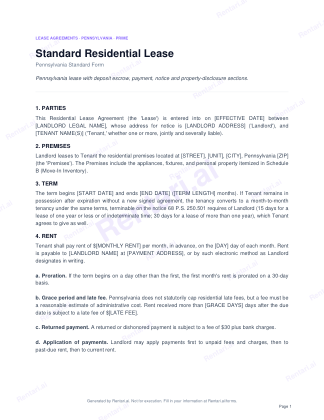
In the Rentari Pennsylvania lease
- Required disclosures
The lease prints a Pennsylvania rights box on deposits, deposit return, plain language and notices to quit, and the federal lead paint disclosure for homes built before 1978.
- Security deposit limit
The Pennsylvania lease states the deposit and repeats the two-month limit for the first year, the one-month limit from the second year and the five-year rule.
- Deposit return
The lease repeats the 30-day list and payment rule, the loss of the right to withhold, double damages and the tenant's duty to give a new address in writing.
- Move-in condition
The lease records that the tenant accepts the home's condition at move-in, with a line for documented exceptions.
- Landlord entry
The lease says Pennsylvania has no statewide entry notice period and, as a lease term, promises at least 24 hours' written notice (or the longer period you set) before non-emergency entry, plus Philadelphia's notice rules for homes in Philadelphia.
- Repairs and habitability
The lease states an implied warranty of habitability, asks the tenant for written notice of a defect and a reasonable time to repair, and describes the City Rent Withholding Act.
- Tenant repair remedies
The lease describes the City Rent Withholding Act escrow and states, from Pennsylvania case law, that repair and deduct, rent abatement and termination may follow a material breach of habitability.
- Retaliation
The lease cites the tenants' association rule and, as a lease term, promises no termination, non-renewal, rent increase or service cut because the tenant reported a code violation, asked for a repair or used a legal right.
- Lockouts and utilities
The lease says nothing in its abandonment clause allows self-help repossession.
- Ending a month-to-month tenancy
The lease states the 15-day notice to quit and, as a lease term, lets the tenant end a month-to-month tenancy on 15 days' written notice.
- Nonpayment notice
The lease states the 10-day notice, how it may be served, and that this lease does not shorten or waive any notice period.
- Lease violation notice
The lease states the 15-day and 30-day periods by lease length.
- Eviction process
The lease names the magisterial district judge, or the Philadelphia Municipal Court, for possession cases and notes the appeal to the court of common pleas.
68 P.S. § 250.502(a) 68 P.S. § 250.503(a) 42 Pa.C.S. § 1515(a)(2)
- Abandoned property
The lease restates when property may be treated as abandoned, the mailed notice, the 10-day pickup window, storage for up to 30 days on request and the protection from abuse exception.
- Small claims
The lease's venue clause names these courts and the $12,000 civil limit.
- Rent control and local rules
On a Philadelphia lease, the Rentari lease adds a section of Philadelphia rental rules.
Pennsylvania numbers the lease follows
- Security deposit limit
- 2 months
- of rent in the first year; 1 month from the second year
- 68 P.S. § 250.511a(a), (b)
- Deposit refund deadline
- 30 days
- after the lease ends or the home is surrendered and accepted, whichever is first
- 68 P.S. § 250.512(a)
- Unpaid rent notice
- 10 days
- from service of the written notice to quit; the lease may shorten or waive it
- 68 P.S. § 250.501(b), (e)
- Lease violation notice
- 15 or 30 days
- 15 for a lease of one year or less, 30 for a longer lease; no right to cure
- 68 P.S. § 250.501(b)
- Ending month-to-month
- 15 days
- from service of the written notice to quit; the lease may shorten or waive it
- 68 P.S. § 250.501(b), (e)
- Entry notice
- No state rule
- the Landlord and Tenant Act sets none; set it in the lease
- Landlord and Tenant Act of 1951
- Rent increase notice
- No state rule
- the Landlord and Tenant Act sets none statewide
- Landlord and Tenant Act of 1951
- Late fee grace period
- No state rule
- no statutory grace period or late fee cap
- Landlord and Tenant Act of 1951
- Abandoned property
- 10 days
- from the postmark of your mailed notice; storage up to 30 days on request
- 68 P.S. § 250.505a(d)
- Small claims limit
- $12,000
- before a magisterial district judge, not counting interest and costs
- 42 Pa.C.S. § 1515(a)(3)
From the Pennsylvania lease
PENNSYLVANIA RESIDENTIAL LEASE AGREEMENT
68 P.S. 250.501 requires a written notice to quit: fifteen (15) days where the lease is for a term of one year or less or for an indeterminate time (a month-to-month tenancy is indeterminate), thirty (30) days where the lease is for more than one year, and ten (10) days where Tenant has failed on demand to pay rent that is due.
Notice to quit68 P.S. § 250.501(b)
If a Tenant who is the sole tenant of the Premises dies during the Term, the executor or administrator of the Tenant's estate may terminate this Lease on fourteen (14) days' written notice to Landlord, effective on the later of the last day of the second calendar month after the calendar month in which the Tenant died, or the surrender of the Premises and removal of all of the Tenant's personal property.
Death of a sole tenant68 P.S. § 250.514
Tenant has ten (10) days from the postmark to retrieve the property or to ask that it be stored, and on request Landlord shall retain or store it for up to thirty (30) days from the date of the notice at a place of Landlord's choosing, at Tenant's cost, exercising ordinary care and making the property reasonably available for retrieval.
Abandoned property68 P.S. § 250.505a(d)
Pennsylvania lease types
Pick 3, 6, 12, 18 or 36 months or your own dates. At the end, the lease ends or converts to month-to-month.
Standard lease guideEnding month-to-month: 15 days, from service of the written notice to quit; the lease may shorten or waive it.
Pennsylvania month-to-month leaseUpload a lease you already use: send an unsigned one for e-signature, or store one that is already signed.
Rooms use the Pennsylvania lease for now: add the room as its own unit and set house rules with the optional addenda.
Pennsylvania room rentalBefore you sign
Application and screening fees
Partly readThe Landlord and Tenant Act sets no limit on application or screening fees. No other Pennsylvania law on these fees was read for this page.
Landlord and Tenant Act of 1951
- Screening decisions are still subject to the state fair housing law. 43 P.S. § 955(h) See Fair housing on the Pennsylvania page
- An application may not ask about race, color, familial status, age, religious creed, ancestry, sex, national origin or disability. 43 P.S. § 955(h)(6) See Fair housing on the Pennsylvania page
- The FTC explains that consumer reports include credit, rental, eviction and criminal-history reports, screening recommendations and reports from a reference-checking service. Obtain a report only for a permissible purpose and certify to the reporting company that you will use it for housing. Apply the separate fair-housing rules to the decision. FTC: report types and permissible purpose
- An adverse-action notice can be required when a report influences a denial, higher rent or deposit, or a co-signer requirement. The FTC says the report need only play a part in the decision, including when it prompts further investigation. These examples do not authorize a charge or condition that another applicable law prohibits. FTC: adverse actions and mixed reasons
- The notice must identify the reporting agency with its name, address and phone number, explain that it did not make the decision and cannot give the reasons, and state the person's rights to dispute report information and request a free report from that agency within 60 days. The FTC recommends a written record, although the basic notice may be oral, electronic or written. FTC: adverse-action notice contents
- If a credit score was used for the adverse action, the FTC describes additional written or electronic disclosures: the score, its source and creation date, the model's score range, and the key negative factors in order of importance. A general statement that credit was checked does not replace those disclosures. FTC: additional credit-score disclosures
- Investigative reports based on personal interviews carry additional written notice and disclosure duties. The FTC also directs secure disposal of consumer reports and information derived from them when their use is finished. Review those separate requirements and any record-retention duties before collecting interview reports or disposing of records. FTC: investigative reports and secure disposal
- For a Philadelphia rental, the city’s Renters’ Access Act guidance says to give written or electronic screening criteria before accepting an application or fee. Do not screen solely by a credit or tenant-screening score or an eviction record. After rejection, give written or electronic reasons and the relied-on third-party reports within three business days, subject to applicable report-disclosure restrictions. The guidance gives an applicant 48 hours to say they will dispute or request reconsideration and seven business days to provide corrective or mitigating evidence. If that evidence demonstrates an ability to meet tenancy requirements, an owner of five or more city rental units must offer the next available comparable-size, comparable-rent unit. Review the city’s full prohibited-criteria and exception rules for the particular application. These city steps are additional to the federal consumer-report duties above. Philadelphia: Renters’ Access Act tenant-screening guidelines
- Before relying on a report, match it to the applicant and examine the dates, duplicate entries and case outcomes. A court filing does not establish the final result. If the applicant points out an error or supplies corrective records, keep that information with the report and direct report disputes to the reporting company. Track the criteria used, relevant facts, communications and any notice or reconsideration deadlines; Philadelphia's additional steps above must be considered separately. Do not describe a report as a complete or error-free history. FTC: disputing tenant background report errors
Fair housing
Partly readPennsylvania's Human Relations Act makes it unlawful to refuse to rent or otherwise deny housing because of race, color, familial status, age, religious creed, ancestry, sex, national origin, or handicap or disability, or because a tenant uses a guide or support animal.
- It is also unlawful to evict or try to evict an occupant before the lease ends because of pregnancy or the birth of a child. 43 P.S. § 955(h)
- The Act leaves out some rentals: a unit in an owner-occupied building of no more than two households, and rooms in a landlord-occupied rooming house with a common entrance. 43 P.S. § 954(i), (k) 43 P.S. § 955(h)(10)
- You must make reasonable accommodations in rules, policies, practices or services for a person with a disability and allow reasonable modifications at the tenant's expense; in a rental you may condition a modification on restoring the interior. 43 P.S. § 955(h)(3.1), (3.2)
Required disclosures
Partly readPennsylvania's plain language law treats a residential lease of $50,000 or less as a consumer contract: it must be written so it is easy to read and understand and must state any waivers of the tenant's rights.
73 P.S. § 2205 Plain Language Consumer Contract Act § 4(b)
- The plain language rules do not apply to commercial leases or to contracts for more than $50,000. Plain Language Consumer Contract Act § 4(b)(2), (b)(8)
- A lease must include a statement of the contract's waivers of the consumer's rights in residential leases. 73 P.S. § 2205(d)(1)(ii)
- Once the deposit escrow rule applies, tell the tenant in writing the name and address of the bank holding the deposit and the amount. 68 P.S. § 250.511b(a) See Deposit account and interest on the Pennsylvania page
The lease prints a Pennsylvania rights box on deposits, deposit return, plain language and notices to quit, and the federal lead paint disclosure for homes built before 1978.
Flood disclosure
Partly readNone of the Pennsylvania laws read for this page requires a landlord to disclose flood risk or flood history to a tenant.
Landlord and Tenant Act of 1951
- The Landlord and Tenant Act, read in full, has no flood disclosure rule. Landlord and Tenant Act of 1951
Landlord identity disclosure
Partly readThe Landlord and Tenant Act does not require you to give the tenant your name, address or a manager's contact details. No other Pennsylvania law on this was read for this page.
Landlord and Tenant Act of 1951
- Your phone number and address do go in the abandoned property notice, so the tenant can reach you about the items. 68 P.S. § 250.505a(e) See Abandoned property on the Pennsylvania page
Deposits, rent and fees
Security deposit limit
During the first year of a lease you may not require a deposit of more than two months' rent. From the second year on, and during any renewal, the deposit may not be more than one month's rent.
- Once a tenant has been in possession for five years or more, a rent increase cannot come with a required increase in the deposit. 68 P.S. § 250.511a(d)
- These limits apply only to residential rentals, and a tenant's agreement to waive them is void. 68 P.S. § 250.511a(e), (f)
- Instead of holding the deposit in escrow, you may guarantee its return, less the cost of necessary repairs and with interest, with a bond from a bonding company authorized in Pennsylvania. 68 P.S. § 250.511c See Deposit account and interest on the Pennsylvania page
The Pennsylvania lease states the deposit and repeats the two-month limit for the first year, the one-month limit from the second year and the five-year rule.
Deposit return
Within 30 days after the lease ends or the tenant surrenders the home and you accept it, whichever comes first, give the tenant a written list of the damages you claim and pay back the deposit, with any unpaid interest, less the actual damages.
- You may also keep deposit money for unpaid rent or for the tenant's breach of another lease condition. 68 P.S. § 250.512(a)
- If you do not send the written list within the 30 days, you lose the right to keep any part of the deposit and the right to sue the tenant for damage to the home. 68 P.S. § 250.512(b)
- If you do not pay the balance within the 30 days, you can owe double the amount by which the deposit and interest exceed the actual damages, and you must prove the damages. 68 P.S. § 250.512(c)
- A tenant who does not give you a new address in writing when the lease ends or the home is surrendered releases you from liability under this section. 68 P.S. § 250.512(e)
- A tenant's waiver of these rules is void, and they apply only to residential leases. 68 P.S. § 250.512(d), (f)
- For each damage deduction, record the condition at move-in and move-out, describe what the tenant damaged, and retain dated photos and repair invoices or other evidence of the actual loss. This is practical evidence guidance: section 512 requires a written damages list and puts proof of actual damage on the landlord. Routine turnover work alone does not show damage caused by this tenant. 68 P.S. § 250.512(a), (c)
The lease repeats the 30-day list and payment rule, the loss of the right to withhold, double damages and the tenant's duty to give a new address in writing.
Deposit account and interest
After the second anniversary of the deposit, deposit money over $100 must be kept in an escrow account at a bank regulated by the Federal Reserve Board, the Federal Home Loan Bank Board, the Comptroller of the Currency or the Pennsylvania Department of Banking, and you must tell the tenant in writing the bank's name and address and the amount deposited.
- Do not rely on a noninterest-bearing account after the second anniversary: the Act mentions both kinds of account, but from the third year the deposit is returned together with interest, and the Act speaks of money required to be deposited in an interest-bearing escrow account. Of the interest earned you may keep 1% a year as your only administrative fee; the rest belongs to the tenant and is paid each year on the anniversary of the lease. 68 P.S. § 250.511b(a), (b) 68 P.S. § 250.511a(c)
- If you hold the one-month deposit in the third or a later year of a lease, or in a renewal after two years of tenancy, it is returned with interest when the lease ends or the home is surrendered and accepted. 68 P.S. § 250.511a(c)
- You may use a guarantee bond instead of an escrow account. 68 P.S. § 250.511c
Move-in condition
Partly readThe Landlord and Tenant Act does not require a move-in inspection, a condition checklist or photos. A written record signed at move-in still helps you prove damage under the 30-day deposit rule.
Landlord and Tenant Act of 1951
- If you keep deposit money for damage, you carry the burden of proving the actual damage the tenant caused. 68 P.S. § 250.512(c) See Deposit return on the Pennsylvania page
The lease records that the tenant accepts the home's condition at move-in, with a line for documented exceptions.
Rent and late fees
Not set by statuteThe Landlord and Tenant Act sets no cap on a residential late fee and no grace period. Any late fee and grace period come from the lease, so write them in.
Landlord and Tenant Act of 1951
- You may sue for rent in arrears as a debt, and the court may allow interest at the legal rate if that is fair in the case. 68 P.S. § 250.301
- Unpaid rent can also support a 10-day notice to quit. 68 P.S. § 250.501(b) See Nonpayment notice on the Pennsylvania page
Returned payment fee
Partly readThe Landlord and Tenant Act sets no fee for a bounced check or returned payment. Pennsylvania's general laws on dishonored checks were not read for this page, so no state limit is stated here.
Rent increase notice
Partly readThe Landlord and Tenant Act sets no notice period and no limit for a rent increase. During a fixed term, the lease sets the rent.
Landlord and Tenant Act of 1951
- After a tenant has been in possession five years or more, a rent increase cannot require a bigger deposit. 68 P.S. § 250.511a(d) See Security deposit limit on the Pennsylvania page
- If you raise the rent within six months after tenants paid your unpaid utility bill to keep service on, the increase is presumed to be a reprisal. 66 Pa.C.S. § 1531 Utility Service Tenants Rights Act § 11 See Retaliation on the Pennsylvania page
- Philadelphia has its own notice rule for an increase at the end of a residential tenancy: at least 60 days before it takes effect for a tenancy of one year or more, and at least 30 days for a shorter tenancy, unless the lease requires longer. The notice must identify the increase amount, effective date and new payment amount. This is a Philadelphia rule, separate from the statewide notice-to-quit periods. Check the City's current requirements and any housing-program conditions before setting the date or treating refusal of a proposed increase as ending the tenancy. Philadelphia Code § 9-804(11): rent-increase notice
During the tenancy
Landlord entry
Not set by statuteThe Landlord and Tenant Act sets no notice period or other conditions for entering an occupied home. Entry terms come from the lease, so write them in.
Landlord and Tenant Act of 1951
- In a building of three or more households, the tenant may invite workers and suppliers of the tenant's choice, and social guests and family for a reasonable period of time, as long as the tenant keeps the tenant duties in the Act; the lease may not waive these rights or charge a fee for them. 68 P.S. § 250.504-A
The lease says Pennsylvania has no statewide entry notice period and, as a lease term, promises at least 24 hours' written notice (or the longer period you set) before non-emergency entry, plus Philadelphia's notice rules for homes in Philadelphia.
Repairs and habitability
Partly readThe Landlord and Tenant Act does not list a landlord's repair duties. The duty to keep a rental fit to live in comes from Pennsylvania court decisions, which were not read for this page.
Landlord and Tenant Act of 1951
- In a building or complex of three or more households, a landlord who keeps control of stairways, passages, roadways and other common facilities must use reasonable care to keep them safe for tenants and their guests. 68 P.S. § 250.502-A
- The tenant must follow the codes that apply to tenants and may not willfully damage the unit or common facilities or disturb other tenants and neighbors, or let guests do so. 68 P.S. § 250.503-A
- When a city agency certifies a home unfit for human habitation, rent can be paid into escrow instead of to you. 35 P.S. § 1700-1 See Tenant repair remedies on the Pennsylvania page
The lease states an implied warranty of habitability, asks the tenant for written notice of a defect and a reasonable time to repair, and describes the City Rent Withholding Act.
Tenant repair remedies
Partly readIn a city of the first, second, second A or third class, if the city's licenses and inspections or public safety department, or the health department of the city or of its county, certifies a home as unfit for human habitation, the tenant's duty to pay rent is suspended and the tenant pays rent into an escrow account at a bank or trust company the city or county approves.
- If the home is certified fit within six months of the unfit certification, the escrowed rent is paid to you; if not, it goes back to the tenant, though it may be used to make the home fit and to pay utilities you were required to pay. 35 P.S. § 1700-1
- No tenant may be evicted for any reason while rent is being paid into that escrow. 35 P.S. § 1700-1
- The certifying agency sends you a monthly statement of the escrowed funds by first class mail. 68 P.S. § 250.206
- If you are the utility customer of record and do not pay, tenants who pay the utility to keep service on may deduct those payments from rent. 66 Pa.C.S. § 1529 Utility Service Tenants Rights Act § 9 See Lockouts and utilities on the Pennsylvania page
The lease describes the City Rent Withholding Act escrow and states, from Pennsylvania case law, that repair and deduct, rent abatement and termination may follow a material breach of habitability.
Security devices
Partly readThe Landlord and Tenant Act sets no rule on locks, rekeying or other security devices. No other Pennsylvania law on rental security devices was read for this page.
Landlord and Tenant Act of 1951
- In buildings of three or more households, common areas you control must be kept reasonably safe. 68 P.S. § 250.502-A See Repairs and habitability on the Pennsylvania page
Smoke and carbon monoxide alarms
Partly readIn a building of three or more households, each apartment that has a fossil fuel heater or appliance, a fireplace or an attached garage must have an approved, working carbon monoxide alarm near the bedrooms and the heater or fireplace. No state smoke alarm rule for rentals was read for this page.
Carbon Monoxide Alarm Standards Act § 4 Carbon Monoxide Alarm Standards Act § 5
- The owner installs the alarm, replaces one that went missing or stopped working during a prior occupancy, and makes sure the batteries work when a new occupant moves in. Carbon Monoxide Alarm Standards Act § 5
- During the tenancy, the occupant keeps the alarm in good repair, tests it, replaces batteries and any stolen or broken alarm, and tells the owner in writing about any problem. Carbon Monoxide Alarm Standards Act § 5
- Willful failure to install or maintain a required alarm is a summary offense with a fine of up to $50. Carbon Monoxide Alarm Standards Act § 6
Retaliation
You may not end or refuse to renew a residential lease because the tenant or a family member takes part in a tenants' organization or association.
- A tenants' organization is a group of tenants organized for any purpose directly related to their rights or duties as tenants. 68 P.S. § 250.102
- If you are the utility customer of record, you may not threaten or take reprisals against tenants who pay the utility to keep service on and deduct it from rent; damages are two months' rent or actual damages, whichever is greater, plus costs and attorney fees. 66 Pa.C.S. § 1531 Utility Service Tenants Rights Act § 11
- Under that utility rule, a termination notice, rent increase or substantial change in terms within six months after the tenant acted is presumed to be a reprisal, unless the termination is for rent not lawfully withheld. 66 Pa.C.S. § 1531 Utility Service Tenants Rights Act § 11
The lease cites the tenants' association rule and, as a lease term, promises no termination, non-renewal, rent increase or service cut because the tenant reported a code violation, asked for a repair or used a legal right.
Lockouts and utilities
Partly readThe Landlord and Tenant Act gives landlords a court process to recover possession, carried out by a constable or sheriff under a writ, and no section of it allows changing the locks or removing a tenant yourself. Court decisions on self-help evictions were not read for this page.
68 P.S. § 250.501 68 P.S. § 250.503(b)
- If you are the utility customer of record and fall behind, the utility must notify the tenants before it shuts service off, and the tenants may pay to keep or restore service. The Public Utility Code covers utilities the Public Utility Commission regulates; a separate act covers a municipal utility serving inside its own limits. 66 Pa.C.S. § 1523(a)(3) 66 Pa.C.S. § 1527 Utility Service Tenants Rights Act § 3(a)(3) Utility Service Tenants Rights Act § 7
- Tenants who pay the utility may deduct those payments from rent or get them back from you, and a waiver of these rights is void. 66 Pa.C.S. § 1529 66 Pa.C.S. § 1530 Utility Service Tenants Rights Act § 9 Utility Service Tenants Rights Act § 10
- If your building has units that are not individually metered, tell each utility that you own the building and rent it out; if you do not, you are still responsible for paying for the service. 66 Pa.C.S. § 1529.1(a), (c)
- You may not take control of belongings in a home that is still lived in without the tenant's express permission. 68 P.S. § 250.505a(f) See Abandoned property on the Pennsylvania page
The lease says nothing in its abandonment clause allows self-help repossession.
Ending a tenancy
Ending a month-to-month tenancy
To end a month-to-month tenancy, give the tenant a written notice to quit that allows at least 15 days from the date it is served.
- The 15 days apply to a tenancy for an indeterminate time and to any lease of one year or less; a lease for more than one year needs 30 days. 68 P.S. § 250.501(b)
- The Act sets no notice period for a tenant who wants to leave, so the lease should set one. Landlord and Tenant Act of 1951
- The lease may shorten the notice or let the tenant waive it. 68 P.S. § 250.501(e)
The lease states the 15-day notice to quit and, as a lease term, lets the tenant end a month-to-month tenancy on 15 days' written notice.
Ending a fixed term early
Pennsylvania lets certain military tenants, and the estate of a sole tenant who dies, end a lease early. No statute read for this page gives other tenants a general right to leave before the term ends.
51 Pa.C.S. § 7315 51 Pa.C.S. § 7315.1 68 P.S. § 250.514
- A Pennsylvania National Guard member called to active duty (other than for training) or to State active duty, or a reserve member called to active duty, for 30 consecutive days or more may end a dwelling lease signed before the duty began, without penalty, by written notice; for a monthly lease, the end date is 30 days after the next rent due date. 51 Pa.C.S. § 7315(a) to (c)
- A service member or full-time Guard member who gets permanent change of station orders, temporary duty orders of more than three months, orders to government quarters, or is honorably discharged or released from active duty may end the lease by written notice effective at least 30 days after you receive it, with a copy of the orders or a commanding officer's letter before the end date. 51 Pa.C.S. § 7315.1(a), (b)
- Under that rule, final rent is prorated to the end date and rent paid in advance for later periods is refunded within 30 days. 51 Pa.C.S. § 7315.1(c) to (e)
- Holding the member's belongings or deposit to cover rent after that end date is a summary offense. 51 Pa.C.S. § 7315.1(h)
- You may ask a court, before the end date, to modify the relief as justice and equity require. 51 Pa.C.S. § 7315(d) 51 Pa.C.S. § 7315.1(f)
- If a sole tenant dies, the estate's executor or administrator may end the lease on 14 days' written notice, effective on the later of the last day of the second calendar month after the month of death or the surrender of the home with all belongings removed; the estate still owes rent and debts up to then but no early termination penalty. 68 P.S. § 250.514
- For domestic violence victims, the state rule is about appeals, not early termination: the tenant gets 30 days instead of 10 to appeal an eviction judgment. 68 P.S. § 250.513(b) See Eviction process on the Pennsylvania page
Nonpayment notice
If the tenant fails, after your demand, to pay rent that is due, a written notice to quit must give the tenant 10 days from the date it is served to move out before you can file for possession.
- Serve the notice by handing it to the tenant, leaving it at the main building on the property or posting it conspicuously on the leased home. 68 P.S. § 250.501(f)
- The notice may be shorter, or waived by the tenant, if the lease says so. 68 P.S. § 250.501(e)
- In a case based only on unpaid rent, the tenant can cancel the writ of possession any time before it is carried out by paying the officer the rent actually in arrears and the costs. 68 P.S. § 250.503(c) See Eviction process on the Pennsylvania page
The lease states the 10-day notice, how it may be served, and that this lease does not shorten or waive any notice period.
Lease violation notice
To recover possession for a breach of the lease, give a written notice to quit: 15 days from service where the lease is for one year or less or for an indeterminate time, and 30 days where the lease is for more than one year.
- The Act does not give the tenant a right to cure; this is a notice to leave, not a notice to fix the problem. 68 P.S. § 250.501(a), (b)
- A first conviction for selling, making or distributing illegal drugs on the property, a second drug law violation there, or a police seizure of illegal drugs on the leased premises is a breach that supports a 10-day notice to quit. 68 P.S. § 250.505-A 68 P.S. § 250.501(d)
- A lease may shorten the notice or let the tenant waive it. 68 P.S. § 250.501(e)
The lease states the 15-day and 30-day periods by lease length.
Eviction process
After the notice to quit runs out, you file a complaint with the magisterial district judge (in Philadelphia, the Municipal Court). The Act says the summons sets a hearing 7 to 10 days after it issues, but under the court rules magisterial district judges follow, the hearing is set 7 to 15 days after you file the complaint; if you prove the case, the judge enters judgment for possession, damages and unpaid rent.
68 P.S. § 250.502(a) 68 P.S. § 250.503(a) 42 Pa.C.S. § 1515(a)(2) 42 Pa.C.S. § 1123(a)(3) 246 Pa. Code Rule 504(a)
- Under the court rules magisterial district judges follow, you may request an order for possession after the 10th day but within 120 days after a residential judgment. On or after the 11th day after the order is served, the officer may remove anyone still in the home, and an order cannot be carried out more than 60 days after it is issued. 246 Pa. Code Rule 515(B) 246 Pa. Code Rule 519(B), (C)
- The Landlord and Tenant Act itself still says the writ may issue after the fifth day after judgment; the court rules set the longer wait so the tenant's 10-day appeal period runs first. 68 P.S. § 250.503(b) 246 Pa. Code Rule 515(B)
- In a case based only on unpaid rent, the tenant can stop the writ any time before it is carried out by paying the rent actually in arrears and the costs. 68 P.S. § 250.503(c)
- Either side may appeal to the court of common pleas within 10 days of a residential judgment, or 30 days for a tenant who is a domestic violence victim. The Act ties the stay to paying the judgment, but under the court rules the tenant's appeal stops the eviction if the tenant deposits the lesser of three months' rent or the rent actually in arrears, then deposits the monthly rent within 30 days after the appeal and every 30 days after that. 68 P.S. § 250.513(a), (b) 246 Pa. Code Rule 1008(b)(1)
- A tenant who cannot afford the deposit may file the tenant's affidavit the court rules provide instead. 246 Pa. Code Rule 1008(c)
- A tenant who is a domestic violence victim may file a domestic violence affidavit that stops the order for possession from being carried out, with no money posted, until the tenant appeals, the 30th day after the judgment or a common pleas order, whichever comes first. 246 Pa. Code Rule 514.1(c)
- While the appeal is pending, the court releases escrowed money to you, on request, for the tenant's use of the home. 68 P.S. § 250.513(c)
- If the tenant is a Pennsylvania National Guard or reserve member called to active duty other than for training, or a Guard member called to State active duty, no eviction from a home the member or the member's family lives in may proceed without leave of court, and on the member's application the court must stay the case for six months unless the service has not materially affected the tenant's ability to pay rent. 51 Pa.C.S. § 7312(a), (b)
- The notice to quit rule does not apply when you are removing a person who is not and never was a tenant. 68 P.S. § 250.501(g)
- For a magisterial district court complaint, the judge sends a copy by first-class mail to the tenant's last known address and delivers a copy to the sheriff or a certified constable for service. The officer hands it to the tenant or an adult temporarily in charge if found, and posts it conspicuously at the premises. Posting is required in every case; service must occur at least five days before the hearing. 246 Pa. Code Rule 506
- A tenant who wants to assert an occupancy-related claim within the magisterial district judge's jurisdiction must file a cross-complaint before the hearing on the prescribed civil complaint form. Rule 508 sets a joint hearing seven to fifteen days after that filing, with service on the landlord at least five days before the hearing. Its official note states there is no filing fee for this cross-complaint. 246 Pa. Code Rule 504 246 Pa. Code Rule 508
- An occupant who is not named in the complaint may still be affected by an eviction. Before the hearing, the occupant may file a verified intervention request on the court's form, stating that they are the landlord's tenant, their occupancy length, to whom they paid rent and whether they are a party to a lease. They must attend and offer evidence; the judge adds them as a tenant only after finding that tenancy. 246 Pa. Code Rule 504 246 Pa. Code Rule 513.1
- An intervening occupant with an occupancy-related claim within the judge's jurisdiction must file that cross-complaint with the intervention request. The court serves the request on the parties; its notice gives the landlord grounds to seek a continuance. If intervention is granted, the underlying case and cross-complaint proceed together, and the added tenant may be liable for a landlord's judgment, including rent, damage, costs and fees. 246 Pa. Code Rule 513.1
The lease names the magisterial district judge, or the Philadelphia Municipal Court, for possession cases and notes the appeal to the court of common pleas.
Abandoned property
Before you remove or dispose of belongings left behind, send the tenant a written notice by first class mail, to the rental and to any forwarding or emergency address, in the form the law gives. The tenant then has 10 days from the postmark to collect the items or ask you to store them for up to 30 days from the notice, at the tenant's cost.
- Property may be treated as abandoned only when the tenant has left after a written lease ended; has left with nearly everything after a possession order was entered; a possession order has been carried out; has given a forwarding address in writing and left with nearly everything; or has left without saying they would return, with rent more than 15 days late, and you have since posted notice of their rights. 68 P.S. § 250.505a(b)
- Use ordinary care with stored items and make them reasonably available for pickup. 68 P.S. § 250.505a(d)
- Never take control of belongings in a home that is still lived in without the tenant's express permission. 68 P.S. § 250.505a(f)
- If a possession order was carried out and you know of a protection from abuse order for the tenant or the tenant's family, wait 30 days from the notice before disposing of anything, and store on request for up to 30 days. 68 P.S. § 250.505a(h)
- A deceased tenant's belongings are handled under the probate code, not this rule. 68 P.S. § 250.505a(c)
- A written lease controls if it conflicts with this rule, except for the protection from abuse rule; a landlord who violates the rule faces treble damages, attorney fees and costs. 68 P.S. § 250.505a(g), (i)
The lease restates when property may be treated as abandoned, the mailed notice, the 10-day pickup window, storage for up to 30 days on request and the protection from abuse exception.
Small claims
Magisterial district judges hear civil claims for money of up to $12,000, not counting interest and costs. In Philadelphia, the Municipal Court hears civil claims up to the same amount.
42 Pa.C.S. § 1515(a)(3) 42 Pa.C.S. § 1123(a)(4)
- You may give up the part of a claim above $12,000 to bring it within that limit, but the waiver is revoked if the defendant appeals. 42 Pa.C.S. § 1515(a)(3) 42 Pa.C.S. § 1123(a)(4)
- Landlord and tenant cases go to the magisterial district judge, or in Philadelphia to the Municipal Court, which may enter judgments over $5,000 in those cases. 42 Pa.C.S. § 1515(a)(2) 42 Pa.C.S. § 1123(a)(3)
The lease's venue clause names these courts and the $12,000 civil limit.
More Pennsylvania rules
Preparing your first Pennsylvania rental
Partly readPrepare the property and paperwork before taking applications: check local permissions, plan the costs, document the home’s condition and set up a clear lease and management process. State-level guidance does not replace the requirements for the property’s municipality.
Philadelphia: new landlord checklist
- Compare similar rentals by location, size, condition and included utilities. Build a budget for taxes, insurance, repairs, turnover and time without rent, and record the assumptions behind your asking price. Keep repair reserves and the property’s operating records separate from security deposit accounting. Review the deposit limits and account rules before collecting money. 68 P.S. § 250.511a See Deposit account and interest on the Pennsylvania page
- Check zoning, rental licensing, inspections and safety requirements for the address. Philadelphia’s new-landlord guide, for example, covers zoning and activity-license steps before a Rental License, plus lead-safety and tax-compliance requirements. Its tenant-document checklist includes the Rental License, Certificate of Rental Suitability, lead certification, housing brochure and bed bug notice. Use the city’s current instructions for details and exceptions; this example is not a statewide licensing rule. Philadelphia: new landlord checklist
- Prepare consistent lawful criteria before advertising and screening. Review the screening and fair-housing sections, including the selected Philadelphia requirements where relevant. Use a readable lease that clearly identifies the parties, home, rent, deposits, utilities, dates, payment arrangements and notice contacts. Check the required disclosures and retain signed copies and delivery records. 73 P.S. § 2205 Plain Language Consumer Contract Act § 4(b) See Application and screening fees on the Pennsylvania page
- Record the starting condition with dated photos and a written checklist. Give the tenant clear instructions for rent, repair requests and urgent problems. Keep a ledger and organize receipts, notices, communications and maintenance records with appropriate access limits. Calendar lease events and deadlines; software can help organize the work while you remain responsible for decisions and follow-through. Landlord and Tenant Act of 1951 See Move-in condition on the Pennsylvania page
Local rules
Rent control and local rules
Partly readNo state statute read for this page limits how much you may charge in rent. Cities, Philadelphia in particular, have their own codes with added rental rules, with selected rent-increase notice guidance summarized above; other municipal rules were not reviewed.
Landlord and Tenant Act of 1951
- A municipality may adopt carbon monoxide alarm rules equal to or stricter than the state's. Carbon Monoxide Alarm Standards Act § 7
On a Philadelphia lease, the Rentari lease adds a section of Philadelphia rental rules.
Selected city screening guidance is summarized under Application and screening fees. Philadelphia also has rental licensing and other local requirements; those wider rules were not reviewed here.
Philadelphia: Renters’ Access Act tenant-screening guidelines
Local governments have their own housing, building, fire and rental licensing codes that can add duties for rental property. None was read for this page; check the codes of the municipality where the property is located.
Pennsylvania lease renewals
Read the agreement's renewal clause and the notice rules above before choosing a new term, changing rent or ending the tenancy. A fixed end date does not override applicable renewal rights, rent regulation, just-cause rules or protections against retaliation and discrimination.
Confirm the notice, timing and delivery requirements for the rental's state and locality. Review any required new disclosures and attachments when preparing the renewal. Get the parties' agreement to changed terms in writing.
Customize an unsigned agreement or prepare an addendum to an existing lease.
How it works
- Add your Pennsylvania rental
Enter the property and its units.
- Set the terms
Choose the rental, add tenants, and set rent, deposit and fees.
- Review the lease
Preview and edit the Pennsylvania lease and its addenda.
- Send for e-signature
Tenants sign online; sending is included on paid plans.
Follow the full lease builder guide, add supporting files, or download and print the agreement.
Pennsylvania lease questions
Does the Rentari Pennsylvania lease follow the state deposit limits?
Yes. It states the two-month limit for the first year, the one-month limit from the second year and the five-year rule, and it repeats the 30-day return rule with the written damage list.
What notice periods does the Pennsylvania lease use?
It states the statute's notice to quit periods: 10 days for unpaid rent, 15 days for a lease of one year or less or a month-to-month tenancy, and 30 days for a lease of more than one year. It does not shorten or waive them.
Does the lease cover a tenant who dies during the term?
Yes. It lets the executor or administrator of a sole tenant end the lease on 14 days' written notice, effective on the later of the end of the second calendar month after the death or the surrender of the home with all belongings removed.
How does the lease handle belongings left behind?
It follows the statute: a mailed notice, 10 days from the postmark to collect, storage for up to 30 days on request at the tenant's cost, and no control over belongings in a home that is still lived in.