- Home
- Lease agreement
- Rhode Island
Rhode Island residential lease agreement
State rules checked September 24, 2026 General information, not legal advice
Jump to a topic
Rhode Island lease document preview
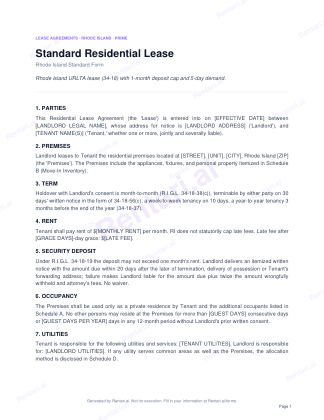
In the Rentari Rhode Island lease
- Required disclosures
The lease carries the fee, utility and insurance disclosure, the housing code violation notice, the rental registry notice, the liability insurance duty, an owner and agent addendum, and a state lead addendum for pre-1978 homes. The insurance declaration page and the lead clearance documents are not in the package; you supply them.
R.I. Gen. Laws § 34-18-15 R.I. Gen. Laws § 34-18-22 R.I. Gen. Laws § 34-18-22.1
- Owner and manager disclosure
Every Rhode Island lease attaches an owner and agent identification addendum with the names, addresses and phone number, the mortgage delinquency notice duty and the nonresident agent rule. Check that the phone number shown is correct before signing.
- Security deposit limit
The lease states the one-month limit and the furniture deposit rule, and the lease builder stops a security deposit above one month's rent. A separate furniture deposit cannot be added in the builder.
- Returning the deposit
The lease repeats the 20-day deadline from the latest of the three events, the four allowed deductions, the itemized notice and the double-damages penalty.
- Move-in condition
The lease has the tenant accept the home as shown in any move-in condition report and report pre-existing damage in writing within seven days of move-in.
- Rent and late fees
The lease charges the late fee you choose only after the grace day you set, lists it with every other fee in a disclosure inside the rent section, and says no Rhode Island statute caps a late fee or sets a grace period. Rentari suggests at least three days' grace but does not require it.
R.I. Gen. Laws § 34-18-15 R.I. Gen. Laws § 34-18-61 R.I. Gen. Laws ch. 34-18
- Landlord entry
The lease gives two days' notice, or the longer notice you choose, and repeats the emergency and seven-day absence exceptions, the limits on other access and the remedies for abuse of access.
- Repairs and habitability
The lease restates the maintenance duties, including heat from October 1 to May 1, and the liability insurance duty.
R.I. Gen. Laws § 34-18-22 R.I. Gen. Laws § 34-18-18 R.I. Gen. Laws § 34-18-24
- Tenant repair remedies
The lease sets out the 30-day termination notice, the under-$500 repair and deduct remedy and the essential services remedy.
R.I. Gen. Laws § 34-18-28 R.I. Gen. Laws § 34-18-30 R.I. Gen. Laws § 34-18-31
- Smoke and carbon monoxide alarms
The lease has the landlord provide working smoke and carbon monoxide detectors at move-in and bars the tenant from disabling them.
- Retaliation
The lease states the four protected grounds, the remedies, the six-month presumption and its exception, and the three cases where possession may still be sought.
- Lockouts and utility shutoffs
The lease says the landlord may not change locks or exclude the tenant except through the court process and may not take possession by self-help.
- Ending a month-to-month tenancy
The lease states all three notice periods, week to week, month to month and year to year.
- Notice for unpaid rent
The lease repeats the 15-day arrears trigger, the five days from mailing, the sixth-day filing rule and both cure rights.
- Notice for lease violations
The lease repeats the 20 days from mailing, the 21-day termination date, the six-month repeat rule and the no-notice cases.
- Eviction process
The lease names the District Court or housing court for the premises and describes the notices each kind of case needs.
R.I. Gen. Laws § 34-18-9 R.I. Gen. Laws § 34-18-10 R.I. Gen. Laws § 34-18-35
- Abandonment and belongings left behind
The lease defines abandonment, sets out the certified letter and seven-day wait, and says belongings left behind are handled as applicable law requires.
- Small claims
The lease names the District Court for the division where the premises are, or the housing court where one has jurisdiction.
Rhode Island numbers the lease follows
- Security deposit limit
- 1 month's rent
- a separate furniture deposit is allowed only for furniture worth $5,000 or more
- R.I. Gen. Laws § 34-18-19(a), (e)
- Deposit refund deadline
- 20 days
- after the tenancy ends, possession is returned or a forwarding address is given, whichever is last
- R.I. Gen. Laws § 34-18-19(b)
- Demand for unpaid rent
- 5 days
- from mailing, once rent is 15 days in arrears
- R.I. Gen. Laws § 34-18-35
- Time to fix a lease violation
- 20 days
- from mailing; the lease ends no sooner than 21 days after mailing
- R.I. Gen. Laws § 34-18-36
- Ending a month-to-month tenancy
- 30 days
- written notice before the date named
- R.I. Gen. Laws § 34-18-37(b)
- Rent increase notice
- 60 days
- 120 days for a month-to-month tenant over 62
- R.I. Gen. Laws § 34-18-16.1
- Rental application fee
- Not allowed
- a background or credit check may be charged at actual cost only if the applicant has none from the last 90 days
- R.I. Gen. Laws § 34-18-59
- Late fee limit
- None set
- chapter 34-18 sets no amount or grace period; list the fee with the rent
- R.I. Gen. Laws § 34-18-15(a)(1)R.I. Gen. Laws ch. 34-18
- Dishonored check collection fee
- $25
- recoverable with triple damages if unpaid 30 days after a notice of dishonor
- R.I. Gen. Laws § 6-42-3(b)
From the Rhode Island lease
RHODE ISLAND RESIDENTIAL LEASE AGREEMENT
Rhode Island law requires all fees charged to Tenant to be disclosed in writing in the same section of the rental agreement as rent. All fees charged under this Lease are disclosed here, in the rent section of this Lease. [Each fee and its amount.] No fee other than those disclosed in this Lease may be charged to Tenant. Payment methods: Landlord shall not charge Tenant a convenience fee or other fee for a method of paying rent unless Tenant is offered at least one method of payment that carries no fee.
Fee, utility and insurance disclosureR.I. Gen. Laws § 34-18-15(a) R.I. Gen. Laws § 34-18-61
A Tenant who is sixty-five (65) years of age or older, or who will turn sixty-five during the Term, may terminate this Lease in order to enter a residential care and assisted living facility, a nursing facility or a unit in a housing complex designated by the federal government as housing for the elderly, by written notice to the person to whom rent is paid, accompanied by documentation of admission or pending admission. Termination is effective no earlier than forty-five (45) days after the first rental payment due date following delivery of the notice.
Termination by a tenant aged 65 or olderR.I. Gen. Laws § 34-18-15(e)
Landlord must be registered with the Rhode Island Department of Health in the statewide rental registry (landlord and manager names, addresses, telephone numbers and email addresses, and each dwelling unit), must re-register by October 1 of each year, and, for a dwelling built before 1978 that is not exempt from the Lead Hazard Mitigation Act, must file a valid certificate of conformance or evidence of exemption. A landlord who is not in compliance may not commence an eviction for nonpayment of rent and must show the court proof of compliance when filing one.
Statewide rental registry and lead certificateR.I. Gen. Laws § 34-18-58
Rhode Island lease types
Pick 3, 6, 12, 18 or 36 months or your own dates. At the end, the lease ends or converts to month-to-month.
Standard lease guideEnding a month-to-month tenancy: 30 days, written notice before the date named.
Rhode Island month-to-month leaseUpload a lease you already use: send an unsigned one for e-signature, or store one that is already signed.
Rooms use the Rhode Island lease for now: add the room as its own unit and set house rules with the optional addenda.
Rhode Island room rentalBefore you sign
Application and screening fees
A landlord, broker, property manager or anyone acting for them may not require a prospective tenant to pay a rental application fee. You may require an official state criminal background check or a credit check, but if the applicant provides one issued within the last 90 days you may not charge for it. If the applicant does not, you may charge no more than the actual cost of obtaining it, and you must give the applicant a copy.
R.I. Gen. Laws § 34-18-59 R.I. Gen. Laws § 34-18-62 R.I. Gen. Laws § 34-37-4
- You may always run your own background check or credit report at your own expense. R.I. Gen. Laws § 34-18-59(b)(3)
- The official state criminal background check can come from the Bureau of Criminal Identification, the Attorney General, the state police or the local police where the applicant lives. R.I. Gen. Laws § 34-18-59(b)
- Since July 2, 2025, a landlord may not ask about, or require any statement about, the immigration or citizenship status of a tenant, applicant or occupant. You may still ask for what you need to verify an applicant's identity or finances, or to meet a federal legal duty. R.I. Gen. Laws § 34-18-62
- You may ask whether an applicant is 18 or older and confirm the source, amount and expected duration of a lawful source of income, but not ask about any protected characteristic. R.I. Gen. Laws § 34-37-4(a)
- A minimum income requirement must be measured only against the part of the rent the tenant will pay, counting any rental assistance or housing subsidy. R.I. Gen. Laws § 34-37-4(c)
Fair housing
Rhode Island bars housing discrimination based on race, color, religion, sex, sexual orientation, gender identity or expression, marital status, lawful source of income, status as a servicemember or as a veteran with an honorable or general discharge, country of ancestral origin, disability, age, familial status, or being a victim of domestic abuse or having sought a protective order. That covers refusing to rent, different terms or services, discriminatory ads, and misrepresenting availability.
R.I. Gen. Laws § 34-37-2 R.I. Gen. Laws § 34-37-4
- Lawful source of income includes child support, alimony, Social Security, public assistance and rental assistance such as Section 8 vouchers. An owner-occupied building of three units or fewer is exempt from the source of income rule. R.I. Gen. Laws § 34-37-3(18) R.I. Gen. Laws § 34-37-4.6
- Allow reasonable modifications at the tenant's expense and make reasonable accommodations in rules and services for a person with a disability. A trained assistance animal may not be charged extra, though the tenant is liable for damage it causes. R.I. Gen. Laws § 34-37-4(d), (e)
- The familial status rule does not apply to a two-unit owner-occupied building, some owner-occupied buildings of four units or fewer, and qualifying housing for older persons. R.I. Gen. Laws § 34-37-4.1
- A person renting out part of a home they will share may choose a housemate of a particular gender. R.I. Gen. Laws § 34-37-4(k)
- Retaliating against anyone who opposes discrimination or takes part in a complaint is prohibited. R.I. Gen. Laws § 34-37-4(m)
Required disclosures
In the lease, list every fee beyond the rent in the rent section, say which utilities the rent covers and which the tenant pays, and state any renters insurance requirement. Before signing, tell the tenant about any outstanding minimum housing code violations on the building. Carry at least $100,000 of general liability insurance and give the tenant the policy's declaration page with the written lease and a new copy at each renewal.
R.I. Gen. Laws § 34-18-15 R.I. Gen. Laws § 34-18-22 R.I. Gen. Laws § 34-18-22.1 R.I. Gen. Laws § 34-18-58
- If you are cited for a housing code violation during the tenancy, deliver a copy of the notice to every tenant of the affected building within 30 days of receiving it, unless you correct every violation within that time. R.I. Gen. Laws § 34-18-22.1(a)
- Every landlord must register with the Department of Health's statewide rental registry, re-register by October 1 each year, and register a newly acquired or newly rented property within 30 days. For a pre-1978 home that is not exempt, file a lead certificate of conformance or proof of exemption. Fines start at $50 a month, or $125 for the lead filing. R.I. Gen. Laws § 34-18-58
- For a pre-1978 rental that is not lead safe, give the tenant basic information on lead hazard control, a copy of the independent clearance inspection, and instructions for reporting deteriorating conditions. R.I. Gen. Laws § 42-128.1-8(a)(4)
- If you fall 120 days behind on the mortgage on the property, tell the tenant it may be subject to foreclosure. R.I. Gen. Laws § 34-18-20(d)
- Give the names, addresses and phone numbers of the manager and of the owner or owner's agent for notices. R.I. Gen. Laws § 34-18-20(a) See Owner and manager disclosure on the Rhode Island page
- Starting January 1, 2027, for a unit that is shoreline property, give the tenant before the tenancy starts a written shoreline access disclosure covering the public's shore rights, any public rights of way you know of, and whom to contact about them. R.I. Gen. Laws § 34-18-20(e) (P.L. 2026, ch. 165)
The lease carries the fee, utility and insurance disclosure, the housing code violation notice, the rental registry notice, the liability insurance duty, an owner and agent addendum, and a state lead addendum for pre-1978 homes. The insurance declaration page and the lead clearance documents are not in the package; you supply them.
Flood disclosure
Partly readChapter 34-18 requires no flood disclosure to a tenant. Other parts of Rhode Island law were not searched for one for this page.
Owner and manager disclosure
At or before the start of the tenancy, give the tenant in writing the name, address and phone number of the person authorized to manage the premises and of an owner or the owner's agent for service of process and notices. Keep it current; a successor landlord is bound too.
R.I. Gen. Laws § 34-18-20 R.I. Gen. Laws § 34-18-22.3
- Anyone who fails to disclose becomes the landlord's agent for receiving notices and for performing the landlord's duties. R.I. Gen. Laws § 34-18-20(c)
- A landlord who does not live in Rhode Island must designate and keep an in-state agent, filed with the Secretary of State and the city or town clerk, or face a civil fine of $100 a month up to $1,200 a year, or one month's rent if the rent exceeds $1,200. R.I. Gen. Laws § 34-18-22.3
- A seller stays liable until written notice of the sale gives the buyer's name, address and phone number and certifies housing code compliance; a departing manager gives similar notice. R.I. Gen. Laws § 34-18-23
- Landlords in Providence and Warwick also register their name, home address and phone number with the city clerk. R.I. Gen. Laws § 34-18-57
- The statewide rental registry requires the landlord's and any manager's contact details for each unit. R.I. Gen. Laws § 34-18-58(a)
Every Rhode Island lease attaches an owner and agent identification addendum with the names, addresses and phone number, the mortgage delinquency notice duty and the nonresident agent rule. Check that the phone number shown is correct before signing.
Deposits, rent and fees
Security deposit limit
A landlord may not demand or receive a security deposit, however it is labeled, of more than one month's periodic rent.
R.I. Gen. Laws § 34-18-19 R.I. Gen. Laws § 34-18-11
- A landlord who rents a furnished apartment may also take a separate furniture security deposit of up to one month's rent, but only if the furniture supplied is worth $5,000 or more to replace, valued when the lease is signed. R.I. Gen. Laws § 34-18-19(e)
- The furniture deposit comes back within the same 20 days, less reasonable cleaning, repair and damage to the furniture beyond ordinary wear and tear. R.I. Gen. Laws § 34-18-19(f)
- A security deposit is money the tenant gives at or shortly after the start of the tenancy as a deposit against physical damage to the unit. R.I. Gen. Laws § 34-18-11
- A lease may not waive any part of the deposit section. R.I. Gen. Laws § 34-18-19(h)
- Money a tenant with a disability pays into an escrow account to restore a modified unit does not count toward the one-month limit, though the return rules still apply to it. R.I. Gen. Laws § 34-37-4(d)
The lease states the one-month limit and the furniture deposit rule, and the lease builder stops a security deposit above one month's rent. A separate furniture deposit cannot be added in the builder.
Returning the deposit
Within 20 days after the latest of the end of the tenancy, the return of possession, or the tenant giving a forwarding address for the deposit, deliver a written notice itemizing any deductions together with the balance. You may deduct only unpaid accrued rent, reasonable cleaning, reasonable trash disposal, and physical damage beyond ordinary wear and tear caused by the tenant's failure to meet the tenant's duties.
R.I. Gen. Laws § 34-18-19 R.I. Gen. Laws § 34-18-11
- If you do not comply, the tenant may recover the amount due plus damages of twice the amount wrongfully withheld and reasonable attorney's fees. R.I. Gen. Laws § 34-18-19(c)
- Ordinary wear and tear is deterioration from the tenant's normal, nonabusive living, and includes deterioration caused by the landlord's failure to prepare for expected conditions or to meet the landlord's own obligations. R.I. Gen. Laws § 34-18-11
- Whoever holds the landlord's interest when the tenancy ends is bound by the deposit rules, so a buyer takes on the duty to return it. R.I. Gen. Laws § 34-18-19(g)
- When a tenant ends the lease because of an uncured serious breach by the landlord, a fire or casualty, or an unlawful lockout or utility shutoff, return all recoverable security and all prepaid rent. R.I. Gen. Laws § 34-18-28(d) R.I. Gen. Laws § 34-18-33(b) R.I. Gen. Laws § 34-18-34
- If a tenant dies and a household member stays on under the post-death grace period, you may deduct damage from the existing deposit but may not ask for a new one. The balance goes to that person if the grace period runs longer than one month, and to the estate otherwise. R.I. Gen. Laws § 34-18-38(d)(10)
The lease repeats the 20-day deadline from the latest of the three events, the four allowed deductions, the itemized notice and the double-damages penalty.
Deposit account and interest
Not set by statuteChapter 34-18 does not require a landlord to keep a security deposit in a separate account or to pay interest on it.
R.I. Gen. Laws ch. 34-18 R.I. Gen. Laws § 34-18-19
- One exception runs through the fair housing law: where a tenant with a disability agrees to pay toward restoring a modification, the money goes into an interest-bearing escrow account and the interest belongs to the tenant. R.I. Gen. Laws § 34-37-4(d)
Move-in condition
Not set by statuteChapter 34-18 does not require a move-in inspection or a written condition checklist. The landlord must deliver possession at the start of the term in line with the lease and the duty to keep the home fit and habitable.
R.I. Gen. Laws § 34-18-21 R.I. Gen. Laws ch. 34-18
- Deposit deductions are limited to damage beyond ordinary wear and tear, so a record of the unit's condition at move-in is the landlord's best evidence. R.I. Gen. Laws § 34-18-19(b)
- If the landlord fails to deliver possession, rent abates until it is delivered, and the tenant may end the lease on five days' written notice or demand possession. R.I. Gen. Laws § 34-18-29
The lease has the tenant accept the home as shown in any move-in condition report and report pre-existing damage in writing within seven days of move-in.
Rent and late fees
Rent is due at the time and place the parties agree, without demand. Chapter 34-18 sets no late fee amount and no grace period. Any fee beyond the rent must be disclosed in the same section of the lease as the rent, with a statement that additional fees may apply, and a landlord may not charge a convenience fee on a rent payment unless it also accepts a way to pay that carries no such fee.
R.I. Gen. Laws § 34-18-15 R.I. Gen. Laws § 34-18-61 R.I. Gen. Laws ch. 34-18
- Unless agreed otherwise, rent is paid at the unit, at the start of each term of a month or less and otherwise in equal monthly installments at the start of each month, and it accrues day to day. R.I. Gen. Laws § 34-18-15(c)
- With no written lease, give the tenant a written list of every fee beyond the rent; a change in required fees must be disclosed in writing at least 30 days before it takes effect. R.I. Gen. Laws § 34-18-15(a)(2)
- The lease must also say which utilities the rent includes and which the tenant pays, and state any renters insurance requirement. R.I. Gen. Laws § 34-18-15(a)(3), (a)(4)
- A tenant may recover any fee that was not disclosed as required. R.I. Gen. Laws § 34-18-15(a)(5)
- If the parties never agreed on rent, the tenant owes the fair rental value. R.I. Gen. Laws § 34-18-15(b)
- Accepting part of the rent does not waive the balance, but accepting rent with knowledge of a default waives the right to end the lease for that breach unless you give written notice within 10 days. R.I. Gen. Laws § 34-18-41
The lease charges the late fee you choose only after the grace day you set, lists it with every other fee in a disclosure inside the rent section, and says no Rhode Island statute caps a late fee or sets a grace period. Rentari suggests at least three days' grace but does not require it.
Returned payment fee
When a check, draft or other instrument is dishonored and stays unpaid for 10 days, the holder may send a notice of dishonor in the statutory form. If the writer does not pay within 30 days after that notice is mailed, the holder may recover in District Court the amount of the check, a $25 collection fee, and three times the amount of the check, but not less than $200 or more than $1,000.
R.I. Gen. Laws § 6-42-1 R.I. Gen. Laws § 6-42-2 R.I. Gen. Laws § 6-42-3 R.I. Gen. Laws § 6-42-4
- Send the notice by certified mail, return receipt requested, or by regular mail backed by an affidavit of mailing. R.I. Gen. Laws § 6-42-2(b)
- It is a defense that the dishonor came from a justified stop payment order or an attachment of the account, or that the full amount was paid within 30 days after the notice was mailed. R.I. Gen. Laws § 6-42-4
- The holder may choose the small claims procedure for this claim. R.I. Gen. Laws § 6-42-3(a)
- These sections speak of checks, drafts and other instruments and do not set a limit on a returned-payment fee written into a lease. Any such fee must be listed with the rent. R.I. Gen. Laws § 6-42-3 R.I. Gen. Laws § 34-18-15(a)(1)
Rent increase notice
Give the tenant written notice at least 60 days before a rent increase takes effect. A month-to-month tenant over the age of 62 gets at least 120 days' notice. Chapter 34-18 limits the notice, not the size of the increase.
- Independent living, assisted living and congregate care facilities are excluded from both notice periods. R.I. Gen. Laws § 34-18-16.1(a), (b)
- Where another state or federal law or a housing program sets its own timeframe, this section does not require more notice than that. R.I. Gen. Laws § 34-18-16.1(c)
- A rent increase made in retaliation for a code complaint, a repair complaint, joining a tenants' union or using a legal right is prohibited. R.I. Gen. Laws § 34-18-46 See Retaliation on the Rhode Island page
During the tenancy
Landlord entry
Except in an emergency or where it is impracticable, give the tenant at least two days' notice of your intent to enter, and enter only at reasonable times. The tenant may not unreasonably refuse entry to inspect, make necessary or agreed repairs, supply services, or show the unit to buyers, lenders, tenants, workers or contractors.
R.I. Gen. Laws § 34-18-26 R.I. Gen. Laws § 34-18-45
- You may enter without consent in an emergency, or during a tenant's absence of more than seven days if reasonably necessary to protect the property. R.I. Gen. Laws § 34-18-26(b)
- Otherwise you have no right of access except by court order, to make repairs the tenant failed to make after notice, or once the tenant has abandoned or surrendered the unit. R.I. Gen. Laws § 34-18-26(d) R.I. Gen. Laws § 34-18-39
- You may not abuse the right of access or use it to harass the tenant. R.I. Gen. Laws § 34-18-26(c)
- If the tenant refuses lawful access, you may seek a court order or end the lease; if the landlord enters unlawfully, unreasonably or with harassing demands, the tenant may seek an order or end the lease. The winner recovers actual damages, costs and reasonable attorney's fees. R.I. Gen. Laws § 34-18-45
- A lease may require the tenant to tell you, no later than its first day, about any absence longer than 10 days. R.I. Gen. Laws § 34-18-27
The lease gives two days' notice, or the longer notice you choose, and repeats the emergency and seven-day absence exceptions, the limits on other access and the remedies for abuse of access.
Repairs and habitability
Keep the premises fit and habitable: comply with building and housing codes affecting health and safety, make all needed repairs, keep common areas clean and safe, and keep electrical, plumbing, sanitary, heating, ventilating and air conditioning systems and supplied appliances in good and safe working order. Provide trash receptacles and removal, running water and reasonable hot water at all times, and reasonable heat from October 1 to May 1 where the building must be equipped for it.
R.I. Gen. Laws § 34-18-22 R.I. Gen. Laws § 34-18-18 R.I. Gen. Laws § 34-18-24
- Where the housing code duty is stricter than the others, the code duty controls. R.I. Gen. Laws § 34-18-22(b)
- A tenant may agree in a signed writing to do specified repairs or maintenance only if the deal is made in good faith for adequate consideration, the work is not needed to cure a code violation, and it does not reduce your duties to other tenants. R.I. Gen. Laws § 34-18-22(c)
- No lease or other document may let a landlord collect rent free of the duty to maintain the premises. R.I. Gen. Laws § 34-18-18
- The tenant must keep the unit clean and safe, dispose of waste, use fixtures and appliances reasonably, not damage the premises, and not disturb neighbors. R.I. Gen. Laws § 34-18-24
- If the tenant fails a maintenance duty affecting health and safety, you may give 20 days' written notice, or act promptly in an emergency, then do the work and bill its reasonable cost as rent. R.I. Gen. Laws § 34-18-39
- A landlord who converts space into apartments knowing they would violate zoning or the housing code pays the moving costs of tenants forced out, within the same city or town. R.I. Gen. Laws § 34-18-22.2
- Pre-1978 rental homes that are not lead safe must meet the state lead hazard mitigation standard, and hazards must be corrected within 30 days after notice from a tenant whose household has an at-risk occupant. R.I. Gen. Laws § 42-128.1-8(a)
The lease restates the maintenance duties, including heat from October 1 to May 1, and the liability insurance duty.
Tenant repair remedies
If the landlord breaks the lease or the maintenance duties in a way that materially affects health and safety, the tenant may give written notice that the lease will end on a date at least 30 days after you receive it unless the breach is fixed within 20 days. For code, repair, trash, water or heat failures whose reasonable cost is under $500 in total per year, the tenant may instead notify you and, if you do not comply or show ongoing good faith efforts within 20 days of written notice, have the work done in a skilled manner and deduct the cost after giving you an itemized statement.
R.I. Gen. Laws § 34-18-28 R.I. Gen. Laws § 34-18-30 R.I. Gen. Laws § 34-18-31
- If substantially the same breach recurs within six months, the tenant may end the lease on at least 14 days' written notice. R.I. Gen. Laws § 34-18-28(a)(2)
- The tenant may also recover actual damages and get a court order, plus attorney's fees if the breach was willful. R.I. Gen. Laws § 34-18-28(b)
- If the landlord willfully or negligently fails to supply heat, water, hot water, electricity, gas or another essential service, the tenant may, after reasonable notice, buy the service and deduct its cost, recover the lost rental value, or move to substitute housing and owe no rent for that time, plus attorney's fees. R.I. Gen. Laws § 34-18-31
- In a nonpayment case or a suit for rent the tenant may counterclaim, and the court may order rent paid into court. R.I. Gen. Laws § 34-18-32
- If fire or casualty substantially impairs the home, the tenant may move out and end the lease by written notice within 14 days, or, where lawful, stay and pay reduced rent for the usable part. R.I. Gen. Laws § 34-18-33
- None of these remedies applies to a condition the tenant, the tenant's family or guests caused. R.I. Gen. Laws § 34-18-28(a)(3) R.I. Gen. Laws § 34-18-30(b) R.I. Gen. Laws § 34-18-31(d)
The lease sets out the 30-day termination notice, the under-$500 repair and deduct remedy and the essential services remedy.
Locks and security devices
Partly readSince July 1, 2026, when a tenant or household member reasonably believes they face an imminent threat of abuse, domestic violence, sexual assault or stalking at the unit, you must, at the request of all tenants in possession or on a court order, make a good faith effort within two business days to change the locks, or let the tenant change them, and give the requester a key. Chapter 34-18 sets no other rule on locks or rekeying between tenants. The state housing and fire codes were not fully read for this page, so check them and local codes.
R.I. Gen. Laws § 34-18-65 (P.L. 2026, ch. 147) R.I. Gen. Laws ch. 34-18
- You may charge a fee no higher than the reasonable price customarily charged for changing locks in that community, and you may ask in good faith for written verification of victim status. R.I. Gen. Laws § 34-18-65(b), (d) (P.L. 2026, ch. 147)
- If you do not act within two business days, the tenant may change the locks with locks of similar or better quality and must try to give you a key within two business days. R.I. Gen. Laws § 34-18-65(e) (P.L. 2026, ch. 147)
- If the threat comes from another tenant or household member, you may change the locks and deny that person a key when the request comes with a protective order or other court order. R.I. Gen. Laws § 34-18-65(c), (f) (P.L. 2026, ch. 147)
- Blocking a lawful lock change, or changing the locks without a good faith effort to give the requester a key, can cost two months' rent plus costs and attorney's fees, unless the court finds you acted in good faith. R.I. Gen. Laws § 34-18-65(g) (P.L. 2026, ch. 147)
- The general duty to comply with building and housing codes affecting health and safety still applies. R.I. Gen. Laws § 34-18-22(a)(1)
Smoke and carbon monoxide alarms
Not readRhode Island's smoke and carbon monoxide alarm rules sit in the state Fire Safety Code and its regulations, which were not read for this page. Chapter 34-18 has no alarm section of its own.
The lease has the landlord provide working smoke and carbon monoxide detectors at move-in and bars the tenant from disabling them.
Retaliation
You may not raise the rent, cut services, or bring or threaten an eviction because the tenant complained to a code enforcement agency about a health and safety violation, complained to you about a maintenance violation, organized or joined a tenants' union, or used any other lawful right.
- A retaliating landlord faces the lockout remedies: the greater of three months' rent or three times actual damages, plus attorney's fees, and the tenant has a defense to the eviction. R.I. Gen. Laws § 34-18-46(b) R.I. Gen. Laws § 34-18-34
- A complaint made within six months before the landlord's action creates a presumption of retaliation, unless the complaint came after notice of a proposed rent increase or cut in services. R.I. Gen. Laws § 34-18-46(b)
- You may still seek possession if the tenant's lack of care caused the violation, the tenant is behind on rent, or code compliance or public action requires work that would displace the tenant and the city's relocation rules are met. R.I. Gen. Laws § 34-18-46(c)
The lease states the four protected grounds, the remedies, the six-month presumption and its exception, and the three cases where possession may still be sought.
Lockouts and utility shutoffs
A landlord may not take back the unit by self-help, including by willfully interrupting heat, running water, hot water, electricity, gas or another essential service, except after abandonment or surrender or as chapter 34-18 allows. Possession comes through the court.
R.I. Gen. Laws § 34-18-44 R.I. Gen. Laws § 34-18-34
- A tenant who is unlawfully removed or excluded, or whose essential services are willfully cut, may recover possession or end the lease and recover the greater of three months' rent or three times actual damages, plus attorney's fees; if the lease ends, the landlord returns the deposit and prepaid rent. R.I. Gen. Laws § 34-18-34
- Distraint for rent is abolished, and a landlord's lien on a tenant's household goods is not enforceable. R.I. Gen. Laws § 34-18-42
The lease says the landlord may not change locks or exclude the tenant except through the court process and may not take possession by self-help.
Ending a tenancy
Ending a month-to-month tenancy
Either side may end a month-to-month tenancy, or any periodic tenancy longer than a month and shorter than a year, by written notice delivered at least 30 days before the date named. A week-to-week tenancy needs at least 10 days, and a year-to-year tenancy needs notice at least three months before the end of the occupation year. Each notice should follow the statutory form.
R.I. Gen. Laws § 34-18-37 R.I. Gen. Laws § 34-18-56
- Without a fixed term, a tenancy is week to week for a roomer who pays weekly and month to month in every other case. R.I. Gen. Laws § 34-18-15(d)
- The statutory form tells the tenant to leave on the first day after the end of the current rental period and to keep paying rent until then. R.I. Gen. Laws § 34-18-56(c)
- If the tenant stays on after the date, you may file on the next day. A willful, bad faith holdover can cost up to three months' rent or three times your actual damages, whichever is greater, plus attorney's fees. R.I. Gen. Laws § 34-18-38(a), (c)
The lease states all three notice periods, week to week, month to month and year to year.
Ending a lease early
Chapter 34-18 gives a tenant three ways to end a lease early. A tenant who is 65 or older, or turns 65 during the term, may end it to move into assisted living, a nursing facility or federally designated elderly housing, by written notice with proof of admission; it ends no earlier than 45 days after the first rent due date after the notice. A servicemember may end it after entering military service, or on permanent change of station or deployment orders of at least 90 days, by written notice with a copy of the orders. Since July 1, 2026, a tenant may also end it without penalty if the tenant or a household member was a victim of abuse, domestic violence, sexual assault or stalking within the last 150 days, with written verification.
R.I. Gen. Laws § 34-18-15 R.I. Gen. Laws § 30-7-10 R.I. Gen. Laws § 34-18-40 R.I. Gen. Laws § 34-18-63 (P.L. 2026, ch. 147)
- For a monthly lease, the servicemember's termination takes effect 30 days after the next rent due date following the notice. Rent is prorated, no early termination charge is allowed, prepaid rent is refunded within 30 days, and dependents are released. R.I. Gen. Laws § 34-18-15(f)
- National Guard members on state active duty for more than 90 days in a row have the rights of the federal Servicemembers Civil Relief Act, including ending a lease. R.I. Gen. Laws § 30-7-10
- If a tenant leaves without notice, with rent more than 15 days unpaid and substantially all belongings gone, send a certified letter saying you will re-rent unless you hear back in seven days, then make reasonable efforts to re-rent at a fair rent. R.I. Gen. Laws § 34-18-11(1) R.I. Gen. Laws § 34-18-40 See Abandonment and belongings left behind on the Rhode Island page
- A party harmed by a breach must take reasonable steps to limit the damages. R.I. Gen. Laws § 34-18-5(a)
- If the last tenant on the lease dies, a live-in caregiver or another adult living there may continue the lease for three months or the rest of the term, whichever is shorter. R.I. Gen. Laws § 34-18-38(d)
- The verification can be a protective order, proof of filing for one, a police report, or a letter from a law enforcement official, attorney, health care provider, social worker, counselor, therapist or victim advocate. Keep it and the household's personal details confidential. R.I. Gen. Laws § 34-18-63(a), (b) (P.L. 2026, ch. 147)
- A tenant ending the lease this way moves out within 30 days of the notice unless you agree otherwise, owes rent only through the later of the termination date or the move-out date, and gets the deposit back under the usual 20-day rule. R.I. Gen. Laws § 34-18-63(c) to (e) (P.L. 2026, ch. 147)
- You may not refuse to rent to an applicant because the applicant ended a lease this way or asked for a lock change, and a lease may not waive these rights. R.I. Gen. Laws §§ 34-18-64, 34-18-67 (P.L. 2026, ch. 147)
Notice for unpaid rent
Once any rent is 15 days in arrears, mail the tenant a written demand, substantially in the statutory form, stating the amount 15 days overdue and that the lease ends unless the tenant pays within five days of the date of mailing. If the tenant does not pay, you may file for eviction no earlier than the sixth day after mailing.
R.I. Gen. Laws § 34-18-35 R.I. Gen. Laws § 34-18-56
- The tenant may cure by paying the full rent before you file. If the tenant has not received a demand in the six months before filing, the tenant may also cure at the hearing by paying the rent in arrears plus court costs. R.I. Gen. Laws § 34-18-35(e)
- If the tenant got a demand within the prior six months and the nonpayment was willful, you may also recover a reasonable attorney's fee. R.I. Gen. Laws § 34-18-35(d)
- The statutory demand includes a certificate that it was placed in first class mail. R.I. Gen. Laws § 34-18-56(a)
- You may not file a nonpayment eviction unless you are registered in the state rental registry when you file, and you must show the court proof of it. R.I. Gen. Laws § 34-18-58(g) See Required disclosures on the Rhode Island page
The lease repeats the 15-day arrears trigger, the five days from mailing, the sixth-day filing rule and both cure rights.
Notice for lease violations
For a material breach of the lease or a breach of the tenant's duties that materially affects health and safety, mail a written notice, substantially in the statutory form, saying what the breach is, what the tenant must do to fix it, and that unless it is fixed within 20 days of mailing the lease ends on a stated date at least 21 days after mailing. If the tenant fixes it in time, the lease continues.
R.I. Gen. Laws § 34-18-36 R.I. Gen. Laws § 34-18-56
- If substantially the same breach recurs within six months after a good faith notice, you may end the lease on at least 20 days' written notice with no chance to cure. R.I. Gen. Laws § 34-18-36(e)
- For drug nuisance, drug dealing or a crime of violence on or next to the premises, no notice is needed and you may file at once. The same applies to certain seasonal tenants charged with a municipal violation or breaking occupancy or noise terms. R.I. Gen. Laws § 34-18-36(f) R.I. Gen. Laws § 34-18-24(8) to (10)
- If the breach is not fixed, you may file no earlier than the day after the termination date in the notice. R.I. Gen. Laws § 34-18-36(b)
- You may recover possession and actual damages, plus attorney's fees if the tenant's breach was willful. R.I. Gen. Laws § 34-18-36(d)
The lease repeats the 20 days from mailing, the 21-day termination date, the six-month repeat rule and the no-notice cases.
Eviction process
Evictions are filed in the District Court, or a housing court where one has jurisdiction, on the statutory complaint forms. For nonpayment, the clerk sets a hearing 14 to 24 days after filing, you mail the summons, complaint and blank answer on the day you file, and a sheriff or constable serves the tenant at least five days before the hearing. For a lease violation or a holdover, the tenant has 20 days after service to answer.
R.I. Gen. Laws § 34-18-9 R.I. Gen. Laws § 34-18-10 R.I. Gen. Laws § 34-18-35 R.I. Gen. Laws § 34-18-36 R.I. Gen. Laws § 34-18-38
- A holdover case may be filed no earlier than the day after the lease expires or the periodic tenancy ends. R.I. Gen. Laws § 34-18-38(a)
- If no appeal is taken and the judgment is unpaid, execution issues on the sixth day after judgment. R.I. Gen. Laws § 34-18-48
- While execution is stayed or an appeal is pending, the tenant must keep paying amounts equal to the rent, and missing them lets the court order execution or dismiss the appeal. R.I. Gen. Laws § 34-18-49 R.I. Gen. Laws § 34-18-51 R.I. Gen. Laws § 34-18-52 R.I. Gen. Laws § 34-18-53
- A nonpayment case needs proof that you are registered in the state rental registry. R.I. Gen. Laws § 34-18-58(g)
- An eviction record may be sealed on motion in the cases the statute lists, such as a dismissal or a satisfied judgment, no more than once every five years. R.I. Gen. Laws § 34-18-60
- A foreclosing owner of a building with four or fewer units generally needs just cause to evict a tenant with a bona fide lease. R.I. Gen. Laws § 34-18-38.2
The lease names the District Court or housing court for the premises and describes the notices each kind of case needs.
Abandonment and belongings left behind
A unit is abandoned when the tenant has left without notice and does not intend to return, shown by rent unpaid for more than 15 days and removal of substantially all belongings. Send a certified letter, return receipt requested, to the last known address saying you will re-rent unless you hear back within seven days. If the letter comes back or the tenant does not reply in seven days, make reasonable efforts to re-rent at a fair rent.
R.I. Gen. Laws § 34-18-11(1) R.I. Gen. Laws § 34-18-40
- A new tenancy that starts before the old lease would have ended terminates the old lease on that date. If you do not try to re-rent, or you accept the abandonment as a surrender, the lease is treated as ended on the date you learned of the abandonment. R.I. Gen. Laws § 34-18-40
- Chapter 34-18 sets no storage period or sale procedure for belongings left behind. R.I. Gen. Laws ch. 34-18
- After a court-ordered removal, the tenant pays the moving costs and any prepaid storage before the belongings are released. R.I. Gen. Laws § 34-18-50
The lease defines abandonment, sets out the certified letter and seven-day wait, and says belongings left behind are handled as applicable law requires.
Small claims
The District Court's small claims procedure is available, at the plaintiff's choice, for contract claims for money only up to $5,000, not counting interest and costs. A plaintiff who chooses it waives the right to appeal.
R.I. Gen. Laws § 10-16-1 R.I. Gen. Laws § 10-16-2
- Landlord and tenant cases under chapter 34-18 belong to the District Court or the appropriate housing court. R.I. Gen. Laws § 34-18-9
- A claim on a dishonored check may also use the small claims procedure. R.I. Gen. Laws § 6-42-3(a)
The lease names the District Court for the division where the premises are, or the housing court where one has jurisdiction.
More Rhode Island rules
Unauthorized occupancy and adverse possession
Partly readAn adverse-possession claim concerns ownership, not simply whether an occupant must move. Rhode Island requires actual, open, notorious, hostile, continuous and exclusive use under a claim of right for at least ten years, established by clear and convincing evidence. The passage of time alone does not prove every element. Boundaries, permission and the character of the use can matter; this overview does not decide a particular title dispute.
Rhode Island Supreme Court: Union Cemetery v. Foisy
- Document how occupancy began and what permission or agreement existed. A tenant holding over, an invited occupant and a person asserting ownership may raise different issues. Keep title and boundary records, leases, written permissions, dated photographs and correspondence, then obtain advice about the appropriate possession or title proceeding rather than assuming one notice period fits every case. Rhode Island Supreme Court: Union Cemetery v. Foisy R.I. Gen. Laws § 34-18-9 See Eviction process on the Rhode Island page
- For genuinely vacant property, maintain entrances, arrange lawful condition checks and keep a contact for reports of damage or unexpected activity. If someone is occupying the home, preserve evidence and establish the lawful response before changing access or removing belongings. Tenant possession and essential services remain subject to the protections explained under lockouts and utility shutoffs. R.I. Gen. Laws § 34-18-44 R.I. Gen. Laws § 34-18-34 See Lockouts and utility shutoffs on the Rhode Island page
Local rules
Rent control and local rules
Partly readChapter 34-18 regulates the notice for a rent increase, not its amount. Landlords who own and lease property in Providence or Warwick must also register their name, home address and phone number with that city's clerk. City and town ordinances were not read for this page.
R.I. Gen. Laws § 34-18-16.1 R.I. Gen. Laws § 34-18-57
- The statewide notice is 60 days, or 120 days for a month-to-month tenant over 62. R.I. Gen. Laws § 34-18-16.1 See Rent increase notice on the Rhode Island page
- A nonresident landlord must file an in-state agent designation with the Secretary of State and the clerk of the city or town where the unit is. R.I. Gen. Laws § 34-18-22.3 See Owner and manager disclosure on the Rhode Island page
Anyone who owns and leases property in Providence or Warwick must register their name, home address with ZIP code and phone number with the city clerk. City ordinances were not read for this page.
Cities and towns have their own housing, building and fire codes that can add duties for rental property. None was read for this page, so check the codes where the property is located.
Rhode Island lease renewals
Read the agreement's renewal clause and the notice rules above before choosing a new term, changing rent or ending the tenancy. A fixed end date does not override applicable renewal rights, rent regulation, just-cause rules or protections against retaliation and discrimination.
Confirm the notice, timing and delivery requirements for the rental's state and locality. Review any required new disclosures and attachments when preparing the renewal. Get the parties' agreement to changed terms in writing.
Customize an unsigned agreement or prepare an addendum to an existing lease.
How it works
- Add your Rhode Island rental
Enter the property and its units.
- Set the terms
Choose the rental, add tenants, and set rent, deposit and fees.
- Review the lease
Preview and edit the Rhode Island lease and its addenda.
- Send for e-signature
Tenants sign online; sending is included on paid plans.
Follow the full lease builder guide, add supporting files, or download and print the agreement.
Rhode Island lease questions
Does the Rentari Rhode Island lease keep the deposit within the limit?
Yes. The lease states the one-month limit and the 20-day return rule, and the builder will not let you set a security deposit above one month's rent. A separate furniture deposit cannot be added in the builder.
Does the lease disclose fees the way Rhode Island requires?
Yes. Every fee you set, such as a late fee, pet fee or parking fee, is listed in a disclosure inside the rent section, along with which utilities you pay and whether renters insurance is required.
Does the package include my liability insurance declaration page?
No. The lease states your duty to carry at least $100,000 of liability insurance and to hand over the declaration page, but you must give the tenant that page yourself, with the lease and at each renewal.
What does the lease include for a home built before 1978?
A Rhode Island lead hazard addendum that sets out the owner's duties and the tenant's rights. The clearance inspection copy and the lead information the law requires are not in the package; you provide them.
Does the lease tell the tenant who the owner and manager are?
Yes. An owner and agent identification addendum gives the names, addresses and phone number the law requires. Check that the phone number shown is correct before signing.