- Home
- Lease agreement
- South Carolina
South Carolina residential lease agreement
State rules checked October 1, 2026 General information, not legal advice
Jump to a topic
South Carolina lease document preview
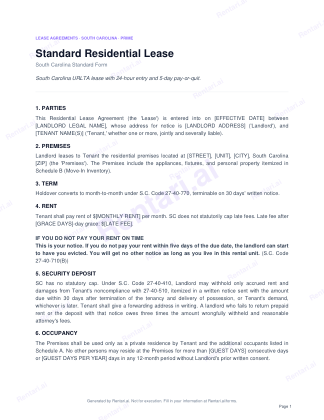
In the Rentari South Carolina lease
- Application and screening fees
The Rentari South Carolina lease makes a material misstatement or omission in the rental application a material breach of the lease.
- Required disclosures
The Rentari South Carolina lease prints an owner and agent disclosure box, the nonpayment provision and, when there is a deposit, a deposit standards notice.
- Owner and agent disclosure
The Rentari South Carolina lease prints an owner and agent disclosure box with the names and addresses you enter.
- Security deposit limit
The Rentari South Carolina lease states the deposit amount and says no South Carolina statute caps it; a deposit standards notice is attached whenever the lease has a deposit.
S.C. Code Ann. §§ 27-40-10 to 27-40-940 S.C. Code Ann. § 27-40-210 (18)
- Deposit return
The Rentari South Carolina lease states the 30-day rule, the forwarding address duty and the treble damages remedy in the statute's terms.
- Move-in condition
The Rentari South Carolina lease has the tenant leave the home in the condition received, ordinary wear and tear excepted.
S.C. Code Ann. §§ 27-40-10 to 27-40-940 S.C. Code Ann. § 27-40-430
- Rent and late fees
The Rentari South Carolina lease charges the late fee you set after the grace day you choose and says no South Carolina statute sets a late fee amount.
S.C. Code Ann. §§ 27-40-10 to 27-40-940 S.C. Code Ann. § 27-40-310 (c)
- Returned payment fee
The Rentari South Carolina lease charges your returned payment fee but never more than $30.
- Landlord entry
The Rentari South Carolina lease requires at least 24 hours' notice (or the longer period you set) with the emergency and tenant-requested service exceptions; it does not include the scheduled services exception, so routine service visits need the full notice.
- Repairs and habitability
The Rentari South Carolina lease summarizes your statutory maintenance duties in a tenant rights box.
- Tenant repair remedies
The Rentari South Carolina lease states the 14-day termination notice, the essential services remedies and that repair and deduct is not allowed.
- Locks and security devices
The Rentari South Carolina lease requires you to provide working exterior locks and bars the tenant from changing or rekeying them without your written permission.
S.C. Code Ann. §§ 27-40-10 to 27-40-940 S.C. Code Ann. § 27-40-530 (e)
- Smoke alarms
The Rentari South Carolina lease has you provide working smoke and carbon monoxide detectors at move-in and bars the tenant from disabling them.
S.C. Code Ann. §§ 27-40-10 to 27-40-940 S.C. Code Ann. § 27-40-440 (a)(1)
- Retaliation
The Rentari South Carolina lease states the retaliation rule, its damages, the 10-day defense notice and the exceptions.
- Lockouts and utility shutoffs
The Rentari South Carolina lease's tenant rights box states that self-help eviction and service shutoffs are not allowed and what they cost.
- Ending a month-to-month tenancy
The Rentari South Carolina lease states the 30-day and 7-day notices and the holdover rules.
- Ending a fixed-term lease early
The Rentari South Carolina lease states the domestic violence termination right and the servicemember right, and keeps a tenant who leaves early liable for rent subject to your duty to try to re-rent.
S.C. Code Ann. § 27-40-350 (2026 Act No. 184) S.C. Code Ann. § 25-1-4040
- Notice for unpaid rent
The Rentari South Carolina lease prints the statute's IF YOU DO NOT PAY YOUR RENT ON TIME provision in a bordered, bold clause, so no separate nonpayment notice is needed.
- Notice for a lease violation
The Rentari South Carolina lease states the 14-day notice and the tenant's right to cure.
- Eviction process
The Rentari South Carolina lease says ejectment proceedings are brought under the state ejectment chapter.
- Abandoned property
The Rentari South Carolina lease states the 15-day and immediate abandonment rules and the $500 disposal limit, and adds a storage period you choose as a lease term.
- Small claims
The Rentari South Carolina lease says a claim under it may be brought in magistrate's court or circuit court within each court's limits.
- Prohibited lease terms
The Rentari South Carolina lease has no tenant indemnity and states only the tenant's statutory duty not to damage the premises.
South Carolina numbers the lease follows
- Security deposit limit
- No limit
- South Carolina sets no maximum
- S.C. Code Ann. §§ 27-40-10 to 27-40-940
- Deposit refund deadline
- 30 days
- after the tenancy ends and possession is returned, or the tenant demands, whichever is later
- S.C. Code Ann. § 27-40-410 (a)
- Late fee grace period
- None set
- the Act sets no grace period or late fee cap
- S.C. Code Ann. §§ 27-40-10 to 27-40-940
- Unpaid rent before ending the lease
- 5 days
- after the due date, not counting intermediate Saturdays, Sundays and holidays
- S.C. Code Ann. § 27-40-710 (B)SCRCP 6(a)
- Notice to cure a violation
- 14 days
- after the tenant receives the notice
- S.C. Code Ann. § 27-40-710 (A)
- Ending a month-to-month tenancy
- 30 days
- written notice before the termination date
- S.C. Code Ann. § 27-40-770 (b)
- Entry notice
- 24 hours
- except emergencies and some service visits
- S.C. Code Ann. § 27-40-530 (b), (c)
- Rent increase notice
- None set
- the Act sets no notice period, and local rent control is banned
- S.C. Code Ann. §§ 27-40-10 to 27-40-940S.C. Code Ann. § 27-39-60
- Returned payment charge
- $30
- maximum service charge for a dishonored check or draft
- S.C. Code Ann. § 34-11-70 (a)(3)
From the South Carolina lease
SOUTH CAROLINA RESIDENTIAL LEASE AGREEMENT
IF YOU DO NOT PAY YOUR RENT ON TIME This is your notice. If you do not pay your rent within five days of the due date, the landlord can start to have you evicted. You will get no other notice as long as you live in this rental unit.
Five-day nonpayment noticeS.C. Code Ann. § 27-40-710 (B)
OWNER AND AGENT DISCLOSURE (S.C. Code 27-40-420): The name and address of an owner of the Premises, or of a person authorized to act on behalf of the owner as agent for service of process and for receiving or receipting notices or demands: Owner: [Owner name], [Owner address] Agent: [Agent name], [Agent address]
Owner and agent disclosureS.C. Code Ann. § 27-40-420 (a), (b)
RETURNED-CHECK (NSF) FEE (S.C. Code 34-11-70(a)(3)): For any check, draft or other written payment order from Tenant that is dishonored, Tenant shall pay a service charge of [Returned payment fee, at most $30] to compensate Landlord for processing it.
Returned payment feeS.C. Code Ann. § 34-11-70 (a)(3)
South Carolina lease types
Pick 3, 6, 12, 18 or 36 months or your own dates. At the end, the lease ends or converts to month-to-month.
Standard lease guideEnding a month-to-month tenancy: 30 days, written notice before the termination date.
S.C. Code Ann. § 27-40-770 (b)
South Carolina month-to-month leaseUpload a lease you already use: send an unsigned one for e-signature, or store one that is already signed.
Rooms use the South Carolina lease for now: add the room as its own unit and set house rules with the optional addenda.
South Carolina room rentalBefore you sign
Application and screening fees
Not set by statuteThe Residential Landlord and Tenant Act sets no limit on application or screening fees and no refund rule for them.
S.C. Code Ann. §§ 27-40-10 to 27-40-940
- South Carolina's fair housing law lets an application ask the number, ages, sex and family relationship of the applicants and intended occupants, and whether an intended occupant was convicted of illegally making or distributing a controlled substance. S.C. Code Ann. § 31-21-70 (L) See Fair housing on the South Carolina page
The Rentari South Carolina lease makes a material misstatement or omission in the rental application a material breach of the lease.
Fair housing
Partly readSouth Carolina's Fair Housing Law makes it unlawful to refuse to rent, or to set different terms, because of race, color, religion, sex, familial status or national origin, or because of a disability (the statute says handicap) of the renter or anyone living or associated with the renter.
- Discrimination includes refusing reasonable modifications at the tenant's expense or reasonable accommodations in rules and policies. Where reasonable, you may condition a modification on the tenant restoring the interior. S.C. Code Ann. § 31-21-70 (G)
- For an animal that is not a service animal, you may ask whether the person has a disability and a disability-related need for the animal, and request documentation; documentation is sufficient if it shows the person has a disability and the animal provides some disability-related assistance or emotional support. S.C. Code Ann. § 31-21-70 (N)
- These rules do not apply to rooms or units in an owner-occupied building with living quarters for no more than four families, and some single-family houses rented by an owner of no more than three are exempt if rented without a broker and without discriminatory advertising. S.C. Code Ann. § 31-21-70 (A), (B)
- The state law also covers advertising and availability statements. A housing notice or advertisement may not express a preference or limitation based on a listed protected characteristic, and a person may not falsely say an available dwelling is unavailable for that reason. Apply the relevant statutory exceptions before deciding how the provision applies. S.C. Code Ann. 31-21-40(3), (4); 31-21-70
- The state law prohibits coercing, intimidating, threatening or interfering with a person who exercises these housing rights or helps someone else exercise them. This protection also matters during the application process. S.C. Code Ann. 31-21-80
Required disclosures
At or before the start of the tenancy, disclose in writing the name and address of an owner of the premises or of an agent authorized to act for the owner, including for service of process and receiving notices.
S.C. Code Ann. § 27-40-420 (a)
- If you rent more than four adjoining units and use different deposit standards, post or give each prospective tenant a statement of those standards before the lease is made. S.C. Code Ann. § 27-40-410 (c) See Security deposit limit on the South Carolina page
- A lease may carry the statute's conspicuous IF YOU DO NOT PAY YOUR RENT ON TIME provision in place of a separate nonpayment notice. S.C. Code Ann. § 27-40-710 (B) See Notice for unpaid rent on the South Carolina page
- Entry for regularly scheduled services without 24 hours' notice requires a conspicuous written lease term. S.C. Code Ann. § 27-40-530 (b)(2) See Landlord entry on the South Carolina page
The Rentari South Carolina lease prints an owner and agent disclosure box, the nonpayment provision and, when there is a deposit, a deposit standards notice.
Flood disclosure
Not set by statuteThe Residential Landlord and Tenant Act requires no flood zone or flood history disclosure to tenants.
Owner and agent disclosure
At or before the start of the tenancy, give the tenant in writing the name and address of an owner or of an agent authorized to act for the owner, including for service of process and receiving notices and demands. Keep it current; it binds any successor landlord, owner or manager.
S.C. Code Ann. § 27-40-420 (a), (b)
- A person who signs a lease for you without making the disclosure becomes your agent for service of process and notices, and for performing your duties with the rent that person collects. S.C. Code Ann. § 27-40-420 (c)
- A landlord who lives out of state, or a corporation not authorized here, may designate a South Carolina agent for service by filing with the Secretary of State; without one, process may be served on the Secretary of State. S.C. Code Ann. § 27-40-130 (b)
The Rentari South Carolina lease prints an owner and agent disclosure box with the names and addresses you enter.
Deposits, rent and fees
Security deposit limit
Not set by statuteSouth Carolina sets no maximum on a security deposit. The Act defines a security deposit as money the tenant gives you that you hold in trust to secure the tenant's full performance of the lease.
S.C. Code Ann. §§ 27-40-10 to 27-40-940 S.C. Code Ann. § 27-40-210 (18)
- If you rent more than four adjoining units on the premises and use different standards to calculate deposits for different tenants, you must, before the lease is made, post the standards in a conspicuous place on the premises or where rent is paid, or give each prospective tenant a written statement of them. S.C. Code Ann. § 27-40-410 (c)
- If you skip that statement, the part of a tenant's deposit above the lowest deposit you charge for a comparable unit on the premises cannot be applied to damage the tenant caused. S.C. Code Ann. § 27-40-410 (c)
The Rentari South Carolina lease states the deposit amount and says no South Carolina statute caps it; a deposit standards notice is attached whenever the lease has a deposit.
Deposit return
When the tenancy ends you may keep only accrued rent and damages caused by the tenant's failure to meet the tenant's statutory duties. Send a written, itemized notice of any deductions with the amount due within 30 days after the later of the end of the tenancy and return of possession, or the tenant's demand.
S.C. Code Ann. § 27-40-410 (a)
- The tenant must give you a forwarding or new address in writing. A tenant who does not loses the right to damages only if you had no notice of the tenant's whereabouts and mailed the notice and any amount due to the tenant's last known address. S.C. Code Ann. § 27-40-410 (a)
- If you fail to return prepaid rent or the deposit with the required notice, the tenant may recover three times the amount wrongfully withheld plus reasonable attorney's fees. The statute does not require bad faith for this. S.C. Code Ann. § 27-40-410 (b)
- Whoever holds the landlord's interest when the tenancy ends is bound by the deposit rules. A seller stays liable for the deposit unless it is transferred to the buyer and the tenant is told in writing within a reasonable time. S.C. Code Ann. § 27-40-410 (e) S.C. Code Ann. § 27-40-450 (a)
- If a fire or casualty ends the lease and the tenant did not cause it, return the recoverable deposit and all prepaid rent. If you withhold because the tenant caused it, you still owe the 30-day itemized notice. S.C. Code Ann. § 27-40-650 (b)
The Rentari South Carolina lease states the 30-day rule, the forwarding address duty and the treble damages remedy in the statute's terms.
Deposit account and interest
Not set by statuteThe Act does not require a separate or interest-bearing account and does not require you to pay interest on a deposit. It does say the deposit is held in trust.
S.C. Code Ann. §§ 27-40-10 to 27-40-940 S.C. Code Ann. § 27-40-210 (18)
Move-in condition
Not set by statuteThe Act requires no move-in inspection, checklist or condition report. At the start of the term you must deliver possession in compliance with the lease and your duty to keep the home fit and habitable.
S.C. Code Ann. §§ 27-40-10 to 27-40-940 S.C. Code Ann. § 27-40-430
The Rentari South Carolina lease has the tenant leave the home in the condition received, ordinary wear and tear excepted.
Rent and late fees
Not set by statuteSouth Carolina sets no late fee cap and no grace period. Rent is due without demand at the time and place you agree; unless you tell the tenant otherwise in writing, it is payable at the home, at the start of each term for a tenancy of a month or less (such as week to week), and otherwise in equal monthly installments at the start of each month.
S.C. Code Ann. §§ 27-40-10 to 27-40-940 S.C. Code Ann. § 27-40-310 (c)
- The Act counts late charges as part of rent, and excludes security deposits and other charges. S.C. Code Ann. § 27-40-210 (11)
- A court may refuse to enforce, or may limit, any lease term it finds was unconscionable when made, which can include an excessive late charge. S.C. Code Ann. § 27-40-230
- Without an agreed rent, the tenant owes the fair market rental value. Rent is apportioned day to day unless you agree otherwise. S.C. Code Ann. § 27-40-310 (b), (c)
The Rentari South Carolina lease charges the late fee you set after the grace day you choose and says no South Carolina statute sets a late fee amount.
Returned payment fee
You may charge a service charge of not more than $30 when a tenant's check, draft or other written order is dishonored. The charge only compensates you for processing it.
S.C. Code Ann. § 34-11-70 (a)(3)
- A separate notice procedure, with the same $30 charge and 10 days to pay after a certified mail notice, applies when you want to preserve a criminal bad check case. It is not needed to collect the service charge. S.C. Code Ann. § 34-11-70 (a)(1), (a)(3)
The Rentari South Carolina lease charges your returned payment fee but never more than $30.
Rent increase notice
The Residential Landlord and Tenant Act sets no notice period or limit for a rent increase on a house or apartment, and cities and counties may not regulate private rents. For a manufactured home park lot, the owner must give at least 30 days' notice before a new rental rate takes effect when the tenancy continues past its original term. A month-to-month tenancy can be ended on 30 days' written notice.
S.C. Code Ann. §§ 27-40-10 to 27-40-940 S.C. Code Ann. § 27-40-770 (b) S.C. Code Ann. § 27-39-60 S.C. Code Ann. § 27-47-420
- You may not raise rent above fair market value in retaliation for a code complaint to a government agency or a complaint to you about a violation of the Act. S.C. Code Ann. § 27-40-910 (a) See Retaliation on the South Carolina page
- For a manufactured home park lot whose tenancy continues past the original term, give the resident at least 30 days' notice before the new rental rate takes effect. S.C. Code Ann. § 27-47-420
During the tenancy
Landlord entry
Give at least 24 hours' notice of your intent to enter, and enter only at reasonable times. The tenant may not unreasonably refuse entry to inspect, repair, supply services or show the home.
S.C. Code Ann. § 27-40-530 (a), (c)
- No notice is needed in an emergency. A coming change in the weather that is likely to endanger the property may count as one. S.C. Code Ann. § 27-40-530 (b)(1)
- To provide services the tenant asked for, you may enter between 8:00 a.m. and 8:00 p.m. without the 24 hours' notice, but you must announce your intent to enter first. S.C. Code Ann. § 27-40-530 (b)(3)
- For regularly scheduled services such as filter changes or pest treatment, you may enter between 9:00 a.m. and 6:00 p.m. without the 24 hours' notice only if the lease conspicuously says so in writing and you announce your intent first. S.C. Code Ann. § 27-40-530 (b)(2)
- Otherwise you may enter only under a court order, to fix a tenant's health and safety violation or after abandonment as the Act allows, with a law officer serving eviction papers, or after the tenant abandons or surrenders the home. Do not use access to harass the tenant. S.C. Code Ann. § 27-40-530 (c), (d)
- If the tenant refuses lawful access, you may get a court order or end the lease and recover actual damages and attorney's fees. If you enter unlawfully or harass with repeated entries or demands, the tenant may get a court order or end the lease and recover the same. S.C. Code Ann. § 27-40-780
The Rentari South Carolina lease requires at least 24 hours' notice (or the longer period you set) with the emergency and tenant-requested service exceptions; it does not include the scheduled services exception, so routine service visits need the full notice.
Repairs and habitability
You must follow building and housing codes that materially affect health and safety, make all repairs needed to keep the home fit and habitable, keep common areas reasonably safe, supply running water, reasonable hot water and heat, and keep electrical, plumbing, heating, air conditioning and other supplied facilities and appliances in good and safe working order.
S.C. Code Ann. § 27-40-440 (a)
- Appliances in the home are presumed to be supplied by you unless the lease specifically excludes them, and no appliance needed for essential services may be excluded. S.C. Code Ann. § 27-40-440 (a)(5)
- For buildings with more than four units, common areas must also be kept reasonably clean. S.C. Code Ann. § 27-40-440 (a)(3)
- In a single family residence, you and the tenant may agree in writing that the tenant handles the facilities and appliances and other specified work, but only in good faith and not to evade your duties. For other units, the tenant may take on specified work only if it is in good faith, is not needed to cure a code violation and does not reduce your duties to other tenants. S.C. Code Ann. § 27-40-440 (c), (d)
- No lease or other instrument may let anyone collect rent without the duty to keep the premises in compliance. S.C. Code Ann. § 27-40-340
- The tenant must keep the home reasonably safe and clean, dispose of waste properly, use facilities reasonably and not damage the premises. S.C. Code Ann. § 27-40-510
The Rentari South Carolina lease summarizes your statutory maintenance duties in a tenant rights box.
Tenant repair remedies
If you materially fail to comply with the lease, or fail to meet your maintenance duties in a way that materially affects health and safety or the physical condition of the property, the tenant may give written notice that the lease will end on a date at least 14 days after you receive it unless you fix the breach within 14 days. The tenant may also sue for actual damages and an injunction.
S.C. Code Ann. § 27-40-610 (a), (b)
- The lease does not end if you fix the breach in time. A breach not affecting health and safety that cannot be fixed in 14 days does not end it if you start within 14 days and finish in good faith within a reasonable time. S.C. Code Ann. § 27-40-610 (a)(1)
- If you negligently or wilfully fail to provide essential services and do not act within a reasonable time after the tenant's written notice, the tenant may buy reasonable amounts of the service and deduct the actual and reasonable cost from rent, or recover damages for the reduced rental value plus attorney's fees; a tenant who uses this remedy may not also use the 14-day termination remedy for that breach. S.C. Code Ann. § 27-40-630 (a), (b), (d)
- South Carolina does not allow a tenant to make repairs and deduct their cost from rent. S.C. Code Ann. § 27-40-630 (c)
- None of these remedies applies to a condition the tenant, the tenant's family or guests caused. S.C. Code Ann. § 27-40-610 (a)(2) S.C. Code Ann. § 27-40-630 (d)
- In an eviction for unpaid rent, a tenant may raise your maintenance failures as a defense, but waives them if you had no notice 14 days before rent was due (for nonessential services) or no notice in time to make emergency repairs (for essential services). S.C. Code Ann. § 27-40-640
- If fire or casualty substantially impairs the home, the tenant may move out and give written notice within 7 days to end the lease, or move out of the unusable part and pay reduced rent. S.C. Code Ann. § 27-40-650 (a)
The Rentari South Carolina lease states the 14-day termination notice, the essential services remedies and that repair and deduct is not allowed.
Locks and security devices
The Act sets no lock, deadbolt or rekeying requirement for landlords. A tenant may not change the locks without your permission.
S.C. Code Ann. §§ 27-40-10 to 27-40-940 S.C. Code Ann. § 27-40-530 (e)
The Rentari South Carolina lease requires you to provide working exterior locks and bars the tenant from changing or rekeying them without your written permission.
Smoke alarms
Partly readThe Act has no smoke alarm provision of its own. It requires you to comply with building and housing codes materially affecting health and safety; the state and local codes that may require smoke alarms were not read for this page.
S.C. Code Ann. §§ 27-40-10 to 27-40-940 S.C. Code Ann. § 27-40-440 (a)(1)
The Rentari South Carolina lease has you provide working smoke and carbon monoxide detectors at move-in and bars the tenant from disabling them.
Retaliation
You may not raise rent above fair market value, cut essential services or sue for possession in retaliation because the tenant complained to a government code agency about a health and safety violation or complained to you about a violation of the Act. The Act sets no time window for this protection.
S.C. Code Ann. § 27-40-910 (a)
- A landlord who retaliates owes up to three months' rent or three times the tenant's actual damages, whichever is greater, plus reasonable attorney's fees. S.C. Code Ann. § 27-40-910 (h)
- A tenant who wants to raise retaliation as a defense in an eviction must notify you in writing within 10 days after service of the Rule to Vacate or Show Cause. A meritless defense entitles you to attorney's fees, and one raised in bad faith can cost the tenant up to three months' rent or three times your actual damages. S.C. Code Ann. § 27-40-910 (b), (f)
- You may still sue for possession if the code violation was caused mainly by the tenant's lack of care, the tenant is in material noncompliance, or the needed repairs would effectively deprive the tenant of the home. S.C. Code Ann. § 27-40-910 (c)
- If you rent more than four adjoining units, a rent increase that applies uniformly to all tenants, or that stays within fair market value, carries no presumption of retaliation. S.C. Code Ann. § 27-40-910 (e)
- If you retaliate by refusing to renew and the tenant is current on rent, you may not recover possession for 75 days, when the tenant proves your violation and your notice of it and of the complaint before the lease expired. S.C. Code Ann. § 27-40-910 (g)
The Rentari South Carolina lease states the retaliation rule, its damages, the 10-day defense notice and the exceptions.
Lockouts and utility shutoffs
You may not remove or lock out a tenant, or wilfully interrupt essential services, to regain possession. You may take possession only after abandonment, surrender or termination, or as the Act otherwise allows.
S.C. Code Ann. § 27-40-660 S.C. Code Ann. § 27-40-760
- A tenant who is unlawfully removed or excluded, or whose essential services you wilfully cut, may recover possession or end the lease, and in either case recover three months' rent or twice the actual damages, whichever is greater, plus attorney's fees. S.C. Code Ann. § 27-40-660
- Essential services are sanitary plumbing or sewer, electricity, gas used for heat, hot water or cooking, running water, and reasonable hot water and heat. S.C. Code Ann. § 27-40-210 (17)
The Rentari South Carolina lease's tenant rights box states that self-help eviction and service shutoffs are not allowed and what they cost.
Ending a tenancy
Ending a month-to-month tenancy
Either you or the tenant may end a month-to-month tenancy with written notice given at least 30 days before the termination date it states. A week-to-week tenancy takes at least 7 days' written notice.
S.C. Code Ann. § 27-40-770 (a), (b)
- Without a fixed term, a tenancy is week to week for a roomer paying weekly rent and month to month in every other case. S.C. Code Ann. § 27-40-310 (d)
- If the tenant stays without your consent after the lease ends, you may sue for possession. If the holdover is not in good faith you may recover attorney's fees; if it is wilful, up to three months' rent or twice your actual damages, whichever is greater. If you consent, the tenancy continues month to month. S.C. Code Ann. § 27-40-770 (c)
The Rentari South Carolina lease states the 30-day and 7-day notices and the holdover rules.
Ending a fixed-term lease early
A protected tenant who is a victim of documented domestic abuse by another leaseholder on the same property may end the tenant's future obligations by written notice within 60 days after the incident, with documentation, without an early termination fee. Servicemembers have the federal termination rights, which South Carolina applies and extends.
S.C. Code Ann. § 27-40-350 (2026 Act No. 184) S.C. Code Ann. § 25-1-4040
- Protection applies only when both the victim and the perpetrator are leaseholders on the same property and the abuse is documented by a restraining order or order of protection, or the perpetrator was convicted. S.C. Code Ann. § 27-40-210(19), (20) (2026 Act No. 184)
- The termination takes effect on the date in the notice, at least 30 days after you receive it unless you agree in writing to an earlier date. The tenant owes rent through that date and any damage the tenant caused, and no deposit has to be returned before the end of the lease. S.C. Code Ann. § 27-40-350 (2026 Act No. 184)
- Cotenants remain responsible for the full rent for the rest of the term. If the perpetrator is the only tenant left, you may end the lease with 5 days' written notice and collect actual damages from the perpetrator. You may not force the protected tenant out within the 60 days or retaliate for the termination. S.C. Code Ann. § 27-40-350 (2026 Act No. 184)
- The federal Servicemembers Civil Relief Act applies in South Carolina, and the state extends it to National Guard members on state duty, or on similar duty for another state, for more than 30 consecutive days who give you a copy of their orders. S.C. Code Ann. § 25-1-4040 S.C. Code Ann. § 25-1-4030 (2)(c), (d)
- A servicemember, a dependent or the Attorney General may sue a landlord who intentionally violates these protections, and the court may order an injunction, restitution and a civil penalty of up to $5,000 per violation. S.C. Code Ann. § 25-1-4070
- If a tenant abandons, make reasonable efforts to rent the home at a fair rental. If you re-rent for a term that starts early, the old lease ends when the new tenancy starts; if you do not try, or accept a surrender, the lease is treated as ended when you learn of the abandonment. S.C. Code Ann. § 27-40-730 (c)
- A lease may set bona fide liquidated damages for lost rent from a premature termination. S.C. Code Ann. § 27-40-330 (c)
- If the parties negotiate an early release, put the proposal and final agreement in writing. Identify the tenants being released, the agreed end date, key return, rent or other agreed amounts, and what remains to be resolved through the deposit accounting. State whether a replacement tenant or sublease is part of the arrangement and who remains responsible. Keep the signed agreement, move-out records, payments and any re-rental dates together; a discussion or a suggested replacement is not a clear record of an agreed release. S.C. Code Ann. § 27-40-730 (c) S.C. Code Ann. § 27-40-330 (c)
The Rentari South Carolina lease states the domestic violence termination right and the servicemember right, and keeps a tenant who leaves early liable for rent subject to your duty to try to re-rent.
Notice for unpaid rent
If rent is not paid within 5 days after it is due, you may end the lease, but only after giving written notice of the nonpayment and of your intent to end the lease if rent is not paid in that time. The 5 days run from the due date, not from the notice.
S.C. Code Ann. § 27-40-710 (B)
- Because the period is under seven days, intermediate Saturdays, Sundays and holidays are not counted, and a period ending on a weekend or holiday runs to the next business day. S.C. Code Ann. § 27-40-240 (D) SCRCP 6(a)
- A tenant receives a written notice when it comes to the tenant's attention, is delivered in hand, or is mailed by registered or certified mail to the address the tenant designated (or the last known residence); proof of that mailing is notice without proof of receipt. S.C. Code Ann. § 27-40-240 (B)
- One such notice covers the rest of the lease term. You also meet the requirement if the written lease contains the statute's conspicuous provision headed IF YOU DO NOT PAY YOUR RENT ON TIME, or a substantially equivalent one; it then covers a month-to-month tenancy after the term too, and no separate notice is needed before filing. S.C. Code Ann. § 27-40-710 (B) S.C. Code Ann. § 27-37-10 (B)
- A tenant's violation of the duty to use the home only as a dwelling and not allow illegal activity is handled under this same written notice and termination rule, not the 14-day cure notice. S.C. Code Ann. § 27-40-710 (A), (B) S.C. Code Ann. § 27-40-540
- If nonpayment was not in good faith and an attorney represents you, you may recover reasonable attorney's fees. S.C. Code Ann. § 27-40-710 (C)
The Rentari South Carolina lease prints the statute's IF YOU DO NOT PAY YOUR RENT ON TIME provision in a bordered, bold clause, so no separate nonpayment notice is needed.
Notice for a lease violation
For a lease violation other than unpaid rent, or a tenant failure that materially affects health and safety or the property, give written notice naming the breach and saying the lease will end on a date at least 14 days after the tenant receives it unless the breach is fixed within 14 days.
S.C. Code Ann. § 27-40-710 (A)
- The lease does not end if the tenant fixes the breach in time, or, where the fix cannot be finished in 14 days, starts within 14 days and finishes in good faith within a reasonable time. S.C. Code Ann. § 27-40-710 (A)
- The 14 days run from the tenant's receipt. A notice is received when it comes to the tenant's attention, is delivered in hand, or is mailed by registered or certified mail to the address the tenant designated (or the last known residence); proof of that mailing is notice without proof of receipt. S.C. Code Ann. § 27-40-240 (B)
- If a health and safety violation can be fixed by repair, replacement or cleaning and the tenant does not act within 14 days after written notice (or as promptly as an emergency requires), you may enter, have the work done and bill the tenant. S.C. Code Ann. § 27-40-720 (a)
- For other health and safety violations, you may end the lease if the tenant does not comply within 14 days after written notice, or as promptly as an emergency requires. S.C. Code Ann. § 27-40-720 (b)
- If the tenant's violation is wilful and an attorney represents you, you may recover reasonable attorney's fees. S.C. Code Ann. § 27-40-710 (C)
The Rentari South Carolina lease states the 14-day notice and the tenant's right to cure.
Eviction process
Evictions (ejectments) start in magistrate's court. On your application the magistrate issues a rule requiring the tenant to vacate or show cause within 10 days after service why the tenant should not be ejected; if the tenant does not, the magistrate issues a warrant of ejectment.
S.C. Code Ann. § 27-37-20 S.C. Code Ann. § 27-37-40
- The rule may be served like a summons, posted at the home if it has been abandoned for 15 days, or after two failed service attempts posted and mailed through the court clerk. S.C. Code Ann. § 27-37-30
- If the tenant raises defenses, the tenant must keep paying you the rent that comes due after the rule issues, and the rent you claim was owed before it, or show a receipt or cancelled check; if the amount is disputed, the court sets it after a hearing. S.C. Code Ann. § 27-40-790
- When executing the writ, the officer gives the occupants 24 hours to leave before a deputy sheriff may enter by force. S.C. Code Ann. § 27-37-160
- A licensed broker in charge or property manager may complete a form writ of eviction and present facts to the court for the landlord, if no separate charge is made. S.C. Code Ann. § 27-40-710 (C)
- Since June 30, 2026, no court may stay an ejectment on appeal unless the tenant files an affidavit promising to pay the rent the magistrate set as it comes due; if a payment is not made within five days of its due date, the clerk issues a warrant of ejectment on your application. S.C. Code Ann. § 27-40-800 (2026 Act No. 252)
- If people who were never your tenants occupy a home without permission, you may petition for an ex parte order removing them instead of bringing an ejectment. S.C. Code Ann. §§ 27-37-200 to 27-37-350 (2026 Act No. 252)
The Rentari South Carolina lease says ejectment proceedings are brought under the state ejectment chapter.
Abandoned property
A tenant's unexplained absence for 15 days after defaulting on rent is abandonment, and abandonment is immediate if the tenant also voluntarily shut off the utilities. After abandonment or the end of the lease, if the tenant has removed a substantial part of the tenant's belongings or voluntarily and permanently shut off the utilities, you may dispose of property left behind worth $500 or less; anything else may be removed only through the court eviction process.
S.C. Code Ann. § 27-40-730 (a), (b), (d), (e)
- You may dispose of property worth $500 or less, entering by force if needed, when the tenant has removed a substantial part of the tenant's belongings or voluntarily and permanently shut off the utilities. S.C. Code Ann. § 27-40-730 (d)
- If property you disposed of under that rule turns out to be worth more than $500, you are liable only if you were grossly negligent. S.C. Code Ann. § 27-40-730 (f)
- After an eviction, belongings placed on a public street are removed by local officials after 48 hours, not counting weekends and holidays; where no public trash pickup exists, you may dispose of them after 48 hours. The eviction notice must explain this. S.C. Code Ann. § 27-40-710 (D)
- A contractual lien on the tenant's household goods is not enforceable, and rent may be collected by distress only through the court procedure in chapter 27-39. S.C. Code Ann. § 27-40-740
The Rentari South Carolina lease states the 15-day and immediate abandonment rules and the $500 disposal limit, and adds a storage period you choose as a lease term.
Small claims
Magistrate's court hears money claims of up to $7,500, and all landlord and tenant matters and possession cases; the section states no dollar limit for those matters, and their counterclaims are exempt from the $7,500 cap.
S.C. Code Ann. § 22-3-10 (1), (10), (12)
- Magistrate's and circuit courts both hear claims under the Residential Landlord and Tenant Act, whether a tenant sues you or you sue a tenant for damages or possession. S.C. Code Ann. § 27-40-130 (a) S.C. Code Ann. § 27-40-710 (C) S.C. Code Ann. § 27-40-610 (b)
The Rentari South Carolina lease says a claim under it may be brought in magistrate's court or circuit court within each court's limits.
More South Carolina rules
Prohibited lease terms
A South Carolina lease may not make the tenant waive rights under the Act, authorize a confession of judgment, or limit your legal liability or make the tenant indemnify you for it. Such a term is unenforceable.
S.C. Code Ann. § 27-40-330 (a), (b)
- If you knowingly use a lease with a prohibited term and try to enforce it, the tenant may recover actual damages plus up to the security deposit and attorney's fees; if you do so maliciously, up to three months' rent and attorney's fees. S.C. Code Ann. § 27-40-330 (b)
- Bona fide liquidated damages for lost rent after an early termination are allowed. S.C. Code Ann. § 27-40-330 (c)
The Rentari South Carolina lease has no tenant indemnity and states only the tenant's statutory duty not to damage the premises.
Unauthorized occupancy and ownership claims
Partly readAdverse possession is a claim to ownership, separate from whether a person may remain in a rental. South Carolina court decisions describe a ten-year test requiring actual possession that is exclusive, visible, adverse and uninterrupted. A claimed period of occupation alone does not prove every requirement. Questions about title, permission, boundaries or a prior tenancy need assessment before choosing a removal procedure.
South Carolina Court of Appeals: selected adverse-possession discussion S.C. Code Ann. §§ 27-37-200 to 27-37-350 (2026 Act No. 252)
- The 2026 removal provisions allow a qualifying owner to seek an ex parte order for certain unauthorized occupants who were never tenants. This is distinct from ordinary tenant ejectment and from deciding an adverse-possession claim. Check the current eligibility and petition requirements before using that route; a former tenant should not simply be relabeled to bypass tenant procedures. S.C. Code Ann. §§ 27-37-200 to 27-37-350 (2026 Act No. 252) See Eviction process on the South Carolina page
- Keep the title documents, leases, permissions, rent history, communications, inspection dates and photographs that explain who occupied the property and on what basis. A claimed deed, tax receipt or maintenance work does not by itself resolve ownership. This overview does not provide a complete title, tax or boundary analysis. South Carolina Court of Appeals: selected adverse-possession discussion
- During a genuine vacancy, secure doors and windows, arrange lawful checks and exterior upkeep, and keep a contact for reports of damage or unexpected entry. If someone disputes your right to remove them, use the applicable court process instead of confronting them or cutting a tenant's services. S.C. Code Ann. § 27-40-660 S.C. Code Ann. § 27-40-760 See Lockouts and utility shutoffs on the South Carolina page
Reviewing screening reports
Partly readTreat a screening report as information to check against lawful rental criteria. Confirm that records belong to the applicant, distinguish a court filing from its outcome, and address inaccurate or incomplete information before relying on it.
FTC: tenant background checks and rights
- Write down the criteria and the information you need before ordering a report. Compare identifying information, dates, case outcomes and duplicate entries rather than treating a criminal charge, an eviction filing or a gap in rental history as a complete explanation. Apply the fair-housing requirements above and check any additional rules for the property’s city; this guide does not establish that every South Carolina city has the same screening rules. FTC: tenant background checks and rights See Fair housing on the South Carolina page
- If a consumer report contributes to a denial or less favorable rent, deposit or cosigner terms, give the required adverse-action notice. Identify the reporting company by name, address and phone number; explain that it did not make the decision and cannot explain your reasons; and state the rights to dispute inaccurate or incomplete information and request a free report from that company within sixty days of the notice. Credit-score and investigative-report use can carry additional duties. FTC: landlord consumer-report guidance
- Keep the criteria, report date, decision reasons, applicant communications and notice delivery record together. Restrict access to consumer reports and dispose of them securely when retention duties allow. A report provider does not make the housing decision for you. FTC: landlord consumer-report guidance
Local rules
Rent control and local rules
No county or city may enact or enforce an ordinance that regulates the amount of rent for privately owned residential or commercial rental property. Local governments may still regulate their own property and make rent agreements with private owners.
Cities and counties may not regulate the amount of private rents, but they have their own housing, building, fire and other codes that can add duties for rental property. None was read for this page, so no local rule is listed here; check the codes of the city and county where the property is located.
South Carolina lease renewals
Read the agreement's renewal clause and the notice rules above before choosing a new term, changing rent or ending the tenancy. A fixed end date does not override applicable renewal rights, rent regulation, just-cause rules or protections against retaliation and discrimination.
Confirm the notice, timing and delivery requirements for the rental's state and locality. Review any required new disclosures and attachments when preparing the renewal. Get the parties' agreement to changed terms in writing.
Customize an unsigned agreement or prepare an addendum to an existing lease.
How it works
- Add your South Carolina rental
Enter the property and its units.
- Set the terms
Choose the rental, add tenants, and set rent, deposit and fees.
- Review the lease
Preview and edit the South Carolina lease and its addenda.
- Send for e-signature
Tenants sign online; sending is included on paid plans.
Follow the full lease builder guide, add supporting files, or download and print the agreement.
South Carolina lease questions
Do I still need to send a separate five-day notice for unpaid rent?
No. Every Rentari South Carolina lease prints the statute's IF YOU DO NOT PAY YOUR RENT ON TIME provision in a bordered, bold clause, which satisfies the written notice requirement for the lease and a month-to-month tenancy that follows it.
S.C. Code Ann. § 27-40-710 (B) S.C. Code Ann. § 27-37-10 (B)
What returned payment fee does the lease charge?
The fee you enter, but never more than $30, the most South Carolina allows for a dishonored check, draft or other written order.
Does the lease let me enter for routine pest control without 24 hours notice?
No. The lease includes the emergency and tenant-requested service exceptions, but not the conspicuous scheduled-services term the statute requires for that exception, so routine visits need at least 24 hours' notice.
S.C. Code Ann. § 27-40-530 (b)(2) S.C. Code Ann. § 27-40-530 (a), (c)
Does the lease include the owner disclosure South Carolina requires?
Yes. It prints an owner and agent box with the names and addresses you enter, for service of process and notices.
Does the lease cover the new domestic violence termination right?
Yes. It states the 2026 rule: a protected tenant may end the tenant's future obligations by written notice with documentation within 60 days of a qualifying incident, effective at least 30 days after you receive it, without an early termination fee.