- Home
- Lease agreement
- Tennessee
Tennessee residential lease agreement
State rules checked October 1, 2026 General information, not legal advice
Jump to a topic
Tennessee lease document preview
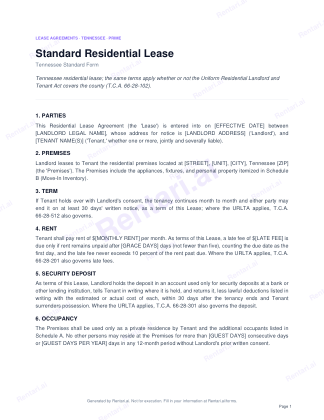
In the Rentari Tennessee lease
- Fair housing
The Rentari Tennessee lease commits the landlord to the federal Fair Housing Act and state and local fair housing laws and explains how to ask for a disability accommodation.
- Required disclosures
The Rentari Tennessee lease attaches an owner and managing agent identification addendum.
- Owner and manager identity
The Rentari Tennessee lease attaches an addendum naming, from the details the landlord enters, the person authorized to manage the home, the owner or agent for service of process and notices, and a maintenance telephone number or email address; a missing address or contact prints as not disclosed.
Tenn. Code Ann. § 66-28-302 (not read) 2024 Tenn. Pub. Acts ch. 907 (as-enacted summary)
- Returning the deposit
The Rentari Tennessee lease returns the deposit, less lawful deductions and with a written list of each deduction and its cost, within the number of days the lease states, never more than 30, after the tenancy ends and the tenant surrenders possession.
- Deposit account and interest
The Rentari Tennessee lease says, as its own term, that the landlord holds the deposit in an account used only for security deposits at a bank or other lending institution and tells the tenant in writing where the account is held.
- Move-in and move-out inspections
The Rentari Tennessee lease lets the tenant, on request, be present at the landlord's move-out inspection, held on the day the tenant vacates or within four calendar days after.
- Returned payment fee
If you set a returned-payment fee, the Rentari Tennessee lease charges that fee for any check or electronic payment returned for insufficient funds.
Tennessee Code Annotated (no returned-check section identified; not read)
- Landlord entry
The Rentari Tennessee lease gives the tenant at least the hours of notice it states (24 by default) before entry at reasonable times, except in an emergency, and allows showings to prospective tenants in the last 30 days of the tenancy after 24 hours' notice.
- Repairs and habitability
The Rentari Tennessee lease says, as its own term, that the landlord keeps the home fit and habitable, complies with building and housing codes that materially affect health and safety, and keeps supplied facilities and appliances in safe working order, and that the tenant reports repairs in writing.
Tennessee Department of Health: Healthy Homes renter guidance
- Tenant repair remedies
The Rentari Tennessee lease says the tenant's remedies are those Tennessee law gives and points to those sections.
- Locks and security devices
The Rentari Tennessee lease requires the landlord to provide working exterior locks and bars the tenant from changing locks without written consent, except as the law allows.
- Smoke alarms
The Rentari Tennessee lease requires the landlord to provide working smoke and carbon monoxide detectors at the start of the tenancy and bars the tenant from disabling them.
Tenn. Code Ann. § 68-120-111 (not read) Tenn. Code Ann. § 68-120-112 (not read) Tenn. Code Ann. § 68-120-118 (not read)
- Retaliation
The Rentari Tennessee lease says the landlord will not retaliate for a complaint to a government agency about a code violation, joining a tenants' organization, or using a right under the lease or the law.
- Ending a month-to-month tenancy
The Rentari Tennessee lease lets either party end a month-to-month tenancy with at least 30 days' written notice before the periodic rental due date.
- Ending a fixed-term lease early
The Rentari Tennessee lease says nothing in it limits the victims' early-termination right, keeps a departing victim's identity confidential without written consent unless law or a court requires otherwise, and includes a servicemember termination clause.
Tenn. Code Ann. § 66-28-205 (not read) Tenn. Code Ann. § 66-7-112 (not read)
- Notice for unpaid rent
The Rentari Tennessee lease promises at least 14 days' written notice to pay before the landlord starts an action for possession for unpaid rent.
Tenn. Code Ann. § 66-28-505 (not read) Tenn. Code Ann. § 66-7-109 (not read)
- Eviction process
The Rentari Tennessee lease says any action under it is brought in the General Sessions Court or Circuit Court of the county where the home is located.
Tenn. Code Ann. title 29, chapter 18 (not read) Tennessee Courts: Tipton County General Sessions local rules, detainer warrants and writs
- Abandoned property
The Rentari Tennessee lease says the landlord handles property left behind strictly as applicable law requires.
Tenn. Code Ann. title 66, chapter 28 (not read) 2005 Tenn. Pub. Acts ch. 156 (amendment summary)
- Small claims
The Rentari Tennessee lease sends disputes to the General Sessions Court or Circuit Court of the county where the home is located and names no dollar figure.
- Which Tennessee law applies
The Rentari Tennessee lease gives the same terms in every county and points to the Act's sections where the Act applies and to T.C.A. 66-7-109 elsewhere.
Tennessee numbers the lease follows
- Security deposit limit
- Not verified
- the governing section is published only through LexisNexis; not read
- Tenn. Code Ann. § 66-28-301 (not read)
- Deposit return deadline
- Not verified
- the governing section is published only through LexisNexis; not read
- Tenn. Code Ann. § 66-28-301 (not read)
- Late fee grace period
- 5 days
- where the Act applies; due date counts as day one; see the Sunday and legal-holiday extension
- Tennessee Legislature Code access: T.C.A. 66-28-201(d)
- Notice for unpaid rent
- Not verified
- the governing section is published only through LexisNexis; not read
- Tenn. Code Ann. § 66-28-505 (not read)Tenn. Code Ann. § 66-7-109 (not read)
- Entry notice
- Not verified
- the governing section is published only through LexisNexis; not read
- Tenn. Code Ann. § 66-28-403 (not read)
- Ending a month-to-month tenancy
- 30 days
- where the Act applies, before the periodic rental date stated in the written notice
- Tennessee Legislature Code access: T.C.A. 66-28-512(b)
- Rent increase notice
- Not verified
- selected sections do not establish a separate rent-increase notice period
- Tennessee Legislature Code access: T.C.A. 66-28-512
From the Tennessee lease
TENNESSEE RESIDENTIAL LEASE AGREEMENT
Tennessee law lets a tenant end a residential lease early, on written notice and documentation, where the tenant or a member of the tenant's household is a victim of domestic abuse, sexual assault or stalking, as T.C.A. 66-28-205 and 66-7-112 provide. Nothing in this Lease limits that right.
Victims of domestic abuse, sexual assault or stalkingTenn. Code Ann. § 66-28-205 (not read) Tenn. Code Ann. § 66-7-112 (not read)
LATE CHARGE: If rent remains unpaid after the [Grace day] day, counting the day rent is due as the first day, Tenant pays a late charge of [Late fee]. The late charge never exceeds ten percent (10%) of the rent past due. These are terms of this Lease; where the Uniform Residential Landlord and Tenant Act applies, T.C.A. 66-28-201 also governs late charges.
Late chargeTenn. Code Ann. § 66-28-201 (not read)
Before starting an action for possession for unpaid rent, Landlord gives Tenant at least fourteen (14) days' written notice to pay. Where the Uniform Residential Landlord and Tenant Act applies, T.C.A. 66-28-505 and 66-28-512 also govern these notices; elsewhere, T.C.A. 66-7-109 governs the notice for unpaid rent.
Notice for unpaid rentTenn. Code Ann. § 66-28-505 (not read) Tenn. Code Ann. § 66-28-512 (not read) Tenn. Code Ann. § 66-7-109 (not read)
Tennessee lease types
Pick 3, 6, 12, 18 or 36 months or your own dates. At the end, the lease ends or converts to month-to-month.
Standard lease guideEnding a month-to-month tenancy: 30 days, where the Act applies, before the periodic rental date stated in the written notice.
Tennessee Legislature Code access: T.C.A. 66-28-512(b)
Tennessee month-to-month leaseUpload a lease you already use: send an unsigned one for e-signature, or store one that is already signed.
Rooms use the Tennessee lease for now: add the room as its own unit and set house rules with the optional addenda.
Tennessee room rentalBefore you sign
Application and screening fees
Not readNo Tennessee section on application or screening fees was identified or read. The Code provisions governing this topic were not read, so this page states no limit.
Fair housing
Partly readThe Tennessee Attorney General identifies denial of housing, worse rental terms, harassment, and refusal of a disability accommodation or modification as potential violations of state housing discrimination law. Its housing guidance also identifies refusal to rent because of a service or emotional support animal as a potential violation. Evaluate the applicable accommodation requirements rather than treating an assistance animal as an ordinary pet.
Tennessee Attorney General: housing discrimination guidance
- A 2005 act (Pub. Ch. 215) requires owners leasing units in buildings of three or more stories to give physically disabled persons priority for units on the first two floors when the disability prevents reasonable access to higher floors. The section was not read and may have been amended since. Tenn. Code Ann. § 66-7-104 (not read) 2005 Tenn. Pub. Acts ch. 215 (bill caption)
- The Civil Rights Enforcement Division accepts state discrimination complaints. Its published process gives 180 days from the alleged discriminatory act to file an agency complaint. It separately describes a private lawsuit deadline of one year after the discriminatory practice ceases, without requiring an agency complaint first. Filing with the division does not extend that private lawsuit deadline. These are distinct routes and deadlines. Tennessee Attorney General: complaint process
The Rentari Tennessee lease commits the landlord to the federal Fair Housing Act and state and local fair housing laws and explains how to ask for a disability accommodation.
Required disclosures
Not readThe written disclosure of the manager, the owner's agent and a maintenance contact is in T.C.A. 66-28-302. The Code provisions governing this topic were not read. Other disclosures the Code may require could not be checked.
Tenn. Code Ann. § 66-28-302 (not read)
- See the owner and manager identity topic for what the Rentari addendum lists. Tenn. Code Ann. § 66-28-302 (not read) See Owner and manager identity on the Tennessee page
The Rentari Tennessee lease attaches an owner and managing agent identification addendum.
Flood disclosure
Not readNo Tennessee flood disclosure rule for rentals was identified or read, so this page states none.
Owner and manager identity
Partly readT.C.A. 66-28-302 governs disclosing who manages the home, who may receive notices and service of process for the owner, and how to request maintenance. A 2024 act (Pub. Ch. 907) requires this disclosure in writing at or before the start of the tenancy. The section was not read, so its exact content is not stated here.
Tenn. Code Ann. § 66-28-302 (not read) 2024 Tenn. Pub. Acts ch. 907 (as-enacted summary)
The Rentari Tennessee lease attaches an addendum naming, from the details the landlord enters, the person authorized to manage the home, the owner or agent for service of process and notices, and a maintenance telephone number or email address; a missing address or contact prints as not disclosed.
Deposits, rent and fees
Security deposit limit
Not readWhether Tennessee limits the size of a security deposit could not be verified. The Code provisions governing this topic were not read, so this page states neither a limit nor the absence of one.
Tenn. Code Ann. § 66-28-301 (not read)
- The Act applies in counties with more than 75,000 residents according to the 2010 federal census, subject to the exclusions in 66-28-102. Check the county census and occupancy type before applying this rule; the separate title 66, chapter 7 rules were not reviewed. Tennessee Legislature Code access: T.C.A. 66-28-102 See Which Tennessee law applies on the Tennessee page
Returning the deposit
Not readThe deadline and itemizing rules for returning a deposit are in T.C.A. 66-28-301 where the Uniform Residential Landlord and Tenant Act applies. The Code provisions governing this topic were not read, so this page states no deadline.
Tenn. Code Ann. § 66-28-301 (not read)
- The Act applies in counties with more than 75,000 residents according to the 2010 federal census, subject to the exclusions in 66-28-102. Check the county census and occupancy type before applying this rule; the separate title 66, chapter 7 rules were not reviewed. Tennessee Legislature Code access: T.C.A. 66-28-102 See Which Tennessee law applies on the Tennessee page
The Rentari Tennessee lease returns the deposit, less lawful deductions and with a written list of each deduction and its cost, within the number of days the lease states, never more than 30, after the tenancy ends and the tenant surrenders possession.
Deposit account and interest
Not readAny duty to hold deposits in a separate account, and any interest rule, could not be verified. The Code provisions governing this topic were not read.
Tenn. Code Ann. § 66-28-301 (not read)
The Rentari Tennessee lease says, as its own term, that the landlord holds the deposit in an account used only for security deposits at a bank or other lending institution and tells the tenant in writing where the account is held.
Move-in and move-out inspections
Not readTennessee's inspection and damage-list rules for deposits could not be verified. The Code provisions governing this topic were not read.
Tenn. Code Ann. § 66-28-301 (not read)
- Where the Act applies, 2005 and 2011 acts (Pub. Ch. 156 and 272) tied the landlord's move-out damage list to written notice of the tenant's right to an inspection. T.C.A. 66-28-301 was not read, so confirm the current procedure before withholding any of the deposit. Tenn. Code Ann. § 66-28-301 (not read) 2005 Tenn. Pub. Acts ch. 156 (amendment summary) 2011 Tenn. Pub. Acts ch. 272 (bill summary)
The Rentari Tennessee lease lets the tenant, on request, be present at the landlord's move-out inspection, held on the day the tenant vacates or within four calendar days after.
Rent and late fees
Where the Uniform Residential Landlord and Tenant Act applies, rent has a five-day grace period before a late fee may be charged; count the due date as day one. If the last grace day is a Sunday or a legal holiday under T.C.A. 15-1-101, no late fee may be imposed when rent is paid the next business day. A late fee may not exceed 10 percent of the rent past due. The statutory extension does not list Saturday.
Tennessee Legislature Code access: T.C.A. 66-28-201(d)
- Apply these limits only after checking Act coverage: 66-28-102 uses county population greater than 75,000 under the 2010 federal census and excludes specified arrangements. A current county population estimate does not replace that census test. Tennessee Legislature Code access: T.C.A. 66-28-102 See Which Tennessee law applies on the Tennessee page
- The five-day grace period concerns late fees; it does not change the agreed rent due date. Section 66-28-201 also bars a rental agreement from waiving rights or remedies granted by the Act. The separate statutory list of legal holidays has not been reviewed here. Tennessee Legislature Code access: T.C.A. 66-28-201(a), (c), (d)
Returned payment fee
Not readNo Tennessee statute capping a landlord's returned-check or returned-payment fee was identified or read, so this page states no cap.
Tennessee Code Annotated (no returned-check section identified; not read)
If you set a returned-payment fee, the Rentari Tennessee lease charges that fee for any check or electronic payment returned for insufficient funds.
Rent increase notice
Partly readThe selected sections reviewed here do not establish a separate notice period for increasing rent. T.C.A. 66-28-512 sets notice for ending periodic tenancies where the Act applies; its 30-day month-to-month rule should not be presented as a standalone rent-increase rule. Check the rental agreement and any applicable housing-program requirements before changing rent.
Tennessee Legislature Code access: T.C.A. 66-28-512
- For notices required by the Act, 66-28-106 requires written notice to the last known or lease-designated address and recognizes actual knowledge. Under 66-28-108, if the tenant supplies an email address in the rental agreement, the landlord may email required notifications unless the Act specifies another form; the landlord cannot require an email address as a condition of renting. These sections do not state an automatic three-day mailing extension. Tennessee Legislature Code access: T.C.A. 66-28-106, 66-28-108
- The full chapter, rules for rentals outside the Act, independent electronic-transactions requirements and housing-program notices were not reviewed for this selected update. This page therefore states no universal rent-increase notice count. Tennessee Legislature Code access: T.C.A. 66-28-102, 66-28-512
During the tenancy
Landlord entry
Not readThe landlord's right of access is in T.C.A. 66-28-403 where the Uniform Residential Landlord and Tenant Act applies. The Code provisions governing this topic were not read, so this page states no notice period.
Tenn. Code Ann. § 66-28-403 (not read)
- The Act applies in counties with more than 75,000 residents according to the 2010 federal census, subject to the exclusions in 66-28-102. Check the county census and occupancy type before applying this rule; the separate title 66, chapter 7 rules were not reviewed. Tennessee Legislature Code access: T.C.A. 66-28-102 See Which Tennessee law applies on the Tennessee page
The Rentari Tennessee lease gives the tenant at least the hours of notice it states (24 by default) before entry at reasonable times, except in an emergency, and allows showings to prospective tenants in the last 30 days of the tenancy after 24 hours' notice.
Repairs and habitability
Partly readTennessee Department of Health guidance tells renters to keep the home clean and safe and report repair problems promptly, preferably in writing. Where the Uniform Residential Landlord and Tenant Act applies, landlords must maintain housing that meets building and housing codes affecting health and safety. This is selected agency guidance; the full maintenance statute was not reviewed for this page.
Tennessee Department of Health: Healthy Homes renter guidance
- Describe the problem, when it began and how it affects use of the home. Keep dated photos, requests and replies. Follow up if repairs stall, and ask the local codes office which inspections it offers. Most landlord-tenant disputes are civil matters; health departments do not resolve every repair disagreement. Get legal help before withholding rent, deducting repair costs or ending the lease, because remedies depend on the applicable law and facts. Tennessee Department of Health: Healthy Homes renter guidance
The Rentari Tennessee lease says, as its own term, that the landlord keeps the home fit and habitable, complies with building and housing codes that materially affect health and safety, and keeps supplied facilities and appliances in safe working order, and that the tenant reports repairs in writing.
Tenant repair remedies
Not readA tenant's remedies when the landlord does not repair are in T.C.A. 66-28-501 to 66-28-504 where the Uniform Residential Landlord and Tenant Act applies. The Code provisions governing this topic were not read, so this page states no remedy or deadline.
Tenn. Code Ann. § 66-28-501 to 66-28-504 (not read)
The Rentari Tennessee lease says the tenant's remedies are those Tennessee law gives and points to those sections.
Locks and security devices
Not readNo Tennessee section on locks or rekeying was identified or read, so this page states no lock rule.
Tenn. Code Ann. title 66, chapter 28 (not read)
The Rentari Tennessee lease requires the landlord to provide working exterior locks and bars the tenant from changing locks without written consent, except as the law allows.
Smoke alarms
Not readTennessee's smoke detector sections (T.C.A. 68-120-111, 68-120-112, 68-120-118 and 68-102-151) were not read, so this page states no device or testing rule.
Tenn. Code Ann. § 68-120-111 (not read) Tenn. Code Ann. § 68-120-112 (not read) Tenn. Code Ann. § 68-120-118 (not read) Tenn. Code Ann. § 68-102-151 (not read)
The Rentari Tennessee lease requires the landlord to provide working smoke and carbon monoxide detectors at the start of the tenancy and bars the tenant from disabling them.
Retaliation
Where the Act applies, a landlord may not retaliate by increasing rent, decreasing services, or bringing or threatening a possession action because the tenant complained to the landlord about a violation under 66-28-301 or exercised a right or remedy under the Act. Section 66-28-514 states no fixed retaliation-presumption period.
Tennessee Legislature Code access: T.C.A. 66-28-514(a)
- The section permits a possession action despite its retaliation rule when the tenant, household or someone present with the tenant's consent caused the complained-of code violation through lack of reasonable care; the tenant is in rent default; or code compliance requires work that deprives the tenant of use of the unit. Such an action does not release liability under 66-28-501(b), whose full remedy text was not reviewed here. Tennessee Legislature Code access: T.C.A. 66-28-514(b)
- The Rentari lease separately promises broader protections, including agency complaints and tenant organization activity. Those lease terms should not be treated as a quotation of 66-28-514. Other statutory protections, incorporated 66-28-301 and case law were not independently reviewed in this update. Tennessee Legislature Code access: T.C.A. 66-28-514
The Rentari Tennessee lease says the landlord will not retaliate for a complaint to a government agency about a code violation, joining a tenants' organization, or using a right under the lease or the law.
Lockouts and utility shutoffs
Not readTennessee's rules on self-help eviction and utility shutoffs could not be verified. The Code provisions governing this topic were not read. Recover possession only through the courts.
Ending a tenancy
Ending a month-to-month tenancy
Partly readWhere the Act applies, either the landlord or tenant may end a month-to-month tenancy by written notice at least 30 days before the periodic rental date specified in the notice. For a week-to-week tenancy, the written notice must be at least 10 days before the stated termination date. These are periodic termination rules, not a separate rule authorizing a rent increase.
Tennessee Legislature Code access: T.C.A. 66-28-512(a), (b)
- A 2023 act (Pub. Ch. 400) requires 60 days' notice to end the tenancy of a rent-current tenant in certain housing for older persons when the reason is new property development. Its text was not read. 2023 Tenn. Pub. Acts ch. 400 (as-enacted summary)
- If a tenant remains after expiration or termination without the landlord's consent, 66-28-512(c) allows an action for possession and specified amounts. Willful holdover without good faith may also lead to actual damages and reasonable attorney fees. Continued occupancy with consent is governed by 66-28-201(c). This does not authorize removing the tenant without the applicable court process. Tennessee Legislature Code access: T.C.A. 66-28-512(c), 66-28-201(c)
The Rentari Tennessee lease lets either party end a month-to-month tenancy with at least 30 days' written notice before the periodic rental due date.
Ending a fixed-term lease early
Not readTennessee's early-termination right for victims of domestic abuse, sexual assault or stalking is in T.C.A. 66-28-205 and 66-7-112. The Code provisions governing this topic were not read, so this page states no notice or document rule. Servicemembers also have federal rights under 50 U.S.C. 3955, which was not read for this page.
Tenn. Code Ann. § 66-28-205 (not read) Tenn. Code Ann. § 66-7-112 (not read)
The Rentari Tennessee lease says nothing in it limits the victims' early-termination right, keeps a departing victim's identity confidential without written consent unless law or a court requires otherwise, and includes a servicemember termination clause.
Notice for unpaid rent
Not readThe notice before an eviction for unpaid rent is in T.C.A. 66-28-505 where the Uniform Residential Landlord and Tenant Act applies and in T.C.A. 66-7-109 elsewhere. The Code provisions governing this topic were not read, so this page states no day count.
Tenn. Code Ann. § 66-28-505 (not read) Tenn. Code Ann. § 66-7-109 (not read)
- The Act applies in counties with more than 75,000 residents according to the 2010 federal census, subject to the exclusions in 66-28-102. Check the county census and occupancy type before applying this rule; the separate title 66, chapter 7 rules were not reviewed. Tennessee Legislature Code access: T.C.A. 66-28-102 See Which Tennessee law applies on the Tennessee page
The Rentari Tennessee lease promises at least 14 days' written notice to pay before the landlord starts an action for possession for unpaid rent.
Notice for a lease violation
Not readNotice and cure rules for other lease breaches are in T.C.A. 66-28-505 where the Uniform Residential Landlord and Tenant Act applies and in T.C.A. 66-7-109 elsewhere. The Code provisions governing this topic were not read, so this page states no cure period.
Tenn. Code Ann. § 66-28-505 (not read) Tenn. Code Ann. § 66-7-109 (not read)
- A separate, shorter termination route for certain violent conduct is in T.C.A. 66-28-517 where the Act applies and, elsewhere, in a 2015 act (Pub. Ch. 172) that exempts tenants who are mentally or physically disabled. Neither was read, so no grounds or day count are stated here. Tenn. Code Ann. § 66-28-517 (not read) 2015 Tenn. Pub. Acts ch. 172 (as-enacted summary)
Eviction process
Partly readA detainer warrant begins the court case for possession; it is different from the later writ used to enforce a possession judgment. Check the appropriate county court for its filing, service and hearing requirements. The required notice depends on the tenancy, the lease and which Tennessee rental law applies. This guide does not supply a complete set of court deadlines.
Tenn. Code Ann. title 29, chapter 18 (not read) Tennessee Courts: Tipton County General Sessions local rules, detainer warrants and writs
- A 2026 act (Pub. Ch. 657), effective April 1, 2026, bars certain people involved in serving eviction papers from publishing or streaming video of the service without the served person's written permission, and lets that person sue. Its text was not read. 2026 Tenn. Pub. Acts ch. 657 (as-enacted summary)
- Prepare the signed lease, amendments, relevant notices and delivery records, rent ledger, receipts, messages and dated photographs. Organize them by the issue the court must decide, with payments and credits clearly recorded. As a local example, Tipton County publishes rules requiring plaintiffs to bring the signed lease, notice and supporting evidence with the necessary copies. Check your own county's current instructions; that local requirement is not a statewide filing checklist. Tennessee Courts: Tipton County General Sessions local rules, detainer warrants and writs
The Rentari Tennessee lease says any action under it is brought in the General Sessions Court or Circuit Court of the county where the home is located.
Abandoned property
Partly readWhere the Act applies, a 2005 act (Pub. Ch. 156) set an abandonment procedure. It requires a notice posted at the home and mailed to the tenant, a waiting period before re-entry, a longer one before remaining possessions may be disposed of, and a court case if the tenant says they will stay. The current section was not read and may have been amended, so confirm the periods before re-entering or disposing of property.
Tenn. Code Ann. title 66, chapter 28 (not read) 2005 Tenn. Pub. Acts ch. 156 (amendment summary)
The Rentari Tennessee lease says the landlord handles property left behind strictly as applicable law requires.
Small claims
Not readThe civil limit of Tennessee's General Sessions Courts is in T.C.A. 16-15-501, which was not read, so this page states no dollar limit.
Tenn. Code Ann. § 16-15-501 (not read)
The Rentari Tennessee lease sends disputes to the General Sessions Court or Circuit Court of the county where the home is located and names no dollar figure.
More Tennessee rules
Firearms in rentals
Partly readA 2026 act (Pub. Ch. 606), effective January 1, 2027, generally restricts a landlord from prohibiting a tenant from lawfully possessing, carrying, transporting or storing a firearm, firearm parts or ammunition. It covers the home, a vehicle in a tenant parking area, and landlord-controlled areas needed to enter or leave, in leases entered into, amended, extended or renewed on or after that date. The Rentari lease cites it as T.C.A. 66-28-206 and 66-7-113. That text was not read, so any exceptions are not stated here.
Tenn. Code Ann. § 66-28-206 (not read) Tenn. Code Ann. § 66-7-113 (not read) 2026 Tenn. Pub. Acts ch. 606 (as-enacted summary)
Which Tennessee law applies
T.C.A. 66-28-102 applies the Uniform Residential Landlord and Tenant Act in counties with a population greater than 75,000 according to the 2010 federal census. It covers agreements entered into, extended or renewed after July 1, 1975, subject to the section's exclusions. Check that census and the type of occupancy; this page does not certify a county list or the separate chapter 7 rules.
Tennessee Legislature Code access: T.C.A. 66-28-102(a)-(d)
- Unless created to avoid the Act, excluded arrangements include specified institutional residence, occupancy by a purchaser under a sale contract, transient hotel or motel lodging or room-occupancy excise-tax lodging, condominium-owner or cooperative proprietary-lease occupancy, and premises used primarily for agriculture. Tennessee Legislature Code access: T.C.A. 66-28-102(c)
- For government- or nonprofit-owned housing regulated by HUD, the Act does not apply to the extent it conflicts with federal regulations, and does apply where those regulations defer to state law. The program regulations were not independently reviewed here. In covered counties the Act preempts the landlord-tenant field, and county action may not conflict with or add to it. Tennessee Legislature Code access: T.C.A. 66-28-102(d), (e)
The Rentari Tennessee lease gives the same terms in every county and points to the Act's sections where the Act applies and to T.C.A. 66-7-109 elsewhere.
Tenant screening and consumer reports
Partly readUse lawful criteria tied to the actual rental and review the information behind a screening recommendation. Tenant background reports can contain errors or incomplete records, and federal consumer-report obligations apply when a report affects a rental decision. Confirm the applicable state, local and housing-program requirements before choosing what to request or consider.
CFPB: rental denial and screening reports FTC: tenant background checks and rights
- Match identifying information to the applicant and review dates, duplicate records and how court cases ended. An eviction filing is not the same as a completed eviction. If the applicant identifies an error, keep the supporting records and direct the report dispute to the reporting company. Review any corrected information with the same lawful criteria used for other applications rather than treating a score or irregular history as a complete explanation. FTC: tenant background checks and rights
- A report-based denial or less favorable terms, such as higher rent or deposit or a cosigner requirement, requires an adverse-action notice. Include the reporting company's name, address and phone number, explain that it did not make the decision and cannot explain your reasons, and state the rights to dispute inaccurate information and request a free report from that company within sixty days of the notice. Review additional duties for investigative reports or use of a credit score. CFPB: rental denial and screening reports FTC: landlord consumer-report guidance
- Keep a clear record of the criteria, authorization, report date, facts reviewed, applicant communications and any required notice. Restrict access to sensitive application information and follow applicable preservation duties before securely disposing of it. Use the separate fair-housing guidance when an accommodation or other protected issue arises; a provider's report is not a substitute for that review. FTC: tenant background checks and rights FTC: landlord consumer-report guidance See Fair housing on the Tennessee page
Unauthorized occupancy and ownership claims
Partly readSeparate an unwanted occupant, a current or former tenant, and a person claiming ownership. The applicable removal procedure depends on those facts. Adverse possession is a title issue with demanding proof requirements, not an automatic right created by a short stay or an unpaid rental bill.
Tennessee Legislature: 2024 sheriff-removal enactment Tennessee Supreme Court: Cumulus adverse-possession discussion
- The 2024 enactment created a limited county-sheriff complaint route for unlawful occupancy of a residential dwelling. Its conditions include an owner or authorized agent, unlawful entry and continued occupation, property closed to the public at entry, a direction to leave, no current or former authorized oral or written tenancy, no immediate-family relationship, and no pending related litigation between the parties. Check the current requirements before using the route. Tennessee Legislature: 2024 sheriff-removal enactment
- The enactment requires a completed, verified complaint and sheriff verification before removal. It also provides a wrongful-removal action with possible restoration and damages. It is not permission to personally remove someone because you call them a squatter. A tenant dispute or an excluded situation requires the appropriate legal process; do not assume a universal seventy-two-hour outcome. Tennessee Legislature: 2024 sheriff-removal enactment See Eviction process on the Tennessee page
- The Tennessee Supreme Court’s Cumulus discussion describes a twenty-year common-law adverse-possession route even without color of title. Statutory routes and tax-related presumptions raise separate requirements. Do not reduce a title dispute to a seven- or twenty-year countdown, or assume paying taxes alone establishes ownership. Have the deed history, boundaries, permission and actual possession assessed together. Tennessee Supreme Court: Cumulus adverse-possession discussion
- Preserve the deed, authorization records, leases, payment history, notices, dated photographs, communications and any pending court papers. For a vacant home, keep entry points secure and arrange lawful periodic checks. Record problems promptly and obtain help identifying the proper route when permission, tenancy or title is disputed; keep occupants and possessions undisturbed while that question is resolved. Tennessee Legislature: 2024 sheriff-removal enactment Tennessee Supreme Court: Cumulus adverse-possession discussion
Local rules
Rent control and local rules
T.C.A. 66-35-102 prohibits local governmental units from enacting, maintaining or enforcing ordinances or resolutions that control rent for private residential or commercial property. Its definition of local governmental unit includes counties and incorporated municipalities. This separate prohibition is not limited to the counties covered by the Uniform Residential Landlord and Tenant Act.
Tennessee Legislature Code access: T.C.A. 66-35-101, 66-35-102(a)
- The statute also restricts mandatory below-market unit allocations and specified zoning or land-use conditions. It preserves purely voluntary incentive programs within its conditions and voluntary attainable-housing incentive programs under 13-3-601 or 13-4-401. Those incorporated program sections and individual agreements were not independently reviewed; the rent-control prohibition does not resolve every subsidized or voluntary housing arrangement. Tennessee Legislature Code access: T.C.A. 66-35-102(b)(1), (2)
Cities and counties have their own housing, building, fire and other codes that can add duties for rental property. None was read for this page, so no local rule is listed here; check the codes of the city and county where the property is located.
Tennessee lease renewals
Read the agreement's renewal clause and the notice rules above before choosing a new term, changing rent or ending the tenancy. A fixed end date does not override applicable renewal rights, rent regulation, just-cause rules or protections against retaliation and discrimination.
Confirm the notice, timing and delivery requirements for the rental's state and locality. Review any required new disclosures and attachments when preparing the renewal. Get the parties' agreement to changed terms in writing.
Customize an unsigned agreement or prepare an addendum to an existing lease.
How it works
- Add your Tennessee rental
Enter the property and its units.
- Set the terms
Choose the rental, add tenants, and set rent, deposit and fees.
- Review the lease
Preview and edit the Tennessee lease and its addenda.
- Send for e-signature
Tenants sign online; sending is included on paid plans.
Follow the full lease builder guide, add supporting files, or download and print the agreement.
Tennessee lease questions
Does the Rentari Tennessee lease work in every county?
Yes. It gives the same terms everywhere and points to the Uniform Residential Landlord and Tenant Act's sections where that Act applies and to T.C.A. 66-7-109 elsewhere. Those sections were not read for this page.
Tenn. Code Ann. § 66-28-102 (not read) Tenn. Code Ann. § 66-7-109 (not read)
What late fee does the Rentari Tennessee lease allow?
The fee you set, printed at no more than 10 percent of the monthly rent, charged only after the grace period counting the due date as day one, and never more than 10 percent of the rent past due. These are lease terms; T.C.A. 66-28-201 was not read, and the lease does not promise the weekend and holiday waiver the General Assembly summaries describe.
Does the lease include the owner and manager disclosure?
Yes. An addendum names the person managing the home, the owner or agent for notices and service of process, and a maintenance phone number or email, for T.C.A. 66-28-302 where it applies. Add your address and a maintenance phone or email: a blank field prints as not disclosed.
How does the lease handle the security deposit?
As lease terms, it holds the deposit in an account used only for deposits, lets the tenant attend the move-out inspection, and returns it with an itemized list within the days stated, never more than 30. T.C.A. 66-28-301 was not read.
Does the Rentari Tennessee lease address firearms?
Yes. For leases starting on or after January 1, 2027, it says no clause or landlord rule prohibits a tenant's lawful firearms, firearm parts or ammunition in the home, in a vehicle in a tenant parking area, or in areas needed to enter or leave. A lease that started earlier and is renewed or amended later does not show it, though the 2026 act as summarized reaches those leases too. T.C.A. 66-28-206 and 66-7-113 were not read.
Tenn. Code Ann. § 66-28-206 (not read) Tenn. Code Ann. § 66-7-113 (not read)