- Home
- Lease agreement
- Texas
Texas residential lease agreement
State rules checked September 24, 2026 General information, not legal advice
Jump to a topic
Texas lease document preview
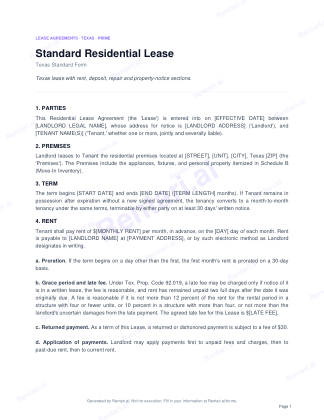
In the Rentari Texas lease
- Fair housing
The lease says the landlord follows federal, state and local fair housing law and will consider requests for reasonable accommodations and modifications.
Tex. Prop. Code § 301.021 Tex. Prop. Code § 301.025 Tex. Prop. Code § 301.0045
- Required disclosures and lease language
The Texas lease carries both early-termination statements, the bold repair-remedies notice, an ownership and emergency-number clause, a Parking Rules paragraph and the smoke alarm notice, and attaches the flood addendum; for homes built before 1978 it also attaches the federal lead-based paint disclosure.
Tex. Prop. Code § 92.0135 Tex. Prop. Code § 92.016 Tex. Prop. Code § 92.0161
- Flood disclosure
Every Texas lease attaches a Flood Disclosure Notice addendum in the statute's words, filled in from the landlord's flood zone and flood history answers and initialed by landlord and tenant.
- Owner and manager identity
The lease names the landlord and the landlord's notice address, names the manager and the manager's address when the property is managed for an owner, gives the landlord's phone number on file for reporting emergencies, and offers the record-title holder's name and address within seven days on request.
Tex. Prop. Code § 92.201 Tex. Prop. Code § 92.202 Tex. Prop. Code § 92.205
- Security deposit limit
The Rentari Texas lease states the deposit amount and says Texas sets no limit on it.
- Returning the deposit
The lease promises the refund and itemized list by the 30th day after surrender, repeats the forwarding-address rule, excludes normal wear and tear, and states the last-month's-rent and bad-faith penalties.
Tex. Prop. Code § 92.103 Tex. Prop. Code § 92.104 Tex. Prop. Code § 92.1041
- Move-in condition
The lease's condition clause refers to any move-in condition report and, as a lease term, asks the tenant to report pre-existing damage in writing within seven days of move-in.
Tex. Prop. Code ch. 92 Tex. Prop. Code § 92.258 Tex. Prop. Code § 92.263
- Rent payments and late fees
The lease charges the agreed late fee only after rent stays unpaid for the landlord's grace period, never fewer than two full days, and restates the 12 and 10 percent figures and the right to a written late-fee statement.
Tex. Prop. Code § 92.019 Tex. Prop. Code § 92.0191 Tex. Prop. Code § 92.011
- Returned payment fee
The Rentari Texas lease starts the returned-payment fee at $30, the 3.506 processing fee, and prints a different amount if you enter one.
- Landlord entry
The Texas lease says no chapter 92 section sets an entry notice and, as a lease term, requires at least 24 hours' notice before entering to inspect, repair or show the home, except in an emergency.
- Repairs and habitability
The lease restates the repair duty, requires the tenant's repair notice in writing, excludes tenant-caused damage other than normal wear and tear, and states the seven-day presumption.
Tex. Prop. Code § 92.052 Tex. Prop. Code § 92.053 Tex. Prop. Code § 92.054
- Tenant repair remedies
The lease carries the required bold notice of the termination, repair-and-deduct and court remedies, and limits repair and deduct to the four statutory cases, the one-month-or-$500 ceiling and an independent contractor.
Tex. Prop. Code § 92.056 Tex. Prop. Code § 92.0561 Tex. Prop. Code § 92.0562
- Locks and security devices
The lease lists the required devices at the landlord's expense, promises rekeying within seven days after each turnover, and offers extra rekeying at the tenant's expense on request.
Tex. Prop. Code § 92.153 Tex. Prop. Code § 92.156 Tex. Prop. Code § 92.158
- Smoke alarms
The lease states the installation locations, the move-in test and the duty to inspect on request, provides the hearing-impairment accommodation, and prints the bold 92.2611 notice.
Tex. Prop. Code § 92.255 Tex. Prop. Code § 92.254 Tex. Prop. Code § 92.258
- Retaliation
The lease restates the six-month bar, points to the 92.332 exceptions, and states the civil penalty.
Tex. Prop. Code § 92.331 Tex. Prop. Code § 92.332 Tex. Prop. Code § 92.333
- Lockouts and utility shutoffs
The lease's KEYS AND LOCKS clause says nothing in it permits the landlord to change locks or exclude the tenant except through judicial process, and the non-waiver clause says duties about utility cutoffs cannot be waived.
Tex. Prop. Code § 92.0081 Tex. Prop. Code § 92.008 Tex. Prop. Code § 92.009
- Ending a month-to-month tenancy
The lease restates the 91.001 rule and, as a lease term, requires the notice in writing at least 30 days before the day it names.
- Ending a fixed-term lease early
The lease prints both statutory statements in bold, summarizes the family violence, sexual offense or stalking, and military rights, says the family violence and sexual offense or stalking rights cannot be waived, and allows a waiver of the military right only in a separate signed document.
Tex. Prop. Code § 92.016 Tex. Prop. Code § 92.0161 Tex. Prop. Code § 92.0162
- Notice for unpaid rent
The lease requires at least three days' written notice to vacate before filing, uses the pay-rent-or-vacate form where the statute requires it, and lists the four delivery methods.
- Notice for other lease violations
The lease requires at least three days' written notice to vacate before any eviction suit.
- Eviction process
The lease names the justice court of the precinct where the home is located and states that the prevailing party in an eviction suit recovers reasonable attorney's fees and all court costs.
Tex. Prop. Code § 24.00505 Tex. Prop. Code § 24.004 Tex. Prop. Code § 24.0041
- Property left behind
The lease's abandonment clause promises to handle property left behind as the law requires and, when the lease states a storage period, to store it at least that long, a lease promise rather than a statute; it authorizes no self-help and has no landlord's lien clause.
Tex. Prop. Code § 54.043 Tex. Prop. Code § 54.044 Tex. Prop. Code § 54.045
Texas numbers the lease follows
- Late fee considered reasonable up to
- 12% or 10%
- of the rent: 12% in a building of 4 or fewer units, 10% in a larger one
- Tex. Prop. Code § 92.019
- Notice to vacate before filing
- 3 days
- unless the written lease sets another period
- Tex. Prop. Code § 24.005
- Ending a month-to-month tenancy
- 1 month
- or the later day named in the notice
- Tex. Prop. Code § 91.001
- Returned payment processing fee
- Up to $30
- for a returned check or electronic payment
- Tex. Bus. & Com. Code § 3.506
- Rent increase notice
- None set
- chapters 91 and 92 set none, so the lease governs
- Tex. Prop. Code ch. 91Tex. Prop. Code ch. 92
From the Texas lease
TEXAS RESIDENTIAL LEASE AGREEMENT
SPECIAL STATUTORY RIGHTS (Tex. Prop. Code §§ 92.016, 92.0161, 92.017): Tenants may have special statutory rights to terminate the lease early in certain situations involving family violence or a military deployment or transfer. Tenants may have special statutory rights to terminate the lease early in certain situations involving certain sexual offenses or stalking.
Special statutory rightsTex. Prop. Code § 92.016 Tex. Prop. Code § 92.0161 Tex. Prop. Code § 92.017
Notice required by Texas Property Code 92.0135. [Landlord name] ( ) is or ( ) is not aware that the dwelling you are renting is located in a 100-year floodplain. If neither box is checked, you should assume the dwelling is in a 100-year floodplain.
Flood Disclosure NoticeTex. Prop. Code § 92.0135
If Landlord is liable to Tenant under Tex. Prop. Code § 92.056(b) for failing to repair a condition that materially affects the physical health or safety of an ordinary tenant after proper notice, Tenant may: (1) terminate this Lease; (2) have the condition repaired or remedied and deduct the cost from rent as provided by Tex. Prop. Code § 92.0561; and (3) obtain judicial remedies under Tex. Prop. Code § 92.0563.
Notice of tenant remediesTex. Prop. Code § 92.056 Tex. Prop. Code § 92.0561 Tex. Prop. Code § 92.0563
Texas lease types
Pick 3, 6, 12, 18 or 36 months or your own dates. At the end, the lease ends or converts to month-to-month.
Standard lease guideEnding a month-to-month tenancy: 1 month, or the later day named in the notice.
Texas month-to-month leaseUpload a lease you already use: send an unsigned one for e-signature, or store one that is already signed.
Rooms use the Texas lease for now: add the room as its own unit and set house rules with the optional addenda.
Texas room rentalBefore you sign
Application and screening fees
Texas does not cap application fees. When you give out a rental application, you must make available printed notice of your tenant selection criteria and the grounds for denial, such as criminal history, rental history, current income, credit history, or inaccurate or incomplete information, and the applicant signs an acknowledgment. If you reject an applicant without having made that notice available, you must return the application fee and any application deposit.
Tex. Prop. Code § 92.3515 Tex. Prop. Code § 92.351 Tex. Prop. Code § 92.352 Tex. Prop. Code § 92.353 Tex. Prop. Code § 92.354
- The acknowledgment must include a statement substantively equivalent to the one 92.3515(c) sets out; it may be part of the application if the notice is underlined or in bold. Tex. Prop. Code § 92.3515(c)
- An application fee is a nonrefundable payment to offset screening costs; an application deposit is refundable if the applicant is rejected. Tex. Prop. Code § 92.351
- An applicant is deemed rejected if you do not give notice of acceptance by the seventh day after a completed application; rejecting one co-applicant rejects all. Tex. Prop. Code § 92.352
- Notice by telephone, or by mail postmarked by the required date, is presumed given; a deadline on a weekend or holiday runs to the end of the next day. Tex. Prop. Code § 92.353
- Bad-faith failure to refund costs $100, three times the amount wrongfully kept and attorney's fees, and a waiver in the application is void. Tex. Prop. Code § 92.354 Tex. Prop. Code § 92.355
- Keep what a reporting agency may report separate from the criteria a landlord may lawfully use. The State Law Library's housing resource distinguishes the federal seven-year arrest-record limit from convictions that may be reported indefinitely under federal law. It also flags that Texas section 20.05's criminal-record time limit may be unenforceable because of federal preemption. Do not promise a universal seven-year cutoff or treat every available record as permission to deny housing. Check the record type, dates, outcome, applicable reporting authority and fair-housing protections with the provider and qualified legal help; resolve mismatches and required notices separately. Texas State Law Library: housing and criminal records Tex. Bus. & Com. Code section 20.05
Fair housing
The Texas Fair Housing Act bars refusing to rent, or setting different terms, because of race, color, religion, sex, familial status, national origin or disability. Disability discrimination includes refusing reasonable accommodations in rules and policies, or refusing reasonable modifications the tenant pays for. Race discrimination includes discrimination based on hair texture or protective hairstyles such as braids, locks and twists.
Tex. Prop. Code § 301.021 Tex. Prop. Code § 301.025 Tex. Prop. Code § 301.0045 Tex. Prop. Code § 301.041 Tex. Prop. Code § 301.081 Tex. Prop. Code § 92.010
- Familial status covers pregnancy and living with a child under 18 as a parent or custodian, with the custodian's written permission, or while seeking custody. Tex. Prop. Code § 301.004
- Narrow exemptions exist, such as an owner of no more than three single-family houses renting without a broker, and an owner living in a building of up to four units; none allows a discriminatory advertisement. Tex. Prop. Code § 301.041 Tex. Prop. Code § 301.022
- Complaints go to the Texas Workforce Commission within one year, and a private lawsuit may be filed within two years. Tex. Prop. Code § 301.0015 Tex. Prop. Code § 301.081 Tex. Prop. Code § 301.151
- Texas limits occupancy to three adults per bedroom unless fair housing law requires more, or for up to one month for someone escaping family violence. Tex. Prop. Code § 92.010
- Source of income is not a protected class in the Texas Act, and cities may not require landlords to accept federal housing vouchers. Tex. Loc. Gov't Code § 250.007
The lease says the landlord follows federal, state and local fair housing law and will consider requests for reasonable accommodations and modifications.
Required disclosures and lease language
Give the flood notice of 92.0135 in the lease, an addendum or a separate signed document at or before signing, and put an underlined or bold notice of the tenant's repair remedies in every lease. Include the two early-termination statements too; without them, a tenant who leaves under those sections owes no overdue rent. The landlord must also give tenants a telephone number for reporting emergencies, disclose the record owner and any off-site manager on request, and deliver a complete copy of the signed lease within three business days.
Tex. Prop. Code § 92.0135 Tex. Prop. Code § 92.016 Tex. Prop. Code § 92.0161 Tex. Prop. Code § 92.017 Tex. Prop. Code § 92.056 Tex. Prop. Code § 92.020 Tex. Prop. Code § 92.201 Tex. Prop. Code § 92.024 Tex. Prop. Code § 92.0131
- Parking or towing rules in a multiunit complex: give the tenant a signed copy before the lease is signed; if they sit in the lease or an attachment, the paragraph title must read Parking or Parking Rules and be capitalized, underlined or bold. Tex. Prop. Code § 92.0131
- Tenant selection criteria must be made available with the rental application. Tex. Prop. Code § 92.3515
- Some landlord rights exist only if the lease grants them in a particular form: a lock change for unpaid rent, a contractual landlord's lien (underlined or conspicuous bold), charging the tenant for security device damage (underlined), deducting rekeying costs after a breach (underlined or bold), a move-out notice condition on the deposit refund (underlined or bold), and landlord remedies for a disabled smoke alarm (underlined or bold). Tex. Prop. Code § 92.0081(d) Tex. Prop. Code § 54.043 Tex. Prop. Code § 92.162(b) Tex. Prop. Code § 92.156(e) Tex. Prop. Code § 92.103(b) Tex. Prop. Code § 92.2611(d)
- Offering a fee in lieu of a deposit requires written notice of the tenant's options and a signed agreement. Tex. Prop. Code § 92.111
- The lease copy may be given on paper, electronically if the tenant asks, or by e-mail if the parties have e-mailed about the lease. Tex. Prop. Code § 92.024(e)
- A lease may not bar a tenant or guest from lawfully possessing, carrying, transporting or storing a firearm or ammunition in the unit, in a vehicle in tenant parking, or on the way in or out, unless state or federal law prohibits it. Tex. Prop. Code § 92.026
- A guarantor who is not a tenant is liable only for the original lease term, unless the original lease states the last date a renewal will bind the guarantor and the other terms 92.021 requires. Tex. Prop. Code § 92.021
The Texas lease carries both early-termination statements, the bold repair-remedies notice, an ownership and emergency-number clause, a Parking Rules paragraph and the smoke alarm notice, and attaches the flood addendum; for homes built before 1978 it also attaches the federal lead-based paint disclosure.
Flood disclosure
Give each tenant a written notice, substantially equivalent to the statutory form, stating whether you are aware the home is in a 100-year floodplain; the form also warns that most renters insurance does not cover flood loss. If you know flooding damaged the home at least once in the five years before the lease takes effect, give a second notice about that. The notices go in a lease paragraph, an addendum or a separate document given at or before signing, and both parties sign it.
- If neither box on the floodplain notice is checked, the tenant should assume the home is in the floodplain. Tex. Prop. Code § 92.0135(b)
- You need not say the home is in the floodplain if it has been raised above the 100-year flood level under federal rules. Tex. Prop. Code § 92.0135(c)
- Leases shorter than 30 days, and short occupancy under a contract of sale, are exempt. Tex. Prop. Code § 92.0135(a-1)
- If you skip the notice and the tenant loses at least half the value of their belongings to a flood, the tenant may end the lease within 30 days, and you refund prepaid rent within 30 days after termination. Tex. Prop. Code § 92.0135(f), (g)
- Flooding includes overflow of inland or tidal waters, rapid runoff from an established water source, and excessive rainfall. Tex. Prop. Code § 92.0135(a)
Every Texas lease attaches a Flood Disclosure Notice addendum in the statute's words, filled in from the landlord's flood zone and flood history answers and initialed by landlord and tenant.
Owner and manager identity
On a tenant's request, disclose the name and street or post office box address of the record title holder, and the name and street address of any off-site management company, within seven days. You can meet this in advance by putting the information in the lease or written rules, or by posting it continuously in the unit or at the on-site office.
Tex. Prop. Code § 92.201 Tex. Prop. Code § 92.202 Tex. Prop. Code § 92.205 Tex. Prop. Code § 92.020 Tex. Prop. Code § 92.003
- Liability arises only after the tenant also gives written notice that remedies may be used if you do not answer within seven days; the tenant may then get a court order, the cost of finding the information, one month's rent plus $100, fees, and may end the lease. Tex. Prop. Code § 92.202 Tex. Prop. Code § 92.205
- Rent owed on the notice date is a defense, but not for willfully false information. Tex. Prop. Code § 92.206 Tex. Prop. Code § 92.204
- Keep the information current and correct it within seven days after a tenant's written notice. Tex. Prop. Code § 92.203
- A management company named in writing to the tenant is the owner's sole agent for service of process in tenant suits. Tex. Prop. Code § 92.003
- Give tenants a telephone number for reporting emergencies; with an on-site office it must be answered 24 hours a day and posted outside the office. Tex. Prop. Code § 92.020
The lease names the landlord and the landlord's notice address, names the manager and the manager's address when the property is managed for an owner, gives the landlord's phone number on file for reporting emergencies, and offers the record-title holder's name and address within seven days on request.
Deposits, rent and fees
Security deposit limit
Not set by statuteTexas does not cap the amount of a security deposit. A security deposit is any advance of money meant mainly to secure the tenant's performance under the lease, other than a rental application deposit or rent paid in advance.
Tex. Prop. Code §§ 92.101 to 92.113
- A landlord who requires a deposit may offer a recurring fee in lieu of it, but must also offer the deposit, may not use the tenant's choice when deciding the application, and needs a written agreement signed by both sides. Tex. Prop. Code § 92.111
- A fee in lieu of a deposit counts as a security deposit unless the parties signed the written agreement and the fee buys insurance covering both damages and unpaid rent the tenant owes. Tex. Prop. Code § 92.111(g), (h)
The Rentari Texas lease states the deposit amount and says Texas sets no limit on it.
Returning the deposit
Refund the deposit on or before the 30th day after the tenant surrenders the premises, with a written description and itemized list of any deductions. You may deduct damages and charges the tenant is legally liable for under the lease, but never normal wear and tear. You do not have to refund or itemize until the tenant gives a written forwarding address, and the tenant does not lose the refund by failing to give one.
Tex. Prop. Code § 92.103 Tex. Prop. Code § 92.104 Tex. Prop. Code § 92.1041 Tex. Prop. Code § 92.107 Tex. Prop. Code § 92.108 Tex. Prop. Code § 92.109 Tex. Prop. Code § 92.113 Tex. Prop. Code § 92.105
- A refund or accounting mailed with a postmark on or before the deadline is presumed on time. Tex. Prop. Code § 92.1041
- No itemized list is needed if the tenant owes rent at move-out and the amount is not disputed. Tex. Prop. Code § 92.104(c)
- Missing the 30 days creates a presumption of bad faith. Keeping a deposit in bad faith costs $100, three times the amount wrongfully withheld and the tenant's attorney's fees; failing in bad faith to send the itemized list also forfeits the right to keep any part of the deposit or to sue for damage to the home. The landlord must prove each deduction was reasonable. Tex. Prop. Code § 92.109
- A tenant may not withhold the last month's rent against the deposit; doing so is presumed bad faith and costs three times the rent withheld plus fees. Tex. Prop. Code § 92.108
- Requiring advance notice of move-out as a condition of the refund works only if the requirement is underlined or in conspicuous bold print in the lease. Tex. Prop. Code § 92.103(b)
- Deposit notices may go by e-mail if the landlord and tenant have e-mailed each other before. Tex. Prop. Code § 92.113
- A new owner, other than a mortgage lender that takes title by foreclosure, becomes liable for existing deposits and must give each tenant a signed statement of the exact amount; the seller stays liable for deposits it received until the buyer receives them or assumes the liability, unless a written contract says otherwise. Tex. Prop. Code § 92.105
- If the lease required no deposit, give the tenant written notice of your claim for damages and charges no later than the day you report it to a consumer reporting agency or debt collector, or you forfeit the right to collect them. The notice is not required if the tenant gave no forwarding address. Tex. Prop. Code § 92.110
The lease promises the refund and itemized list by the 30th day after surrender, repeats the forwarding-address rule, excludes normal wear and tear, and states the last-month's-rent and bad-faith penalties.
Deposit account and interest
A landlord must keep accurate records of all security deposits. Nothing in the deposit subchapter requires paying interest or holding an owner-landlord's deposits in a separate account. A real estate license holder (a broker or sales agent) is different: while engaged in real estate brokerage, commingling other people's money or failing to deposit trust funds within a reasonable time with a Texas-authorized title company or in a trust or escrow account at a Texas-authorized bank is grounds for license discipline.
Tex. Prop. Code § 92.106 Tex. Occ. Code § 1101.652
- The tenant's claim to the deposit ranks ahead of the landlord's creditors, including a bankruptcy trustee. Tex. Prop. Code § 92.103(c)
Move-in condition
Not set by statuteNo section of Property Code chapter 92 requires a general move-in condition inspection, checklist or photo record. The only move-in checks it requires are testing each smoke alarm and, where the landlord installed a fire extinguisher under a local ordinance or other law, inspecting it. A dated record of the unit's condition at move-in is still useful evidence if a deposit deduction is disputed.
Tex. Prop. Code ch. 92 Tex. Prop. Code § 92.258 Tex. Prop. Code § 92.263
- In a tenant's suit over the deposit, the landlord must prove that keeping any part of it was reasonable. Tex. Prop. Code § 92.109(c)
- Normal wear and tear, which can never be deducted, means deterioration from intended use; it does not include damage from negligence, carelessness, accident or abuse by the tenant, household members or guests. Tex. Prop. Code § 92.001(4) Tex. Prop. Code § 92.104(b)
The lease's condition clause refers to any move-in condition report and, as a lease term, asks the tenant to report pre-existing damage in writing within seven days of move-in.
Rent payments and late fees
You may charge a late fee only if the written lease gives notice of it, the fee is reasonable, and some rent has remained unpaid two full days after the date it was originally due. A fee is considered reasonable if it is no more than 12 percent of the rent for the rental period in a structure with four or fewer units, or 10 percent in a structure with more than four; a higher fee is also considered reasonable if it is not more than the landlord's uncertain damages from the late payment, such as collection costs and overhead. An initial fee and a daily fee together count as one late fee.
Tex. Prop. Code § 92.019 Tex. Prop. Code § 92.0191 Tex. Prop. Code § 92.011
- For rent due on the 1st, the two full days are the 2nd and the 3rd, so a fee can apply from the 4th. Tex. Prop. Code § 92.019
- Collecting a late fee in violation of the section costs $100, three times the improper fee and the tenant's attorney's fees, and a lease waiver is void. Tex. Prop. Code § 92.019(c), (d)
- On request, give the tenant a written statement of whether a late fee is owed and how much. Tex. Prop. Code § 92.0191
- You must accept timely rent in cash unless the written lease requires a check, money order or other traceable instrument; for cash, give a written receipt and record the payment in a record book. Tex. Prop. Code § 92.011
The lease charges the agreed late fee only after rent stays unpaid for the landlord's grace period, never fewer than two full days, and restates the 12 and 10 percent figures and the right to a written late-fee statement.
Returned payment fee
When a check or electronic payment is returned unpaid, the holder of the payment, or someone collecting it for the holder, may charge the payer a processing fee of up to $30. Chapter 92 has no separate returned-payment rule for rent.
- No processing fee may be charged if a reimbursement fee was already collected through the criminal process named in 3.506(c). Tex. Bus. & Com. Code § 3.506(c)
- The section says it does not affect other rights or remedies the holder has under a rule, written contract, court decision or other statute. Tex. Bus. & Com. Code § 3.506(e)
The Rentari Texas lease starts the returned-payment fee at $30, the 3.506 processing fee, and prints a different amount if you enter one.
Rent increases
Not set by statuteNo section of Property Code chapters 91 or 92 sets a notice period or a limit for rent increases, so the lease governs the rent for its term.
Tex. Prop. Code ch. 91 Tex. Prop. Code ch. 92
- A landlord may not raise the rent to retaliate within six months after a tenant's protected action, such as a good-faith repair request or a complaint to a code agency. Tex. Prop. Code § 92.331
- If, at lease signing or renewal, a tenant gives written notice that the rental is not their primary residence, requests notices at their primary residence and supplies that address, mail end-of-term rent-increase notices there. Section 92.012 does not apply when notice is actually hand delivered to and received by a person occupying the rental. Tex. Prop. Code § 92.012
- Either party may end a month-to-month tenancy by notice. Tex. Prop. Code § 91.001 See Ending a month-to-month tenancy on the Texas page
- Cities may adopt rent control only under narrow emergency conditions. Tex. Loc. Gov't Code § 214.902 See Rent control and local rules on the Texas page
- For that primary-residence notice, regular United States mail is allowed and the notice counts as given on its postmark date. The tenant must report a change of primary-residence address in writing; an oral update is insufficient. With multiple tenants, the section does not require notices to the primary residence of more than one. These rules do not create a general three-day mailing extension or a separate rent-increase notice period. Tex. Prop. Code § 92.012
During the tenancy
Landlord entry
Not set by statuteNo section of Property Code chapter 92 sets a notice period or general conditions for a landlord entering an occupied unit. Entry terms come from the lease, so write them in.
- Some notices may be posted on the inside of the main entry door. Tex. Prop. Code § 92.013(b) Tex. Prop. Code § 92.0081(d)(3)
- Keeping a tenant out of the unit is a separate question governed by the lockout rules. Tex. Prop. Code § 92.0081
The Texas lease says no chapter 92 section sets an entry notice and, as a lease term, requires at least 24 hours' notice before entering to inspect, repair or show the home, except in an emergency.
Repairs and habitability
Make a diligent effort to repair a condition that materially affects the physical health or safety of an ordinary tenant, or a failure to keep a device supplying hot water of at least 120 degrees Fahrenheit working, once the tenant gives notice to the person or place where rent is normally paid and is current on rent. You have no duty to repair a condition caused by the tenant, household, occupants or guests, other than normal wear and tear. Seven days is presumed a reasonable time to repair; the presumption can be rebutted based on when notice arrived, the severity of the condition and the availability of labor, materials and utilities.
Tex. Prop. Code § 92.052 Tex. Prop. Code § 92.053 Tex. Prop. Code § 92.054 Tex. Prop. Code § 92.056 Tex. Prop. Code § 92.006 Tex. Prop. Code § 92.061
- The tenant's notice must be in writing only if a written lease requires it. Tex. Prop. Code § 92.052(d)
- If you do not give a written explanation for a delay within five days after receiving the tenant's written demand for one, you carry the burden of proving diligence and that a reasonable time for repair had not passed. Tex. Prop. Code § 92.053(b)
- After an insured casualty such as fire or hail, the repair period starts when the insurance proceeds arrive. Tex. Prop. Code § 92.054(a)
- The repair duty cannot be waived except as the statute allows. A landlord who owns only one rental dwelling may shift repairs to the tenant only if the home has no health or safety hazard at the start of the term, none is expected, and a specific underlined or bold written agreement is made knowingly, voluntarily and for consideration. Any landlord may use an agreement in that form to have the tenant pay for wastewater stoppages from improper objects in lines serving only that unit, damage to doors, windows or screens, and damage from doors or windows left open, unless the landlord's negligence caused it. Tex. Prop. Code § 92.006(e), (f)
- A landlord who knowingly makes an unlawful waiver of the repair duty owes actual damages, a civil penalty of one month's rent plus $2,000 and attorney's fees. Tex. Prop. Code § 92.0563(b)
- The landlord need not furnish security guards. Tex. Prop. Code § 92.052(c)
- These duties replace common-law warranties of habitability and repair. Tex. Prop. Code § 92.061
The lease restates the repair duty, requires the tenant's repair notice in writing, excludes tenant-caused damage other than normal wear and tear, and states the seven-day presumption.
Tenant repair remedies
If a landlord fails to repair after proper notice and a reasonable time, the tenant may end the lease, have the work done and deduct the cost from rent in the cases the statute allows, or go to court. These remedies require either a second written notice after a reasonable time or a first notice sent by certified, registered or other tracked mail, and the tenant must have been current on rent when each notice was given. Every lease must describe these remedies in underlined or bold print.
Tex. Prop. Code § 92.056 Tex. Prop. Code § 92.0561 Tex. Prop. Code § 92.0562 Tex. Prop. Code § 92.0563 Tex. Prop. Code § 92.058
- Repair and deduct is limited to raw sewage backup or flooding inside the unit, a total loss of landlord-supplied water, inadequate heating or cooling certified by a local official, or another condition a local official certified in writing. Tex. Prop. Code § 92.0561(d)
- Deductions are capped at the greater of one month's rent or $500 in any month, the work must be done by an independent contractor (licensed where the city requires), and the tenant hands over the bill and receipt with the rest of the rent. Tex. Prop. Code § 92.0561
- After the tenant's notice of intent to repair, the tenant may act at once for sewage or flooding, after three days for lost water or certified heating or cooling, and after seven days for other certified conditions. Tex. Prop. Code § 92.0561(e)
- A sworn landlord affidavit, delivered before the tenant contracts for the repair, can delay tenant repairs by 15 days for a parts delay that is not the landlord's fault, or 30 days for a general shortage of labor or materials after a natural disaster; later affidavits may extend the total delay to six months. Tex. Prop. Code § 92.0562
- In court the tenant can win a repair order, a rent reduction, a civil penalty of one month's rent plus $500, actual damages, costs and fees; a justice court may award up to $20,000 in these cases. Tex. Prop. Code § 92.0563
- A tenant who withholds rent or deducts in bad faith after your written warning owes a civil penalty of one month's rent plus $500. Tex. Prop. Code § 92.058
The lease carries the required bold notice of the termination, repair-and-deduct and court remedies, and limits repair and deduct to the four statutory cases, the one-month-or-$500 ceiling and an independent contractor.
Locks and security devices
Without being asked, a landlord must equip each unit, at the landlord's expense, with a window latch on every exterior window; a keyed dead bolt or doorknob lock, a keyless bolting device and a door viewer on every exterior door; and a pin lock plus a handle latch or security bar on every exterior sliding glass door. Rekey every key, card or combination device within seven days after each new tenant moves in, at your expense. Repair or replace a broken device when the tenant asks, and rekey or change locks at the tenant's expense whenever the tenant requests.
Tex. Prop. Code § 92.153 Tex. Prop. Code § 92.156 Tex. Prop. Code § 92.158 Tex. Prop. Code § 92.161 Tex. Prop. Code § 92.164
- Keyed dead bolts and keyless bolting devices go at least 36 inches from the floor and no higher than 48 inches (54 for installs before September 1, 1993), with a strike plate and, for newer installs, a one-inch throw. Tex. Prop. Code § 92.154
- Tenant requests are presumed handled in a reasonable time within seven days, or within 72 hours when the tenant reports an unauthorized entry or attempt at the unit, or one at another unit or a violent crime at the complex in the prior two months. Tex. Prop. Code § 92.161
- A tenant's request may be oral unless an underlined or bold lease term requires writing. Tex. Prop. Code § 92.159
- If you fail to install or rekey a required device, the tenant may do it and deduct the cost. If it is still not done three days after you receive the tenant's written request (seven days if the lease carries the notice in 92.164(b), unless the tenant reported a break-in or violent crime), the tenant may end the lease or sue for a civil penalty of one month's rent plus $500 and other relief. Tex. Prop. Code § 92.164 Tex. Prop. Code § 92.165
- The subchapter does not cover hotels, accredited college or preparatory school housing, or short occupancy under a contract of sale. Tex. Prop. Code § 92.152
- A keyless bolting device may be omitted in some housing for tenants over 55 or with a disability. Tex. Prop. Code § 92.153(e), (f)
The lease lists the required devices at the landlord's expense, promises rekeying within seven days after each turnover, and offers extra rekeying at the tenant's expense on request.
Smoke alarms
Install at least one smoke alarm in each bedroom, in the hallway serving multiple bedrooms, and on each level of the unit, and test each one when the tenant moves in. During the tenancy, inspect and repair an alarm within a reasonable time after the tenant reports a problem or asks. On request, an alarm must be able to alert a person with a hearing impairment.
Tex. Prop. Code § 92.255 Tex. Prop. Code § 92.254 Tex. Prop. Code § 92.258 Tex. Prop. Code § 92.260 Tex. Prop. Code § 92.2611
- Alarms must be listed by Underwriters Laboratories, Factory Mutual or United States Testing and installed per the manufacturer, on a ceiling at least 6 inches from a wall or on a wall 6 to 12 inches below the ceiling unless the instructions say otherwise. Tex. Prop. Code § 92.254 Tex. Prop. Code § 92.257
- Units occupied, or given a certificate of occupancy, before September 1, 2011 may use battery-powered alarms that are not interconnected, with limits on replacements. Tex. Prop. Code § 92.255(b)
- You need not supply batteries after move-in if the alarm worked at move-in; for damage the tenant caused, you repair only if the tenant pays in advance. Tex. Prop. Code § 92.258
- If you fail to act within seven days after the tenant's written notice, the tenant may get a court order, a civil penalty of one month's rent plus $100, fees, or end the lease. Tex. Prop. Code § 92.259 Tex. Prop. Code § 92.260
- A landlord may recover damages from a tenant who disables an alarm; a court order, a civil penalty of one month's rent plus $100, costs and attorney's fees also require an underlined or bold lease notice and a separate written notice giving the tenant seven days to fix it. Tex. Prop. Code § 92.2611
- The subchapter does not apply to buildings of five or more stories where a local ordinance regulates smoke alarms, among other exemptions. Tex. Prop. Code § 92.253
The lease states the installation locations, the move-in test and the duty to inspect on request, provides the hearing-impairment accommodation, and prints the bold 92.2611 notice.
Retaliation
For six months after a tenant in good faith uses a legal right or remedy, gives a repair notice, complains to a code agency, utility or civic group about a code violation or utility problem, or joins a tenant organization, a landlord may not retaliate. Barred retaliation includes filing an eviction, depriving the tenant of the unit, cutting services, raising the rent, ending the lease, or a bad-faith course of conduct that materially interferes with the lease.
Tex. Prop. Code § 92.331 Tex. Prop. Code § 92.332 Tex. Prop. Code § 92.333 Tex. Prop. Code § 92.335 Tex. Prop. Code § 92.015
- Not retaliation: evicting or ending the lease of a tenant who was behind on rent when you gave notice or filed, whose household or guests intentionally damaged property or threatened someone's safety, who materially breached the lease, or who held over in the situations 92.332 lists. Tex. Prop. Code § 92.332
- A landlord is not liable if it proves the action was not taken to retaliate. Rent increases under a written escalation clause for utilities, taxes or insurance, and rent increases or service reductions across a whole project, are not retaliation unless they violate a prior repair order under 92.0563. Tex. Prop. Code § 92.332(a)
- A retaliating landlord owes a civil penalty of one month's rent plus $500, actual damages, court costs and attorney's fees, less rent owed; a tenant who sues in bad faith faces the same civil penalty. Tex. Prop. Code § 92.333 Tex. Prop. Code § 92.334
- Retaliation is a defense in an eviction suit. Tex. Prop. Code § 92.335
- A landlord may not bar or penalize a tenant for calling police or emergency help based on a reasonable belief that someone needs it. Tex. Prop. Code § 92.015
The lease restates the six-month bar, points to the 92.332 exceptions, and states the civil penalty.
Lockouts and utility shutoffs
A landlord may not keep a tenant out of the unit without a court order, except for bona fide repairs, construction or an emergency, removing the contents of an abandoned unit, or a lock change for delinquent rent that follows 92.0081 exactly. A landlord also may not interrupt utilities, whether the tenant pays the utility company or the landlord supplies the service, except for bona fide repairs, construction or an emergency.
Tex. Prop. Code § 92.0081 Tex. Prop. Code § 92.008 Tex. Prop. Code § 92.009 Tex. Prop. Code § 92.0091 Tex. Prop. Code § 92.301
- A lock change for unpaid rent needs a lease clause giving that right, plus advance written notice (mailed locally at least five days before, or hand-delivered or posted inside the main door at least three days before) stating the earliest date, the amount due and where to pay, and, in underlined or bold print, the tenant's right to a new key at any hour. Tex. Prop. Code § 92.0081(d)
- After the change, post a notice on the front door and provide a new key at any hour whether or not rent is paid; never change locks while anyone is inside, more than once per rent period, on a day (or the day before a day) when no one is available to take payment, or on common areas. Tex. Prop. Code § 92.0081
- Violations let the tenant retake possession or end the lease and recover one month's rent plus $1,000, actual damages, court costs and fees; a justice court can order reentry or restored service. Tex. Prop. Code § 92.0081(h) Tex. Prop. Code § 92.009 Tex. Prop. Code § 92.008(f) Tex. Prop. Code § 92.0091
- A landlord that submeters or allocates electricity may interrupt electric service for an unpaid electric bill only with a lease right and under the notice, weather and medical limits of 92.008(h) to (r). Tex. Prop. Code § 92.008(h)
- If you agreed to pay for utilities and the utility company cuts or threatens to cut service because you did not pay, the tenant may pay it and deduct the payment from rent, or end the lease. Tex. Prop. Code § 92.301
- If you are the utility customer for a master-metered, not submetered, property of at least 10 dwellings, give each tenant written notice in English and Spanish within five days after receiving a disconnection notice, including the tenant's remedies, and notify the city by certified mail. Tex. Prop. Code § 92.302
The lease's KEYS AND LOCKS clause says nothing in it permits the landlord to change locks or exclude the tenant except through judicial process, and the non-waiver clause says duties about utility cutoffs cannot be waived.
Ending a tenancy
Ending a month-to-month tenancy
Either party can end a month-to-month tenancy by notice. When rent is paid monthly, the tenancy ends on the later of the day named in the notice or one month after the notice is given; with a shorter rent period, such as weekly, the minimum is one full rent period. The parties may agree to a different notice period, or to none, in a document both sign.
Tex. Prop. Code § 91.001 Tex. Prop. Code § 24.005
- If the tenancy ends partway through a rent period, rent is owed only through the termination date. Tex. Prop. Code § 91.001(d)
- To evict a tenant who holds over after the tenancy ends, give the 24.005 notice to vacate and also meet 91.001. Tex. Prop. Code § 24.005(a) Tex. Prop. Code § 91.001
- A landlord may not end a tenancy to retaliate within six months after a tenant's protected action. Tex. Prop. Code § 92.331
The lease restates the 91.001 rule and, as a lease term, requires the notice in writing at least 30 days before the day it names.
Ending a fixed-term lease early
Texas lets a tenant end a lease early and avoid future rent in four situations: family violence, certain sexual offenses or stalking, military service, and, through the estate's representative, the death of a tenant who was the sole occupant. The lease should contain two statutory statements about these rights; without them, a tenant who leaves under the family violence, sexual offense or stalking, or military sections is also released from rent already overdue. When a tenant abandons the unit in violation of the lease, the landlord has a duty to mitigate damages, and a lease clause waiving that duty is void.
Tex. Prop. Code § 92.016 Tex. Prop. Code § 92.0161 Tex. Prop. Code § 92.0162 Tex. Prop. Code § 92.017 Tex. Prop. Code § 91.006
- Statement for 92.016(f) and 92.017(g): "Tenants may have special statutory rights to terminate the lease early in certain situations involving family violence or a military deployment or transfer." Tex. Prop. Code § 92.016(f) Tex. Prop. Code § 92.017(g)
- Statement for 92.0161(g): "Tenants may have special statutory rights to terminate the lease early in certain situations involving certain sexual offenses or stalking." Tex. Prop. Code § 92.0161(g)
- Family violence: the tenant provides a qualifying protective order or documentation from a licensed health care or mental health provider or an advocate, gives written notice at least 30 days before the termination date, and moves out; no notice is needed when a cotenant or occupant committed the violence. Tex. Prop. Code § 92.016
- Sexual offenses in the prior six months, or stalking in the prior six months on the premises or at any dwelling on the premises: the tenant, or a parent or guardian living with the victim, provides the documentation 92.0161 lists and 30 days' written notice, then moves out; the landlord may share that information only for a legitimate or customary business purpose or as law requires. Tex. Prop. Code § 92.0161
- Military: a servicemember or dependent may end the lease on entering service after signing, or on orders for a permanent change of station or a deployment of 90 days or more, by giving written notice plus a copy of the orders, or, for someone who entered service after signing, a government document showing entry into service; with monthly rent, termination takes effect 30 days after the next rent due date following the notice. Tex. Prop. Code § 92.017
- Death of a sole occupant: the estate's representative gives written notice, removes the property and signs any inventory you require; termination takes effect on the later of 30 days after notice or when those steps are done. Tex. Prop. Code § 92.0162
- Violating the family violence, sexual offense or stalking, or military sections costs actual damages, a civil penalty of one month's rent plus $500, and attorney's fees. Tex. Prop. Code § 92.016(e) Tex. Prop. Code § 92.0161(f) Tex. Prop. Code § 92.017(h)
- A tenant may also end the lease after certain landlord failures, including uncured repairs, an unlawful lockout or utility cutoff, a missing flood notice followed by a major flood loss, and a casualty that makes the unit totally unusable. Tex. Prop. Code § 92.056 Tex. Prop. Code § 92.0081 Tex. Prop. Code § 92.008 Tex. Prop. Code § 92.0135(f) Tex. Prop. Code § 92.054(b)
- When negotiating an early exit, put the agreed move-out date, key return, remaining rent, any release payment and deposit accounting in a signed agreement. Clarify whether it releases future rent. Handing back keys or paying a reletting charge does not by itself establish that the landlord agreed to a complete release. Texas State Law Library: ending the lease
- The State Law Library distinguishes reasonable reletting expenses from an inflated penalty. Check the lease and the actual charge rather than assuming every early move-out has a fixed price. Keep a record of marketing and replacement-tenant efforts, and reconcile the claimed balance when the unit is rented again. Texas State Law Library: ending the lease
The lease prints both statutory statements in bold, summarizes the family violence, sexual offense or stalking, and military rights, says the family violence and sexual offense or stalking rights cannot be waived, and allows a waiver of the military right only in a separate signed document.
Notice for unpaid rent
Before filing an eviction suit for unpaid rent, give the tenant at least three days' written notice to vacate, unless the written lease sets a shorter or longer period. If the tenant was not late or delinquent before the month of the notice, the notice must be a notice to pay rent or vacate; for a tenant who was late before, either form may be used.
Tex. Prop. Code § 24.005 Tex. Prop. Code § 24.0042
- Deliver the notice by mail (first class, registered, certified or a delivery service), inside the unit in a conspicuous place, by hand to a tenant 16 or older, or electronically if the parties agreed in writing; any method works if the tenant actually receives it. Tex. Prop. Code § 24.005(f-3), (f-4)
- Count from the day after delivery, weekends and holidays included; if the last day is a Saturday, Sunday or state or federal holiday, the period runs to the next day that is not. Tex. Prop. Code § 24.0042
- If federal law requires a longer notice, you may still file after the Texas notice, but the writ of possession cannot be served until the federal period has run. Tex. Prop. Code § 24.005(c-1)
- A response period that the lease or a state or federal rule requires may run at the same time as the notice. Tex. Prop. Code § 24.005(e)
The lease requires at least three days' written notice to vacate before filing, uses the pay-rent-or-vacate form where the statute requires it, and lists the four delivery methods.
Notice for other lease violations
For violations other than unpaid rent, chapters 24 and 92 give no general right to cure before the landlord gives a notice to vacate. The landlord gives the same written notice to vacate, at least three days unless the written lease sets another period, before filing an eviction suit.
Tex. Prop. Code § 24.005 Tex. Prop. Code § 92.332
- The exceptions are narrow: a landlord that interrupted submetered electricity for an unpaid electric bill may not evict for that bill unless it stays unpaid after service has been off at least two days, not counting weekends or state or federal holidays, and a tenant who disabled a smoke alarm gets seven days to fix it before the landlord's court remedies. Tex. Prop. Code § 92.008 Tex. Prop. Code § 92.2611
- Evicting or ending the lease for a material breach, such as violating written lease rules against serious misconduct or criminal acts, is not retaliation. Tex. Prop. Code § 92.332(b)(3)
- Delivery methods and day counting are the same as for unpaid rent. Tex. Prop. Code § 24.005(f-3) Tex. Prop. Code § 24.0042
The lease requires at least three days' written notice to vacate before any eviction suit.
Eviction process
After the notice to vacate, an eviction starts with a sworn petition in the justice court of the precinct where the property is located. The court decides the right to possession and may award unpaid rent within a $20,000 limit that includes attorney fees but excludes statutory interest and court costs; it does not decide title, and counterclaims are not allowed. The citation sets trial 10 to 21 days after the petition is filed. Since January 1, 2026, a landlord whose sworn petition alleges a forcible entry and detainer may include a sworn motion for summary disposition, asking for judgment without trial; in the usual case against a tenant who stays after the right to possession ends, either side may instead move for summary disposition under the general justice court rule. A writ of possession cannot issue before the sixth day after the judgment is signed or the day after the appeal deadline, whichever is later, except under the possession-bond procedure.
Tex. Prop. Code § 24.00505 Tex. Prop. Code § 24.004 Tex. Prop. Code § 24.0041 Tex. Prop. Code § 24.0051 Tex. Prop. Code § 24.005106 Tex. Prop. Code § 24.005107 Tex. Prop. Code § 24.0053 Tex. Prop. Code § 24.0061 Tex. Prop. Code § 24.006 Tex. Prop. Code § 24.011 Tex. Prop. Code § 24.0043 Tex. Prop. Code § 1.004 Tex. R. Civ. P. 510.1(a) Tex. R. Civ. P. 510.8(b)(10) Tex. R. Civ. P. 510.10
- The sheriff or constable must make a diligent effort to serve within five business days after filing. If service has not occurred, the landlord may request an alias citation for another appropriately trained law enforcement officer; the landlord remains responsible for that officer's fee. Tex. Prop. Code § 24.0051(f) Tex. R. Civ. P. 510.8(d)
- The court issues a citation immediately for each defendant. For a written residential lease, name and serve every resident lease tenant sought to be evicted. Ordinary service delivers the citation and petition to the defendant or leaves them at the usual residence with someone over 16 other than the plaintiff; service must be at least four days before trial and cannot occur on Sunday. Tex. R. Civ. P. 510.6(d), 510.8(a), (d)
- Delivery to the premises requires the judge's authorization after the officer's sworn account of at least two diligent attempts at all known in-county addresses. The authorized officer delivers at the premises and mails a copy by first-class mail at least four days before trial. The return of service must be filed at least one day before trial. This is court service, separate from the landlord's pre-suit notice. Tex. R. Civ. P. 510.8(e), (f)
- Trial may not be earlier than the fourth day after service and may be postponed more than seven days only by written agreement. Tex. Prop. Code § 24.0051(g) Tex. R. Civ. P. 510.15(b)
- In a suit alleging a forcible entry and detainer, a summary disposition motion can bring judgment without trial unless the tenant files a response by the fourth day after service showing a genuinely disputed fact; the court may still consider a later response filed before judgment. Tex. Prop. Code § 24.005106(a), (b) Tex. R. Civ. P. 510.10(a)
- The petition must include the contents the Texas Rules of Civil Procedure require, and local court rules may not demand more or require mediation or another proceeding before trial. Tex. Prop. Code § 24.00505 Tex. Prop. Code § 24.00506(b)
- In an ordinary forcible detainer suit, either party may file a sworn summary disposition motion stating supporting facts and attaching the documents relied on. Rule 503.2 permits a sworn written response; the court cannot consider the motion until it has been on file for at least 14 days. The judge may consider evidence at a hearing, or decide the motion and response without a hearing if both parties agree. The separate four-day response procedure for forcible entry and detainer does not replace this process. Tex. R. Civ. P. 510.10(b), 503.2
- The tenant does not have to file a written answer, and an answer that simply denies the petition still lets the tenant raise any defense at trial. Tex. R. Civ. P. 510.11(a), (c)
- Court deadlines in an eviction case count every day; one that ends on a Saturday, Sunday or state or federal holiday moves to the next day that is not one, and a filing deadline on a day the court is closed moves to its next business day. Tex. R. Civ. P. 510.4(a)
- Either side may appeal within five days after the judgment is signed. An appealing tenant must affirm a good-faith meritorious defense and pay one rent period into the court registry within five days after filing the appeal, then at the start of each rent period; if the tenant misses a payment after the court's written notice, the court on request issues a writ without a hearing. Tex. Prop. Code § 24.005107 Tex. Prop. Code § 24.0053 Tex. Prop. Code § 24.0054
- The officer must serve the writ within five business days after issuance and post a warning giving at least 24 hours before execution. If it remains unserved, the landlord may request a replacement writ for another appropriately trained law enforcement officer. Ordinarily issuance must occur within 60 days after the signed judgment, extendable to 90 days for good cause; execution cannot occur after day 90. A properly perfected appeal with required registry rent prevents issuance. Tex. Prop. Code § 24.0061 Tex. R. Civ. P. 510.18(g)
- A landlord can recover attorney's fees only under a written lease clause, or after a demand to vacate sent by registered or certified mail at least 10 days before filing that warns of fees if the tenant does not leave before the 11th day after receiving it. The same clause or demand lets a prevailing tenant recover fees from the landlord, and the prevailing party recovers court costs. Tex. Prop. Code § 24.006
- Parties may appear for themselves or through non-lawyer agents in justice court. Tex. Prop. Code § 24.011
- Only the Legislature may modify or suspend these procedures, except that a Texas Supreme Court disaster order may apply to eviction suits under the conditions the statute sets; cities and counties may not regulate evictions. Tex. Prop. Code § 24.0043 Tex. Prop. Code § 1.004
The lease names the justice court of the precinct where the home is located and states that the prevailing party in an eviction suit recovers reasonable attorney's fees and all court costs.
Property left behind
If a tenant has abandoned the unit, the landlord may remove its contents. Seizing a tenant's property for unpaid rent is lawful only under a written lease clause that authorizes it and is underlined or in conspicuous bold print, without a breach of the peace, and never for exempt items; selling it requires lease authorization and at least 30 days' notice by both first-class and certified mail. No statute Rentari reviewed sets a general storage period for property left in an abandoned unit.
Tex. Prop. Code § 54.043 Tex. Prop. Code § 54.044 Tex. Prop. Code § 54.045 Tex. Prop. Code § 54.042 Tex. Prop. Code § 92.0081 Tex. Prop. Code § 92.014 Tex. Prop. Code § 24.0061 Tex. Prop. Code § 24.0062
- The residential landlord's lien secures rent that is due and reaches only nonexempt property; exempt items include clothing, tools of a trade, beds and bedding, kitchen furniture, food, medicine, one car and one truck, and children's toys. Tex. Prop. Code § 54.041 Tex. Prop. Code § 54.042
- After a seizure, leave written notice with an itemized list, the amount owed and a contact; the tenant may redeem the property before a sale. Tex. Prop. Code § 54.044(b) Tex. Prop. Code § 54.045(e)
- A willful violation costs actual damages, return of the property or proceeds, one month's rent plus $1,000, and attorney's fees. Tex. Prop. Code § 54.046
- If a sole occupant dies, you may remove and store the property, must release it to the person the tenant named or anyone lawfully entitled who asks first, and may discard it only after a certified-mail request to the named person, 30 days without removal, and no contact from anyone claiming it, unless the lease sets another procedure. Tex. Prop. Code § 92.014
- After an eviction judgment, the officer executing the writ has belongings placed outside the unit or stored by a bonded or insured warehouse; the tenant can redeem listed essentials within 30 days by paying the charges attributable to them. Tex. Prop. Code § 24.0061(d), (e) Tex. Prop. Code § 24.0062
The lease's abandonment clause promises to handle property left behind as the law requires and, when the lease states a storage period, to store it at least that long, a lease promise rather than a statute; it authorizes no self-help and has no landlord's lien clause.
Small claims and justice court
Justice courts hear civil claims up to $20,000, not counting interest, as well as eviction suits. Small claims cases there follow Texas Supreme Court rules meant to be quick and inexpensive, and those rules may not require a party to have a lawyer.
Tex. Gov't Code § 27.031 Tex. Gov't Code § 27.060
- In a repair suit under 92.0563, a justice court's award may not exceed $20,000, excluding interest and court costs. Tex. Prop. Code § 92.0563(e)
- A corporation does not need a lawyer in justice court, and in eviction suits parties may use non-lawyer agents. Tex. Gov't Code § 27.031(d) Tex. Prop. Code § 24.011
- Justice courts cannot hear suits over title to land or to enforce a lien on land. Tex. Gov't Code § 27.031(b)
More Texas rules
Preparing your first Texas rental
Partly readPrepare the property, application process and lease before move-in, then track the safety and management steps that follow possession. Use the detailed Texas topics in this guide for the applicable notices, documents, conditions and deadlines.
- Compare similar homes by location, size, condition and included services. Budget for taxes, insurance, utilities you pay, maintenance, turnover and vacancy, with a reserve for unexpected work. Check local rental registration, licensing, inspection, zoning and safety requirements for the address. Use actual bills and rent receipts to update the plan. Tex. Prop. Code § 92.052
- Prepare lawful selection criteria and the required printed notice and acknowledgment when providing applications. Review the application-fee, application-deposit and response rules before collecting money or ordering reports. Apply fair-housing requirements and keep the criteria, report information, decision notices, receipts and communications together with appropriate access limits. Tex. Prop. Code § 92.3515 See Application and screening fees on the Texas page
- Confirm the parties, home, dates, rent, deposits, utilities, payment methods and entry arrangements in the lease. Prepare the flood notice, repair-remedy and early-termination statements, emergency phone contact and other applicable disclosures. Deliver the required signed lease copy and retain delivery records; use the disclosure topic to check each item’s timing and conditions. Tex. Prop. Code § 92.0135 Tex. Prop. Code § 92.056 Tex. Prop. Code § 92.020 Tex. Prop. Code § 92.024 See Required disclosures and lease language on the Texas page
- Complete repairs and document the starting condition with dated photos. Check required security devices and alarms, schedule the required rekeying and record completion. Explain rent payments, routine repair requests and urgent contacts to the resident. Organize the ledger, receipts, notices, maintenance history and communications, and calendar lease events and deadlines. Tex. Prop. Code § 92.153 Tex. Prop. Code § 92.156 Tex. Prop. Code § 92.258 See Locks and security devices on the Texas page
Adverse possession and title records
Partly readAn assertion of ownership does not establish title. Texas has different adverse-possession limitation periods tied to the kind of title claim, possession, use and other conditions. Assess those issues separately from an eviction case, which decides the right to possession rather than title.
Texas Civil Practice and Remedies Code, Chapter 16: real-property limitations
- Chapter 16 defines adverse possession as actual, visible appropriation under a claim of right inconsistent with and hostile to another person’s claim. The three-year provision applies to peaceable and adverse possession under title or color of title, terms with specific statutory meaning. It is not a rule that any person staying in a home for three years becomes its owner. Texas Civil Practice and Remedies Code, Chapter 16: real-property limitations
- The five-year provision requires qualifying possession, cultivation, use or enjoyment, payment of applicable taxes and a claim under a duly registered deed. It excludes claims based on quitclaim or forged deeds and deeds executed under a forged power of attorney. The ten-year provision concerns qualifying possession by someone cultivating, using or enjoying the property. Other periods, acreage rules and exceptions can matter, so obtain a title assessment rather than choosing a deadline from a short list. Texas Civil Practice and Remedies Code, Chapter 16: real-property limitations
- Keep deeds and the chain of transfers, surveys and boundary plans, tax assessments and payments, leases and permissions, dated photographs and communications together. Record the claimed area and history of use, including interruptions or transfers. Secure and maintain vacant property and arrange lawful checks. Seek advice promptly when a person produces a competing deed or ownership claim. Texas Civil Practice and Remedies Code, Chapter 16: real-property limitations
- For a possession dispute, identify the occupant’s relationship to the property and use the applicable current notice and court process. The guide’s eviction topic explains the separate justice-court procedure, including the 2026 rules. Do not treat a general three-day notice, a rent-related lock-change exception or a claim to ownership as permission for a private eviction. Tenant lockout and utility protections remain subject to their specific statutory conditions. Tex. Prop. Code § 92.0081 Tex. Prop. Code § 92.008 Tex. Prop. Code § 92.009 Tex. Prop. Code § 92.0091 Tex. Prop. Code § 92.301 See Eviction process on the Texas page
Local rules
Rent control and local rules
A Texas city may adopt rent control only after finding a housing emergency caused by a disaster, and only with the governor's approval. A city or county may not regulate conduct in a field the Property Code occupies unless another statute expressly authorizes it, and that expressly includes evictions and notices to vacate. Cities and counties also may not bar landlords from turning down tenants who would pay rent partly with federal housing assistance, except to protect military veterans.
Tex. Loc. Gov't Code § 214.902 Tex. Prop. Code § 1.004 Tex. Loc. Gov't Code § 250.007
- Some local rules survive by statute: fire, building and housing codes on smoke alarms, ordinances adding enforcement to the ownership disclosure rules, certain pre-1993 security device ordinances and pre-2008 emergency-number ordinances. Tex. Prop. Code § 92.252 Tex. Prop. Code § 92.208 Tex. Prop. Code § 92.170 Tex. Prop. Code § 92.020(c)
- Voluntary local programs that encourage voucher acceptance remain allowed. Tex. Loc. Gov't Code § 250.007(c)
- Cities may adopt fair housing ordinances substantially equivalent to federal law. Tex. Loc. Gov't Code § 214.903
Cities and counties have their own housing, building, fire and other codes that can add duties for rental property. None was read for this page, so no local rule is listed here; check the codes of the city and county where the property is located.
Texas lease renewals
Read the agreement's renewal clause and the notice rules above before choosing a new term, changing rent or ending the tenancy. A fixed end date does not override applicable renewal rights, rent regulation, just-cause rules or protections against retaliation and discrimination.
Confirm the notice, timing and delivery requirements for the rental's state and locality. Review any required new disclosures and attachments when preparing the renewal. Get the parties' agreement to changed terms in writing.
Customize an unsigned agreement or prepare an addendum to an existing lease.
How it works
- Add your Texas rental
Enter the property and its units.
- Set the terms
Choose the rental, add tenants, and set rent, deposit and fees.
- Review the lease
Preview and edit the Texas lease and its addenda.
- Send for e-signature
Tenants sign online; sending is included on paid plans.
Follow the full lease builder guide, add supporting files, or download and print the agreement.
Texas lease questions
Does the Rentari Texas lease include the flood disclosure?
Yes. Every Texas lease attaches the statutory flood notice as an addendum, filled in from your flood zone and flood history answers and initialed by you and the tenant.
What if a Texas lease leaves out the early termination statements?
A tenant who ends the lease under the family violence, sexual offense or stalking, or military sections is then also released from rent that is already overdue. The Rentari Texas lease prints both statements in bold.
Tex. Prop. Code § 92.016(f) Tex. Prop. Code § 92.0161(g) Tex. Prop. Code § 92.017(g)
Does the lease let me change the locks when rent is late?
No. The lease says nothing in it permits changing the locks or keeping the tenant out except through the courts. Texas allows a lock change for unpaid rent only when the lease grants that right and the landlord follows the notice and key rules of section 92.0081.
How soon does the tenant get a copy of the signed lease?
Texas requires at least one complete copy within three business days after signing, and the Rentari Texas lease states that duty.
Can I e-sign a Texas lease with Rentari?
Yes. Send the lease for e-signature from your Rentari account; sending for e-signature is included on paid plans.