- Home
- Lease agreement
- Utah
Utah residential lease agreement
State rules checked September 24, 2026 General information, not legal advice
Jump to a topic
Utah lease document preview
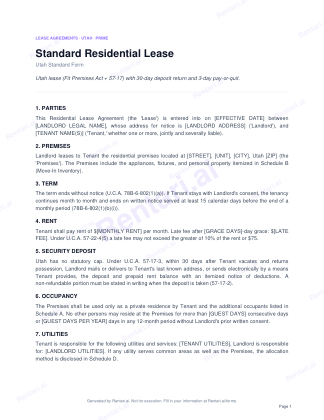
In the Rentari Utah lease
- Fair housing
When the landlord accepts vouchers, the lease states that the landlord considers all lawful sources of income, including housing choice vouchers.
- Security deposit limit
The Rentari Utah lease states the deposit amount, says no Utah statute caps it, and says any non-refundable part must be stated in writing when the deposit is taken.
- Returning the deposit
The lease promises the balance of the deposit and prepaid rent with an itemized notice within 30 days after the tenant vacates and returns possession, sent to the last known address or electronically, and restates the tenant's notice, the landlord's five business days to comply and the $100 penalty.
- Move-in condition
The lease's move-in inventory clause restates the three options and says the completed inventory, form or walkthrough record documents the condition at move-in.
- Rent and late fees
The lease's late charge clause states the landlord's fee and grace period, the greater of 10 percent or $75 limit, and the rule against fees not in the lease. Rentari suggests at least a 3-day grace period as its own guideline, not Utah law.
- Landlord entry
The lease promises the entry notice the landlord sets, 24 hours by default, entry only at reasonable times except in an emergency, and states the tenant's duty not to refuse entry for repairs.
- Repairs and habitability
The lease's maintenance clause lists the same duties, including garbage receptacles in a building with more than two units.
- Tenant repair remedies
The lease restates the notice, the three and ten day corrective periods, both remedies, the two-month cap and the 24-hour start for a dangerous condition.
- Security devices and locks
The lease restates the crime victim's lock right. Its general lock clause says the landlord provides working exterior locks and the tenant may not rekey without written permission.
- Smoke alarms
The lease says the landlord provides working smoke and carbon monoxide detectors at the start of the tenancy and the tenant may not disable them.
- Retaliation
The lease says Utah's statutes have no general rule, states the public safety bar, and adds its own promise not to take adverse action for exercising rights or reporting code violations.
- Lockouts and utilities
The lease says the landlord may not exclude the tenant except by judicial process.
- Ending a month-to-month tenancy
The lease states the 15 calendar day notice before the end of a monthly period and that a fixed term ends without notice.
- Ending a fixed term early
The lease restates the domestic violence termination right and its conditions, and a servicemember clause for federal military orders and Utah state military service.
- Notice for unpaid rent
The lease says an unpaid rent notice gives three business days after service to pay or surrender, and lists the ways a notice may be served.
- Notice for other lease violations
The lease states the three calendar day notice to perform or surrender and the three calendar day notice to quit for the listed breaches.
- Eviction process
The lease says an unlawful detainer action is brought under Utah's forcible entry and detainer statutes and may be filed in any Utah court with jurisdiction.
- Abandoned property
The lease restates the abandonment presumption, the 24-hour declaration, the 15-day retrieval period and the sale or donation rules, and adds a storage period the landlord sets, 30 days by default, as a lease term.
Utah numbers the lease follows
- Deposit refund deadline
- 30 days
- after the tenant vacates and returns possession
- Utah Code § 57-17-3(2)
- Notice for unpaid rent
- 3 business days
- to pay or surrender, after service
- Utah Code § 78B-6-802(1)(c)
- Ending month to month
- 15 days
- served before the end of the rental period
- Utah Code § 78B-6-802(1)(b)(i)
- Repair and deduct limit
- 2 months' rent
- after the corrective period passes
- Utah Code § 57-22-6(4)(a)(ii)
- Abandoned property claim period
- 15 days
- calendar days after the notice
- Utah Code § 78B-6-816(2)(b)(ii)
From the Utah lease
UTAH RESIDENTIAL LEASE AGREEMENT
OWNER OR MANAGER CONTACT (Utah Code 57-22-4(7)): Owner: [name], [address], telephone [number]. Landlord shall also give Tenant an executed copy of this Lease and a copy of any rules and regulations that apply to the Premises.
Owner or manager contactUtah Code § 57-22-4(7)
A late fee may not exceed 10% of the rent or $75, whichever is greater, and Landlord may not charge a fee, fine or other cost greater than, or not included in, this Lease, except that under a month-to-month agreement Landlord may add one on fifteen (15) days' notice.
Late chargeUtah Code § 57-22-4(5)
A month-to-month tenancy ends at the end of a monthly period on written notice served at least fifteen (15) calendar days before the end of that period. If rent or other amounts due are not paid, Landlord may serve a notice requiring payment or surrender of the Premises within three (3) business days after service.
Termination and noticesUtah Code § 78B-6-802(1)(b), (1)(c)
Utah lease types
Pick 3, 6, 12, 18 or 36 months or your own dates. At the end, the lease ends or converts to month-to-month.
Standard lease guideEnding month to month: 15 days, served before the end of the rental period.
Utah Code § 78B-6-802(1)(b)(i)
Utah month-to-month leaseUpload a lease you already use: send an unsigned one for e-signature, or store one that is already signed.
Rooms use the Utah lease for now: add the room as its own unit and set house rules with the optional addenda.
Utah room rentalBefore you sign
Application and screening fees
Before you accept an application fee or any other payment from a prospective tenant, disclose in writing a good faith estimate of the rent and of each fixed non-rent expense, the type of each use-based non-rent expense, the date the unit should be available, the criteria you will use to decide eligibility (including criminal history, credit, income, employment and rental history), and how the applicant can get money back.
- You may make the estimate disclosure in a rental application, a deposit agreement or a written summary. Utah Code § 57-22-4(3)(b)
- If the rental agreement's amounts differ from the estimate, or it adds a use-based expense you did not disclose, the applicant may demand the money back in writing within five business days after receiving the agreement, as long as the applicant has not signed it or moved in. You must then return all of it within five business days after you receive the demand. Utah Code § 57-22-4(4)
- The Fit Premises Act does not set a maximum application fee. Utah Code ch. 57-22
Fair housing
Partly readUtah's Fair Housing Act makes it unlawful to refuse to rent, to set different terms, or to publish or use an application form that expresses a preference, because of race, color, religion, sex, national origin, familial status, source of income, disability, sexual orientation or gender identity.
- Source of income includes federal, state or local assistance, including rental assistance and rent supplements. Utah Code § 57-21-2(25)
- Allow reasonable modifications at the tenant's expense and reasonable accommodations in rules and policies for a person with a disability. For a modification you may, where reasonable, require the tenant to restore the interior at move-out. Restoration must except reasonable wear and tear. Utah Code § 57-21-5(4)
- Renting a single-family home is exempt if the owner holds an interest in no more than three single-family homes for sale or rent, has not sold two or more homes the owner was not living in within 24 months, uses no broker, and uses no discriminatory ad or application form. Renting a room in an owner-occupied home of four or fewer units is exempt except for the advertising rule. Utah Code § 57-21-3(1), (3)
- You may still turn down an applicant who cannot meet the lease's terms, including its financial obligations. Utah Code § 57-21-3(6)
- Since May 6, 2026, a private landlord may designate a boarding house, shared rental or other group-living accommodation where residents share a bedroom or bathroom as single-sex housing and limit it by biological sex at birth, unless that would violate federal law or a condition of federal funding. Utah Code § 57-21-5(6)(b) Utah Code § 57-21-2(24)
- Coercion, threats, interference and reprisal over fair housing rights are also prohibited. Utah Code § 57-21-7
- The Utah Labor Commission explains that a disability accommodation can be requested during the application process and need not use special wording, a written request or a particular form. Evaluate requests individually and respond promptly; when a requested change is unreasonable, discuss effective reasonable alternatives. Utah Labor Commission: accommodation requests
- For a qualifying assistance animal, the Commission says to use the accommodation process rather than ordinary pet restrictions. Do not impose pet deposits or fees; uniformly charged general damage deposits and responsibility for actual animal damage still apply. The agency also says an assistance animal needs no special certification. Utah Labor Commission: assistance animals
When the landlord accepts vouchers, the lease states that the landlord considers all lawful sources of income, including housing choice vouchers.
Required disclosures
At or before the start of the term, disclose in writing the owner's name, address and telephone number, or those of the person authorized to manage the unit, and give the tenant an executed copy of a written rental agreement and any rules. Before taking an application payment, give the written estimate and criteria disclosure. Before signing, offer the condition inventory, form or walkthrough. If you actually know the property is currently contaminated by methamphetamine use, storage or manufacture, disclose it in the lease.
Utah Code § 57-22-4(3), (6), (7) Utah Code § 57-27-201
- A non-refundable part of a deposit must be stated in writing when the deposit is taken. Utah Code § 57-17-2
- A person may sue to enforce the methamphetamine disclosure, and the court may award damages, costs and attorney fees to the prevailing party. Utah Code § 57-27-201(3)
- The owner or manager contact disclosure is covered in more detail under landlord identity. Utah Code § 57-22-4(7) See Owner and manager identity on the Utah page
Flood disclosure
Partly readUtah's Fit Premises Act and deposit law have no flood disclosure rule for rentals. Other Utah law was not checked for one.
Owner and manager identity
At or before the start of the rental term, disclose in writing the owner's name, address and telephone number, or the name, address and telephone number of the person authorized to manage the unit. If the manager cannot receive notices, also name the person authorized to receive notices and act for the owner.
- A managing agent, leasing agent or resident manager counts as the owner for notices unless the rental agreement says otherwise in writing. Utah Code § 57-22-2(1)
- Also give the tenant an executed copy of a written rental agreement and a copy of any rules for the unit. Utah Code § 57-22-4(7)(b)
Deposits, rent and fees
Security deposit limit
Not set by statuteUtah does not cap the amount of a security deposit. If any part of a deposit is non-refundable and there is a written agreement, say so in writing to the tenant when you take the deposit.
Utah Code ch. 57-17 Utah Code § 57-17-2
- The deposit rules apply to deposits however they are labeled, so a cleaning or pet deposit is held to the same return rules. Utah Code § 57-17-1
- Whoever holds the owner's interest when the tenancy ends is bound by the deposit rules, so a buyer of the property takes on the return duty. Utah Code § 57-17-4
The Rentari Utah lease states the deposit amount, says no Utah statute caps it, and says any non-refundable part must be stated in writing when the deposit is taken.
Returning the deposit
No later than 30 days after the tenant vacates and returns possession, mail or deliver to the tenant's last known address, or send electronically by a means the tenant gave you, the balance of the deposit, the balance of any prepaid rent, and a written notice that itemizes and explains each deduction. You may deduct rent, damage beyond reasonable wear and tear, other costs and fees the contract provides for, and cleaning of the unit.
Utah Code § 57-17-3 Utah Code § 57-17-5
- If you miss the deadline, the tenant may serve a notice to provide deposit disposition, substantially in the statutory form, by personal delivery, substitute service or posting at the address in the lease, or by registered or certified mail. You then have five business days to comply. Utah Code § 57-17-3(3) to (5)
- If you still do not comply, the tenant may recover the full deposit, the full prepaid rent and a $100 civil penalty, and sue to enforce. A court awards costs and attorney fees to the prevailing party only if the other side acted in bad faith. Utah Code § 57-17-5(1), (2)
- A tenant who never serves the notice is not entitled to that relief, and either side may still recover other damages it is owed. Utah Code § 57-17-5(3), (4)
- If you cannot deliver possession on the agreed date and the tenant ends the agreement in writing, return all prepaid rent and any deposit as promptly as reasonable. Utah Code § 57-22-4.1
The lease promises the balance of the deposit and prepaid rent with an itemized notice within 30 days after the tenant vacates and returns possession, sent to the last known address or electronically, and restates the tenant's notice, the landlord's five business days to comply and the $100 penalty.
Deposit account and interest
Not set by statuteUtah's deposit law does not require a separate account for security deposits and does not require you to pay interest on them.
- Licensing rules for real estate brokers and property managers were not read for this page. Utah Code ch. 57-17
Move-in condition
Before signing the rental agreement, do one of three things: give the prospective tenant a written inventory of the unit's condition, excluding ordinary wear and tear; give the tenant a form to record the condition and allow a reasonable time after move-in to complete and return it; or offer a walkthrough inspection.
- A tenant may not use your failure to follow this rule to excuse the tenant's own compliance with the rental agreement or as a basis for a lawsuit against you. Utah Code § 57-22-4(9)
- For a useful condition record, identify the unit and inspection date, note each existing defect and attach clear room-by-room photographs. Record which inventory, returnable form or walkthrough option was offered, give both sides a copy of the resulting record and keep later repair messages with it. This is a practical recordkeeping checklist; it does not require all three statutory options. Utah Code § 57-22-4(6)
The lease's move-in inventory clause restates the three options and says the completed inventory, form or walkthrough record documents the condition at move-in.
Rent and late fees
A late fee may not exceed the greater of 10 percent of the rent in the rental agreement or $75. You also may not charge any fee, fine, assessment, interest or other cost that is higher than the rental agreement states, or that the agreement does not include at all, except that under a month-to-month agreement you may add one with 15 days' notice.
- Ten percent of the rent passes $75 once the rent is above $750, so on $2,000 rent the ceiling is $200 and on $500 rent it is $75. Utah Code § 57-22-4(5)(a)
- The Fit Premises Act sets no grace period before a late fee may be charged. Utah Code ch. 57-22
- Any fee, fine, assessment, interest or cost allowed by law or stated in the rental agreement is not prohibited by this section. Utah Code § 57-22-4(8)
The lease's late charge clause states the landlord's fee and grace period, the greater of 10 percent or $75 limit, and the rule against fees not in the lease. Rentari suggests at least a 3-day grace period as its own guideline, not Utah law.
Returned payment fee
Partly readUnder Utah's check law, when a check is returned because the account lacks funds, is closed or does not exist, when it comes back marked refer to maker, or when payment is stopped to defraud you, the person who wrote it owes the check amount plus a $20 service charge. After a written notice, unpaid amounts can grow by collection costs of up to $35, and by further damages in a lawsuit if still unpaid 30 calendar days after the notice. Separately, the Fit Premises Act does not bar a fee stated in the rental agreement.
Utah Code § 7-15-1 Utah Code § 57-22-4(8)
- The service charge cannot be collected if you redeposit the check and it clears. Utah Code § 7-15-1(3)(b)
- Collection costs require a written notice first, and they apply only if the $20 is not paid within 15 calendar days after the notice is mailed. A lawsuit may not start unless the amounts are still unpaid 30 calendar days after that notice is mailed, and a suit filed sooner recovers only the check amount. Utah Code § 7-15-1(4), (5), (7)
- In a lawsuit the court may add interest, court costs, reasonable attorney fees and damages of the greater of $100 or three times the check amount, up to the check amount plus $500, and may waive these for good cause. Before suing you may offer to settle for the greater of $50 or three times the check amount, up to the check amount plus $250, plus up to $50 in attorney fees. Utah Code § 7-15-1(6), (7)
- The check law does not bar relief under other laws. Whether the $20 charge limits a returned electronic payment or a higher fee written into a lease was not settled for this page. Utah Code § 7-15-1(1)(a), (8) Utah Code § 57-22-4(8)
Rent increase notice
Partly readThe Utah statutes read for this page set no notice period for a rent increase and no limit on its size. During a fixed term, the rent is what the lease says. A month-to-month tenancy can be ended on notice served at least 15 calendar days before the end of a rental period, and cities and counties may not adopt rent control.
Utah Code ch. 57-22 Utah Code § 78B-6-802(1)(b) Utah Code § 57-20-1
- A new fee that the month-to-month agreement does not include needs 15 days' notice. Utah Code § 57-22-4(5)(b)
- You may end a month-to-month tenancy by serving notice at least 15 calendar days before the period ends. Utah Code § 78B-6-802(1)(b)(i) See Ending a month-to-month tenancy on the Utah page
- Local governments may not control rents or fees on private residential property without the Legislature's express approval. Utah Code § 57-20-1 See Rent control and local rules on the Utah page
- For a clear rent-change letter, first check the lease term, any agreed notice requirement and any housing-program rules. Identify the property, unit and tenants; show the current rent, proposed rent, dollar difference and proposed effective date. Explain any renewal offer and how to reply. Keep a dated copy, delivery record and any later agreement before updating the rent ledger. This is a practical record checklist, not a prescribed legal form; the separate 15-day rules above do not establish a blanket rent-increase notice period. Utah Code ch. 57-22 Utah Code § 78B-6-802(1)(b) Utah Code § 57-20-1
During the tenancy
Landlord entry
Give the tenant at least 24 hours' notice before entering the unit, unless the rental agreement provides otherwise. The tenant may not unreasonably deny access or withhold consent to entry by you, your agent or manager to make repairs.
Utah Code § 57-22-4(2) Utah Code § 57-22-5(2)(c)
- A tenant's written notice of a deficient condition must give you permission to enter to fix it. Utah Code § 57-22-6(2)(b)(iv)
The lease promises the entry notice the landlord sets, 24 hours by default, entry only at reasonable times except in an emergency, and states the tenant's duty not to refuse entry for repairs.
Repairs and habitability
Keep each rental unit fit for human habitation and in line with local ordinances and board of health rules, with electrical systems, heating, plumbing, and hot and cold water. Do not rent premises that are not safe, sanitary and fit for human occupancy. Maintain common areas in a sanitary and safe condition, the electrical, plumbing, heating and hot and cold water systems, any air conditioning in operable condition, and any other appliances the rental agreement specifically covers.
Utah Code § 57-22-3 Utah Code § 57-22-4(1)
- In a building with more than two rental units, provide and maintain garbage receptacles and arrange removal, unless you and the tenant agree otherwise. Utah Code § 57-22-4(1)(b)(v)
- The chapter does not cover breakage, malfunctions or other conditions that do not materially affect the physical health or safety of the ordinary renter. Utah Code § 57-22-3(3)
- Any duty in the act may be shifted to the other party only by an explicit written agreement signed by both. Utah Code § 57-22-3(4)
- Tenants must keep the unit clean and safe, dispose of garbage properly, use facilities reasonably, and not damage the unit or disturb neighbors. Utah Code § 57-22-5
The lease's maintenance clause lists the same duties, including garbage receptacles in a building with more than two units.
Tenant repair remedies
A tenant may serve a written notice of a deficient condition that describes it, gives you the corrective period (three calendar days for a habitability standard, ten calendar days for a rental agreement requirement), names the remedy the tenant chooses, and allows you to enter. If you do not take substantial action toward fixing it in time, the tenant may either abate rent and end the agreement, or repair it and deduct the cost from future rent, up to two months' rent.
- With rent abatement, the agreement ends, rent is abated from the date of the notice, you must immediately pay back the whole deposit and prorated prepaid rent, and the tenant must move out within 10 calendar days after the corrective period ends. Utah Code § 57-22-6(4)(a)(i)
- With repair and deduct, the tenant keeps receipts and gives you copies within five calendar days after the next rental period begins. Utah Code § 57-22-6(4)(a)(ii)
- For a dangerous condition, one posing a substantial risk of imminent loss of life or significant physical harm, the tenant may tell you by any reasonable means, and you must start remedial action within 24 hours and pursue it diligently. Utah Code § 57-22-6(3)
- A tenant who is not complying with the renter's duties, or who caused the condition, has no remedy. Utah Code § 57-22-6(1)(b), (4)(b)
- If the unit is not fit for occupancy, you may instead end the agreement by written notice before the corrective period ends, refund prorated prepaid rent and any deposit within 10 calendar days, and give the tenant at least 10 calendar days to leave. Utah Code § 57-22-6(4)(c)
- After the corrective period, the tenant may sue to enforce the chosen remedy; you must answer within three business days, and the court may award costs and attorney fees to the prevailing party. Utah Code § 57-22-6(5), (7)
The lease restates the notice, the three and ten day corrective periods, both remedies, the two-month cap and the 24-hour start for a dangerous condition.
Security devices and locks
A tenant who is a crime victim, including of domestic violence, stalking, dating violence, a sexual offense or burglary, may require you to install a new lock by giving you a protective order issued after a hearing or a police report documenting the act, and paying the cost. You may rekey a working lock or replace the mechanism with one of equal or better quality, keep a key, and must refuse a key to the perpetrator.
Utah Code § 57-22-5.1(1) to (3)
- A perpetrator who is on the rental agreement and not barred by a protective order may petition a court within 30 days for a key or to be released from the agreement. Utah Code § 57-22-5.1(3)(e), (3)(f)
- Until January 1, 2027, enticing a minor, sexual battery, lewdness and lewdness involving a child are excluded from the offenses that qualify; the version in force on that date drops the exclusion. Utah Code § 57-22-5.1(1)(b)
- The Fit Premises Act sets no general rule on rekeying between tenants or on lock standards. Utah Code ch. 57-22
The lease restates the crime victim's lock right. Its general lock clause says the landlord provides working exterior locks and the tenant may not rekey without written permission.
Smoke alarms
Partly readUtah's Fit Premises Act has no smoke alarm section, but it requires rentals to meet local ordinances and board of health rules, so any alarm rule in the codes that apply to the building matters. State fire and building codes were not read for this page.
The lease says the landlord provides working smoke and carbon monoxide detectors at the start of the tenancy and the tenant may not disable them.
Retaliation
Utah's Fit Premises Act and its eviction statutes contain no general rule against retaliation. They do bar you from restricting a tenant's ability to call a public safety agency, such as police, fire or ambulance, and from penalizing or evicting a tenant for making reasonable requests for that help.
- Under Utah's fair housing law, reprisal against a person who opposed a discriminatory practice or took part in a fair housing complaint or investigation is itself a discriminatory housing practice. Utah Code § 57-21-7(1)(f)
- A city's good landlord program may not reduce your benefits because of calls for help that you are barred from restricting or penalizing. Utah Code § 57-22-7(3)
The lease says Utah's statutes have no general rule, states the public safety bar, and adds its own promise not to take adverse action for exercising rights or reporting code violations.
Lockouts and utilities
Partly readYou may not willfully exclude a tenant from the premises in any manner except by judicial process. The one exception is retaking and rerenting premises the tenant has abandoned.
- Willful exclusion means preventing the tenant from entering with the intent to deprive the tenant of entry. Utah Code § 78B-6-801(11)
- You must keep electrical systems, plumbing, heating, and hot and cold water maintained throughout the tenancy. Utah Code § 57-22-4(1)(b)(ii)
- The Fit Premises Act and the eviction statutes do not address shutting off utilities. Other Utah law was not checked for a utility shutoff rule. Utah Code ch. 57-22 Utah Code tit. 78B, ch. 6, pt. 8
The lease says the landlord may not exclude the tenant except by judicial process.
Ending a tenancy
Ending a month-to-month tenancy
To end a tenancy with monthly or other periodic rent, serve notice at least 15 calendar days before the end of the month or period, requiring the tenant to leave at the end of it. A tenancy at will needs notice of at least five calendar days. A fixed term ends when the term expires without any notice.
Utah Code § 78B-6-802(1)(a), (1)(b)
- Serve the notice by one of the methods the eviction statutes allow. Utah Code § 78B-6-805
The lease states the 15 calendar day notice before the end of a monthly period and that a fixed term ends without notice.
Ending a fixed term early
Partly readA tenant who is a victim of domestic violence may end all future obligations under the rental agreement by giving you a court order protecting the tenant (not an ex parte order) or a police report showing the tenant is a victim and not the predominant aggressor, a written notice with the move-out date, and a termination fee of one month's rent. The tenant must move out within 15 days after the notice and pay rent for that time.
Utah Code § 57-22-5.1(4) to (9)
- The tenant must be in compliance with the rental agreement, except for a rent or conduct default caused by domestic violence that began less than 30 days before the notice. Utah Code § 57-22-5.1(4)(a), (5)
- The right is lost once an eviction notice has been served, the tenant still owes amounts from before the notice, and the agreement continues for any other occupant. Utah Code § 57-22-5.1(7) to (9)
- If you fail to deliver possession on the agreed date, the tenant may end the agreement by written notice, or keep it with rent abated until you deliver. Utah Code § 57-22-4.1
- A tenant who abandons the unit owes either the rent for the rest of the term or, if less, the rent until the unit is rerented at fair value plus the difference in rent, a reasonable commission and restoration costs. Utah Code § 78B-6-816(1) See Abandoned property on the Utah page
- Utah National Guard and State Defense Force members in state military service have the same rights and protections that federal law gives for federal activation. Utah Code § 39A-6-102
- Federal military protections cover more than a deployment longer than ninety days. Common qualifying situations include signing before entering military service, or signing while serving and later receiving permanent-change-of-station orders or deployment orders for at least ninety days. Give proper written termination notice and a copy of the orders. For these qualifying leases with monthly rent, termination generally takes effect thirty days after the next rent payment becomes due following delivery of notice, without an early-termination charge. Other protected circumstances and timing rules exist; get military legal assistance if eligibility or the effective date is uncertain. Keep the notice, orders, delivery record and final rent calculation together. U.S. Department of Justice: servicemember housing rights
The lease restates the domestic violence termination right and its conditions, and a servicemember clause for federal military orders and Utah state military service.
Notice for unpaid rent
When rent or other amounts due are unpaid, serve a written notice requiring payment or surrender of the premises. The tenant commits unlawful detainer only if the notice goes uncomplied with for three business days after service. The notice may be served any time after the rent becomes due.
Utah Code § 78B-6-802(1)(c) Utah Code § 78B-6-805
- Serve the notice by handing it to the tenant, by registered or certified mail or an equivalent, by leaving it with a person of suitable age and discretion if the tenant is absent, or, if no such person can be found, by posting it in a conspicuous place on the property. Utah Code § 78B-6-805
- After the notice period, the tenant, a subtenant or another interested person may still perform and save the lease from forfeiture. Utah Code § 78B-6-802(2)
- During state military service, a Utah National Guard or State Defense Force member's household may not be evicted for nonpayment of rent under $2,400 a month without a court order. Utah Code § 39A-6-113
The lease says an unpaid rent notice gives three business days after service to pay or surrender, and lists the ways a notice may be served.
Notice for other lease violations
For a breach of a lease condition or covenant other than rent, serve a written notice requiring the tenant to perform or surrender the property within three calendar days after service, on the tenant and any subtenant in actual occupation. For assigning or subletting against the lease, waste, an unlawful business, a nuisance, or a criminal act on the premises, a three calendar day notice to quit may be served instead.
Utah Code § 78B-6-802(1)(d) to (1)(h)
- If a violated covenant cannot later be performed or brought into compliance, a notice to quit under the listed grounds may be given. Utah Code § 78B-6-802(2)
- The notice rules for nuisance do not apply to a court action to abate a private nuisance by eviction. Utah Code § 78B-6-802(4)
The lease states the three calendar day notice to perform or surrender and the three calendar day notice to quit for the listed breaches.
Eviction process
Partly readAfter the notice period runs, file an unlawful detainer action. The summons gives the tenant three business days from service to appear and defend, unless the court allows more time. When the tenant stays in possession, the court must expedite the case and begin trial within 60 days after the complaint is served unless the parties agree otherwise.
Utah Code § 78B-6-807 Utah Code § 78B-6-810
- Either party may ask for an evidentiary hearing within 10 business days after the tenant answers, where the court decides who holds possession while the case is pending. Utah Code § 78B-6-810(2)
- A judgment for the landlord includes an order of restitution, rent, and three times the damages assessed for unlawful detainer, waste, amounts due under the contract, or a forcible entry or detainer. The court awards costs and reasonable attorney fees to the prevailing party. Utah Code § 78B-6-811(1) to (3), (5)
- The order of restitution gives the tenant three calendar days after service to vacate, unless the court orders otherwise, and a sheriff or constable enforces it. Utah Code § 78B-6-812(2), (4)
- A landlord may file a possession bond, which opens alternative remedies to the tenant, including keeping the lease by paying all amounts due within three calendar days in a nonpayment case. Utah Code § 78B-6-808
- Either party may appeal within 10 days, or within three days in a private nuisance abatement case. Utah Code § 78B-6-813
- Since September 1, 2026, a pet found when an order of restitution is enforced goes to the tenant if present; otherwise the officer or landlord calls animal control, and you must give animal control the tenant's name and last known contact information. Utah Code § 78B-6-812(4)(e), (4)(f)
- Which Utah courts hear eviction cases, and the court rules that govern them, were not read for this page. Utah Code tit. 78B, ch. 6, pt. 8
The lease says an unlawful detainer action is brought under Utah's forcible entry and detainer statutes and may be filed in any Utah court with jurisdiction.
Abandoned property
Abandonment is presumed when the tenant has not told you of an absence and either has not paid rent within 15 days after it was due and nothing but their belongings suggests they still live there, or has not paid when due, has removed their belongings and shows no sign of living there. You may serve a declaration of abandonment; if the tenant does not dispute it in writing within 24 hours, not counting weekends and court holidays, abandonment is established.
Utah Code § 78B-6-815 Utah Code § 78B-6-816
- You may remove belongings left behind, store them, and recover actual moving and storage costs. Post a notice that the property is considered abandoned and mail it to the tenant's last known address. Utah Code § 78B-6-816(2)(a), (2)(b)(i)
- The tenant may reclaim the property within 15 calendar days of the notice by paying inventory, moving and storage costs. Extend this by up to 15 more days if the tenant shows domestic violence, an extended hospitalization, or the tenant's death. Utah Code § 78B-6-816(2)(b)(ii), (7)
- After 15 days in storage with no reasonable effort to recover it and no hearing pending, you may sell the property at a public sale, with at least five calendar days' mailed notice, or donate it where that is commercially reasonable. Utah Code § 78B-6-816(2)(b)(iii), (9)
- Hazardous items, animals, garbage and perishables need not be stored and may be disposed of right away. Motor vehicles are not covered by these rules. Utah Code § 78B-6-816(4), (6), (8)
- Property removed when an eviction order is enforced is treated as abandoned property, but the tenant must get access within five business days to clothing, identification, financial, public benefit and medical items. Utah Code § 78B-6-812(4)(c), (4)(d)
The lease restates the abandonment presumption, the 24-hour declaration, the 15-day retrieval period and the sale or donation rules, and adds a storage period the landlord sets, 30 days by default, as a lease term.
Small claims
Partly readUtah small claims court hears money claims up to $20,000 through December 31, 2029, including attorney fees but not court costs and interest, rising to $25,000 on January 1, 2030. The defendant must live, or the debt must have been incurred, within the court's jurisdiction.
- People and companies may appear with or without a lawyer, in person or through authorized employees. Other non-lawyer representation follows the Supreme Court's small claims rules, which were not read for this page. Utah Code § 78A-8-102(6)
- A counterclaim is allowed if it arises from the same transaction as the claim. Utah Code § 78A-8-102(4)
More Utah rules
Disputed occupancy and ownership claims
Partly readIdentify whether the person is a tenant, a guest or someone asserting ownership before choosing a response. Utah’s adverse-possession rules require qualifying occupation and tax payments; seven years of presence alone does not settle title. Occupancy and ownership disputes may require different procedures.
Utah Property Rights Ombudsman: adverse possession Utah Courts: criminal trespass by a long-term guest
- The state overview describes continuous occupation and claim for seven years, together with payment of the taxes lawfully levied and assessed on the land. Title and tax-title rules can affect the analysis. The overview also explains that clearing competing claims can require agreement or legal proceedings; do not treat elapsed time or a tax receipt as a complete title determination. Utah Property Rights Ombudsman: adverse possession
- Utah recognizes possession claims both with and without a written instrument. The required enclosure, cultivation, improvement or other qualifying use depends on the route, and a claim without a written instrument is limited to the land actually occupied. A document described as color of title is not a universal requirement. Have the deed, boundaries and actual use assessed together. Utah Property Rights Ombudsman: adverse possession
- The court guide distinguishes a tenant from a qualifying long-term guest. A written or oral rental agreement, or value given in exchange for living there, can establish tenant status; value can include work or household contributions. Utah has a limited long-term-guest trespass process with its own requirements. Read the full court guide before relying on it, and do not use the guest label to bypass tenant protections. Utah Courts: criminal trespass by a long-term guest See Eviction process on the Utah page
- Keep deeds, surveys, tax records, leases and permissions, payment or work agreements, dated condition photographs and communications in one file. Maintain secure access and lawful checks of vacant property. When occupation or title is disputed, obtain help identifying the correct notice and process. Preserve the rule against willfully excluding a tenant without judicial process, subject to the existing abandonment exception. Utah Code § 78B-6-814 See Lockouts and utilities on the Utah page
Local rules
Rent control and local rules
A Utah county, city or town may not control rents or fees on private residential property without the Legislature's express approval. Counties and cities also may not adopt ordinances inconsistent with the Fit Premises Act, though they may still enforce their own administrative remedies for local code violations.
Utah Code § 57-20-1 Utah Code § 57-22-7
- Local enforcement may not change the repair corrective periods, limit a tenant's repair remedies, or change your habitability duties to the tenant. Utah Code § 57-22-7(2)(b)
- Local zoning, building and planning powers are not affected. Utah Code § 57-20-1(2)
Salt Lake City's own rental ordinances were not read for this page. State law bars local rent control and ordinances inconsistent with the Fit Premises Act, but local housing and business codes can still add duties.
Provo's own rental ordinances were not read for this page. Check its housing and rental codes before renting there.
Local housing, building, fire and health codes can add duties for rental property, and some cities run good landlord programs. None was read for this page.
Utah lease renewals
Read the agreement's renewal clause and the notice rules above before choosing a new term, changing rent or ending the tenancy. A fixed end date does not override applicable renewal rights, rent regulation, just-cause rules or protections against retaliation and discrimination.
Confirm the notice, timing and delivery requirements for the rental's state and locality. Review any required new disclosures and attachments when preparing the renewal. Get the parties' agreement to changed terms in writing.
Customize an unsigned agreement or prepare an addendum to an existing lease.
How it works
- Add your Utah rental
Enter the property and its units.
- Set the terms
Choose the rental, add tenants, and set rent, deposit and fees.
- Review the lease
Preview and edit the Utah lease and its addenda.
- Send for e-signature
Tenants sign online; sending is included on paid plans.
Follow the full lease builder guide, add supporting files, or download and print the agreement.
Utah lease questions
Does the Rentari Utah lease include the owner contact disclosure?
Yes. The first page prints the owner's or manager's name, address and telephone number, and marks an item you have not entered as not disclosed or not provided, so you can fill it in before signing.
Does the lease cap the late fee the way Utah law does?
Yes. The lease states the greater of 10 percent of the rent or $75 as the limit, and Rentari stops a late fee above that figure before the lease is sent.
Does the lease explain the tenant's repair remedies?
Yes. It restates the written notice of a deficient condition, the three and ten calendar day corrective periods, rent abatement and termination, and repair and deduct up to two months' rent.
Does the lease cover methamphetamine contamination?
Every Utah lease attaches a methamphetamine contamination disclosure that restates the owner's duty. When the item is not answered it says so, so tell the tenant in writing what you know before signing.
Can I e-sign a Utah lease with Rentari?
Yes. Send the lease for e-signature from your Rentari account; sending for e-signature is included on paid plans.