- Home
- Lease agreement
- Virginia
Virginia residential lease agreement
State rules checked October 1, 2026 General information, not legal advice
Jump to a topic
Virginia lease document preview
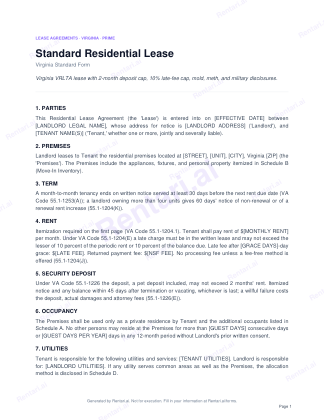
In the Rentari Virginia lease
- Fair housing
The Virginia lease includes a fair housing and reasonable accommodation clause, and a source of income clause when you accept housing assistance.
- Security deposit limit
The Rentari Virginia lease states the deposit, caps it at two months' rent with any refundable pet deposit included, and caps the deposit plus any insurance premiums paid before move-in at two months' rent.
- Returning the deposit
The Virginia lease gives the 45-day itemized accounting from the later of termination or move-out, the 15-day contractor extension, the move-out inspection notice and 72-hour inspection, and the 30-day notice of deductions made during the tenancy.
- Move-in inspection report
The Virginia lease commits you to the five-day move-in report, including whether there is visible mold, and says the duty applies to every tenancy.
- Rent and late charges
The Virginia lease caps its late charge at the lesser of 10 percent of the periodic rent or of the balance due, applies it only after the grace day you choose, and restates the payment method and statement of account rules.
- Returned check and rejected payment charges
If you set a returned-payment fee, the Virginia lease charges it when a check or electronic payment is returned for insufficient funds.
- Rent increase notice
The Virginia lease states the 60-day renewal notice for landlords with more than four units, the change to 90 days on July 1, 2027, and the 30-day rule for a month-to-month or holdover rent change.
- Landlord entry
The Virginia lease sets 24 hours' notice as a lease term, adds the 72-hour notice for routine maintenance the tenant did not request, and restates the emergency and abuse-of-access rules.
- Repairs and habitability
The Virginia lease restates your fit-premises duties, including mold remediation and the smoke alarm certificate, and the bar on repair fees.
- Tenant repair remedies
The Virginia lease lists the tenant's repair by licensed contractor, tenant's assertion, termination, essential service and move-in hazard remedies with their deadlines.
- Locks and security devices
The Virginia lease says you provide working exterior locks, the tenant may not change or rekey them without your written permission, and a tenant with an exclusive possession order may have a new lock installed.
- Smoke and carbon monoxide alarms
The Virginia lease says you provide working smoke and carbon monoxide detectors at move-in, gives the yearly smoke alarm certificate, and adds a carbon monoxide alarm on written request.
- Retaliation
The Virginia lease states the retaliation rule in force today, who bears the burden of proof, and the January 1, 2027 change.
- Lockouts and utility shutoffs
The Virginia lease says nothing in it lets you change locks or exclude the tenant except through the court process.
- Ending a month-to-month tenancy
The Virginia lease lets either side end a month-to-month tenancy with written notice served at least 30 days before the next rent due date, or seven days for a week-to-week tenancy.
- Ending a fixed-term lease early
The Virginia lease keeps a tenant who leaves early liable for rent through the end of the term while you make good-faith efforts to re-rent, and restates the military, victim, foreclosure notice and death rules.
- Notice for unpaid rent
The Virginia lease gives the 14-day notice of nonpayment and of the intention to terminate.
- Notice for a lease violation
The Virginia lease gives the 21-day cure with termination at least 30 days after receipt, the 30-day notice for a breach that cannot be fixed or is repeated, and immediate termination for a criminal or willful act.
- Eviction process
The Virginia lease says an action for possession goes to the general district court where the home is located.
- Abandonment and property left behind
The Virginia lease handles property left behind as the law requires, without self-help, and restates the 10-day notice after the death of a sole tenant.
- Changes coming in 2027
The Virginia lease mentions the 2027 retaliation change and the 90-day renewal notice; the other 2027 changes are not in it.
Virginia numbers the lease follows
- Security deposit limit
- 2 months' rent
- a pet deposit counts toward the cap
- Va. Code § 55.1-1226(A)Va. Code § 55.1-1208(A)(7)
- Deposit accounting deadline
- 45 days
- after the tenancy ends or the tenant moves out, whichever is later
- Va. Code § 55.1-1226(A)
- Late charge cap
- 10%
- of the rent or of the balance due, whichever is less, and only if the written lease provides for it
- Va. Code § 55.1-1204(E)
- Late charge grace period
- None set
- for a written lease; the fifth-of-the-month rule applies only where no written lease is offered
- Va. Code § 55.1-1204(C), (E)
- Notice for unpaid rent
- 14 days
- written notice of the nonpayment and of your intention to terminate
- Va. Code § 55.1-1245(F)
- Time to cure a lease violation
- 21 days
- termination no sooner than 30 days after the tenant receives the notice
- Va. Code § 55.1-1245(A)
- Ending a month-to-month tenancy
- 30 days
- before the next rent due date, unless the lease sets a different period
- Va. Code § 55.1-1253(A)
- Entry notice
- No fixed hours
- notice of intent at reasonable times; at least 72 hours for routine maintenance the tenant did not request
- Va. Code § 55.1-1229(A)(4)
- Rent increase notice
- 30 days
- month to month; owners of more than four units give 60 days before a renewal term
- Va. Code § 55.1-1253(D)Va. Code § 55.1-1204(K)
- Returned check charge
- $50
- processing charge, plus the bank's returned-check fee
- Va. Code § 8.01-27.1(A)
From the Virginia lease
VIRGINIA RESIDENTIAL LEASE AGREEMENT
No additional security deposits or rent shall be charged unless they are listed below or incorporated into this agreement by way of a separate addendum after execution of this rental agreement. Security deposit: [Security deposit] Rent due per payment period (monthly): [Monthly rent] One-time charges due before the commencement date or included in the first rental payment: [One-time charges, or none]
Fee itemization on page oneVa. Code § 55.1-1204.1
If rent is unpaid when due, Landlord may serve written notice of the nonpayment and of Landlord's intention to terminate this Lease if the rent is not paid within fourteen (14) days, and may then terminate and seek possession (Va. Code 55.1-1245(F)).
Notice for unpaid rentVa. Code § 55.1-1245(F)
Landlord does not take reasonable steps to remedy it within fourteen (14) days, Tenant may have a licensed third-party contractor (or licensed pest control business) do the work and deduct the actual cost, not exceeding the greater of one month's rent or $1,500, after giving Landlord an itemized statement with receipts (Va. Code 55.1-1244.1)
Repair by a licensed contractorVa. Code § 55.1-1244.1(B), (C)
Virginia lease types
Pick 3, 6, 12, 18 or 36 months or your own dates. At the end, the lease ends or converts to month-to-month.
Standard lease guideEnding a month-to-month tenancy: 30 days, before the next rent due date, unless the lease sets a different period.
Virginia month-to-month leaseUpload a lease you already use: send an unsigned one for e-signature, or store one that is already signed.
Rooms use the Virginia lease for now: add the room as its own unit and set house rules with the optional addenda.
Virginia room rentalBefore you sign
Application fees and screening
A nonrefundable application fee may not exceed $50, plus the actual out-of-pocket cost you pay a third party for background, credit or other checks. For public housing or other HUD-regulated units the limit is $32 plus those costs. You may also take a refundable application deposit.
- If the applicant does not rent, refund the application deposit, less your actual expenses and damages, with an itemized list within 20 days. If you rejected the applicant and the deposit was paid by cash, certified check, cashier's check or postal money order, the refund is due within 10 days. Va. Code § 55.1-1203(A)
- You may ask for a social security number or individual taxpayer identification number and may photocopy a driver's license or similar photo identification, but not a U.S. government identification where federal law forbids copying it. Va. Code § 55.1-1203(B)
- You must consider evidence that an applicant is a victim of family abuse to offset a low credit score of an otherwise qualified applicant, shown by a letter from a domestic violence program, HUD-certified counselor or attorney, a police report or a court order. Va. Code § 55.1-1203(D)
- A landlord owning more than four Virginia rental units, or more than a 10 percent interest in more than four, individually or through a business entity, may not deny an applicant based solely on payment history or an eviction for nonpayment between March 12, 2020 and 30 days after the Governor's COVID-19 state of emergency expired or was revoked, and must follow the written denial notice process; the penalty is $1,000 plus attorney fees. Va. Code § 55.1-1245(J)
- Information you receive with an application stays a confidential tenant record and may be released only in response to a subpoena. Va. Code § 55.1-1209(B)
- From July 1, 2027, before you request or collect any payment or information, you must tell applicants in writing, or post where they can see it, your fees and deposits and whether they are refundable, your selection criteria, automatic denial criteria, other criteria that may lead to denial, the name and address of any consumer reporting agency you use, and the applicant's right to a free copy of the report and to dispute it. Va. Code § 55.1-1203(A) (effective July 1, 2027)
- For landlords covered by the pandemic-period screening rule, a denial notice must explain the applicant's right to challenge reliance on the protected payment history or nonpayment eviction, include statewide legal-aid contact information, and state the seven-day deadline from the postmark. Additional electronic or telephone notice can permit proceeding after the next business day without an assertion, subject to the statute's notice and timing-validation conditions. Va. Code 55.1-1245(J)(2), current version
- If the applicant asserts that right and you relied on a screening report, make a good-faith effort to ask its producer whether the determination rested solely on protected pandemic-period history. The statute permits proceeding with the report information if its producer does not respond within three business days of the request. Va. Code 55.1-1245(J)(2), current version
Fair housing
Partly readThe Virginia Fair Housing Law makes it unlawful to refuse to rent to, or set different terms for, anyone because of race, color, religion, national origin, sex, elderliness, source of funds, familial status, sexual orientation, gender identity, military status or disability, or to advertise a preference based on any of them.
- Disability discrimination includes refusing reasonable accommodations in rules, policies, practices or services, and refusing reasonable modifications the tenant pays for; for a rental you may, where reasonable, require the interior to be restored at move-out. Any agreed restoration must except reasonable wear and tear. Va. Code § 36-96.3(B)
- Source of funds means any lawful source of money paid to or for a renter, including assistance, benefit and subsidy programs. Va. Code § 36-96.1:1
- An owner of no more than four rental units in Virginia (and no more than a 10 percent interest in more than four) may decline a renter based on source of funds, and any owner may do so if the source is not approved within 15 days of the request for tenancy approval. Va. Code § 36-96.2(I), (J)
- Most of the law does not apply to an owner renting no more than three single-family houses without a broker or discriminatory ads, or to an owner-occupied building of up to four units; the advertising rule still applies. Va. Code § 36-96.2(A), (B)
- On request, provide a smoke alarm suited to a tenant or household member who is deaf or hard of hearing; you may take a refundable deposit up to its cost but may not raise rent for it. Va. Code § 36-99.5
- For an assistance animal in covered housing, Virginia bars pet fees, pet deposits and extra rent. Uniform resident rules may still apply if they preserve equal use and enjoyment. Physical-damage responsibility applies where residents with pets bear comparable responsibility; this is different from charging an animal fee. Va. Code 36-96.3:1(A)
- Do not seek extra disability verification when the disability or accommodation need is obvious or known. If the disability is known but the related need is not, verification may address that need. Otherwise, reliable supporting documentation may include someone with whom the requester has or had a therapeutic relationship. Evaluate the request and its supporting information. Va. Code 36-96.3:1(B)-(E)
- Evaluate accommodation requests individually. A necessary request without undue financial and administrative burden or fundamental alteration must be granted. If those burdens may arise, offer a good-faith discussion of effective alternatives; the requester need not accept an alternative when the requested accommodation is also reasonable. For animals, assess actual substantial harm and possible accommodations rather than relying solely on breed, size or type. Va. Code 36-96.3:2
The Virginia lease includes a fair housing and reasonable accommodation clause, and a source of income clause when you accept housing assistance.
Required disclosures
You must offer a prospective tenant a written lease and give with it the Statement of Tenant Rights and Responsibilities published by the Department of Housing and Community Development, and you and the tenant sign the Department's form acknowledging it was received; if the tenant does not sign, record the dates you provided the form and that the tenant did not sign. You may not sue the tenant for a lease violation until you have provided the Statement. The first page of the lease must itemize the security deposit, the rent per payment period and any one-time charges due before or with the first payment, under a sentence the law prescribes.
Va. Code § 55.1-1204(B), (H) Va. Code § 55.1-1204.1
- Give the tenant a copy of the signed lease and the Statement within 10 business days of the lease's effective date. Va. Code § 55.1-1204(H)
- Before a lease is signed, tell a prospective tenant in writing if the property is in a noise zone or accident potential zone near a military air installation; without it, the tenant may end the lease in the first 30 days. Va. Code § 55.1-1217
- Disclose in writing before signing any defective drywall you know has not been remediated, or that you know the unit was used to make methamphetamine and was not cleaned up; otherwise the tenant may end the lease within 60 days of finding out. Va. Code § 55.1-1218 Va. Code § 55.1-1219
- For a multifamily unit, tell prospective tenants in writing of a filed condominium or cooperative registration or a plan within six months to demolish, substantially rehabilitate or convert the property. Va. Code § 55.1-1216(C)
- Disclose visible mold in the move-in report. Va. Code § 55.1-1215 See Move-in inspection report on the Virginia page
- If the lease does not require renter's insurance, give a written notice about personal property and flood coverage before signing. Va. Code § 55.1-1206(D) See Flood and renter's insurance notice on the Virginia page
Flood and renter's insurance notice
Chapter 12 has no separate flood zone disclosure. But if your lease does not require renter's insurance, before the lease is signed give the tenant a written notice that you are not responsible for the tenant's belongings, your insurance does not cover them, and the tenant should get renter's insurance; it must also say renter's insurance does not cover flood damage and point the tenant to FEMA's National Flood Insurance Program or the state Flood Risk Information System to check for a special flood hazard area.
- Failing to give the notice does not affect the lease's validity. If the tenant asks for a translation, you may help or refer the tenant to a translation service, at no charge. Va. Code § 55.1-1206(D)
Owner and manager disclosure
At or before the start of the tenancy, give the tenant in writing the name and address of the person authorized to manage the property and of an owner or someone authorized to act for the owner, and keep it current. Anyone who fails to do so becomes the landlord's agent for service of process and notices.
- If you sell the property, tell the tenant and give the buyer's name, address and telephone number. Va. Code § 55.1-1216(B)
- An owner who lives outside Virginia must appoint a Virginia agent with an office in the state, file it with the State Corporation Commission, and name the agent and office address in every lease. Until the designation is filed, the owner may not bring a court action about the property. Va. Code § 55.1-1211(B), (D), (E)
Deposits, rent and fees
Security deposit limit
You may not demand or receive a security deposit, however it is labeled, of more than two months' periodic rent. A refundable pet deposit is a security deposit and counts toward the cap.
Va. Code § 55.1-1226(A) Va. Code § 55.1-1200
- A lease may not make the tenant pay a security deposit, damage insurance premiums and renter's insurance premiums before the tenancy starts that together exceed two months' periodic rent. Va. Code § 55.1-1208(A)(7)
- You may require damage insurance or renter's insurance and charge the premiums; they count as rent, not as a deposit, and you must tell the tenant in writing of the right to buy a separate policy. Va. Code § 55.1-1206(A), (B)
- Money paid toward a security deposit is treated as an application deposit until the lease's commencement date. Va. Code § 55.1-1200
- You may let a tenant buy damage insurance instead of paying a deposit. The insurer must be licensed or approved by the State Corporation Commission, the coverage must last the whole term and be at least the deposit you require per claim, and the insurer must tell you within 10 days if the policy lapses. Va. Code § 55.1-1226(I)
- A tenant who chose damage insurance may switch to paying the full deposit at any time without your consent, and you may not change the lease terms because of it. Va. Code § 55.1-1226(J)
- If the tenant has an assignee or sublessee, you may hold a security deposit from only one party. Va. Code § 55.1-1226(H)
The Rentari Virginia lease states the deposit, caps it at two months' rent with any refundable pet deposit included, and caps the deposit plus any insurance premiums paid before move-in at two months' rent.
Returning the deposit
Within 45 days after the tenancy ends or the tenant vacates, whichever is later, give the tenant a written notice itemizing the deposit and every deduction, together with any amount due. You may deduct only accrued rent and late charges the lease specifies, damage from the tenant's breach of the tenant duties less reasonable wear and tear, other charges the lease provides for, and actual damages for breach of the lease.
- When you ask the tenant to vacate, or within five days after you receive the tenant's notice of intent to vacate, tell the tenant in writing of the right to be present at the move-out inspection. If the tenant asks in writing to attend, the inspection must be made within 72 hours of delivery of possession. Va. Code § 55.1-1226(G)
- If damage exceeds the deposit and needs a third-party contractor, say so in writing within the 45 days and you get 15 more days to itemize the damage and repair cost. Va. Code § 55.1-1226(E)
- Deductions you make during the tenancy must be itemized to the tenant in writing within 30 days of deciding on them, except deductions made less than 30 days before the lease ends. Va. Code § 55.1-1226(E)
- You may hold back a reasonable part of the deposit for the tenant's unpaid water, sewer or other utility bill owed to a third-party provider, but only if you told the tenant of this right in the termination notice, in a notice confirming the move-out date, or in a separate notice at least 15 days before the accounting. After the bill is paid, confirm it in writing and pay any balance within 10 days. Va. Code § 55.1-1226(C)
- With more than one tenant, unless each agrees otherwise in writing, refund with one check payable to all of them, sent to a forwarding address one of them gives. Without a forwarding address you may hold the deposit in escrow and, one year after the 45 days end, send it to the State Treasurer as unclaimed property. Va. Code § 55.1-1226(B)
- If you willfully fail to comply, the court orders the deposit returned with actual damages and reasonable attorney fees, unless the tenant owes rent, in which case the deposit is credited against the rent. Va. Code § 55.1-1226(E)
- Keep itemized records of deposit deductions for two years and let the tenant or the tenant's agent inspect them during normal business hours. Va. Code § 55.1-1226(F)
- Whoever holds the landlord's interest when the tenancy ends must return any deposit owed, whether or not it was transferred, and a selling owner must transfer deposits to the buyer at the sale. Va. Code § 55.1-1226(E) Va. Code § 55.1-1213
- You may do the accounting early and charge an administrative fee for it only if the lease provides for it and the tenant asks in a separate written document. Va. Code § 55.1-1226(D)
The Virginia lease gives the 45-day itemized accounting from the later of termination or move-out, the 15-day contractor extension, the move-out inspection notice and 72-hour inspection, and the 30-day notice of deductions made during the tenancy.
Deposit account and interest
Partly readChapter 12 does not require you to pay interest on a security deposit or to keep it in a separate account. Prepaid rent is different: put it in an escrow account at a federally insured depository by the end of the fifth business day after you receive it, and leave it there until it comes due.
Va. Code §§ 55.1-1200 to 55.1-1262 Va. Code § 55.1-1205
- Prepaid rent may leave the escrow account without the tenant's written consent only when you have become entitled to it. Va. Code § 55.1-1205
- If you or your managing agent is a real estate licensee, following the multiple-tenant and forwarding-address rules for the deposit counts as compliance with the licensee escrow statute and the Real Estate Board's matching regulations, which sit outside the landlord and tenant law and were not read for this page. Va. Code § 55.1-1226(B)
Move-in inspection report
Within five days after the tenant moves in, give the tenant a written report itemizing damage that exists at move-in. The report is treated as correct unless the tenant objects in writing within five days after receiving it. This applies to every tenancy, whether or not you take a deposit.
- You may adopt a written policy letting the tenant prepare the report (it is then correct unless you object in writing within five days) or letting you and the tenant prepare it together, signed by both. Va. Code § 55.1-1214(B)
- The report must say whether there is any visible evidence of mold in readily accessible interior areas. If it says there is, the tenant may end the tenancy; if the tenant chooses to stay, remediate within five business days of that decision, reinspect, and give a new report. Va. Code § 55.1-1215
- Damage listed on the report does not by itself require repair, unless the mold rule or your duty to keep the home fit requires it. Va. Code § 55.1-1214(C)
The Virginia lease commits you to the five-day move-in report, including whether there is visible mold, and says the duty applies to every tenancy.
Rent and late charges
You may charge for late rent only if the written lease provides for it, and the charge may not exceed 10 percent of the periodic rent or 10 percent of the remaining balance due, whichever is less. Virginia sets no grace period for a written lease; only where no written lease is offered is rent due on the 1st and late if not paid by the 5th.
Va. Code § 55.1-1204(E) Va. Code § 55.1-1204(C)
- Rent is payable without demand or notice at the time and place agreed; unless the lease says otherwise, it is due at the start of each month at the place you designate. Va. Code § 55.1-1204(D)
- You must accept rent and any security deposit by check and money order, and give a written receipt for rent paid in cash or by money order. A landlord with four or fewer units need not accept credit or debit cards. Va. Code § 55.1-1204(J)
- You may not charge a fee to process a payment unless you also offer a way to pay with no fee, and any fee may not exceed what a third party actually charges you to process a card or electronic payment. Va. Code § 55.1-1204(J)
- On the tenant's written request, give a written statement of all charges and payments over the tenancy or the past 12 months, whichever is shorter, within 10 business days. Va. Code § 55.1-1204(D)
- You may not charge the tenant a fee for maintenance or repair unless the tenant's own violation made it necessary. Va. Code § 55.1-1208(C)
- Submetering or a ratio utility billing system may be used only if the lease clearly says so. Billing fees must be agreed in the lease and cover only actual third-party costs, and a late charge on a utility bill is capped at $5 and cannot apply sooner than 15 days after the bill is mailed or delivered. Va. Code § 55.1-1212(B), (C), (D)
The Virginia lease caps its late charge at the lesser of 10 percent of the periodic rent or of the balance due, applies it only after the grace day you choose, and restates the payment method and statement of account rules.
Returned check and rejected payment charges
When a check is refused for insufficient funds or a bad-faith stop payment, or an electronic transfer is rejected for the same reasons, you may claim the amount plus legal interest from the date of the check, the fee your bank charged you, a $50 processing charge, and attorney fees if the court awards them. Chapter 12 controls where it says otherwise.
- Charging more than those amounts makes you liable, on demand, for the lesser of $50 plus the excess or twice the excess. Va. Code § 8.01-27.1(B)
- After a rent check bounces or a rent transfer is rejected, your 14-day nonpayment notice may require payment by cash, cashier's check, certified check or a completed electronic transfer. Va. Code § 55.1-1245(F) See Notice for unpaid rent on the Virginia page
- You may ask for these returned-check costs in the eviction case if you gave notice, and that notice may be part of the 14-day notice. Va. Code § 55.1-1245(F)
If you set a returned-payment fee, the Virginia lease charges it when a check or electronic payment is returned for insufficient funds.
Rent increase notice
Chapter 12 sets no limit on how much rent may rise. During a lease, a change in terms needs notice under the lease or the law and both parties' written consent. When a month-to-month or holdover tenancy continues after a lease ends with no new agreement, a new rent set by written notice takes effect on the next rent due date that comes at least 30 days after the notice.
Va. Code § 55.1-1204(I) Va. Code § 55.1-1253(D)
- If you own more than four rental units in Virginia, or more than a 10 percent interest in more than four, give written notice of a rent increase for the next term to a tenant with a renewal option or an automatic renewal at least 60 days before the term ends. The same 60 days applies to a notice that you will not renew. Va. Code § 55.1-1204(K)
- From July 1, 2027 that renewal notice becomes 90 days and must set a reply deadline at least 30 days after delivery. Va. Code § 55.1-1204(K) (effective July 1, 2027)
- You may not raise rent to retaliate against a tenant for a protected complaint or activity, though you may raise it to market rates. Va. Code § 55.1-1258(A) See Retaliation on the Virginia page
The Virginia lease states the 60-day renewal notice for landlords with more than four units, the change to 90 days on July 1, 2027, and the 30-day rule for a month-to-month or holdover rent change.
During the tenancy
Landlord entry
Except in an emergency or where it is impractical, give the tenant notice of your intent to enter and enter only at reasonable times; the law sets no hour count for that notice. For routine maintenance the tenant did not request, give at least 72 hours' notice unless impractical, do the work within 14 days, and state the last possible date in the notice.
- The tenant may not unreasonably refuse entry to inspect, make necessary or agreed repairs or improvements, supply services, or show the home to buyers, lenders, tenants, workers or contractors. Va. Code § 55.1-1229(A)(1)
- You may enter without consent in an emergency. Maintenance the tenant asked for needs no notice. You may not abuse the right of access or use it to harass the tenant. Va. Code § 55.1-1229(A)(4)
- Otherwise you have no right of entry except by court order, to make repairs after notice under the tenant-breach repair rule, during the tenant's absence of more than seven days, or after abandonment or surrender. Va. Code § 55.1-1229(C) Va. Code § 55.1-1248 Va. Code § 55.1-1249
- A tenant who refuses lawful access, or a landlord who enters unlawfully, unreasonably or with harassing demands, can face an injunction or termination of the lease, plus actual damages and attorney fees. Va. Code § 55.1-1210
- Give at least 48 hours' written notice before applying insecticide or pesticide in the unit, unless the tenant asked for it or agrees to less. Va. Code § 55.1-1223(A)
- For a nonemergency condition that can only be fixed with the tenant out, you may require a temporary move of up to 30 days on 30 days' written notice, to a comparable unit or hotel at your cost. Va. Code § 55.1-1229(B)
The Virginia lease sets 24 hours' notice as a lease term, adds the 72-hour notice for routine maintenance the tenant did not request, and restates the emergency and abuse-of-access rules.
Repairs and habitability
You must comply with building and housing codes materially affecting health and safety, make all repairs needed to keep the home fit and habitable, keep shared areas clean and structurally safe, and maintain the electrical, plumbing, heating, air conditioning and other facilities and appliances you supply. Supply running water and reasonable hot water at all times, heat in season, and reasonable air conditioning if provided, except where heat, air conditioning or hot water comes from equipment in the tenant's exclusive control or a direct public utility connection.
- Keep the home free of moisture buildup and mold growth, respond promptly to the tenant's mold notices, remediate visible mold to professional standards, reinspect, and give the tenant a summary of the remediation. Va. Code § 55.1-1220(A)(5)
- Provide trash receptacles and arrange for removal. Va. Code § 55.1-1220(A)(6)
- You are liable only for the tenant's actual damages caused by your failure to use ordinary care. Va. Code § 55.1-1220(B)
- You and the tenant may agree in writing, in good faith, that the tenant takes on common-area cleaning, trash, the supply of water and heat, or specified repairs and tasks, if it does not reduce your duties to other tenants. Va. Code § 55.1-1220(D)
- You may not charge the tenant a fee for maintenance or repair unless the tenant's own violation made it necessary. Va. Code § 55.1-1208(C)
- The tenant must keep the unit clean and safe, use facilities reasonably, and not damage the premises or disable a working smoke alarm. Va. Code § 55.1-1227(A)
- If a mold condition materially affects health or safety, you may require the tenant to move out for up to 30 days while you remediate it to professional standards, but you must provide a comparable unit or a hotel room at no cost to the tenant and pay the relocation and remediation costs unless the mold resulted from the tenant's breach; the tenant keeps paying rent. Va. Code § 55.1-1231
- If a serious condition such as rodents or no heat, water, electricity or sewage disposal is not fixed within a reasonable time after the locality notifies you, the locality may sue in circuit court on behalf of injured tenants for an injunction and damages, and any person adversely affected by a violation of the landlord and tenant law may also sue there. Va. Code § 55.1-1259
The Virginia lease restates your fit-premises duties, including mold remediation and the smoke alarm certificate, and the bar on repair fees.
Tenant repair remedies
If the tenant gives written notice of a material noncompliance or of a condition that threatens life, health or safety (such as rodents or no heat, water, light, electricity or sewage disposal) and you do not take reasonable steps to fix it within 14 days, the tenant may hire a licensed contractor or licensed pest control business and deduct the actual cost from rent, up to one month's rent or $1,500, whichever is greater, after giving you an itemized statement with receipts.
Va. Code § 55.1-1244.1(B), (C)
- The repair remedy is not available for a condition the tenant, an occupant or a guest caused, when you were denied access, or when you already fixed it. Va. Code § 55.1-1244.1(E)
- For a material noncompliance affecting health and safety, the tenant may give written notice that the lease ends at least 30 days after you receive it unless you fix the breach within 21 days, and may recover damages and attorney fees unless you prove you acted reasonably. Va. Code § 55.1-1234
- The tenant may file a tenant's assertion in general district court and pay rent into court within five days of each due date; a delay of more than 30 days after your notice is presumed unreasonable. A new version of this section takes effect January 1, 2027. Va. Code § 55.1-1244(A), (B) Va. Code § 55.1-1244 (effective January 1, 2027)
- If you willfully or negligently fail to supply an essential service, the tenant may, after written notice and a reasonable time, recover the lost rental value or get substitute housing with rent excused. Va. Code § 55.1-1239
- If a serious hazard exists when the tenancy begins, the tenant may end the lease by written notice within seven days of the date possession was to transfer and get all deposits and rent back within 15 business days, unless you object in writing within 15 business days. Va. Code § 55.1-1234.1
- In a case for unpaid rent, the tenant may defend on the ground of a serious hazard you failed to fix. Va. Code § 55.1-1241
The Virginia lease lists the tenant's repair by licensed contractor, tenant's assertion, termination, essential service and move-in hazard remedies with their deadlines.
Locks and security devices
Partly readThe landlord and tenant law does not itself list required locks, though you must meet the applicable building and housing codes (not read for this page). A locality may also require landlords with five or more units in one multifamily building to install dead bolts and peepholes on entry doors, locks and bars on sliding glass doors, and locks on exterior windows that meet the building code.
Va. Code § 55.1-1221 Va. Code § 55.1-1220(A)(1)
- The tenant may install new security systems, including chain latches you approve and fire detection devices, if they cause no permanent damage, you get keys and instructions, and the tenant pays to remove them and repair damage at move-out. Va. Code § 55.1-1229(D)
- A tenant holding a court order, other than an ex parte order, that grants exclusive possession may ask you to install a new lock at your actual cost to the tenant, or to let the tenant install one; once you have a copy of the order, you may not give keys to anyone it excludes. Va. Code § 55.1-1230(A), (C), (D)
- A landlord with more than 200 units on one property must adopt key-access policies for employees. Va. Code § 55.1-1209.1
The Virginia lease says you provide working exterior locks, the tenant may not change or rekey them without your written permission, and a tenant with an exclusive possession order may have a new lock installed.
Smoke and carbon monoxide alarms
Partly readNo more than once every 12 months, give the tenant a certificate that all smoke alarms are present, have been inspected and are in good working order. The tenant may not remove or disable a working smoke alarm, including by removing batteries, and must maintain it as the fire code requires.
Va. Code § 55.1-1220(A)(8) Va. Code § 55.1-1227(A)
- On the tenant's written request, install a carbon monoxide alarm within 90 days; you may charge a reasonable fee for the equipment and labor. Va. Code § 55.1-1229(E)
- On request, provide a smoke alarm suited to a person who is deaf or hard of hearing. Va. Code § 36-99.5 See Fair housing on the Virginia page
- Where smoke alarms must be installed is set by the Uniform Statewide Building Code and the Statewide Fire Prevention Code, which were not read for this page. Va. Code § 36-99.5
The Virginia lease says you provide working smoke and carbon monoxide detectors at move-in, gives the yearly smoke alarm certificate, and adds a carbon monoxide alarm on written request.
Retaliation
You may not raise rent, cut services, bring or threaten an eviction, or end a periodic tenancy in retaliation after learning that the tenant complained to a housing code agency about a violation affecting health or safety, complained to you or sued you under the landlord and tenant law, organized or joined a tenants' organization, or testified against you. Under the version in force until January 1, 2027, the tenant must prove retaliatory intent.
- You may still raise rent to market levels, reduce services for all tenants equally, and seek possession if the tenant caused the code violation, owes rent, or breached a duty affecting health and safety, or if code work would require the tenant to leave. Va. Code § 55.1-1258(A), (C)
- A tenant may raise retaliation as a defense to an eviction and recover actual damages. Va. Code § 55.1-1258(B)
- From January 1, 2027 the protected acts add complaints to news media and written complaints under the lease or the fair housing laws, the prohibited acts add raising fees, selective enforcement of rules, threats, harassment and refusing to renew a voucher holder's tenancy (unless for good cause), and the sentence placing the burden of proving retaliatory intent on the tenant is removed. Va. Code § 55.1-1258 (effective January 1, 2027)
The Virginia lease states the retaliation rule in force today, who bears the burden of proof, and the January 1, 2027 change.
Lockouts and utility shutoffs
You may not take back the home by willfully interrupting an essential service or by refusing the tenant access, except under a court order for possession.
- A tenant who is unlawfully excluded, has an essential service willfully cut off, or whose home you made unsafe can petition the general district court; the first hearing is within five days, and the tenant recovers actual damages, statutory damages of $5,000 or four months' rent (whichever is greater), and attorney fees. Va. Code § 55.1-1243.1
- A tenant whose essential service you willfully or negligently fail to supply has the remedies of the essential services rule. Va. Code § 55.1-1239 See Tenant repair remedies on the Virginia page
The Virginia lease says nothing in it lets you change locks or exclude the tenant except through the court process.
Ending a tenancy
Ending a month-to-month tenancy
Either side may end a month-to-month tenancy with written notice served at least 30 days before the next rent due date, unless the lease sets a different notice period. A week-to-week tenancy needs seven days' notice before the next rent due date.
- An owner of a multifamily property who, within any 30-day period, does not renew at least 20 month-to-month tenancies or at least half of them in that property, whichever number is greater, must give each of those tenants at least 60 days' written notice, except a tenant who has not paid rent. Va. Code § 55.1-1253(B)
- If you own more than four units, a notice that you will not renew a lease term is due at least 60 days before the term ends. Va. Code § 55.1-1204(K)
- A tenant who stays without consent after the tenancy ends owes actual damages, attorney fees and costs unless staying was reasonable, and the lease may set liquidated damages of up to 150 percent of the daily rent for each day of holding over. Va. Code § 55.1-1253(C)
- If you do not offer a written lease, the tenancy runs 12 months by law and does not renew automatically. Va. Code § 55.1-1204(C)
- You may not end a tenancy to retaliate against a tenant for protected activity. Va. Code § 55.1-1258 See Retaliation on the Virginia page
The Virginia lease lets either side end a month-to-month tenancy with written notice served at least 30 days before the next rent due date, or seven days for a week-to-week tenancy.
Ending a fixed-term lease early
You and the tenant may agree in writing to end a lease early. Without that agreement, a tenant who leaves early owes actual damages, which may include rent until the term ends or a new tenancy begins, whichever comes first; you must try to re-rent, and you may not get a judgment for accelerated rent for the rest of the term.
Va. Code § 55.1-1253(A) Va. Code § 55.1-1251
- The state military termination rule covers Armed Forces members and National Guard members serving on full-time duty or as civil service technicians. Qualifying grounds include permanent change of station, temporary duty longer than three months, discharge or release from the specified service, and government quarters that cause loss of the quarters allowance. A qualifying emergency stop-movement order must be indefinite or last at least 30 days and prevent residential use of the leased home. No liquidated damages may be charged. Va. Code § 55.1-1235
- A qualifying victim of family abuse, sexual abuse or assault, stalking or trafficking may end the lease obligations effective 28 days after serving written notice, using the protective-order or criminal-document routes below. Rent remains payable through that date, no liquidated damages may be charged, and co-tenants remain liable. Va. Code § 55.1-1236
- If you do not tell the tenant of a single-family rental within five business days after you receive a lender's notice of default, acceleration or foreclosure sale, the tenant may end the lease on five business days' written notice. Va. Code § 55.1-1237
- If the sole tenant dies, the lease is deemed ended on the date of death without a court order, and the estate owes actual damages that you must mitigate. Va. Code § 55.1-1256(C)
- If you willfully fail to deliver possession, rent stops until you do and the tenant may end the lease on five days' written notice. Va. Code § 55.1-1238
- If your lease lets you approve or refuse a sublessee or assignee, decide within 10 business days after receiving the applicant's written application on your form; not acting in time is evidence that you approved. Va. Code § 55.1-1204(G)
- Military notice must state an effective date at least 30 days after the first rent-payment due date following delivery. Before that termination date, provide either the official orders notification or a signed letter from the commanding officer confirming the orders. The statute preserves the tenant duties it references in section 55.1-1227. Va. Code section 55.1-1235(B)-(D)
- The victim protective-order route covers orders under sections 16.1-253.1 or 16.1-279.1, or preliminary or permanent orders under sections 19.2-152.9 or 19.2-152.10. The order must be obtained during an active, current rental agreement, and termination notice must be given while that order or an extension is in effect. Va. Code section 55.1-1236(A)(1)-(2)
- The criminal-document route includes a conviction order or a warrant, summons, information or indictment charging a listed crime against the victim during an active, current rental agreement. A conviction can support termination of the agreement in effect when the conviction order is entered and one subsequent agreement. Serve the written notice and provide a copy of the qualifying order or criminal document. Va. Code section 55.1-1236(A)(3), (B)
- The victim's tenant duties continue through the effective termination date, and co-tenants remain responsible for rent for the balance of the term. If the perpetrator becomes the sole tenant still obligated, the landlord may terminate that remaining tenancy and pursue actual damages under section 55.1-1251. Va. Code section 55.1-1236(C)-(E)
The Virginia lease keeps a tenant who leaves early liable for rent through the end of the term while you make good-faith efforts to re-rent, and restates the military, victim, foreclosure notice and death rules.
Notice for unpaid rent
If rent is unpaid when due, you may serve written notice of the nonpayment and of your intention to terminate the lease if the rent is not paid within 14 days. If the tenant does not pay within those 14 days, you may terminate and seek possession through an unlawful detainer case.
Va. Code § 55.1-1245(F) Va. Code § 55.1-1251
- Accepting full payment of everything owed ends your right to evict for nonpayment alone. To accept a partial payment and still evict, you must first give written notice, using the exact statutory wording, that payments are accepted with reservation; it may be part of the 14-day notice. Va. Code § 55.1-1250(A)
- The tenant can stop an unlawful detainer for nonpayment by paying all rent, contracted charges and late fees, attorney fees and court costs owed as of the court date, or, after judgment, by paying all amounts claimed on the summons at least 48 hours before the scheduled eviction. Va. Code § 55.1-1250(C), (D)
- A termination notice to a tenant using a housing choice voucher or other tenant-based rental assistance is not effective unless its first page gives the statewide legal aid telephone number and website. Va. Code § 55.1-1202(D)
- From July 1, 2027, a landlord with more than four units must offer a payment plan before terminating for unpaid rent of one month or less, and every nonpayment termination notice must include a statement of charges and payments. Va. Code § 55.1-1245(G) (effective July 1, 2027) Va. Code § 55.1-1202(E) (effective July 1, 2027)
- Serve a notice to the tenant at the tenant's last known residence, which may be the rental. You may send notices electronically only if the lease provides for it, any tenant may choose paper instead, and you must keep proof of electronic delivery. Va. Code § 55.1-1202(A), (B)
The Virginia lease gives the 14-day notice of nonpayment and of the intention to terminate.
Notice for a lease violation
For a material breach of the lease, or a breach of the tenant's duties that materially affects health and safety, serve written notice describing the breach and stating that the lease will end on a date at least 30 days after the tenant receives the notice unless the breach is fixed within 21 days. If the tenant fixes it in time, the lease continues.
- A breach that cannot be fixed allows a notice ending the lease at least 30 days after receipt, with no cure period. Va. Code § 55.1-1245(C)
- A criminal or willful act that cannot be fixed and threatens health or safety, including illegal drug activity by the tenant, an occupant or a guest, lets you terminate immediately and seek possession; you prove it by a preponderance of the evidence and need no conviction. Va. Code § 55.1-1245(C)
- If the tenant fixed an earlier breach after notice and then intentionally repeats a breach of a like nature, you may give a 30-day notice that refers to the earlier one, with no new cure period. Va. Code § 55.1-1245(E)
- A lease does not end only because of family abuse against the tenant when the abuser is barred from the unit by you or by a court order the tenant gave you. Va. Code § 55.1-1245(D)
- For a breach of the lease or of the tenant's duties that materially affects health and safety and can be fixed by repair, replacement of a damaged item or cleaning, you may give written notice, do the work and bill the actual and reasonable cost, due as rent on the next rent due date. Va. Code § 55.1-1248 Va. Code § 55.1-1229(A)(2)
The Virginia lease gives the 21-day cure with termination at least 30 days after receipt, the 30-day notice for a breach that cannot be fixed or is repeated, and immediate termination for a criminal or willful act.
Eviction process
Partly readAfter the lease has been terminated by a proper notice, file an unlawful detainer in the general district court. For a residential tenancy the first hearing is set within 21 days of filing (no later than 30), and the summons must be served at least 10 days before the return date.
- After judgment, the sheriff serves notice at least 72 hours before executing the writ of eviction and should execute it within 15 days of receiving it; an order of possession stays valid for 180 days. Va. Code § 8.01-470
- If the tenant asks for a continuance or a contested trial, the court on your request orders the rent due as of the first court date paid into escrow unless it finds the tenant has a good faith defense, and if the tenant fails to pay as ordered the court on your request enters judgment and an order of possession. Va. Code § 55.1-1242
- A tenant may stop an eviction for nonpayment by paying everything owed by the court date, by presenting a redemption tender from a local government or nonprofit that pays within 10 days, or by paying all amounts claimed on the summons, including sheriff fees, at least 48 hours before the scheduled eviction. Once paid, you must promptly tell the sheriff to cancel the eviction; a willful failure may be treated as an unlawful exclusion. An owner of four or fewer units may limit this right of redemption to once per lease period by written notice to the tenant. Va. Code § 55.1-1250(A) to (D) Va. Code § 55.1-1243.1
- In a general district court that runs the Eviction Diversion Program, a tenant who appears at the first docket call, pays at least 10 percent of the amount due and meets the other eligibility conditions is directed, with you, into a court-ordered payment plan. Va. Code § 55.1-1262
- Self-help eviction is not allowed. Va. Code § 55.1-1252 See Lockouts and utility shutoffs on the Virginia page
The Virginia lease says an action for possession goes to the general district court where the home is located.
Abandonment and property left behind
If you cannot tell whether the tenant has abandoned the home, serve written notice asking the tenant to say in writing within seven days that they intend to stay. With no reply and no other sign of occupancy, the home is presumed abandoned and the lease ends when the seven days run out; you must still mitigate damages.
- After the lease has ended and possession is delivered, you may treat property left behind as abandoned and dispose of it, if your termination notice, your seven-day abandonment notice, or a separate 10-day notice said that property left would be disposed of within 24 hours after the period ends. Va. Code § 55.1-1254
- The tenant may remove the property at reasonable times until you dispose of it, and any sale proceeds go to the tenant's account, with any remainder treated as a security deposit. Va. Code § 55.1-1254
- After an eviction, the sheriff oversees moving property out, and the tenant has 24 hours to remove it. Va. Code § 55.1-1255
- When a sole tenant dies and no one is appointed by the court, give at least 10 days' written notice to the emergency contact named in the application or lease (or to the tenant's address if none) before treating the property as abandoned. Va. Code § 55.1-1256(A)
The Virginia lease handles property left behind as the law requires, without self-help, and restates the 10-day notice after the death of a sole tenant.
Small claims
Virginia's small claims court hears the civil claims the law assigns to it when the amount claimed is $5,000 or less, not counting interest, alongside the general district court.
- Unlawful detainer cases are heard in the general district court. Va. Code § 8.01-126(B) See Eviction process on the Virginia page
More Virginia rules
Changes coming in 2027
Several sections have new versions already enacted with delayed effective dates. A lease signed now may run past January 1, 2027 and July 1, 2027, when these take effect.
Va. Code §§ 55.1-1200 to 55.1-1262
- January 1, 2027: the retaliation rule expands and a new version of the tenant's assertion section takes effect. Va. Code § 55.1-1258 (effective January 1, 2027) Va. Code § 55.1-1244 (effective January 1, 2027)
- January 1, 2027: after a fire or casualty, a landlord who ends the lease must give 21 days' notice instead of 14 and, unless the tenant's breach caused the damage, must first meet or try to meet with the tenant about the damage and alternatives and offer any substantially similar unit available in the same complex; the tenant's window to give notice after vacating grows from 14 to 21 days, and the tenant may ask for a reevaluation within seven days. Va. Code § 55.1-1240 (effective January 1, 2027)
- January 1, 2027: if you own more than four units, you may not bar a tenant from installing a small plug-in solar device of up to 1,200 watts on the exterior of the tenant's premises, though you may set reasonable size, place and manner rules; the tenant must give you seven days' notice with proof the device meets the standards and is liable for any damage it causes. Va. Code § 55.1-1212.1 (effective January 1, 2027)
- July 1, 2027: a landlord with more than four units must offer a payment plan before terminating for unpaid rent of one month or less. Va. Code § 55.1-1245(G) (effective July 1, 2027)
- July 1, 2027: a termination notice for nonpayment must include a statement of charges and payments. Va. Code § 55.1-1202(E) (effective July 1, 2027)
- July 1, 2027: the renewal rent increase notice for owners of more than four units becomes 90 days. Va. Code § 55.1-1204(K) (effective July 1, 2027)
- July 1, 2027: before collecting application money or information you must post or give a notice of fees and screening criteria. Va. Code § 55.1-1203(A) (effective July 1, 2027)
- July 1, 2027: you may not file or keep an unlawful detainer against a residential tenant for a lease violation until you have given a proper and effective termination notice, and the court may enter neither possession nor a judgment for you without a copy of that notice in evidence. Va. Code § 8.01-126 (effective July 1, 2027)
The Virginia lease mentions the 2027 retaliation change and the 90-day renewal notice; the other 2027 changes are not in it.
Guests and barring notices
A landlord may bar a tenant's guest or invitee for conduct on the landlord's property that violates the lease, a local ordinance, or state or federal law. Section 55.1-1246 requires a written notice personally served on that guest or invitee, a copy served on the tenant, and a description of the conduct supporting the action.
- The notice must identify the conduct that forms the basis for barring the guest or invitee. Serve the tenant's copy under the chapter's notice rules; notice to the tenant alone does not replace the required personal service on the guest or invitee. Va. Code section 55.1-1246(A)
- After the service required by subsection A, the landlord may apply to a magistrate for a trespass warrant, in addition to the chapter's remedies against the tenant. A barring notice does not itself issue a warrant or authorize the landlord to remove someone by force. Va. Code section 55.1-1246(B)
- The tenant may file a tenant's assertion under section 55.1-1244 asking the general district court to review the barring action. That incorporated filing procedure was not freshly reviewed in this selected follow-up. Va. Code section 55.1-1246(C)
Tenant screening and report review
Partly readDocument lawful rental criteria and the applicable rules before requesting screening. Review a report as evidence to check, not a guarantee that every record is correct or usable. Consumer-report notices operate alongside Virginia's fee, protected-credit and fair-housing requirements; a screening provider does not replace that review.
FTC: tenant background checks and rights FTC: using consumer reports as a landlord
- Confirm that the identifying information matches the applicant and examine dates, duplicate entries and the outcome of court cases. A filing alone does not show how a case ended. If the applicant identifies a reporting error, preserve the supporting records and direct them to the reporting company's dispute process; keep the landlord informed of any updated report. Record the facts reviewed rather than treating a score or a gap in history as a complete explanation. FTC: tenant background checks and rights
- When report information contributes to a denial or less favorable terms, such as higher rent or deposit or a cosigner requirement, give the required adverse-action notice. Identify the reporting company with its name, address and telephone number, explain that it did not make the decision and cannot explain your reasons, and state the right to dispute errors and obtain a free report from the company within sixty days of the notice. Use the FTC landlord guide for the complete notice requirements, including additional investigative-report duties; a written notice provides a useful record. FTC: tenant background checks and rights FTC: using consumer reports as a landlord
- Read the separate Virginia application-fee and screening provisions for protected family-abuse evidence, covered pandemic-period history and required denial procedures. Keep the future July 2027 criteria-disclosure rule distinct from the rules currently in force. Maintain the criteria, authorization, report date, relevant communications and notice record securely, and apply the applicable accommodation and source-of-funds protections. Va. Code § 55.1-1203(A), (C) Va. Code § 36-96.3(A) See Application fees and screening on the Virginia page
Local rules
Rent control and local rules
Chapter 12 sets no cap on rent. It applies in every Virginia locality, cannot be changed by a local government, and replaces local ordinances on landlord and tenant relations, though localities may still enforce property maintenance codes and set up voluntary mediation.
- A locality may require landlords with five or more units in one multifamily building to install dead bolts, peepholes and window and sliding door locks. Va. Code § 55.1-1221 See Locks and security devices on the Virginia page
Chapter 12 replaces local ordinances on landlord and tenant relations, but localities may enforce property maintenance codes and may require locks and peepholes in multifamily buildings with five or more units. No city or county code was read for this page; check the codes where the property is located.
Virginia lease renewals
Read the agreement's renewal clause and the notice rules above before choosing a new term, changing rent or ending the tenancy. A fixed end date does not override applicable renewal rights, rent regulation, just-cause rules or protections against retaliation and discrimination.
Confirm the notice, timing and delivery requirements for the rental's state and locality. Review any required new disclosures and attachments when preparing the renewal. Get the parties' agreement to changed terms in writing.
Customize an unsigned agreement or prepare an addendum to an existing lease.
How it works
- Add your Virginia rental
Enter the property and its units.
- Set the terms
Choose the rental, add tenants, and set rent, deposit and fees.
- Review the lease
Preview and edit the Virginia lease and its addenda.
- Send for e-signature
Tenants sign online; sending is included on paid plans.
Follow the full lease builder guide, add supporting files, or download and print the agreement.
Virginia lease questions
Does the Rentari Virginia lease include the first-page fee itemization?
Yes. The first page lists the security deposit (with any refundable pet deposit), the rent per payment period (with pet rent or recurring parking) and the one-time charges, under the sentence the law prescribes.
What notice for unpaid rent does the lease use?
The 14-day notice of nonpayment and of the intention to terminate that Virginia law requires before you terminate for unpaid rent.
Does the lease include the Statement of Tenant Rights and Responsibilities?
No. The lease says the state's Statement and its signed acknowledgment form are separate documents you must provide; until you provide the Statement you may not sue the tenant for a lease violation.
What does the lease say about entering the home?
It sets 24 hours' notice as a lease term except in an emergency, and at least 72 hours' notice for routine maintenance the tenant did not request, done within 14 days. Virginia law itself sets no hour count for other entries, except at least 48 hours' written notice before you apply insecticide or pesticide in the unit, unless the tenant asked for it or agrees to less.
How does the lease handle the security deposit?
It caps the deposit, a refundable pet deposit included, at two months' rent and commits you to an itemized accounting within 45 days after the tenancy ends or the tenant moves out, whichever is later.