- Home
- Lease agreement
- Washington, D.C.
Washington, D.C. residential lease agreement
State rules checked October 1, 2026 General information, not legal advice
Jump to a topic
Washington, D.C. lease document preview
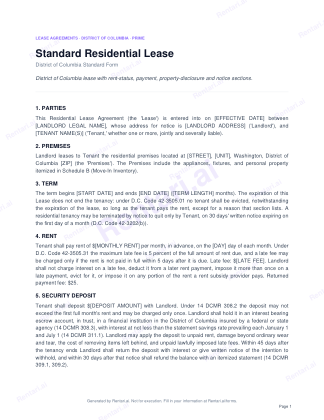
In the Rentari Washington, D.C. lease
- Fair housing
The Rentari D.C. lease states that you comply with federal and local fair housing laws and handle reasonable accommodation requests, and, if you accept housing vouchers, that you consider all lawful sources of income.
- Landlord identity
The Rentari D.C. lease names you as the landlord; the license, registration and ownership information go with the application disclosure form, not the lease.
- Security deposit limit
The Rentari D.C. lease states the deposit amount and says it may not exceed the first full month's rent and may be charged only once.
- Returning the deposit
The Rentari D.C. lease says that within 45 days after the tenancy ends you either return the deposit with interest or give written notice of the intent to withhold, with documentation and the tenant's right to dispute, and refund the balance with an itemized statement within 30 days after that notice.
- Deposit account and interest
The Rentari D.C. lease says the deposit is held in an interest bearing escrow account in a District financial institution and earns interest at not less than the statement savings rate set each January 1 and July 1.
- Move-in condition
The Rentari D.C. lease has the tenant accept the unit as shown in any move-in condition report and report pre-existing damage in writing within the period the law provides or, if none, within 7 days.
- Rent and late fees
The Rentari D.C. lease states in bold that the maximum late fee is 5 percent of the full rent due, charges it only after at least 5 days, and lists each of the limits above.
- Returned payment fee
The Rentari D.C. lease includes a returned payment fee only if you enter one, and then states the amount.
- Landlord entry
The Rentari D.C. lease follows these rules: 48 hours' written notice, 9 a.m. to 5 p.m., not on Sundays or federal holidays, and only for the listed purposes, except in an emergency.
- Repairs and habitability
The Rentari D.C. lease has you keep the unit habitable and the tenant report needed repairs promptly.
- Locks and security devices
The Rentari D.C. lease includes the 5-business-day lock change for victims, with the 45-day reimbursement, and has you provide working exterior locks.
- Smoke and carbon monoxide alarms
The Rentari D.C. lease has you provide working smoke and carbon monoxide detectors at the start of the tenancy and bars the tenant from disabling them.
- Retaliation
The Rentari D.C. lease prohibits retaliation and states the 6-month presumption and the clear and convincing evidence standard.
- Ending a month-to-month tenancy
The Rentari D.C. lease says in bold that the lease expiring does not end the tenancy, and that only the tenant may end it by a 30-day written notice that expires on the first of a month.
D.C. Code § 42-3505.01(a)(1) D.C. Code § 42-3202(b) D.C. Code § 42-3505.54(a)
- Ending a fixed-term lease early
The Rentari D.C. lease includes the intrafamily offense release on these terms, requires your written consent to sublet or assign, and says you will not unreasonably withhold it.
- Notice for unpaid rent
The Rentari D.C. lease says no tenant may be evicted without the written notice District law requires and that only a court can order an eviction; it does not state a day count for this notice.
- Notice for a lease violation
The Rentari D.C. lease says any notice other than for nonpayment is also served on the Rent Administrator and must be in the tenant's primary language when District law requires it.
- Eviction process
The Rentari D.C. lease says only a court can order an eviction and that free legal help is available from the Office of the Tenant Advocate.
- Abandoned property
The Rentari D.C. lease says property left behind is handled as the law requires, including any notice and storage period.
- Small claims
The Rentari D.C. lease says actions under it are brought in the Superior Court of the District of Columbia, and possession cases in its Landlord and Tenant Branch.
- Rent control
The Rentari D.C. lease states on its first page that District law gives tenants rights when the building is sold and that the lease waives none of them; when the property address is in Washington, it adds a note that the Rental Housing Act limits rent increases for covered units.
Washington, D.C. numbers the lease follows
- Security deposit limit
- 1 month
- of rent, all deposits together, under the housing regulations
- 14 DCMR 308
- Deposit refund deadline
- 45 days
- after the tenancy ends, to refund or give written notice of amounts claimed
- D.C. Code § 42-3502.17(e)(2)14 DCMR 309
- Late fee grace period
- 5 days
- after the due date, or any longer grace period in the lease
- D.C. Code § 42-3505.31(b)(2)
- Late fee limit
- 5%
- of the full rent due, and only if the lease states the maximum
- D.C. Code § 42-3505.31(a), (b)(1)
- Unpaid rent notice
- 10 days, allow 30
- notice of intent to file; its required wording says 30 days, and none is allowed under $600 owed
- D.C. Code § 42-3505.01(a-1)
- Lease violation notice
- 30 days
- for the tenant to correct a violation other than unpaid rent
- D.C. Code § 42-3505.01(b)
- Ending month-to-month
- Tenant only
- a landlord needs a ground the law lists; the tenant gives 30 days, ending on the first of a month
- D.C. Code § 42-3505.01(a)(1)D.C. Code § 42-3202(b)
- Entry notice
- 48 hours
- written, between 9 a.m. and 5 p.m., not on a Sunday or federal holiday
- D.C. Code § 42-3505.51(a)
- Rent increase notice
- 60 days
- the increase starts on the first rent day more than 60 calendar days after notice
- D.C. Code § 42-3509.04(b)
- Application fee limit
- $50
- may be adjusted yearly by inflation since 2024; no other fee before signing
- D.C. Code § 42-3505.10(b)
From the Washington, D.C. lease
WASHINGTON, D.C. RESIDENTIAL LEASE AGREEMENT
The maximum late fee District law allows is 5 percent of the full amount of rent due. If Tenant has not paid the full amount of rent within [Grace days] days after the day it is due, Tenant shall pay a late fee of [Late fee amount], which does not exceed that maximum.
Late fee maximumD.C. Code § 42-3505.31
Reasonable notice is written notice at least forty-eight (48) hours before the entry, or a shorter time Tenant agrees to in writing. It may be given by email or text message, but if Tenant does not acknowledge it in writing Landlord shall give a paper notice. A reasonable time is between 9 a.m. and 5 p.m., and not on a Sunday or federal holiday, unless Tenant agrees to another time.
Entry noticeD.C. Code § 42-3505.51(a)
The expiration of this Lease does not end the tenancy. No tenant shall be evicted, notwithstanding the expiration of the lease, so long as the tenant continues to pay the rent to which the housing provider is entitled, except for one of the reasons D.C. Code 42-3505.01 lists and after the written notice that section requires.
Lease expirationD.C. Code § 42-3505.01(a)(1)
Washington, D.C. lease types
Pick 3, 6, 12, 18 or 36 months or your own dates. At the end, the lease ends or converts to month-to-month.
Standard lease guideEnding month-to-month: Tenant only, a landlord needs a ground the law lists; the tenant gives 30 days, ending on the first of a month.
D.C. Code § 42-3505.01(a)(1) D.C. Code § 42-3202(b)
Washington, D.C. month-to-month leaseUpload a lease you already use: send an unsigned one for e-signature, or store one that is already signed.
Rooms use the Washington, D.C. lease for now: add the room as its own unit and set house rules with the optional addenda.
Washington, D.C. room rentalBefore you sign
Application and screening fees
You may charge a prospective tenant an application fee of no more than $50, which may be adjusted each year from January 1, 2024 by the change in the Consumer Price Index. No other fee may be charged before the lease is signed.
- Before asking for any information or fee, tell the applicant in writing, or by an accessible posting, each fee and deposit and whether it is refundable, what information you will check, the criteria for automatic denial and other denial, the credit agency used and the applicant's right to a free copy of the report if denied, the approximate number of units you expect to have for rent over a period by bedroom size and rent (or how many became available each month in your prior fiscal year), how many days you will take to decide, and the applicant's rights to dispute, to a refund of an unused fee and to complain. D.C. Code § 42-3505.10(a)
- If the same applicant applies for another of your District units within 30 calendar days, charge only one fee unless more than one screening is required. D.C. Code § 42-3505.10(b-1)
- If you do not screen the applicant for any reason, refund the application fee within 14 days. D.C. Code § 42-3505.10(c)
- Do not require a holding deposit from an applicant using a government-funded housing voucher. D.C. Code § 42-3505.10(b)(5)
- Do not ask about or deny for an eviction case that did not end in a judgment for the landlord or was filed 3 or more years ago, and do not deny solely on a credit score. D.C. Code § 42-3505.10(d), (e)
- Never ask about or consider an arrest that did not end in a conviction. Do not ask about a pending criminal accusation or conviction until you make a conditional offer, and never about a household member under 18. Before taking an application fee, give the applicant your written eligibility criteria and a statement that they may show inaccuracies in their record, rehabilitation or other mitigating factors. D.C. Code § 42-3541.02(a), (b), (c), (g)
- After a conditional offer, you may consider only a pending accusation or a conviction within the past 7 years for one of the listed crimes, and withdraw the offer only if, weighing the listed factors, it serves a substantial, legitimate, nondiscriminatory interest. Give the reasons in writing with notice of the right to complain to the Office of Human Rights, and on a request within 20 days give a free copy of what you relied on within 10 days. D.C. Code § 42-3541.02(d), (e), (f)
- These criminal record rules do not apply to an owner who lives in a building with 3 or fewer rental units, or where federal or District law requires or allows considering criminal history. D.C. Code § 42-3541.03
- If you deny an applicant, give written notice by your stated response date with the specific grounds, a free copy or summary of third party information used, and the applicant's dispute and complaint rights; answer any dispute in writing within 10 days. D.C. Code § 42-3505.10(f), (g)
- If you let a tenant find a replacement, assign or sublet, a replacement fee may not exceed the application fee limit. D.C. Code § 42-3505.10(b)(4)
- Do not charge any fee, at any time, for services you must provide to keep the unit habitable and up to the housing code. D.C. Code § 42-3505.10(b-2) D.C. Law 26-156
- The screening restriction also covers certain alleged lease breaches, even without an eviction case. Do not ask about, require disclosure of, or base an adverse action on an allegation tied to a qualifying violence-related defense, the applicant being a crime victim in the unit, the applicant's or a household member's disability, or conduct three or more years old. Apply the statutory conditions to the allegation rather than treating every landlord reference as usable. D.C. Code 42-3505.10(d)(2)
- An adverse action includes approving an application on different, less favorable terms than those advertised or communicated in writing, as well as denying it. The written-notice requirements therefore apply to that kind of conditional approval too. Receiving prohibited information incidentally in a report does not itself violate the screening section if you did not request it and can demonstrate that you did not rely on it for adverse action. D.C. Code 42-3505.10(e)(2), (f), (j)
- Keep District denial and dispute notices alongside any required federal consumer-report notice. If a consumer report contributes to a rejection or less favorable terms, identify the reporting company by name, address and phone number; explain that it did not make the decision and cannot explain your reasons; and state the applicant’s rights to dispute inaccurate or incomplete information and request a free report from that company within sixty days of the notice. A federal notice does not replace the District’s written reasons, response deadlines or limits on records you may use. Save the criteria, decision reasons, notices and delivery records together. FTC: landlord consumer-report guidance D.C. application screening and notices
Fair housing
The D.C. Human Rights Act makes it unlawful to refuse, end or set different terms for a real estate transaction, wholly or partly because of actual or perceived race, color, religion, national origin, sex, age, marital status, personal appearance, sexual orientation, gender identity or expression, familial status, family responsibilities, disability, matriculation, political affiliation, source of income, a sealed eviction record, status as a victim of an intrafamily offense, place of residence or business, or homeless status.
- Source of income is protected, so you may not turn away an applicant because rent would be paid with a housing voucher; you also may not require a holding deposit from a voucher holder. D.C. Code § 2-1402.21(a) D.C. Code § 42-3505.10(b)(5)
The Rentari D.C. lease states that you comply with federal and local fair housing laws and handle reasonable accommodation requests, and, if you accept housing vouchers, that you consider all lawful sources of income.
Required disclosures
Partly readWhen a prospective tenant files an application, you must give them the Rent Administrator's disclosure form with the supporting documents. It covers the rent, pending petitions and surcharges, how often rent may rise, the rent control or exempt status with the business license and registration, housing code violation reports from the past 12 months, the Rent Administrator's rent increase pamphlet, any nonrefundable application fee, the deposit, its interest rate and how it is returned, any conversion, ownership information, known indoor mold in the past 3 years, the Tenant Bill of Rights, and the voter registration packet. Lead paint and lead plumbing forms are also due before the tenant is bound by a lease.
D.C. Code § 42-3502.22(b)(1) D.C. Code § 8-231.04 D.C. Code § 42-3271
- Keep a compilation of these forms in a publicly accessible spot in the building, update it within 30 days of a change, tell each tenant where it is, and give a tenant a free copy within 10 business days of a written request once a year. D.C. Code § 42-3502.22(b)(2)
- Once a year, on a tenant's written request, provide within 10 business days each rent increase of the last 3 years and its basis. D.C. Code § 42-3502.22(a)
- Rent may not be increased while you willfully violate these duties, or fail to comply within 10 business days of written notice of a failure. D.C. Code § 42-3502.22(c)
- Before a lease is signed for a unit exempt from rent stabilization, the prospective tenant must get written notice that rent increases are not regulated by the rent stabilization program. D.C. Code § 42-3502.05(d)
- Before screening, give the written notice of fees, criteria and applicant rights that the screening law requires. D.C. Code § 42-3505.10(a) See Application and screening fees on the Washington, D.C. page
- For a unit built before 1978, give the tenant the Mayor's lead disclosure form with what you reasonably know about lead-based paint, lead-based paint hazards and pending District orders before the tenant is bound by the lease. D.C. Code § 8-231.04(a)
- If a child under 6 or a pregnant woman will live in or regularly visit a pre-1978 unit, also give a clearance report issued within the previous 12 months, unless you instead give a certification that the unit is lead-free or three clearance reports at least 12 months apart within the past 7 years with no recent housing code violations. D.C. Code § 8-231.04(b), (d) D.C. Code § 8-231.01(31)
- Give the Mayor's form on tenant lead rights whenever a lease is signed or renewed and with each rent increase notice, and if you discover lead-based paint, tell the tenant within 10 days. D.C. Code § 8-231.04(e), (f)
- Before a tenant signs or renews a lease, give the Mayor's lead plumbing disclosure form completed with what you know about water lead tests, lead-bearing plumbing, the lead water service line and any replacement, related fines, and whether DC Water lists the property; if you later learn of lead plumbing or a lead service line, tell the tenant within 48 hours and give the completed form. D.C. Code § 42-3271(a), (b)
Flood disclosure
Partly readNo flood disclosure duty appears in the D.C. Code sections read for this page, including the list of disclosures due at application. Other District law was not searched for one.
- The application disclosure list covers code violations, mold and other items, but not flooding. D.C. Code § 42-3502.22(b)(1) See Required disclosures on the Washington, D.C. page
Landlord identity
Partly readAt application, the disclosure form must include the building's business license, its rent stabilization registration or claim of exemption, and the ownership information from the registration statement.
D.C. Code § 42-3502.22(b)(1)(E), (J)
- For a unit that is not exempt from rent stabilization, file a notice of any change in ownership or management with the Rent Administrator within 30 days after the change. D.C. Code § 42-3502.05(a), (g)(1)(C)
- To evict, you must show a current rental housing business license. D.C. Code § 42-3505.01(q) D.C. Code § 16-1501(c)
The Rentari D.C. lease names you as the landlord; the license, registration and ownership information go with the application disclosure form, not the lease.
Deposits, rent and fees
Security deposit limit
Partly readThe District's housing regulations limit a security deposit to one month's rent, counting all deposits together, and allow it to be collected only once. The D.C. Code says deposits are collected under the Security Deposit Act and those regulations. The regulations are published only as Word files and were not reread for this page.
14 DCMR 308 D.C. Code § 42-3502.17(a)
- A landlord may not demand a deposit from a tenant who has lived in the unit since July 17, 1985 without ever having paid one, except for newly built units and some exempt units. D.C. Code § 42-3502.17(a)
- A separate pet deposit was added to the Code in 2025 but is marked not funded, so it has not taken effect. D.C. Code § 42-3502.17(d) D.C. Law 25-308
- When a prospective tenant applies, you must disclose the amount of any initial security deposit, the interest rate on it and how it is returned. D.C. Code § 42-3502.22(b)(1)(H) See Required disclosures on the Washington, D.C. page
The Rentari D.C. lease states the deposit amount and says it may not exceed the first full month's rent and may be charged only once.
Returning the deposit
Partly readWhen the tenancy ends, ask the tenant for a forwarding mailing or email address. Within 45 days after the tenancy ends, you must send the tenant written notice of any unpaid amounts you claim, with photographs or other documentation, a statement of the tenant's right to dispute them, and your contact information. The housing regulations also set the refund itself: return the deposit with interest within 45 days, or give written notice of the intent to withhold, then refund any balance with an itemized statement within 30 days after that notice.
D.C. Code § 42-3502.17(e) 14 DCMR 309
- Send the notice in person, by email or by certified mail to the forwarding address. It may claim unpaid rent, damage beyond ordinary wear and tear, and the cost of removing items the tenant left behind. D.C. Code § 42-3502.17(e)(2)
- The tenant has 30 calendar days after the notice is served to dispute the amounts, and you must answer in writing within 10 days after receiving the tenant's information. D.C. Code § 42-3502.17(e)(3)
- Keep proof that the notice was served for at least 60 days before you send any unpaid amount to a debt collector. D.C. Code § 42-3502.17(e)(4)
- You may not keep any of the deposit to replace items damaged by ordinary wear and tear, meaning deterioration from intended use, age or worn condition. Damage from negligence, carelessness, accident or abuse by the tenant, family or guests is not ordinary wear and tear. D.C. Code § 42-3502.17(c)
- Unpaid late fees that were lawfully imposed and invoiced may be taken from the deposit at the end of the tenancy. D.C. Code § 42-3505.31(d) See Rent and late fees on the Washington, D.C. page
- Under the regulations, a deposit withheld in bad faith can cost treble damages; the regulation text was not reread for this page. 14 DCMR 309
The Rentari D.C. lease says that within 45 days after the tenancy ends you either return the deposit with interest or give written notice of the intent to withhold, with documentation and the tenant's right to dispute, and refund the balance with an itemized statement within 30 days after that notice.
Deposit account and interest
Partly readUnder the housing regulations, keep the deposit in an interest bearing escrow account, in trust, in a financial institution in the District that is insured by a federal or state agency, and pay the tenant interest at not less than the statement savings rate in effect each January 1 and July 1. The regulations are published only as Word files and were not reread for this page.
- At application, disclose the interest rate on the deposit and how it will be returned. D.C. Code § 42-3502.22(b)(1)(H)
- Complaints about a deposit that was not returned, or interest that was not paid, can be heard by the Office of Administrative Hearings. D.C. Code § 42-3502.17(b)
The Rentari D.C. lease says the deposit is held in an interest bearing escrow account in a District financial institution and earns interest at not less than the statement savings rate set each January 1 and July 1.
Move-in condition
Partly readNo move-in checklist rule appears in the D.C. Code sections read for this page. The housing regulation on inspecting the unit for the deposit is published only as a Word file and was not read.
- Photographs or other documentation are required to support any amount you later claim from the tenant, so a dated move-in record helps. D.C. Code § 42-3502.17(e)(2)(B) See Returning the deposit on the Washington, D.C. page
The Rentari D.C. lease has the tenant accept the unit as shown in any move-in condition report and report pre-existing damage in writing within the period the law provides or, if none, within 7 days.
Rent and late fees
You may charge a late fee only if the written lease tells the tenant the maximum late fee, and only after the tenant has not paid the full rent within 5 days, or any longer grace period in the lease, after the due date. The fee may not exceed 5 percent of the full rent due.
- You may not charge interest on a late fee, deduct it from a later rent payment, charge it more than once for the same late payment, evict for not paying it, or charge it on any part of the rent a subsidy provider is responsible for. D.C. Code § 42-3505.31(c) D.C. Code § 42-3505.01(a)(1)
- After the grace period you may invoice a lawful late fee, payable within 30 days; if it stays unpaid, you may take it from the deposit at the end of the tenancy. D.C. Code § 42-3505.31(d)
The Rentari D.C. lease states in bold that the maximum late fee is 5 percent of the full rent due, charges it only after at least 5 days, and lists each of the limits above.
Returned payment fee
Not readNo limit on a fee for a returned check or payment was found in the D.C. Code sections read for this page, and the Code was not searched in full for one.
- Separately, no fee may be charged for services you must provide to keep the unit habitable; that rule does not itself address a returned payment fee. D.C. Code § 42-3505.10(b-2)
The Rentari D.C. lease includes a returned payment fee only if you enter one, and then states the amount.
Rent increase notice
A rent increase does not take effect until the first day rent is normally due that falls more than 60 calendar days after you give the tenant notice of it.
- If your lease requires the tenant to give more than 30 days' notice before moving out, it must also require you to give notice of a rent increase at least 30 days longer than that period. D.C. Code § 42-3505.54(b)
- For a rent stabilized unit, rent may be increased only once every 12 months, the notice must state the current and new rent and include a summary of tenant rights, and a copy of the notice is filed with the Rent Administrator within 30 days after the increase takes effect. An increase above base rent is also invalid unless the unit and common areas substantially comply with the housing regulations, the building is registered, you and any manager are licensed or registered as required, the notice complies with the notice statute, a nonresident owner has a registered agent, and you have given the tenant written notice of the maximum increase for elderly tenants and tenants with disabilities and how to claim that status. D.C. Code § 42-3502.08(f), (g) D.C. Code § 42-3502.05(g)(1)(A) D.C. Code § 42-3502.08(a)(1) See Rent control on the Washington, D.C. page
- Serve notices by hand, by leaving them at the tenant's home with a person of suitable age, or by mail. D.C. Code § 42-3509.04(a)
During the tenancy
Landlord entry
Except in an emergency, you may enter only for a reasonable purpose, at a reasonable time, and after written notice at least 48 hours ahead, unless the tenant agrees in writing to a shorter period. A reasonable time is between 9 a.m. and 5 p.m., not on a Sunday or federal holiday, unless the tenant agrees to another time.
- Notice may be by email or text message, but if the tenant does not acknowledge it in writing you must give a paper notice. D.C. Code § 42-3505.51(a)(1)
- Reasonable purposes are keeping the property safe, inspecting, making repairs or improvements, supplying services, showing the unit to buyers, lenders, tenants or workers, and work a government agency ordered. D.C. Code § 42-3505.51(a)(2)
- A court can stop unlawful entry or repeated unreasonable demands for entry and award damages. D.C. Code § 42-3505.51(b)(2)
- When a tenant reports a housing code violation, the tenant must give you access within 48 hours of your written request to assess and fix it. D.C. Code § 42-3505.51(b)(3)
The Rentari D.C. lease follows these rules: 48 hours' written notice, 9 a.m. to 5 p.m., not on Sundays or federal holidays, and only for the listed purposes, except in an emergency.
Repairs and habitability
Partly readDistrict law treats the implied warranty of habitability and the housing code as the landlord's baseline, but the housing code itself (Title 14 of the D.C. Municipal Regulations) is published only as Word files and was not read for this page.
D.C. Code § 42-3505.10(b-2) 14 DCMR chapter 3
- You may not charge a fee, before move-in, during the tenancy or after move-out, for services you must provide to keep the unit consistent with the implied warranty of habitability and the housing regulations. D.C. Code § 42-3505.10(b-2) D.C. Law 26-156
- For rent stabilized units, a rent increase requires the unit and common areas to be in substantial compliance with the housing regulations, unless the problem is the tenant's fault. D.C. Code § 42-3502.08(a) See Rent control on the Washington, D.C. page
- When a tenant reports a housing code violation, the tenant must give you access within 48 hours of your written request so you can assess and fix it. D.C. Code § 42-3505.51(b)(3)
The Rentari D.C. lease has you keep the unit habitable and the tenant report needed repairs promptly.
Tenant repair remedies
Partly readThe Code sections read recognize that a tenant may lawfully withhold rent after reasonable notice of a housing code violation, but they do not spell out a repair and deduct or withholding procedure; the housing regulations and court decisions that do were not read for this page.
- A tenant who lawfully withheld rent after notice of a violation, asked for repairs, or reported violations to District officials within the past 6 months is presumed to be facing retaliation if you act against them. D.C. Code § 42-3505.02(b) See Retaliation on the Washington, D.C. page
- A court can award damages and stop a landlord from unlawful entry, which protects the tenant's right to quiet enjoyment. D.C. Code § 42-3505.51(b)(2)
Locks and security devices
Partly readOn the written request of a tenant who is a victim of an intrafamily offense, you must change the locks on every entrance door to the unit within 5 business days. No general rekeying rule appears in the sections read for this page, but you may not charge tenants a fee for lock services you must provide to keep the unit habitable and up to the housing code.
D.C. Code § 42-3505.08 D.C. Code § 42-3505.10(b-2)(1)(A)
- If the offender lives in the same unit, the tenant must give you a protection order; otherwise no documentation is required. D.C. Code § 42-3505.08(a)
- You pay for the change first; the tenant reimburses the cost and any usual fee within 45 days after you give documentation of the cost. D.C. Code § 42-3505.08(b)
- Once you have the court order, do not give the offender keys or access unless the court allows it. D.C. Code § 42-3505.08(c)
The Rentari D.C. lease includes the 5-business-day lock change for victims, with the 45-day reimbursement, and has you provide working exterior locks.
Smoke and carbon monoxide alarms
Partly readThe owner of every occupied dwelling unit must install smoke detectors and carbon monoxide detectors as the District's Construction Codes require. The Construction Codes themselves were not read for this page.
- The older Code sections on detector locations, equipment and installation have been repealed in favor of the Construction Codes. D.C. Code § 6-751.03 D.C. Code § 6-751.05
The Rentari D.C. lease has you provide working smoke and carbon monoxide detectors at the start of the tenancy and bars the tenant from disabling them.
Retaliation
You may not retaliate against a tenant for exercising any legal right, for example by seeking possession, raising rent unlawfully, cutting services, harassing, refusing to renew or ending the tenancy without cause. If within the 6 months before your action the tenant took one of the protected steps listed in the statute, the action is presumed retaliatory and the tenant wins unless you rebut it with clear and convincing evidence.
- The protected steps are a witnessed oral or written request for repairs needed to meet the housing regulations, contacting District officials about violations, lawfully withholding rent after notice of a violation, tenant organization activity, an effort to secure or enforce rights under the lease, and bringing legal action against the landlord. D.C. Code § 42-3505.02(b)
The Rentari D.C. lease prohibits retaliation and states the 6-month presumption and the clear and convincing evidence standard.
Lockouts and utilities
Partly readNo tenant may be evicted except as the eviction statute allows, after the required notice and a court case; an eviction is carried out by the U.S. Marshals, and you change the locks in their presence. The sections read do not separately address utility shutoffs by a landlord. If you are billed for a master-metered apartment house and fall behind, the utility must first let tenants take service in their own names, and what tenants pay the utility may be deducted from their rent.
D.C. Code § 42-3505.01(a)(1) D.C. Code § 42-3505.01a(c) D.C. Code § 42-3302
- Starting January 1, 2027, you may not bill tenants separately, other than through the monthly rent, for utility charges for common spaces or vacant units. A ratio utility billing system that allocates master-metered charges among tenants is still allowed within that limit. Under the fee ban as rewritten in 2026, a ratio utility billing system may pass through only the allocated utility charges, with no billing or administrative fee, and on a rent stabilized unit an unapproved mandatory fee also carries treble damages. D.C. Code § 42-3505.11 D.C. Law 26-156 D.C. Code § 42-3505.10(b-2)(1)(A) D.C. Code § 42-3502.11a
- An eviction may not be carried out on a day the National Weather Service forecasts at 8 a.m. below 32 or above 95 degrees Fahrenheit at National Airport, or while precipitation is falling, with narrow exceptions. D.C. Code § 42-3505.01(k), (k-1)
Ending a tenancy
Ending a month-to-month tenancy
A landlord cannot end a residential tenancy, month-to-month or after a lease expires, just by giving notice. As long as the tenant pays the rent you are entitled to, you may recover the unit only for one of the reasons the eviction statute lists, after the notice it requires. The tenant may end a month-to-month tenancy with 30 days' written notice that expires on the first day of a month.
D.C. Code § 42-3505.01(a)(1) D.C. Code § 42-3202(b) D.C. Code § 42-3505.54(a)
- The tenant's notice expires on the first day of the first month at least 30 days after the date of the notice. D.C. Code § 42-3505.54(a) D.C. Code § 42-3202(b)
- Grounds other than the tenant's fault each carry their own notice to vacate, for example 90 days when an owner who is a natural person (not a company) in good faith wants to live in the unit, 120 days for approved renovations, and 180 days to stop using the unit as housing, and some come with relocation help and limits on re-renting. D.C. Code § 42-3505.01(d), (f), (i) See Eviction process on the Washington, D.C. page
- A clause requiring more than 30 days' notice from the tenant when an initial lease term ends is void unless the lease says it expires with the initial term and that the tenant may then leave on 30 days' notice while month-to-month. D.C. Code § 42-3505.53
The Rentari D.C. lease says in bold that the lease expiring does not end the tenancy, and that only the tenant may end it by a 30-day written notice that expires on the first of a month.
Ending a fixed-term lease early
If a tenant leaves before the lease ends, or in bad faith never moves in, any damages you claim are subject to your duty to mitigate them, which in practice means trying to re-rent the unit.
- A tenant who is a victim of an intrafamily offense, or the parent or guardian of a minor victim, is released from the lease on giving written notice with a protection order or documentation signed by a qualified third party, such as a police officer, health professional or domestic violence counselor. The request must come within 90 days of the incident. D.C. Code § 42-3505.07(a) to (c), (e)
- The release takes effect 14 days after you receive the notice and documentation, or when a new tenancy for the unit starts if sooner, and the tenant owes rent only pro-rated to that point, whatever the lease says about penalties. D.C. Code § 42-3505.07(d), (f)
- You may prohibit subletting or assignment if the lease says so. If the lease allows it with your reasonable consent or is silent, you may require the proposed subtenant to meet your reasonable rental criteria, which you must give the tenant on request. D.C. Code § 42-3505.55
The Rentari D.C. lease includes the intrafamily offense release on these terms, requires your written consent to sublet or assign, and says you will not unreasonably withhold it.
Notice for unpaid rent
Before filing an eviction case for unpaid rent, you must give the tenant written notice of your intent to file. The Code says the notice comes at least 10 days before filing, but the wording the same subsection requires in the notice tells the tenant you may file if the balance is not paid within 30 days, so allow 30 days before filing. You may not send this notice, or file for possession, when less than $600 in rent is owed.
D.C. Code § 42-3505.01(a-1) D.C. Code § 16-1501(b)
- The notice must state the total rent owed, attach a ledger of charges and payments for the period of delinquency, tell the tenant they may stay if the balance is paid in full, and give the Office of the Tenant Advocate and legal help phone numbers, using the prescribed or substantially similar language. D.C. Code § 42-3505.01(a-1)(2)
- Deliver it both ways: by certified mail or a tracked delivery service with return receipt requested, and by hand delivery to the unit or posting on its front door. D.C. Code § 42-3505.01(a-1)(3)
- If you post a notice, give the court a photograph of the posted notice with a readable timestamp. If you know the tenant's primary language is one other than English or Spanish that District law covers, give the notice in that language. D.C. Code § 42-3505.01(a)(2), (a)(3)
- The court may dismiss a case filed without the required notice or before the notice period has run. D.C. Code § 42-3505.01(a)(4)
- To file, you need a valid rental registration or claim of exemption and a current rental housing business license. D.C. Code § 16-1501(c) See Eviction process on the Washington, D.C. page
- Not paying a late fee is never a ground for eviction. D.C. Code § 42-3505.01(a)(1)
The Rentari D.C. lease says no tenant may be evicted without the written notice District law requires and that only a court can order an eviction; it does not state a day count for this notice.
Notice for a lease violation
To recover the unit because the tenant is breaking an obligation of the tenancy other than paying rent, give written notice and let the tenant correct the violation; you may proceed only if it is not corrected within 30 days after the tenant receives the notice. Serve this notice on both the tenant and the Rent Administrator.
D.C. Code § 42-3505.01(a)(1), (b)
- If a court has found that the tenant or another occupant performed an illegal act in the unit or building, serve a 30-day notice to vacate. A tenant can be evicted for another occupant's act only if the tenant knew or should have known of it. D.C. Code § 42-3505.01(c)(1)
- For cases filed after December 31, 2025 involving a dangerous crime or crime of violence not committed in self-defense, the notice to vacate is 10 days, after you consider in good faith ways to preserve housing for occupants who did not offend, and the court holds an expedited hearing. D.C. Code § 42-3505.01(c)(2)
- It is a defense that the tenant, or a minor child of the tenant, is the victim of an intrafamily offense that is the basis for the notice. D.C. Code § 42-3505.01(c-1)
- Serve a notice to quit in English and Spanish, in person if possible, otherwise on a person of proper age at the unit, or by posting it and mailing a copy first class within 3 calendar days. D.C. Code § 42-3206
The Rentari D.C. lease says any notice other than for nonpayment is also served on the Rent Administrator and must be in the tenant's primary language when District law requires it.
Eviction process
Only a court can order an eviction. You file a complaint for possession in the Landlord and Tenant Branch of the Superior Court after the required notice, and you need a valid rental registration or claim of exemption and a current rental housing business license to file.
D.C. Code § 16-1501 D.C. Code § 42-3505.01
- You may not file for possession for unpaid rent of less than $600, though you may sue for the money. D.C. Code § 16-1501(b) See Notice for unpaid rent on the Washington, D.C. page
- The court may dismiss a case if notice was missing or too short, if a posted notice or summons lacks a timestamped photograph, or if a required translated notice was not given. D.C. Code § 42-3505.01(a)(4) D.C. Code § 16-1501(d)
- No tenant may be evicted unless you show the court a current rental housing business license when you file for the writ. D.C. Code § 42-3505.01(q)
- The court may pause a nonpayment case while a tenant's emergency rental assistance application is pending. D.C. Code § 42-3505.01(r)
- Give the tenant a notice confirming the eviction date at least 21 days ahead. D.C. Code § 42-3505.01a(b) See Abandoned property on the Washington, D.C. page
- Grounds that are not the tenant's fault, such as personal use, sale for personal use, renovation, demolition, substantial rehabilitation or discontinuing housing use, each have their own notice to vacate and conditions. D.C. Code § 42-3505.01(d) to (i)
The Rentari D.C. lease says only a court can order an eviction and that free legal help is available from the Office of the Tenant Advocate.
Abandoned property
Partly readAfter a court-ordered eviction, give the tenant a notice at least 21 days before the eviction date confirming the date and warning that property left behind is considered abandoned 7 days after the eviction, not counting Sundays and federal holidays. During those 7 days the tenant may come back for their belongings, with no rent or storage charge.
- Send the 21-day notice by phone or electronic message, by first class mail to the unit, and by posting it at the unit; it must also give the Marshals', Tenant Advocate's and court's phone numbers and say it is your final notice. D.C. Code § 42-3505.01a(b)
- Give access at times agreed, for at least 16 hours between 8 a.m. and 6 p.m. over no more than 2 days, including a Saturday if the tenant asks. D.C. Code § 42-3505.01a(b)(2)(G)
- On the day of the eviction, mail to any emergency contact and post a notice naming an agent who can let the tenant in. D.C. Code § 42-3505.01a(d)
- Property left after an ejectment action has its own rule. D.C. Code § 42-3210.01
The Rentari D.C. lease says property left behind is handled as the law requires, including any notice and storage period.
Small claims
The Small Claims and Conciliation Branch of the Superior Court hears money-only claims up to $10,000, not counting interest, attorney fees and costs. A claim affecting an interest in real property, such as possession of the unit, cannot be brought there.
- Eviction cases go to the Landlord and Tenant Branch instead. D.C. Code § 16-1501 See Eviction process on the Washington, D.C. page
The Rentari D.C. lease says actions under it are brought in the Superior Court of the District of Columbia, and possession cases in its Landlord and Tenant Branch.
Local rules
Rent control
Partly readThe District has rent stabilization. It applies to each rental unit unless the statute exempts it; units in buildings with 4 or fewer units owned by up to 4 natural persons who own no other District rental unit, newer buildings permitted after 1975, and federally or District subsidized units, among others, can qualify, and the exemption for small owners requires a claim filed with the Rent Administrator. For an occupied stabilized unit, a yearly increase is limited to the adjustment of general applicability plus 2 percent, never more than 10 percent.
D.C. Code § 42-3502.05(a) D.C. Code § 42-3502.08(h)
- Rent on a stabilized unit may be increased only after a full 12 months since the last increase. D.C. Code § 42-3502.08(g)
- For an elderly tenant or a tenant with a disability, an increase is limited to the lowest of the adjustment of general applicability, the latest Social Security cost-of-living adjustment, or 5 percent. D.C. Code § 42-3502.24(a)
- Every housing provider registers the building, or files a claim of exemption, with the Rent Administrator; for a unit that is not exempt, you also file each rent increase notice within 30 days after it takes effect and a notice of any ownership or management change within 30 days. D.C. Code § 42-3502.05(a), (f), (g)
- Tenants also have a right to purchase when a housing accommodation is sold, under the Tenant Opportunity to Purchase Act, which was not read for this page. D.C. Code § 42-3404.02
- For a rent stabilized unit, do not impose any mandatory fee for a service or facility unless it was approved through a services and facilities petition or a voluntary agreement; a violation makes you liable for treble damages. D.C. Code § 42-3502.11a D.C. Code § 42-3502.11 D.C. Code § 42-3502.15
- For standard annual increases effective May 1, 2026 through April 30, 2027, the Commission sets a 4.1 percent limit for other rent-controlled tenants and a 2.1 percent limit for tenants age 62 or older or with a disability who have registered that status with the Rent Administrator. These are annual adjustment limits for covered units; separately approved increases and their protections require their own review. Confirm the lawful rent, coverage and last increase before calculating a new amount. Rental Housing Commission, 2026 adjustment notice Office of the Tenant Advocate, 2026 rent control year
- Use the District's RentRegistry for housing-provider registration and any claim of exemption. The Commission requires housing providers to file rent increases taking effect on or after December 1, 2025 electronically, and tenants claiming age or disability status must also file through RentRegistry. Government filing is separate from giving the tenant a properly served notice; completing one does not establish that the other was completed. Rental Housing Commission, 2026 notice: electronic filing See Rent increase notice on the Washington, D.C. page
The Rentari D.C. lease states on its first page that District law gives tenants rights when the building is sold and that the lease waives none of them; when the property address is in Washington, it adds a note that the Rental Housing Act limits rent increases for covered units.
The District is a single jurisdiction, so its own Code and Municipal Regulations are the local law and no separate city or county code applies. The housing regulations in Title 14 of the Municipal Regulations, which hold the housing code and the deposit and rent stabilization rules, are published only as Word files and were not read for this page.
Washington, D.C. lease renewals
Read the agreement's renewal clause and the notice rules above before choosing a new term, changing rent or ending the tenancy. A fixed end date does not override applicable renewal rights, rent regulation, just-cause rules or protections against retaliation and discrimination.
Confirm the notice, timing and delivery requirements for the rental's state and locality. Review any required new disclosures and attachments when preparing the renewal. Get the parties' agreement to changed terms in writing.
Customize an unsigned agreement or prepare an addendum to an existing lease.
How it works
- Add your Washington, D.C. rental
Enter the property and its units.
- Set the terms
Choose the rental, add tenants, and set rent, deposit and fees.
- Review the lease
Preview and edit the Washington, D.C. lease and its addenda.
- Send for e-signature
Tenants sign online; sending is included on paid plans.
Follow the full lease builder guide, add supporting files, or download and print the agreement.
Washington, D.C. lease questions
Does the Rentari D.C. lease state the maximum late fee?
Yes. District law allows a late fee only if the written lease tells the tenant the maximum, so the lease states in bold that the maximum is 5 percent of the full rent due, never charges it before 5 days, and lists the limits on charging it.
Does the lease end the tenancy when its term runs out?
No. The lease says in bold that its expiration does not end the tenancy, because District law lets you recover the unit only for a listed reason after the required notice, while the tenant may leave on 30 days' notice ending on the first of a month.
Does the lease include the application disclosure form and Tenant Bill of Rights?
No. Those are due when the tenant applies, on the Rent Administrator's form. The lease lists what the form covers and says the documents are given with it and are not part of the lease package.
What does the lease say about the security deposit?
It states the amount, limits it to the first full month's rent, says it is held in an interest bearing escrow account in the District, lists what it may be used for, and sets the 45-day refund or notice deadline with documentation and the tenant's right to dispute.
Does the lease cover tenants who are victims of domestic violence?
Yes. It includes the release from the lease 14 days after notice with a protection order or qualified third party's documentation, requested within 90 days, and the lock change within 5 business days at the tenant's later expense.