- Home
- Lease agreement
- West Virginia
West Virginia residential lease agreement
State rules checked September 24, 2026 General information, not legal advice
Jump to a topic
West Virginia lease document preview
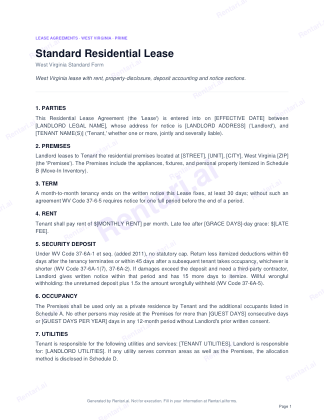
In the Rentari West Virginia lease
- Fair housing
The lease says you follow federal, state and local fair housing laws and explains how a tenant with a disability can ask for an accommodation or modification.
- Required disclosures
When you say the home was built before 1978 and no exemption applies, the lease attaches the federal lead-based paint disclosure.
- Landlord identity disclosure
The lease names the landlord and gives the landlord's address in its opening paragraph.
W. Va. Code chapter 37, article 6 W. Va. Code 37-6A-1(5) W. Va. Code 37-6A-2(e)
- Security deposit limit
The West Virginia lease states the deposit amount you set and says West Virginia does not cap the deposit.
W. Va. Code chapter 37, article 6 W. Va. Code chapter 37, article 6A
- Deposit return
The West Virginia lease states the shorter of 60 days or 45 days after a new tenant occupies, the permitted deductions, the 15-day contractor extension, delivery by hand or mail, the one and a half times penalty, and that the deposit is not a credit against delinquent rent.
- Move-in condition
The lease has the tenant accept the home as documented in any move-in condition report and report pre-existing damage in writing within seven days of move-in.
W. Va. Code chapter 37, article 6A W. Va. Code 37-6A-2(b)(2)
- Rent and late fees
The lease charges the late fee you set after the day you choose, as a lease term. Rentari suggests staying within 5 percent of the rent or $100 and allowing 3 days' grace; that is Rentari's guideline, not West Virginia law.
W. Va. Code chapter 37, article 6 W. Va. Code chapter 37, article 6A W. Va. Code 37-6A-2(b)(1)
- Landlord entry
As a lease term, the lease requires at least the hours of written notice you set (24 unless you choose otherwise) before a non-emergency entry, and entry only at reasonable times.
W. Va. Code chapter 37, article 6 W. Va. Code chapter 37, article 6A
- Repairs and habitability
The West Virginia lease restates these duties, including heat from October 1 through the last day of April, and that you need not make repairs while the tenant is behind on rent.
- Tenant repair remedies
The lease says the tenant may not withhold rent unless a statute allows it, and its casualty clause lets either party end the lease if a casualty the tenant did not cause makes the home wholly unfit, with rent abating for a partial loss.
W. Va. Code chapter 37, article 6 W. Va. Code chapter 37, article 6A W. Va. Code 55-3A-3(b)
- Locks and security devices
As a lease term, you provide working exterior locks, and the tenant may not change or rekey them without your written permission.
- Smoke and carbon monoxide alarms
As a lease term, you provide working smoke and carbon monoxide detectors at the start of the tenancy, and the tenant may not disable them.
- Retaliation
As a lease term, the lease bars adverse action against the tenant for exercising rights under the lease or the law, or for reporting code violations.
- Lockouts and utility shutoffs
The lease says who pays each utility, and adds a ratio billing clause when you use one.
- Ending a month-to-month tenancy
The lease sets its own month-to-month notice, as the statute allows: at least the number of days you choose (30 unless you choose otherwise), in writing, by either party.
- Notice for unpaid rent
The lease says you file a verified petition in magistrate or circuit court to remove a tenant who is behind on rent, and that the statute requires no notice before filing.
- Notice for lease violations
The lease says you file a verified petition to remove a tenant who has breached the lease or damaged the home. Rentari's notice to cure gives the days you enter, 30 unless you choose otherwise, not a statutory period.
- Eviction process
The lease states that you remove a tenant by verified petition in magistrate or circuit court, with a hearing five to ten judicial days later.
- Abandoned property
The lease states the one-month posted notice for an abandoned home with rent unpaid and the 30-day (60 for active duty) notice before belongings left behind are forfeited.
- Small claims
The lease says a petition for possession or a deposit claim may be brought in the magistrate or circuit court of the county where the home is.
West Virginia numbers the lease follows
- Security deposit limit
- No limit set
- neither the deposit article nor the landlord and tenant article caps it
- W. Va. Code chapter 37, article 6W. Va. Code chapter 37, article 6A
- Deposit return deadline
- 60 days
- after the tenancy ends, or 45 days after a new tenant moves in if that is sooner
- W. Va. Code 37-6A-1(7)W. Va. Code 37-6A-2(a)
- Extra time to itemize
- 15 days
- when damage exceeds the deposit, needs a contractor, and you told the tenant in time
- W. Va. Code 37-6A-2(c)
- Wrongful withholding
- 1.5 times
- the amount wrongfully withheld, plus the deposit, for willful or bad-faith failure
- W. Va. Code 37-6A-5(a)
- Notice before filing for unpaid rent
- None required
- you file a verified petition in magistrate or circuit court
- W. Va. Code 55-3A-1
- Month-to-month notice
- One full month
- before the end of a period, unless the lease sets another notice
- W. Va. Code 37-6-5
- Abandoned belongings
- 30 days
- after the notice is mailed before they are forfeited (60 for active duty)
- W. Va. Code 37-6-6(d)
- Heat season
- Oct 1 to Apr 30
- reasonable heat where the unit has direct utility connections
- W. Va. Code 37-6-30(a)(7)
From the West Virginia lease
WEST VIRGINIA RESIDENTIAL LEASE AGREEMENT
Landlord delivers the balance with a written itemization within sixty (60) days after the tenancy ends or forty-five (45) days after a new tenant occupies the Premises, whichever is shorter, in person or by mail to Tenant's last known or forwarding address (Tenant must give an accurate address).
Deposit returnW. Va. Code 37-6A-1(7) W. Va. Code 37-6A-2
To remove a tenant who is in arrears in rent, has breached this Lease or has damaged the Premises, Landlord files a verified petition in magistrate or circuit court, which sets a hearing five (5) to ten (10) judicial days later; the statute requires no notice before filing.
Removing a tenantW. Va. Code 55-3A-1
... and, where the unit has direct utility connections, supplies running water, reasonable hot water, and reasonable heat from October 1 through the last day of April. Landlord need not make repairs while Tenant is in arrears in rent.
Heat and waterW. Va. Code 37-6-30
West Virginia lease types
Pick 3, 6, 12, 18 or 36 months or your own dates. At the end, the lease ends or converts to month-to-month.
Standard lease guideMonth-to-month notice: One full month, before the end of a period, unless the lease sets another notice.
West Virginia month-to-month leaseUpload a lease you already use: send an unsigned one for e-signature, or store one that is already signed.
Rooms use the West Virginia lease for now: add the room as its own unit and set house rules with the optional addenda.
West Virginia room rentalBefore you sign
Application and screening fees
Neither article caps an application fee. The deposit article defines an application fee as money a person pays to be considered as a tenant, and the fee falls outside its security deposit definition only if you and the applicant expressly agree in writing that it is nonrefundable.
Fair housing
The West Virginia Fair Housing Act makes it unlawful to refuse to rent, or to set different terms, conditions, services or facilities, because of race, color, religion, ancestry, sex, familial status, blindness, disability or national origin. You also may not publish a rental notice or advertisement that shows a preference on those grounds, or, on those grounds, tell someone a home is unavailable when it is available.
W. Va. Code 16B-18-5(a) to (d)
- Refusing a reasonable accommodation in rules, policies, practices or services, or a reasonable modification the tenant pays for, is disability discrimination. For a rental you may, where reasonable, condition a modification on the tenant agreeing to restore the interior at move-out, reasonable wear and tear excepted. W. Va. Code 16B-18-5(f)(3)
- For an assistance animal you may ask for documentation from a professional treatment provider of the disability-related need, but not medical records or detailed information about the impairment. You may not charge a fee or deposit for it or apply your pet terms, and you may deny it only on objective, individualized evidence that the specific animal is a direct threat or would cause substantial physical damage that another accommodation cannot prevent. W. Va. Code 16B-18-5(f)(10)
- The state definition includes service, therapy or support animals weighing less than 150 pounds, with or without specific training or certification, that provide disability-related work, assistance or emotional support. That state definition does not resolve independent federal accommodation duties. Review both laws before treating a weight threshold as a reason to reject a request; the state also bars unreasonable delays in responding to an accommodation request. W. Va. Code 16B-18-3(p) W. Va. Code 16B-18-5(f)(10)(D) 42 U.S.C. 3604(f)(3)
- Familial status covers a child under 18 living with a parent, a legal custodian or their written designee, and anyone who is pregnant or securing legal custody of a child. W. Va. Code 16B-18-3
- Narrow exemptions exist: renting rooms in an owner-occupied rooming house with no more than four rented rooms, and, for familial status only, a single-family house rented without a broker or discriminatory ad by a private owner of no more than three such houses, or units in an owner-occupied building of up to four families. W. Va. Code 16B-18-4
- It is unlawful to coerce, intimidate, threaten or interfere with anyone for exercising fair housing rights or helping someone else do so. W. Va. Code 16B-18-16
- A tenant may file a complaint with the West Virginia Human Rights Commission within one year, or sue in circuit court within two years. W. Va. Code 16B-18-11(a) W. Va. Code 16B-18-14(a)
The lease says you follow federal, state and local fair housing laws and explains how a tenant with a disability can ask for an accommodation or modification.
Required disclosures
Partly readNeither article requires a disclosure form at signing. The deposit article requires writing at three points: the itemization that goes with the returned deposit, the notice that the damage needs a third-party contractor, and the agreement that a pet fee or application fee is nonrefundable.
W. Va. Code 37-6A-2(a), (c) W. Va. Code 37-6A-1(14)
- Federal law on lead-based paint in homes built before 1978 was not read for this page. W. Va. Code chapter 37, article 6 W. Va. Code chapter 37, article 6A
When you say the home was built before 1978 and no exemption applies, the lease attaches the federal lead-based paint disclosure.
Flood disclosure
Partly readNeither article requires a flood disclosure. No other West Virginia law on flood disclosure was read for this page.
W. Va. Code chapter 37, article 6 W. Va. Code chapter 37, article 6A
Landlord identity disclosure
Neither article requires you to give the tenant your name or address. Under the deposit article, a managing agent who does not disclose the owner's name counts as the landlord, and whoever holds the landlord's interest when the tenancy ends must return any deposit owed.
W. Va. Code chapter 37, article 6 W. Va. Code 37-6A-1(5) W. Va. Code 37-6A-2(e)
- A tenant's notice to end a periodic tenancy may be served on anyone who owns the home in whole or in part, or the owner's agent. W. Va. Code 37-6-5 See Ending a month-to-month tenancy on the West Virginia page
The lease names the landlord and gives the landlord's address in its opening paragraph.
Deposits, rent and fees
Security deposit limit
Not set by statuteNo section of West Virginia's security deposit article or its landlord and tenant article caps the amount of a security deposit.
W. Va. Code chapter 37, article 6 W. Va. Code chapter 37, article 6A
- A security deposit is any refundable deposit a tenant gives to secure performance of the rental agreement or against damage to the home. It does not include rent or prepaid rent. W. Va. Code 37-6A-1(14)
- A pet fee or an application fee falls outside the security deposit definition only if you and the tenant expressly agree in writing that it is nonrefundable. W. Va. Code 37-6A-1(14)
- If the tenant has an assignee or subtenant, you may hold a security deposit from only one of them. W. Va. Code 37-6A-2(f) See Deposit return on the West Virginia page
The West Virginia lease states the deposit amount you set and says West Virginia does not cap the deposit.
Deposit return
When the tenancy ends, deliver the deposit, minus any deductions, with a written itemization of the damages and other charges within the notice period: 60 days after the tenancy ends, or 45 days after a new tenant occupies the home, whichever is shorter.
W. Va. Code 37-6A-1(7) W. Va. Code 37-6A-2(a)
- You may apply the deposit only to rent due (including the reasonable late charges the rental agreement specifies), damage from the tenant's noncompliance less reasonable wear and tear, utilities billed to and paid by you that the tenant owed under the agreement, reasonable costs of removing and storing the tenant's belongings, and other damages or charges the rental agreement provides, such as a third-party contractor's repairs of damage the tenant caused. W. Va. Code 37-6A-2(b)
- If the damage exceeds the deposit and needs a third-party contractor, tell the tenant so in writing within the notice period; you then have 15 more days to provide the itemization and the cost of repair. W. Va. Code 37-6A-2(c)
- The tenant is not entitled, when the tenancy ends, to an immediate credit of the deposit against delinquent rent. W. Va. Code 37-6A-2(d)
- Deliver the deposit and any notice in person, or by mail to the tenant's last known address or the forwarding address the tenant gave. If mail comes back undeliverable and personal delivery is not reasonably possible, hold it for six months and hand it over at your place of business within 72 hours after a written request. W. Va. Code 37-6A-2(g)
- Whoever holds the landlord's interest when the tenancy ends must return any deposit owed, even if the original landlord never transferred it. W. Va. Code 37-6A-2(e)
- Keep itemized records of deposit deductions for one year after the tenancy ends, and within 72 hours of a written request let the tenant inspect them or give a copy during normal business hours. W. Va. Code 37-6A-3
- If you fail to comply willfully or not in good faith, the tenant may get a judgment for the unreturned deposit plus damages of one and a half times the amount wrongfully withheld; if the tenant owes you rent, the court credits the award against it. W. Va. Code 37-6A-5(a)
- A lease term waiving the tenant's deposit rights is unenforceable, and if you sue to enforce one, the tenant may recover actual damages and reasonable attorney's fees. W. Va. Code 37-6A-4
The West Virginia lease states the shorter of 60 days or 45 days after a new tenant occupies, the permitted deductions, the 15-day contractor extension, delivery by hand or mail, the one and a half times penalty, and that the deposit is not a credit against delinquent rent.
Deposit account and interest
Not set by statuteNeither the security deposit article nor the landlord and tenant article requires you to keep a deposit in a separate account or to pay interest on it.
W. Va. Code chapter 37, article 6 W. Va. Code chapter 37, article 6A
Move-in condition
Not set by statuteNeither article requires a move-in inspection or condition checklist. Deductions cannot cover reasonable wear and tear, so a dated record of the home's condition at move-in helps you support a deduction.
W. Va. Code chapter 37, article 6A W. Va. Code 37-6A-2(b)(2)
The lease has the tenant accept the home as documented in any move-in condition report and report pre-existing damage in writing within seven days of move-in.
Rent and late fees
Not set by statuteNeither article caps a late fee or sets a grace period, so any late fee comes from the lease. When the tenancy ends, you may apply the deposit to the reasonable late charges the rental agreement specifies.
W. Va. Code chapter 37, article 6 W. Va. Code chapter 37, article 6A W. Va. Code 37-6A-2(b)(1)
- Rent may be recovered by a court action, and interest is allowed on it as on other contracts. W. Va. Code 37-6-9
The lease charges the late fee you set after the day you choose, as a lease term. Rentari suggests staying within 5 percent of the rent or $100 and allowing 3 days' grace; that is Rentari's guideline, not West Virginia law.
Returned payment fee
Partly readThe payee or holder of a check, draft or order dishonored for insufficient funds or credit may charge a fee of up to $25 per worthless check, and may send the writer a notice giving ten days to pay the full amount plus that fee. The fee may not be imposed or collected after a complaint for a warrant has been delivered to magistrate court.
- Once a complaint for a warrant has been presented to magistrate court, payment may be made only through the court. W. Va. Code 61-3-39e
- This page does not say whether the $25 limit reaches an electronic payment that is returned: the section speaks of a check, draft or order, and no other payment statute was read. W. Va. Code 61-3-39e
Rent increase notice
Not set by statuteNeither article sets a notice period for a rent increase or limits how much rent may rise.
W. Va. Code chapter 37, article 6 W. Va. Code chapter 37, article 6A
- Do not treat section 37-6-5's termination notice as a separate statutory deadline for changing rent. It addresses year-to-year and shorter periodic tenancies, allows a special agreement on notice and expressly dispenses with notice for a term ending at a certain time. Identify the actual tenancy and review its rent-change terms before choosing a renewal rate and effective date. A year-to-year periodic tenancy and a fixed term with a stated end date are different for this notice rule. W. Va. Code 37-6-5: notice qualifications
During the tenancy
Landlord entry
Not set by statuteNeither article sets a notice period before you enter the home or limits when you may enter, so the lease sets those terms.
W. Va. Code chapter 37, article 6 W. Va. Code chapter 37, article 6A
- After a tenant who owes rent abandons the home and does not pay within one month of your posted notice, you are entitled to possession and may enter. W. Va. Code 37-6-6(a) See Abandoned property on the West Virginia page
As a lease term, the lease requires at least the hours of written notice you set (24 unless you choose otherwise) before a non-emergency entry, and entry only at reasonable times.
Repairs and habitability
For residential property, deliver the home and surrounding premises fit and habitable at the start of the tenancy and keep them that way. Meet applicable health, safety, fire and housing codes, unless the tenant, a family member or someone there with the tenant's consent caused the failure, and make all repairs needed to keep the home fit and habitable, except those made necessary mainly by that group's lack of reasonable care.
- Keep the electrical, plumbing, sanitary, heating, ventilating and air conditioning systems and the other facilities and appliances you supply, including elevators, in good and safe working order. W. Va. Code 37-6-30(a)(5)
- Where the unit has direct public utility connections, supply running water and reasonable amounts of hot water at all times, and reasonable heat from October 1 through the last day of April, unless the tenant alone controls the installation that produces them. W. Va. Code 37-6-30(a)(7)
- In a building with more than one unit, keep the common areas you control clean, safe and in repair, and provide appropriate ways to remove ashes, garbage, rubbish and other waste. W. Va. Code 37-6-30(a)(3), (a)(6), (d)
- You are not required to make repairs while the tenant is behind on rent. W. Va. Code 37-6-30(c)
- If the lease gives you a greater duty than the statute, the lease controls. W. Va. Code 37-6-30(b)
The West Virginia lease restates these duties, including heat from October 1 through the last day of April, and that you need not make repairs while the tenant is behind on rent.
Tenant repair remedies
Partly readNeither article gives the tenant a repair-and-deduct or rent withholding remedy. When you petition for possession over unpaid rent, the tenant may answer that you breached a material covenant on which the duty to pay rent depends, and the court then holds a hearing on that issue.
W. Va. Code chapter 37, article 6 W. Va. Code chapter 37, article 6A W. Va. Code 55-3A-3(b)
- If buildings are destroyed in whole or in part by fire or otherwise without the tenant's fault or negligence, rent is reasonably reduced until they are replaced, unless the lease provides otherwise. If you do not rebuild as soon as you reasonably can, the tenant may surrender possession after a reasonable time and owe no rent after that. W. Va. Code 37-6-28
- West Virginia court decisions on a tenant's remedies were not read for this page. W. Va. Code chapter 37, article 6
The lease says the tenant may not withhold rent unless a statute allows it, and its casualty clause lets either party end the lease if a casualty the tenant did not cause makes the home wholly unfit, with rent abating for a partial loss.
Locks and security devices
Partly readNeither article has a rule on locks, rekeying or security devices. Building, fire and housing codes, which you must meet under the habitability section, were not read for this page.
W. Va. Code chapter 37, article 6 W. Va. Code 37-6-30(a)(2)
As a lease term, you provide working exterior locks, and the tenant may not change or rekey them without your written permission.
Smoke and carbon monoxide alarms
Partly readIn a one- or two-family dwelling, including a manufactured home, the owner must provide, install and replace an operational smoke detector near each sleeping area. In a home the owner does not live in, the tenant does routine maintenance on the detectors.
- If a deaf or hard of hearing person lives in a home the owner does not occupy, the owner must provide a smoke detector with a light signal on written request. W. Va. Code 15A-10-12(c)
- An AC-powered carbon monoxide detector with battery backup is required in newly built residential units with a fuel-burning heating or cooking source, and, in apartment buildings and one- and two-family homes meant for rent, in sleeping rooms next to, above or below rooms with permanently installed fuel-burning appliances. W. Va. Code 15A-10-12(f), (g)
- A violation is a misdemeanor with a $250 fine for a first offense, $750 for a second and $2,000 for later offenses. W. Va. Code 15A-10-12(l)
- Smoke detector rules for apartment buildings come from the State Fire Code, which was not read for this page. W. Va. Code 15A-10-12(a)
As a lease term, you provide working smoke and carbon monoxide detectors at the start of the tenancy, and the tenant may not disable them.
Retaliation
Partly readNeither article has a retaliation section. If a tenant wins an appeal from a possession order after the lease term has expired, the relief is money damages only and does not restore possession, unless there is an issue of title, retaliatory eviction or breach of warranty.
W. Va. Code chapter 37, article 6 W. Va. Code 55-3A-3(g)
- The Fair Housing Act separately makes it unlawful to coerce, threaten or interfere with anyone for exercising fair housing rights or helping someone else do so. W. Va. Code 16B-18-16
- West Virginia court decisions on retaliation were not read for this page. W. Va. Code chapter 37, article 6
As a lease term, the lease bars adverse action against the tenant for exercising rights under the lease or the law, or for reporting code violations.
Lockouts and utility shutoffs
Partly readNeither article has a section on lockouts or utility shutoffs. Removal under the summary procedure is by court order: if the tenant stays past the time the order sets, the sheriff removes the tenant.
W. Va. Code chapter 37, article 6 W. Va. Code 55-3A-3(f)
- Where the unit has direct public utility connections, you must supply running water, reasonable hot water and reasonable heat from October 1 through the last day of April. W. Va. Code 37-6-30(a)(7) See Repairs and habitability on the West Virginia page
- If the rental agreement says so, you may use submetering, energy allocation equipment or a ratio utility billing system. W. Va. Code 37-6A-1(17)
- Other West Virginia chapters and court decisions on self-help eviction were not read for this page. W. Va. Code chapter 37, article 6
The lease says who pays each utility, and adds a ratio billing clause when you use one.
Ending a tenancy
Ending a month-to-month tenancy
A periodic tenancy shorter than a year, such as month-to-month, may be ended by written notice for one full period before the end of any period. A year-to-year tenancy needs written notice at least three months before the end of a year.
- These notice rules do not apply where you and the tenant agree on some other notice period, or on no notice. W. Va. Code 37-6-5
- Notice to the tenant may be served on the tenant or on anyone holding the home under the tenant. The tenant's notice may be served on anyone who owns the home in whole or in part, or the owner's agent. W. Va. Code 37-6-5
The lease sets its own month-to-month notice, as the statute allows: at least the number of days you choose (30 unless you choose otherwise), in writing, by either party.
Ending a fixed-term lease early
Partly readNo notice is needed to end a tenancy whose term ends on a set date. Neither article gives a general right to end a fixed term early, but specific sections do: after a residential tenant dies, the tenant's heir, personal representative, devisee or assignee may end the lease by written notice, effective on the last day of the calendar month two months after the notice is hand-delivered or mailed.
W. Va. Code 37-6-5 W. Va. Code 37-6-11(b)
- That right after a death applies to residential leases entered into or renewed on or after July 1, 2012, cannot be waived, and a lease term requiring longer notice is void. The estate still owes rent through the notice period and the cost of restoring the home, less ordinary wear and tear. W. Va. Code 37-6-11(b)(3) to (5)
- If the whole property is taken by eminent domain, rent ends unless the lease says otherwise; a partial taking reduces rent in proportion. W. Va. Code 37-6-29
- If a tenant who owes rent abandons the home, your posted notice may also say you will relet it; the tenant then stays liable for the difference between the new rent and the lease rent for the rest of the term. W. Va. Code 37-6-6(a) W. Va. Code 37-6-7 See Abandoned property on the West Virginia page
- Neither article gives a right to end a lease because of domestic violence. The domestic violence chapter and the federal servicemember law were not read for this page. W. Va. Code chapter 37, article 6 W. Va. Code chapter 37, article 6A
Notice for unpaid rent
No notice is required before you ask a court to remove a tenant who is behind on rent. You file a verified petition in magistrate court or circuit court in the county where the home is, describing the arrearage.
- A landlord with a right of reentry for unpaid rent may also bring ejectment or unlawful detainer, where service of the papers takes the place of a demand. W. Va. Code 37-6-19
- The tenant may raise any defense available in an ejectment or unlawful detainer action. W. Va. Code 55-3A-2 See Eviction process on the West Virginia page
The lease says you file a verified petition in magistrate or circuit court to remove a tenant who is behind on rent, and that the statute requires no notice before filing.
Notice for lease violations
No cure period or notice is required before filing. You may petition for possession when the tenant has breached a warranty or a lease covenant, or has deliberately or negligently damaged the home or knowingly let someone else do so.
The lease says you file a verified petition to remove a tenant who has breached the lease or damaged the home. Rentari's notice to cure gives the days you enter, 30 unless you choose otherwise, not a statutory period.
Eviction process
To remove a tenant, file a verified petition in magistrate court or circuit court in the county where the home is. The court sets a hearing no fewer than 5 and no more than 10 judicial days after filing, and you must serve notice of the hearing under Rule 4 of the Rules of Civil Procedure or by certified mail, return receipt requested.
- The notice tells the tenant a written defense may be filed and served within five days of receiving it. W. Va. Code 55-3A-1(c)
- If the tenant has filed no appearance or answer by the hearing, the court orders immediate possession. Otherwise it hears the defenses and, if the tenant is wrongfully occupying the home, orders possession. W. Va. Code 55-3A-3(a) to (c), (e)
- Continuances are for cause only. A tenant who gets one must pay into court the rent that comes due during it. W. Va. Code 55-3A-3(d)
- The order sets when the tenant must leave, and if the tenant stays past that time the sheriff removes the tenant. W. Va. Code 55-3A-3(f)
- Magistrate courts hear wrongful occupation of residential rental property when title is not in dispute. W. Va. Code 50-2-1 See Small claims on the West Virginia page
- A squatter, someone occupying without a rental agreement or the tenant's permission, is not covered by the landlord and tenant article, and no court may require an eviction to remove one. W. Va. Code 37-6-31
The lease states that you remove a tenant by verified petition in magistrate or circuit court, with a hearing five to ten judicial days later.
Abandoned property
If a tenant who owes rent abandons the home, post a written notice in a conspicuous place requiring payment within one month. If the rent is not paid by then, you are entitled to possession and may enter, and you may recover the rent owed up to that time.
- To dispose of belongings left behind, post a written notice on the property and mail it first class with a certificate of mailing, in an envelope marked "Please Forward", to the home, any post office box of the tenant's you know of, and the latest forwarding address you have. W. Va. Code 37-6-6(c)
- The notice must say the home is considered abandoned and that the belongings must be removed by a date at least 30 days after mailing (60 days if the tenant told you of active duty in the U.S. Armed Forces), after which the tenant forfeits them and they become yours. W. Va. Code 37-6-6(d)
- If the belongings are worth more than $300 and the tenant or a secured creditor tells you they intend to remove them, store them up to 30 more days, provided they pay your reasonable storage and removal costs. W. Va. Code 37-6-6(e)
- After a court orders possession, belongings left past the vacate time may be disposed of at once if the tenant says in writing they are abandoned or they are garbage; otherwise you may store them or leave them in place and dispose of them after 30 days if the tenant has not paid your reasonable costs and taken them back (stored items also once storage costs equal their value), with the same extra 30 days for property worth more than $300. W. Va. Code 55-3A-3(h), (i) See Eviction process on the West Virginia page
The lease states the one-month posted notice for an abandoned home with rent unpaid and the 30-day (60 for active duty) notice before belongings left behind are forfeited.
Small claims
Magistrate courts hear civil actions where the amount in controversy is no more than $20,000, not counting interest and costs, and cases of wrongful occupation of residential rental property when title is not in dispute.
- A tenant's deposit claim may be brought in magistrate court or circuit court in the county where the home is. W. Va. Code 37-6A-5(b) See Deposit return on the West Virginia page
The lease says a petition for possession or a deposit claim may be brought in the magistrate or circuit court of the county where the home is.
More West Virginia rules
Unauthorized occupancy and adverse possession
Partly readAn ownership claim based on adverse possession requires more than staying at an address. The standard described in the cited court order requires ten years of actual, open and notorious, exclusive, continuous and hostile possession under a claim of title or color of title. Each element matters; a general ten-year summary does not resolve a particular boundary or ownership dispute.
West Virginia courts: case 22-0036 circuit court order W. Va. Code 37-6-31
- West Virginia separately excludes a qualifying squatter from the landlord-and-tenant article: someone occupying without a rental agreement or the tenant's permission. No court may require an eviction to remove a person within that definition. Establish how the person entered and whether an agreement, permission or disputed title exists before choosing a legal route. A former tenant and an unauthorized entrant are not interchangeable labels; ask the appropriate local authority or counsel how the facts should be handled. W. Va. Code 37-6-31 See Eviction process on the West Virginia page
- Keep title and boundary records, leases, written permissions, dated photographs and a timeline of the claimed use. For genuinely vacant property, maintain doors and windows and arrange lawful condition checks. Preserve evidence and obtain the appropriate legal response rather than confronting an occupant or treating a vacancy checklist as permission to remove someone. West Virginia courts: case 22-0036 circuit court order W. Va. Code 37-6-31
Local rules
Rent control and local rules
Partly readNeither article sets rent control or limits rent increases. City and county codes, and any state law on local rent regulation, were not read for this page.
W. Va. Code chapter 37, article 6 W. Va. Code chapter 37, article 6A
Charleston's city code was not read for this page, so no Charleston rule is listed here. Check the city's own rules.
Cities and counties have their own housing, building and fire codes. None was read for this page; check with the city or county where the home is.
West Virginia lease renewals
Read the agreement's renewal clause and the notice rules above before choosing a new term, changing rent or ending the tenancy. A fixed end date does not override applicable renewal rights, rent regulation, just-cause rules or protections against retaliation and discrimination.
Confirm the notice, timing and delivery requirements for the rental's state and locality. Review any required new disclosures and attachments when preparing the renewal. Get the parties' agreement to changed terms in writing.
Customize an unsigned agreement or prepare an addendum to an existing lease.
How it works
- Add your West Virginia rental
Enter the property and its units.
- Set the terms
Choose the rental, add tenants, and set rent, deposit and fees.
- Review the lease
Preview and edit the West Virginia lease and its addenda.
- Send for e-signature
Tenants sign online; sending is included on paid plans.
Follow the full lease builder guide, add supporting files, or download and print the agreement.
West Virginia lease questions
Does the Rentari West Virginia lease cap the deposit?
No. It states the amount you set and says West Virginia does not cap it, then lists the only uses the deposit article allows at move-out.
What deposit return deadline does the West Virginia lease use?
The statute's: 60 days after the tenancy ends or 45 days after a new tenant moves in, whichever is shorter, plus the 15-day contractor extension.
How much entry notice does the West Virginia lease give?
The hours you set, 24 unless you set another figure, as a lease term, since no section of the landlord and tenant articles sets one.
W. Va. Code chapter 37, article 6 W. Va. Code chapter 37, article 6A
Does the lease cover abandoned homes and belongings?
Yes. It states the one-month posted notice when a tenant abandons with rent unpaid and the 30-day (60 for active duty) notice before belongings are forfeited.
Which court does the West Virginia lease name?
The magistrate court or the circuit court of the county where the home is, for a possession petition or a deposit claim.