- Home
- Lease agreement
- Arizona
Arizona residential lease agreement
State rules checked October 1, 2026 General information, not legal advice
Jump to a topic
Arizona lease document preview
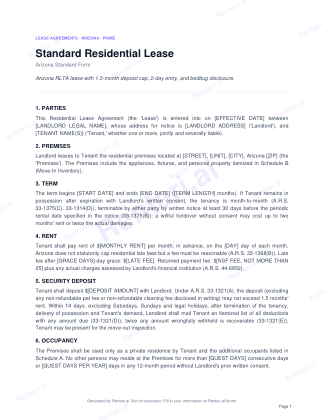
In the Rentari Arizona lease
- Application and screening fees
The lease says a material misstatement or omission in the rental application is a material breach, with the remedies the law allows.
- Owner and manager identity
The Arizona lease prints the manager and owner names and addresses on page one and marks a missing address as not disclosed.
- Security deposit limit
The Rentari Arizona lease states the deposit and the one and one-half months' limit, and counts a refundable pet or cleaning deposit toward that limit.
- Returning the deposit
The Arizona lease states the 14-day deadline excluding weekends and holidays, the first class mail rule, the 60-day dispute window and the double damages.
- Move-in form and inspections
The Arizona lease states these move-in duties, and when a deposit is collected an addendum repeats the tenant's inspection rights; the move-in form itself is not part of the lease package.
- Rent and late fees
The Arizona lease charges the late fee you set after the grace day you choose and says Arizona allows a reasonable late fee in a written lease with no statutory amount.
- Returned payment fee
The Arizona lease charges the lesser of the fee you set and $25, plus your bank's actual charges, for a dishonored check or electronic payment.
- Landlord entry
The Arizona lease requires two days' notice, or the longer period you set, except in an emergency or where impracticable, and treats a tenant's repair request as permission to enter for it.
- Repairs and habitability
The Arizona lease states your repair and supply duties and requires the tenant to report needed repairs in writing.
- Tenant repair remedies
The Arizona lease states the 10-day and 5-day notices, the repair-and-deduct limits and steps, and the essential services remedies.
- Locks and security devices
The lease requires you to provide working exterior locks, bars the tenant from rekeying without your written permission, and states the victim's new-lock right.
- Retaliation
The Arizona lease states the protected acts, the six-month presumption, that the prohibition is not limited to that period, and the exceptions.
- Ending a month-to-month tenancy
The Arizona lease states the 30-day and 10-day periods and the holdover damages.
- Ending a lease early
The Arizona lease states the domestic violence, sexual assault and law enforcement officer termination rights, and a federal servicemember termination clause.
- Notice for unpaid rent
The Arizona lease states the five-day notice, the reinstatement right and that days are calendar days.
- Notice for lease violations
The Arizona lease states the 10-day and 5-day cure periods, the second-noncompliance rule and immediate termination for an irreparable breach.
- Eviction process
The Arizona lease sends disputes to justice court or superior court as the amount allows and says an eviction for nonpayment or breach is a special detainer action.
- Abandonment and property left behind
The lease says property left behind is handled as the law requires and does not authorize self-help repossession.
- Bedbugs
Every Arizona lease attaches bedbug educational information and states only what you reported about bedbug history.
- Partial payments and waiver
The Arizona lease states these partial payment and waiver rules.
- Lease terms Arizona prohibits
The Arizona lease has no indemnity or liability waiver and states the tenant's own duties for damage and guests instead.
Arizona numbers the lease follows
- Deposit refund deadline
- 14 business days
- after move-out, return of possession and the tenant's request
- A.R.S. § 33-1321(D)
- Late fee grace period
- None set
- no state grace period or fee cap; the fee must be in a written lease
- A.R.S. § 33-1368(B)
- Notice for unpaid rent
- 5 days
- calendar days after written notice
- A.R.S. § 33-1368(B)A.R.S. § 33-1368(G)
- Ending a month-to-month tenancy
- 30 days
- before the rental date named in the notice
- A.R.S. § 33-1375(B)
- Rent increase notice
- Check tenancy terms
- monthly termination procedure: 30 days before a rental date
- A.R.S. title 33, chapter 10A.R.S. 33-1375(B)
From the Arizona lease
ARIZONA RESIDENTIAL LEASE AGREEMENT
Tenant deposits [Security deposit]. Landlord may not demand or receive security, however denominated, including prepaid rent, of more than one and one-half (1.5) months' rent; a refundable pet or cleaning deposit is security and counts toward that limit. Tenant may voluntarily pay more than one and one-half months' rent in advance.
Security deposit limitA.R.S. § 33-1321(A)
Except in an emergency or where it is impracticable, Landlord shall give Tenant at least two (2) days' notice of intent to enter and shall enter only at reasonable times. A maintenance or service request from Tenant is permission to enter to act on that request, without separate notice (33-1343(B)).
Entry noticeA.R.S. § 33-1343(B) A.R.S. § 33-1343(D)
For any check or electronic payment from Tenant that is dishonored, Tenant shall pay a service fee of [Returned payment fee, up to $25] plus any actual charges Landlord's financial institution assesses because of the dishonored payment.
Returned check feeA.R.S. § 44-6852
Arizona lease types
Pick 3, 6, 12, 18 or 36 months or your own dates. At the end, the lease ends or converts to month-to-month.
Standard lease guideEnding a month-to-month tenancy: 30 days, before the rental date named in the notice.
Arizona month-to-month leaseUpload a lease you already use: send an unsigned one for e-signature, or store one that is already signed.
Rooms use the Arizona lease for now: add the room as its own unit and set house rules with the optional addenda.
Arizona room rentalBefore you sign
Application and screening fees
The Act sets no limit on application or screening fees. A fee you mean to keep must be designated nonrefundable with its purpose stated in writing, or it is refundable.
A.R.S. § 33-1321(B) A.R.S. title 33, chapter 10
- Materially false information on the application (such as the number of occupants, pets, income, social security number or employment) is a material noncompliance you can act on with a 10-day notice. False information about criminal records, prior evictions or current criminal activity cannot be cured. A.R.S. § 33-1368(A) See Notice for lease violations on the Arizona page
- The property-management record rule applies to property management firms. It covers residential leases and related documents, which may include applications identifying the tenant, for one year after the lease expires or until those records are given to the owner when the management agreement ends. Financial records have a separate minimum three-year period from execution. This section does not set a general one-year period running from every rejected application; confirm the rules that apply to your role and record type. A.R.S. 32-2175(A), (C)
The lease says a material misstatement or omission in the rental application is a material breach, with the remedies the law allows.
Fair housing
Arizona law bars refusing to rent to, or setting different terms for, anyone because of race, color, religion, sex, familial status, national origin or disability. Refusing a reasonable accommodation in rules, policies, practices or services (such as an assistance animal under a no-pets rule), or a reasonable modification at the tenant's expense, that a person with a disability may need is also discrimination.
A.R.S. § 41-1491.14 A.R.S. § 41-1491.19
- Familial status covers pregnancy and living with a child under 18 as parent, custodian or with written permission. A.R.S. § 41-1491.01
- Knowingly refusing to rent because a person has children, or advertising a no-children restriction, is a petty offense with civil remedies, except in qualifying housing for older persons. An occupancy limit of two persons per bedroom is presumed reasonable. A.R.S. § 33-1317
- You are not liable for injuries or damages caused by an assistance or service animal you allow as a reasonable accommodation or modification. A.R.S. § 41-1491.38
Required disclosures
At or before the tenancy starts, disclose in writing the name and address of the manager and of the owner or the owner's agent for service and notices, and tell the tenant in writing that the Act is on the Arizona Department of Housing's website. State the purpose of every nonrefundable fee in writing and give the move-in form and move-out inspection notice.
A.R.S. § 33-1322(A) A.R.S. § 33-1322(B) A.R.S. § 33-1321(B) A.R.S. § 33-1321(C)
- Except for a single family residence, give existing and new tenants bedbug educational materials, and do not lease a unit you know has a current bedbug infestation. A.R.S. § 33-1319(A) A.R.S. § 33-1319(D) See Bedbugs on the Arizona page
- If you rent a home with a swimming pool or other contained body of water, give the tenant the pool safety notice approved by the Department of Health Services. A.R.S. § 36-1681(E)
- If a foreclosure action began before the lease was signed, include the written foreclosure notice in substantially the statutory form; if you receive a first notice of trustee's sale or foreclosure later, give it within five business days. This does not apply to buildings of four or more connected units. A.R.S. § 33-1331
- Where a smoke detector was installed in a new or remodeled unit under the state rule, give the tenant written notice of the tenant's duty to maintain it. A.R.S. § 36-1637(C) See Smoke detectors on the Arizona page
- If you bill utilities separately, the lease must list the separately charged utilities and any administrative fee, and describe any ratio billing method. A.R.S. § 33-1314.01(B) A.R.S. § 33-1314.01(G) See Separately billed utilities on the Arizona page
Flood disclosure
Not set by statuteThe Arizona Residential Landlord and Tenant Act has no flood disclosure requirement.
Owner and manager identity
At or before the tenancy starts, disclose in writing the name and address of the person authorized to manage the premises and of an owner or a person authorized to accept service of process and notices for the owner. Keep it current and give it again when the tenant asks.
A.R.S. § 33-1322(A) A.R.S. § 33-1322(C)
- A person who fails to disclose becomes the landlord's agent for service and notices and for performing the landlord's duties, and a manager who fails to disclose is treated as a landlord. A.R.S. § 33-1322(D) A.R.S. § 33-1310(7)
- With a written lease, deliver a signed copy to the tenant and complete every blank; failing to is a material noncompliance. A.R.S. § 33-1322(E)
The Arizona lease prints the manager and owner names and addresses on page one and marks a missing address as not disclosed.
Deposits, rent and fees
Security deposit limit
You may not demand or receive security, however it is labeled and including prepaid rent, of more than one and one-half months' rent. A tenant may still choose to pay more than one and one-half months' rent in advance.
- Security means money or property given to assure payment or performance under the lease. A reasonable charge for redecorating or cleaning is not security. A.R.S. § 33-1310(15)
- State the purpose of every nonrefundable fee or deposit in writing. Any fee or deposit not designated as nonrefundable is refundable. A.R.S. § 33-1321(B)
- A lease term the Act lists as prohibited, such as a waiver of the tenant's rights under the Act, is unenforceable, and deliberately using a lease with a term you know is prohibited lets the tenant recover actual damages and up to two months' rent. A.R.S. § 33-1315(A) A.R.S. § 33-1315(B) See Lease terms Arizona prohibits on the Arizona page
The Rentari Arizona lease states the deposit and the one and one-half months' limit, and counts a refundable pet or cleaning deposit toward that limit.
Returning the deposit
Within 14 days, not counting Saturdays, Sundays or legal holidays, after the tenancy ends, the tenant delivers possession and the tenant asks for it, give the tenant an itemized list of all deductions with any amount due. Mail the list and any refund by first class mail to the tenant's last known residence unless the tenant has arranged otherwise in writing.
- Delivery of possession means returning the keys and vacating the home. A.R.S. § 33-1310(3)
- You may apply the deposit and prepaid rent to unpaid rent, to charges listed in the signed lease or allowed by the Act (subject to your duty to mitigate), and to damage caused by the tenant's failure to meet the tenant's upkeep duties. A.R.S. § 33-1321(D) A.R.S. § 33-1341
- If the tenant does not dispute the list or the amount within 60 days after it is mailed, it becomes final and further tenant claims are waived. A.R.S. § 33-1321(D)
- If you do not comply, the tenant may recover the money due plus damages of twice the amount wrongfully withheld. A.R.S. § 33-1321(E)
- Whoever holds the landlord's interest when the tenancy ends is bound by these rules, and a seller stays liable to the tenant for the deposit. A.R.S. § 33-1321(H) A.R.S. § 33-1325(A)
- When a tenant abandons the home and you retake it under the abandonment procedure, the deposit is forfeited and applied to accrued rent and your reasonable costs. A.R.S. § 33-1370(B) See Abandonment and property left behind on the Arizona page
The Arizona lease states the 14-day deadline excluding weekends and holidays, the first class mail rule, the 60-day dispute window and the double damages.
Deposit account and interest
Partly readThe Arizona Residential Landlord and Tenant Act does not require interest on deposits or a separate deposit account. During the tenancy you may use refundable deposits as any property management agreement provides, and all refundable deposits must be refunded under the deposit return rules when the tenancy ends. The separate trust account rules for licensed real estate brokers were not read for this page.
- The Act, read in full, has no deposit interest requirement. A.R.S. title 33, chapter 10
Move-in form and inspections
At move-in, give the tenant a signed copy of the lease, a move-in form on which the tenant can list existing damage, and written notice that the tenant may be present at the move-out inspection. If the tenant asks, tell the tenant when the move-out inspection will happen.
- You need not hold a joint move-out inspection when the tenant is being evicted for a material and irreparable breach and you have reasonable cause to fear violence or intimidation. A.R.S. § 33-1321(C)
The Arizona lease states these move-in duties, and when a deposit is collected an addendum repeats the tenant's inspection rights; the move-in form itself is not part of the lease package.
Rent and late fees
Arizona sets no maximum late fee and no grace period. The Act refers to a reasonable late fee set forth in a written rental agreement, so put the fee in the lease. Rent is due without demand at the time and place the lease sets; unless it says otherwise, rent is payable at the home at the start of each month.
A.R.S. § 33-1368(B) A.R.S. § 33-1314(C)
- A tenant who pays all past-due rent and the reasonable late fee in the written lease before you file a special detainer action reinstates the lease. A.R.S. § 33-1368(B) See Notice for unpaid rent on the Arizona page
- A judgment for the landlord in a special detainer action includes late charges stated in the rental agreement. A.R.S. § 33-1377(F)
- A tenant may not withhold rent for any reason the Act does not authorize. A.R.S. § 33-1368(B)
- You need not accept a partial payment. Accepting one keeps your right to proceed only if the tenant agrees in a contemporaneous writing that gives the date the balance is due. A.R.S. § 33-1371(A) See Partial payments and waiver on the Arizona page
- Without a rental agreement, the tenant owes the fair rental value of the home. A.R.S. § 33-1314(B)
The Arizona lease charges the late fee you set after the grace day you choose and says Arizona allows a reasonable late fee in a written lease with no statutory amount.
Returned payment fee
For a dishonored check, draft, order or note, you may charge a service fee of no more than $25 plus the actual charges your own bank assessed because of it. The limit applies notwithstanding any other law.
The Arizona lease charges the lesser of the fee you set and $25, plus your bank's actual charges, for a dishonored check or electronic payment.
Rent increases
Not set by statuteThe Act has no separate rent-increase notice provision or general increase cap. During a fixed term, use the rent terms in the lease. For a proposed change to a monthly tenancy, review the agreement and the written termination procedure in A.R.S. 33-1375(B), which requires at least 30 days before the periodic rental date named in the notice. Do not treat the absence of a standalone increase section as permission to impose a change immediately.
A.R.S. title 33, chapter 10 A.R.S. § 33-1375(B)
- Cities and towns may not control rents on private residential property. A.R.S. § 33-1329(A) See Rent control and local rules on the Arizona page
- You may not raise rent in retaliation for a protected complaint or for joining a tenants' union. A.R.S. § 33-1381(A) See Retaliation on the Arizona page
- A new rule adopted after the lease is signed binds the tenant only after 30 days' notice and only if it does not substantially modify the lease. A.R.S. § 33-1342(B)
- Keep the exact notice and proof of delivery. A.R.S. 33-1313(B) addresses hand delivery and registered or certified mail to the tenant’s designated notice address or, absent one, last known residence. For registered or certified mail, receipt is the earlier of actual receipt or five days after mailing. Work from the applicable receipt date when planning the notice period; a mailing date, text, portal alert or email alone does not establish that every service requirement was met. A.R.S. 33-1313(B)
- Confirm which housing law and program governs the rental before using a general notice. Arizona’s courts distinguish ordinary rental units, public housing and tenant-owned mobile homes. The local rent-control preemption also has an express exception for residential property owned, financed, insured or subsidized by a state agency, city or town; it does not remove every program restriction. Arizona courts: which housing law applies A.R.S. 33-1329(B)
During the tenancy
Landlord entry
Except in an emergency or where it is impracticable, give the tenant at least two days' notice of your intent to enter and enter only at reasonable times. The tenant may not unreasonably refuse entry to inspect, make necessary or agreed repairs or improvements, supply services, or show the home to buyers, lenders, tenants, workers or contractors.
A.R.S. § 33-1343(A) A.R.S. § 33-1343(D)
- A tenant's written service or maintenance request is permission to enter to act on that request, and the tenant waives any separate entry notice for it. A.R.S. § 33-1343(B)
- You may enter without consent in an emergency. A.R.S. § 33-1343(C)
- Do not abuse the right of access or use it to harass the tenant. Apart from a court order, the tenant's failure-to-maintain and abandonment procedures, or abandonment or surrender, you have no other right of access. A.R.S. § 33-1343(D) A.R.S. § 33-1343(E)
- For an unlawful or unreasonable entry, or repeated harassing demands, the tenant may get an injunction or end the lease and recover actual damages of at least one month's rent. A tenant who refuses lawful access faces an injunction, termination and actual damages. A.R.S. § 33-1376
The Arizona lease requires two days' notice, or the longer period you set, except in an emergency or where impracticable, and treats a tenant's repair request as permission to enter for it.
Repairs and habitability
You must comply with building codes materially affecting health and safety, make all repairs needed to keep the home fit and habitable, keep common areas clean and safe, keep supplied electrical, plumbing, sanitary, heating, ventilating and air-conditioning facilities and appliances in good working order, provide for trash removal, and supply running water, reasonable hot water, and reasonable heat and air-conditioning or cooling where installed and offered.
- In a single family residence, you and the tenant may agree in writing, for adequate consideration and in good faith, that the tenant handles trash, utilities, and specified repairs or maintenance, but not work needed to cure a code or habitability problem. A.R.S. § 33-1324(C)
- In other dwellings, such an agreement for specified repairs or maintenance must be in a separate signed writing, in good faith and for adequate consideration, and may not reduce your duties to other tenants. A.R.S. § 33-1324(D)
- The tenant must keep the home clean and safe, use appliances reasonably, not damage the premises, not disturb neighbors, and promptly notify you in writing of anything needing repair. A.R.S. § 33-1341
- If a tenant's failure to maintain materially affects health and safety and can be fixed by repair, replacement or cleaning, you may do the work after 14 days' written notice (or sooner in an emergency) and bill its reasonable cost as rent on the next due date. A.R.S. § 33-1369
- A lease or other document may not let anyone collect rent free of the duty to keep the home fit. A.R.S. § 33-1316
- Fire or casualty that substantially impairs the home lets the tenant vacate and end the lease by written notice within 14 days, or, if still lawful, vacate the unusable part and pay reduced rent. A.R.S. § 33-1366(A)
The Arizona lease states your repair and supply duties and requires the tenant to report needed repairs in writing.
Tenant repair remedies
If you materially fail to comply with the lease, the tenant may give written notice that the lease ends at least 10 days after you receive it unless you fix the breach in 10 days; for a failure to keep the home fit that materially affects health and safety, the period is 5 days. The tenant may also recover damages and get an injunction.
A.R.S. § 33-1361(A) A.R.S. § 33-1361(B)
- Repair and deduct: if a repair costs less than $300 or half the monthly rent, whichever is greater, the tenant may give written notice and, if you do not act within 10 days (or as promptly as an emergency requires), have a licensed contractor do the work and deduct its actual reasonable cost from rent after giving you an itemized statement and a waiver of lien. A.R.S. § 33-1363(A)
- If you deliberately or negligently fail to supply water, gas or electricity, hot water, heat, air-conditioning or cooling where installed and offered, or essential services, the tenant may, after reasonable notice, buy reasonable amounts of water, hot water, heat and essential services and deduct the cost from rent, recover damages for the lost rental value, or move to substitute housing and pay no rent meanwhile. A.R.S. § 33-1364(A)
- In a nonpayment eviction or a suit for rent, the tenant may counterclaim for your noncompliance, and the court may order rent paid into court. A.R.S. § 33-1365
- None of these remedies applies to a condition the tenant, the tenant's family or a guest caused. A.R.S. § 33-1361(A) A.R.S. § 33-1363(B) A.R.S. § 33-1364(H)
The Arizona lease states the 10-day and 5-day notices, the repair-and-deduct limits and steps, and the essential services remedies.
Locks and security devices
The Act sets no general rule on locks or rekeying between tenants. Its one lock rule: a tenant who is a victim of domestic violence or sexual assault may require you to install a new lock at the tenant's cost, by rekeying a working lock or replacing it with one of equal or better quality.
A.R.S. § 33-1318(E) A.R.S. title 33, chapter 10
- You may keep a key to the new lock and may refuse a key to the person named in the protective order or report. A.R.S. § 33-1318(F)
- If a tenant named in an order of protection has been served with it and you have received a copy, you must refuse that tenant access to the home to reclaim property unless a law enforcement officer escorts the tenant in and out. A.R.S. § 33-1318(G)
The lease requires you to provide working exterior locks, bars the tenant from rekeying without your written permission, and states the victim's new-lock right.
Smoke detectors
An approved smoke detector must be installed in every new residential unit and in an existing unit when a sleeping area is remodeled under a permit. The tenant keeps such a detector working unless the tenant gives you written notice that it malfunctions, and then you must repair it.
A.R.S. § 36-1637(A) A.R.S. § 36-1637(B)
- Give the tenant written notice of the tenant's smoke detector responsibilities. A.R.S. § 36-1637(C)
Retaliation
You may not raise rent, cut services, or bring or threaten an action for possession because the tenant complained to a code enforcement agency about a health and safety violation, complained to you about a failure to keep the home fit, organized or joined a tenants' union, or complained to a government agency enforcing the wage-price stabilization act.
- A complaint within six months before the alleged retaliation creates a presumption of retaliation, unless the tenant complained after receiving a termination notice. A.R.S. § 33-1381(B)
- The tenant has a defense to eviction and may recover possession or end the lease and recover up to two months' rent or twice actual damages, whichever is greater. A.R.S. § 33-1381(B) A.R.S. § 33-1367
- You may still sue for possession if the tenant is in default in rent or the code violation was caused mainly by the tenant's household or guests. A.R.S. § 33-1381(C)
The Arizona lease states the protected acts, the six-month presumption, that the prohibition is not limited to that period, and the exceptions.
Lockouts and utility shutoffs
You may not take possession by removing the tenant or the tenant's belongings or by interrupting electric, gas, water or other essential service, except after abandonment, surrender or as the Act permits.
- For an unlawful ouster or willful interruption of essential service, the tenant may recover possession or end the lease, and recover up to two months' rent or twice actual damages, whichever is greater. A.R.S. § 33-1367
- You may not shut off utilities you provide under the lease except to make needed repairs or after a writ, and you may not shift a utility bill to the tenant after signing without the tenant's written consent. A.R.S. § 33-1364(B) A.R.S. § 33-1364(C)
- After a writ of restitution is executed, you may discontinue utilities you provide on the following day, but only through a person the utility authorizes. A.R.S. § 33-1368(D)
- Distraint for rent is abolished, and a landlord lien on household goods is not enforceable. A.R.S. § 33-1372
Ending a tenancy
Ending a month-to-month tenancy
Either side may end a month-to-month tenancy by written notice given at least 30 days before the periodic rental date named in the notice. A week-to-week tenancy needs written notice at least 10 days before the termination date.
A.R.S. § 33-1375(A) A.R.S. § 33-1375(B)
- Without a definite term, a tenancy is week-to-week for a roomer paying weekly rent and month-to-month in every other case. A.R.S. § 33-1314(D)
- A tenant who stays after the lease ends without your consent may be sued for possession; if the holdover is willful and not in good faith, you may also recover up to two months' rent or twice your actual damages, whichever is greater. If you consent in writing to the tenant staying, the tenancy becomes month-to-month. A.R.S. § 33-1375(C)
The Arizona lease states the 30-day and 10-day periods and the holdover damages.
Ending a lease early
A tenant who is a victim of domestic violence, or of sexual assault in the home, may end the lease by written notice asking for release on a mutually agreed date within the next 30 days, with a copy of a protective order or a law enforcement report. The events must have occurred within the 30 days before the notice unless you waive that.
A.R.S. § 33-1318(A) A.R.S. § 33-1318(C)
- For a qualifying termination under 33-1318, the tenant owes rent through the termination date plus earlier outstanding obligations, payable by the day they vacate, and owes no early termination fee. However, the landlord may retain prepaid rent for the month in which the lease ends without a refund. The deposit may not be withheld for the early termination itself, but may cover damages from the tenant's failure to comply with 33-1341. A.R.S. § 33-1318(A) A.R.S. § 33-1318(D)
- A law enforcement officer protected by an injunction against harassment issued within the 30 days before notice may end a lease the same way, after repaying any lease concession received. A.R.S. § 33-1318.01
- When a tenant abandons the home, you must make reasonable efforts to rent it at a fair rental; the old lease ends when a new tenancy begins, and if you do not try to re-rent or you accept the abandonment as a surrender, the lease is treated as ended by you on the date you learned of the abandonment. A.R.S. § 33-1370(C)
- If the owner has not registered the rental with the county assessor, the tenant may give a 10-day notice to comply and then end the lease, with prepaid rent returned. A.R.S. § 33-1902(C) See Rental registration with the county assessor on the Arizona page
- Every party has a duty to mitigate damages. A.R.S. § 33-1305(A)
- When multiple tenants signed a lease terminated under 33-1318, the tenancy also ends for the other signers. Nonvictim tenants other than the person named in the protective order or report that caused termination may be released from the old agreement's financial obligations. Remaining tenants may enter a new lease if they meet the landlord's current application requirements; a replacement lease or financial release is not automatic. A.R.S. section 33-1318(J)
The Arizona lease states the domestic violence, sexual assault and law enforcement officer termination rights, and a federal servicemember termination clause.
Notice for unpaid rent
If rent is unpaid when due, give written notice of the nonpayment and of your intention to terminate the lease if rent is not paid. If the tenant does not pay within five calendar days after the notice, you may terminate by filing a special detainer action.
A.R.S. § 33-1368(B) A.R.S. § 33-1368(G)
- Before you file, the lease is reinstated if the tenant tenders all past-due rent and a reasonable late fee set forth in a written lease. After filing, reinstatement also requires attorney fees and court costs. After judgment for you, reinstatement is your choice. A.R.S. § 33-1368(B)
- A notice is received when delivered in hand or mailed by registered or certified mail; a mailed notice counts as received on actual receipt or five days after mailing, whichever is first. A.R.S. § 33-1313(B)
- If you gave the nonpayment notice before a written partial payment agreement, you need no new notice if the tenant breaks that agreement. A.R.S. § 33-1371(A)
- No court or agency may require a particular form for the notice; a notice with the content the statute requires is enough. A.R.S. § 33-1305(C)
The Arizona lease states the five-day notice, the reinstatement right and that days are calendar days.
Notice for lease violations
For a material noncompliance, give written notice naming the breach and stating that the lease will end on a date at least 10 days after the tenant receives it unless the breach is fixed within 10 days. For a failure of the tenant's upkeep duties that materially affects health and safety, the period is five days.
- If the same or a similar breach happens again during the lease, you may file a special detainer action 10 days after written notice that a second noncompliance has occurred. A.R.S. § 33-1368(A)
- For a material and irreparable breach on the premises, such as an illegal discharge of a weapon, serious violent crime, drug activity, or conduct that jeopardizes others' health and safety or threatens serious property damage, you may give written notice of immediate termination and file a special detainer action. A.R.S. § 33-1368(A) A.R.S. § 33-1377(E)
- The tenant is responsible for guests' lease violations the tenant could reasonably have foreseen and did not try to prevent. A.R.S. § 33-1368(F)
- Accepting rent with knowledge of a default waives the right to terminate for that breach, except under a contemporaneous written partial payment agreement or a housing assistance payment. A.R.S. § 33-1371(C) See Partial payments and waiver on the Arizona page
The Arizona lease states the 10-day and 5-day cure periods, the second-noncompliance rule and immediate termination for an irreparable breach.
Eviction process
Partly readEviction for nonpayment or breach is a special detainer action in justice court or superior court. The summons issues when the complaint is filed and sets an appearance three to six days later, and it must be served at least two days before the return day. The court rules for eviction cases were not read for this page.
A.R.S. § 33-1377(A) A.R.S. § 33-1377(B) A.R.S. § 22-201(C)
- For a material and irreparable breach, trial is set no later than the third day after filing, and restitution is ordered 12 to 24 hours after a finding for you. A.R.S. § 33-1377(E)
- Trial may be postponed for good cause by no more than three days in justice court or five in superior court. A.R.S. § 33-1377(C)
- A judgment for you covers possession, late charges in the lease, costs and, at your option, rent due through the rental period. No writ of restitution issues until five calendar days after judgment. A.R.S. § 33-1377(F) A.R.S. § 12-1178(C)
- For covered eviction actions, the court seals the records when it dismisses the case before judgment or enters judgment for the tenant. The court also seals the case when the landlord and tenant file a written stipulation to set aside the eviction order and seal the file. A private agreement alone is not the court order. The statute limits access to sealed records and prohibits the court and record custodian from transferring them to third parties individually or in bulk. Check the actual disposition and sealing order, and resolve a stale or mismatched report entry before relying on it; a record appearing in a screening report does not itself establish that its use is lawful. A.R.S. § 33-1379
- After an eviction judgment is paid in full, file a satisfaction of judgment within 40 days. If you do not respond within 15 days after a tenant's motion to compel it is filed and served, the judgment is deemed satisfied on the tenant's proof of payment and the court may seal the eviction records. A.R.S. § 22-247(A) A.R.S. § 22-247(E) A.R.S. § 12-1567(A) A.R.S. § 12-1567(E) A.R.S. § 33-1379
- A lease may award attorney fees only to the prevailing party, and a prevailing party in a contested eviction may get fees either way. A.R.S. § 33-1315(A)
The Arizona lease sends disputes to justice court or superior court as the amount allows and says an eviction for nonpayment or breach is a special detainer action.
Abandonment and property left behind
A home is abandoned when the tenant has been absent without notice for at least seven days with rent unpaid for 10 days and no sign of occupancy other than belongings, or absent for at least five days with rent unpaid for five days and no belongings left. Send a notice of abandonment by certified mail, return receipt requested, to the tenant's last known address and every alternate address you know, and post it on the door or another conspicuous place for five days; five days after it is both posted and mailed, you may retake the home.
A.R.S. § 33-1370(J) A.R.S. § 33-1370(A) A.R.S. § 33-1370(B)
- If belongings remain, make an inventory, notify the tenant of where they are and the storage cost, and hold them for 14 calendar days with reasonable care. After that you may donate, sell or, if their value is too low, dispose of them, applying sale proceeds to what the tenant owes and mailing any excess. A.R.S. § 33-1370(D) A.R.S. § 33-1370(F)
- Before the sale, a tenant who gives written notice has five days to reclaim the property by paying removal and storage costs, and may always obtain clothing, work tools, and identification and financial documents. A.R.S. § 33-1370(F) A.R.S. § 33-1370(H)
- For 12 months after a sale, keep adequate records of the unpaid rent and the sale, and hold for the tenant any excess proceeds returned as undeliverable. A.R.S. § 33-1370(G)
- Perishables and plants may be disposed of; animals may be released to a shelter after one day's notice to any person the tenant authorized, or cared for. A.R.S. § 33-1370(E)
- If the tenant returned the keys, you may remove and dispose of property left behind right away unless you agreed otherwise in writing. A.R.S. § 33-1370(I)
- After a writ of restitution is executed, the same inventory, storage and sale rules apply to the tenant's property. A.R.S. § 33-1368(E)
- You may ask the tenant for a person authorized to retrieve belongings and animals if the tenant dies or is incapacitated. A.R.S. § 33-1314(E)
The lease says property left behind is handled as the law requires and does not authorize self-help repossession.
Small claims
The small claims division of justice court hears claims of up to $5,000, not counting interest and costs, such as many deposit disputes. It does not hear eviction cases.
A.R.S. § 22-503(A) A.R.S. § 22-503(B)
- Justice courts hear civil cases of $10,000 or less, not counting interest, costs and awarded attorney fees. A.R.S. § 22-201(B)
More Arizona rules
Rental registration with the county assessor
Keep on file with the county assessor the owner's name, address and phone, the property's street address and parcel number and the year built, and, if an entity owns it, the name, address and phone of a corporate officer, managing or administrative member, general partner, trustee or REIT partner or officer, and update it within 10 days of a change. An owner living outside Arizona must designate an in-state statutory agent. A rental may not be occupied until the information is on file.
A.R.S. § 33-1902(A) A.R.S. § 33-1902(B) A.R.S. § 33-1902(C)
- If you have not filed, the tenant may give a 10-day notice to comply and then end the lease, with prepaid rent returned within 10 days. A.R.S. § 33-1902(C)
- For a newly acquired rental that is not registered, the city or town must assess a $1,000 civil penalty plus $100 for each month until you comply; for any other unregistered rental it may impose $150 a day. The court dismisses the complaint if you comply within 10 days after receiving the complaint or the assessor's notice. A.R.S. § 33-1902(E) A.R.S. § 33-1902(F) A.R.S. § 33-1902(G)
Bedbugs
Except for a single family residence, give existing and new tenants bedbug educational materials and do not lease a unit you know has a current bedbug infestation. A tenant may not knowingly move infested items in and must notify you in writing or electronically of bedbugs.
Every Arizona lease attaches bedbug educational information and states only what you reported about bedbug history.
Partial payments and waiver
You need not accept a partial payment. If you do, you keep the right to proceed against the tenant only if the tenant signs a contemporaneous written agreement on the partial payment that states when the balance is due. Otherwise, accepting rent with knowledge of a default waives the right to terminate for that breach.
- Accepting a housing assistance payment is not a partial payment and does not waive your right to terminate. A.R.S. § 33-1371(B)
The Arizona lease states these partial payment and waiver rules.
Separately billed utilities
You may bill gas, water, wastewater, trash or electricity separately by submetering or a ratio billing system, recovering only the provider's charges plus an administrative fee for actual costs. The lease must list each separately charged utility and the fee, and a ratio method must be described specifically in the lease.
A.R.S. § 33-1314.01(A) A.R.S. § 33-1314.01(B) A.R.S. § 33-1314.01(G)
- Allowed ratio methods include per tenant, by livable square footage, by unit type, by water fixtures, by submetered hot water use, or another fair method described in the lease. A.R.S. § 33-1314.01(F)
- Each bill must show the charges, meter readings and dates, and the administrative fee. You may start separate billing during a lease term only if the lease provides for it and you give an existing tenant at least 90 days' notice, and a utility the lease provides may not be shifted to the tenant after signing without the tenant's written consent. A.R.S. § 33-1314.01(C) A.R.S. § 33-1314.01(E) A.R.S. § 33-1314.01(G) A.R.S. § 33-1364(C)
Lease terms Arizona prohibits
A lease may not make the tenant waive rights under the Act, pay your attorney fees (except a prevailing party clause), accept limits on your legal liability or indemnify you for it, or give up or be penalized for calling police or emergency help.
- A prohibited term is unenforceable, and knowingly using one lets the tenant recover actual damages and up to two months' rent. A.R.S. § 33-1315(B)
- A court may refuse to enforce an unconscionable lease term. A.R.S. § 33-1312
The Arizona lease has no indemnity or liability waiver and states the tenant's own duties for damage and guests instead.
Occupancy and adverse possession
Partly readAn unwanted occupant, a tenant and a person claiming ownership present different questions. Adverse possession requires an actual, visible claim to land that conflicts with another person’s rights; simply staying in a home does not establish ownership. Identify the agreement, permission and claim before choosing a removal process.
A.R.S. 12-521: adverse and peaceable possession Arizona Courts: unwanted occupants
- A rental agreement can be oral. Arizona Courts explains that agreeing to pay rent, including through work or things of value, can establish a tenancy even without a signed lease. The tenant-guest provision addresses a guest not named on a written lease who remains without the tenant’s or landlord’s permission; it does not make every unwanted person the same kind of occupant. Do not rely on a fixed number of days alone to decide status. Arizona Courts: unwanted occupants
- Arizona has different limitation periods for recovering land, with different requirements. Selected examples are three years for possession under title or qualifying color of title, five years with the required recorded deed, tax payments and use, and ten years for the specified peaceable adverse possession and use. These are not automatic ownership deadlines: title, continuity, land area and other conditions matter, and the statutory definition of color of title is more specific than any document that looks official. A.R.S. 12-521: adverse and peaceable possession A.R.S. 12-523 A.R.S. 12-525 A.R.S. 12-526
- Check the current court route for the actual relationship and claim. Arizona Courts identifies unauthorized occupants among situations using the general eviction statutes; an eviction proceeding decides actual possession rather than ownership title. Use the applicable notice, filing, service and enforcement procedure instead of assuming one five-day timeline fits every case. Preserve the tenant protections in the lockout topic, and have the sheriff or constable execute a court writ when that is the required route. Arizona Courts: general eviction proceedings See Lockouts and utility shutoffs on the Arizona page
- Keep the deed, lease or permission records, payment history, dated observations, photographs, communications and any court papers together. For vacant property, maintain secure entry points and arrange lawful periodic checks. Document a problem promptly without confronting occupants or disturbing possessions. Where permission, a claimed tenancy or ownership is disputed, get the claim and correct procedure assessed before taking action. Arizona Courts: unwanted occupants Arizona Courts: general eviction proceedings
Local rules
Rent control and local rules
The state preempts rent control: cities, including charter cities, and towns may not control rents on private residential property. The ban does not reach property owned, financed, insured or subsidized by a state agency, city or town.
- Owners must record each rental with the county assessor, and cities and towns may impose civil penalties for failing to. A.R.S. § 33-1902 See Rental registration with the county assessor on the Arizona page
Cities and towns may not control rents, but they have their own building, housing, fire and other codes that can add duties for rental property. No city or county code was read for this page, so no local rule is listed here; check the codes where the property is located.
Arizona lease renewals
Read the agreement's renewal clause and the notice rules above before choosing a new term, changing rent or ending the tenancy. A fixed end date does not override applicable renewal rights, rent regulation, just-cause rules or protections against retaliation and discrimination.
Confirm the notice, timing and delivery requirements for the rental's state and locality. Review any required new disclosures and attachments when preparing the renewal. Get the parties' agreement to changed terms in writing.
Customize an unsigned agreement or prepare an addendum to an existing lease.
How it works
- Add your Arizona rental
Enter the property and its units.
- Set the terms
Choose the rental, add tenants, and set rent, deposit and fees.
- Review the lease
Preview and edit the Arizona lease and its addenda.
- Send for e-signature
Tenants sign online; sending is included on paid plans.
Follow the full lease builder guide, add supporting files, or download and print the agreement.
Arizona lease questions
Does the Rentari Arizona lease include the owner and manager disclosure?
Yes. Page one names the manager and the owner or the owner's agent with their addresses and says the Act is on the Arizona Department of Housing's website. If an address is missing it prints as not disclosed, so add it before signing.
What notice periods does the Arizona lease use?
Five calendar days after written notice for unpaid rent, 10 days to fix another material breach (five for a health and safety breach), two days before entry, and 30 days before a rental date to end a month-to-month tenancy.
A.R.S. § 33-1368(A) A.R.S. § 33-1368(B) A.R.S. § 33-1343(D) A.R.S. § 33-1375(B)
How does the Arizona lease handle a bounced payment?
It charges the lesser of the fee you set and $25, plus your bank's actual charges for the dishonored payment.
Does the lease cover a home with a pool?
When you report a pool, the lease adds a pool safety box and addendum, but the Department of Health Services' approved notice is not included. Give the tenant that notice separately.
Can I send the Arizona lease for electronic signature?
Yes, e-signature sending is included on paid plans. Arizona requires you to deliver a signed copy to the tenant and to complete every blank in a written lease.