- Home
- Lease agreement
- Idaho
Idaho residential lease agreement
State rules checked October 1, 2026 General information, not legal advice
Jump to a topic
Idaho lease document preview
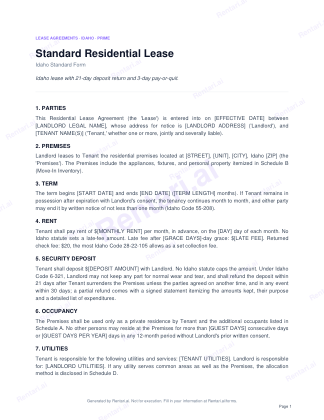
In the Rentari Idaho lease
- Fair housing
The lease says the landlord follows fair housing law and lets a tenant with a disability request a reasonable accommodation or modification at any time.
- Required disclosures and lease language
The lease carries a boxed summary of Idaho tenant rights on repairs, the deposit, termination notices and entry.
- Security deposit limit
The Idaho lease states the deposit amount and says no Idaho statute caps it.
- Returning the deposit
The lease repeats the 21-day deadline, the 30-day outer limit, the ban on keeping any part for normal wear and tear, and the signed itemized statement for a partial refund.
- Deposit account and interest
The lease says a deposit for premises managed by a third-party manager is kept in a separate account at a federally insured institution.
- Move-in condition
The lease has the tenant accept the home as documented in any move-in condition report and report pre-existing damage in writing within seven days of move-in.
- Rent payments and late fees
The lease states the late charge and the day after which it applies, and says no Idaho statute sets a late-fee amount.
- Returned payment fee
The lease caps its collection fee for a dishonored check or other payment at $20.
- Landlord entry
The Idaho lease says no statute sets an entry-notice period and, as a lease term, requires at least 24 hours' notice (or the period the landlord sets) before a non-emergency entry, at reasonable times.
Idaho Code title 6, ch. 3 Idaho Code title 55, ch. 2 Idaho Code title 55, ch. 3
- Repairs and habitability
The lease states the landlord's duties from the statute, the tenant's three-day notice before suing, and the smoke detector rule.
- Tenant repair remedies
The lease gives the three-day notice, the smoke detector install-and-deduct rule, and says the statute gives no other right to repair and deduct.
- Locks and security devices
The lease has the landlord provide keys at move-in and bars the tenant from adding or changing a lock without written consent, except as the law permits.
Idaho Code title 6, ch. 3 Idaho Code title 55, ch. 2 Idaho Code title 55, ch. 3
- Smoke alarms
The lease requires the landlord to install approved smoke detectors and verify them at the start, has the tenant maintain them, and states the 72-hour install-and-deduct rule.
- Retaliation
As a lease term, the lease bars the landlord from taking adverse action against the tenant for exercising rights or reporting code violations.
Idaho Code title 6, ch. 3 Idaho Code title 55, ch. 2 Idaho Code title 55, ch. 3
- Lockouts and utility shutoffs
The lease says the landlord may not change locks or exclude the tenant except through the judicial process the law requires.
- Ending a month-to-month tenancy
Either party may end a month-to-month tenancy by written notice of not less than one month.
- Ending a fixed-term lease early
The lease includes the federal servicemember termination right and says it gives no early-termination right for domestic violence beyond the landlord's written agreement or applicable law.
- Notice for unpaid rent
The lease describes the three-day notice, including the 72-hour statement and the attorney-fee statement.
- Notice for other lease violations
The lease gives three days to perform or give up possession for a breach other than rent, and says controlled-substance activity on the premises is grounds for an unlawful detainer action.
- Eviction process
The lease says an unlawful detainer action is brought in the district court of the county, which may assign it to a magistrate, and describes the shielding of dismissed eviction records.
- Property left behind
The lease states the 72-hour rule and, if the landlord chooses, a storage period for property left after abandonment as a lease term.
Idaho numbers the lease follows
- Deposit refund deadline
- 21 days
- after surrender, or the time the lease fixes, never over 30 days
- Idaho Code § 6-321(2)
- Late fees
- Must be reasonable
- no set cap or grace period; a fee not in a written agreement needs 30 days' written notice
- Idaho Code § 55-305
From the Idaho lease
IDAHO RESIDENTIAL LEASE AGREEMENT
The refund is due within twenty-one (21) days after surrender unless the parties agreed on another time, and in any event within thirty (30) days; a partial refund must be accompanied by a signed statement itemizing the amounts kept, their purpose and a detailed list of expenditures.
Deposit refundIdaho Code § 6-321(2)
If rent is unpaid, Landlord may serve a three (3) day written notice stating the amount due and requiring payment or possession; the notice must also say that if a court enters judgment against Tenant, Tenant will have seventy-two (72) hours to remove Tenant's belongings before Landlord may remove and dispose of them, and, for Landlord to recover attorney fees, that attorney fees shall be awarded to the prevailing party.
Three-day notice for unpaid rentIdaho Code § 6-303(2) Idaho Code § 6-324
If working smoke detectors are not installed within seventy-two (72) hours after Landlord receives Tenant's certified-mail notice, Tenant may install them and deduct the cost from the next month's rent. Idaho Code 6-320 gives no other right to repair and deduct.
Smoke detectorsIdaho Code § 6-320(a)(6)
Idaho lease types
Pick 3, 6, 12, 18 or 36 months or your own dates. At the end, the lease ends or converts to month-to-month.
Standard lease guideEnding a month-to-month tenancy: 1 month, written notice from either side.
Idaho month-to-month leaseUpload a lease you already use: send an unsigned one for e-signature, or store one that is already signed.
Rooms use the Idaho lease for now: add the room as its own unit and set house rules with the optional addenda.
Idaho room rentalBefore you sign
Application and screening fees
Not set by statuteNo Idaho statute sets a limit on application or screening fees. Idaho Code 55-305 requires fees imposed on a residential tenant to be reasonable and limits fees the rental agreement does not include; it does not say whether it reaches a fee charged to an applicant before any rental agreement exists.
Idaho Code § 55-305 Idaho Code title 6, ch. 3
- Cities and counties may not regulate the fees charged for leasing private residential property. Idaho Code § 55-306 See Rent control and local rules on the Idaho page
- Application forms and screening questions may not indicate a limitation or discrimination based on a protected class. Idaho Code § 67-5909(8)(f) See Fair housing on the Idaho page
- Check an eviction case's current disposition and public-record status when reviewing rental history. For cases filed on or after January 1, 2025, section 6-303A provides shielding without a petition when the entire case was dismissed, no appeal is pending, and either three years have passed since filing or the parties filed a stipulation to shield. A filed case is not the same as a judgment against the applicant. Idaho Code 6-303A(1) See Eviction process on the Idaho page
- Shielding removes records from public viewing subject to Supreme Court rules and the court system's capabilities. Court staff and parties to the case retain access, and a party may separately petition for sealing under court rules. Verify the relevant status rather than assuming the record has been erased or that every screening report is current. Idaho Code 6-303A(2) to (5)
Fair housing
Idaho's Human Rights Act makes it unlawful to discriminate in renting because of race, color, religion, sex, national origin or disability. That covers refusing to rent or negotiate, setting different terms, saying a unit is unavailable when it is not, and ads or application forms that show a preference.
Idaho Code § 67-5909(8) Idaho Code § 67-5902
- The disability rule also protects people without a disability who are associated with a person who has one. Idaho Code § 67-5909
- You must allow a disabled tenant to make reasonable modifications at the tenant's expense. Where reasonable, you may require the tenant to restore the premises at move-out, reasonable wear and tear excepted, and that term must be in the lease. Idaho Code § 67-5909(8)(h)
- The rental rules do not apply to a building with housing for no more than two families when you or a family member live in one of them, or to renting rooms in a home where you or a family member live. Idaho Code § 67-5910(7)
The lease says the landlord follows fair housing law and lets a tenant with a disability request a reasonable accommodation or modification at any time.
Required disclosures and lease language
Idaho's landlord-tenant chapters require no set disclosure form in the lease itself. The statements Idaho law requires appear in the 3-day notice for unpaid rent: the 72-hour belongings statement and, to recover attorney fees, the attorney-fee statement.
Idaho Code § 6-303(2) Idaho Code § 6-324
- If you condition a disabled tenant's modification on restoring the premises, the restoration term must be included in the lease or rental agreement. Idaho Code § 67-5909(8)(h) See Fair housing on the Idaho page
- A fee a written rental agreement does not include needs 30 days' written notice before you charge it, and no fee may exceed the amount the agreement states. Idaho Code § 55-305(2) See Rent payments and late fees on the Idaho page
The lease carries a boxed summary of Idaho tenant rights on repairs, the deposit, termination notices and entry.
Flood disclosure
Not set by statuteNo section of Idaho's landlord-tenant chapters requires a flood disclosure to tenants.
Idaho Code title 6, ch. 3 Idaho Code title 55, ch. 2 Idaho Code title 55, ch. 3
- A tenant may sue if you keep the premises in a condition hazardous to health or safety or fail to provide reasonable waterproofing and weather protection. Idaho Code § 6-320(a)(1) Idaho Code § 6-320(a)(3) See Repairs and habitability on the Idaho page
Owner and manager identity
Not set by statuteNo section of Idaho's landlord-tenant chapters requires you to disclose the owner or manager to the tenant.
Idaho Code title 6, ch. 3 Idaho Code title 55, ch. 2 Idaho Code title 55, ch. 3
- A tenant serves a repair notice on you or your agent, including by leaving it at your usual place of business, so a tenant needs to know where that is. Idaho Code § 6-323 See Tenant repair remedies on the Idaho page
Deposits, rent and fees
Security deposit limit
Not set by statuteIdaho sets no maximum security deposit. Any amount a tenant deposits with you for a purpose other than paying rent counts as a security deposit, whatever the lease calls it.
- Because the definition turns on purpose, money deposited for pets, cleaning or keys is a security deposit under the statute. Whether a charge labelled nonrefundable escapes that definition is not settled by the text. Idaho Code § 6-321(1)
- Cities and counties may not enact or enforce rules that regulate the deposits charged for private residential rentals. Idaho Code § 55-306 See Rent control and local rules on the Idaho page
The Idaho lease states the deposit amount and says no Idaho statute caps it.
Returning the deposit
Refund the deposit within 21 days after the tenant surrenders the home, unless the lease fixes another time, and in every case within 30 days after surrender. You may keep only amounts needed for the contingencies the deposit arrangement specifies, and never any part for normal wear and tear.
Idaho Code § 6-321(1) Idaho Code § 6-321(2)
- A partial refund must come with a signed statement itemizing the amounts kept, the purpose of each, and a detailed list of expenditures made from the deposit. Idaho Code § 6-321(2)
- Normal wear and tear is deterioration from the intended use of the unit without negligence, carelessness, accident, misuse or abuse by the tenant, household members, invitees or guests. Idaho Code § 6-321(1)
- If the property changes owners during the tenancy, the new owner is liable for refunding the deposits. Idaho Code § 6-321(3)
- Failing to return a deposit as the law requires is a ground for a tenant's lawsuit, after the tenant gives you 3 days' written notice demanding it. Damages in that suit may be tripled. Idaho Code § 6-320(a)(4) Idaho Code § 6-320(d) Idaho Code § 6-317 See Tenant repair remedies on the Idaho page
- The clock runs from surrender of the premises. The statute does not tie it to a forwarding address. Idaho Code § 6-321(2)
- Idaho counts a period by excluding the first day and including the last, unless the last day is a holiday (every Sunday is one), in which case it is excluded too. Idaho Code § 73-109 Idaho Code § 73-108
The lease repeats the 21-day deadline, the 30-day outer limit, the ban on keeping any part for normal wear and tear, and the signed itemized statement for a partial refund.
Deposit account and interest
Idaho does not require you to pay interest on a deposit or to hold it in any particular account yourself. A deposit for a home managed by a landlord's third-party manager must be kept in a separate account at a federally insured financial institution, apart from the manager's operating account.
- The separate-account rule does not apply to a property owner, to managers who share members or principals with the owner entity, to a real estate licensee, or to a nonprofit organized under Idaho Code title 30, chapter 30. Idaho Code § 6-321(4)
The lease says a deposit for premises managed by a third-party manager is kept in a separate account at a federally insured institution.
Move-in condition
Not set by statuteNo Idaho statute requires a move-in checklist, inspection report or photographs. The one move-in duty in the landlord-tenant chapters is to verify, when the rental agreement begins, that smoke detectors are installed and working.
Idaho Code title 6, ch. 3 Idaho Code § 6-320(a)(6)
- Deductions from the deposit still cannot cover normal wear and tear, so a record of the starting condition helps you show what changed. Idaho Code § 6-321(1) See Returning the deposit on the Idaho page
The lease has the tenant accept the home as documented in any move-in condition report and report pre-existing damage in writing within seven days of move-in.
Rent payments and late fees
Idaho sets no dollar or percentage cap and no grace period for late fees, but any fee you impose on a residential tenant, including a late fee, must be reasonable. You may not charge a fee above the amount the rental agreement states. A fee the agreement does not include may be charged only if the agreement is oral or, for a written agreement, after you give the tenant 30 days' written notice of the change.
Idaho Code § 55-305(1) Idaho Code § 55-305(2)
- The fee rule applies to rental agreements entered into or renewed on or after July 1, 2023. Idaho Code § 55-305(3)
- The fee rule does not limit the amount of rent you may charge. Idaho Code § 55-305(4)
- If rent falls due on a Sunday or legal holiday, the tenant may pay on the next business day with the same effect. Idaho Code § 73-110 Idaho Code § 73-108
- When rent is unpaid, the notice to pay or leave gives 3 days. Idaho Code § 6-303(2) See Notice for unpaid rent on the Idaho page
The lease states the late charge and the day after which it applies, and says no Idaho statute sets a late-fee amount.
Returned payment fee
For a dishonored check, a set collection fee you are entitled to under a written agreement (or a notice posted at the point of sale) may not exceed $20. Without such a set fee, a drawer who has not paid within 15 days after your notice of dishonor also owes interest at 12 percent a year from dishonor and collection costs of up to $20 or the face amount of the check, whichever is less.
- If you sue on the check after the notice and the 15 days, the court shall award reasonable attorney fees as part of the damages. Idaho Code § 28-22-105
- The section does not apply to a check dishonored because of a justifiable stop payment order. Idaho Code § 28-22-105
- The section speaks of checks. It does not address returned electronic or card payments. Idaho Code § 28-22-105
- Any returned-payment fee must also be reasonable, may not exceed the amount the rental agreement states, and needs 30 days' written notice first if a written agreement does not include it. Idaho Code § 55-305 See Rent payments and late fees on the Idaho page
The lease caps its collection fee for a dishonored check or other payment at $20.
Rent increases
Give the tenant written notice of any rent increase at least 30 days before it takes effect. This applies to every residential lease and overrides the older 15-day rule for month-to-month changes.
- For a month-to-month lease, other terms may be changed by written notice given at least 15 days before the end of the month; the new terms take effect at the end of the month if the tenant stays on. Idaho Code § 55-304(1)
- Adding a fee, fine or other cost that a written rental agreement does not include takes 30 days' written notice, and no fee may exceed the amount the agreement states. Idaho Code § 55-305(2) See Rent payments and late fees on the Idaho page
- Idaho sets no limit on the amount of rent, and cities and counties may not regulate rent for private residential rentals. Idaho Code § 55-305(4) Idaho Code § 55-306 See Rent control and local rules on the Idaho page
During the tenancy
Landlord entry
Not set by statuteNo Idaho statute sets a notice period or conditions for a landlord entering an occupied home. Entry terms come from the lease, so write them in.
Idaho Code title 6, ch. 3 Idaho Code title 55, ch. 2 Idaho Code title 55, ch. 3
- Entering by breaking open doors or windows, or by violence or terror, is forcible entry, and so is turning out the person in possession by force, threats or menacing conduct. Idaho Code § 6-301 See Lockouts and utility shutoffs on the Idaho page
The Idaho lease says no statute sets an entry-notice period and, as a lease term, requires at least 24 hours' notice (or the period the landlord sets) before a non-emergency entry, at reasonable times.
Repairs and habitability
Idaho's landlord-tenant statutes set no general habitability standard, but a tenant may sue you for damages and specific performance if you fail to provide reasonable waterproofing and weather protection, fail to keep the electrical, plumbing, heating, ventilating, cooling or sanitary facilities you supply in good working order, or keep the premises in a condition hazardous to the tenant's health or safety.
- The same action covers failing to return a deposit as required, breaching a lease term that materially affects health and safety (stated or implied), and failing to install approved smoke detectors. Idaho Code § 6-320(a)(4) to (6)
- Before suing, the tenant must give you 3 days' written notice listing each failure and demanding cure. Idaho Code § 6-320(d) See Tenant repair remedies on the Idaho page
- Damages in a successful action may be tripled. Idaho Code § 6-317
- These rules do not apply to agricultural tracts of 5 acres or more. Idaho Code § 6-320(e)
The lease states the landlord's duties from the statute, the tenant's three-day notice before suing, and the smoke detector rule.
Tenant repair remedies
A tenant may sue only after giving you 3 days' written notice listing each failure and demanding performance or cure. If a listed problem is not fixed within 3 days after service, the tenant may sue for damages and specific performance. The only repair-and-deduct right in the statute is for smoke detectors.
Idaho Code § 6-320(d) Idaho Code § 6-320(a)(6)
- The tenant serves the notice by handing it to you or your agent, by leaving it with an employee at your usual place of business when you are absent, or by certified mail, return receipt requested. Idaho Code § 6-323
- In an action only for specific performance, the court sets trial within 12 days of filing and you must be served at least 5 days before trial; a damages claim follows the ordinary schedule. Idaho Code § 6-320(a)
- Damages may be tripled. The prevailing party is entitled to attorney fees, except where treble damages are awarded. Idaho Code § 6-317 Idaho Code § 6-324
- If you do not install working smoke detectors within 72 hours after receiving the tenant's certified-mail notice, the tenant may install them and deduct the cost from the next month's rent; the detectors then belong to you. Idaho Code § 6-320(a)(6) See Smoke alarms on the Idaho page
- Keep a repair file identifying the unit, the condition, when it began and any earlier reports. Add dated photographs and messages, describe how the problem affects use of the home and retain proof of delivery. A routine maintenance message and the formal notice used before a lawsuit are different steps; follow the notice content and service requirements above rather than assuming every message starts that process. Idaho Code § 6-320(d) Idaho Code § 6-323
The lease gives the three-day notice, the smoke detector install-and-deduct rule, and says the statute gives no other right to repair and deduct.
Locks and security devices
Not set by statuteNo section of Idaho's landlord-tenant chapters requires particular locks or rekeying between tenants.
Idaho Code title 6, ch. 3 Idaho Code title 55, ch. 2 Idaho Code title 55, ch. 3
- The only safety device the statute requires is approved smoke detectors. Idaho Code § 6-320(a)(6) See Smoke alarms on the Idaho page
The lease has the landlord provide keys at move-in and bars the tenant from adding or changing a lock without written consent, except as the law permits.
Smoke alarms
Install approved smoke detectors in each dwelling unit under your control and verify, when the rental agreement begins, that they are installed and working. The tenant must keep them in good working order during the tenancy.
- An approved smoke detector is battery operated, detects visible or invisible particles of combustion, and carries a label from an approved testing agency. Idaho Code § 6-320(a)(6)
- If working detectors are not installed within 72 hours after you receive the tenant's certified-mail notice, the tenant may install them and deduct the cost from the next month's rent. The detectors then belong to you and stay in the home. Idaho Code § 6-320(a)(6)
The lease requires the landlord to install approved smoke detectors and verify them at the start, has the tenant maintain them, and states the 72-hour install-and-deduct rule.
Retaliation
The general landlord-tenant chapters (title 6, ch. 3 and title 55, chs. 2 and 3) have no retaliation section, but Idaho's Human Rights Act makes it unlawful to treat anyone worse because they opposed a practice the Act forbids or filed a charge or took part in an investigation or case under it, and the Manufactured Home Residency Act bars retaliation against residents of rented lots in a manufactured home community.
Idaho Code title 6, ch. 3 Idaho Code title 55, ch. 2 Idaho Code title 55, ch. 3 Idaho Code § 67-5911 Idaho Code § 55-2015
- A manufactured home community landlord may not end or refuse to renew a lot tenancy, raise rent, cut services or threaten eviction because a resident complained in good faith to a code agency or to the landlord, joined a resident association or hired counsel. Idaho Code § 55-2015
- A tenant's statutory remedy for conditions and deposits is a lawsuit after a 3-day notice. Idaho Code § 6-320(d) See Tenant repair remedies on the Idaho page
As a lease term, the lease bars the landlord from taking adverse action against the tenant for exercising rights or reporting code violations.
Lockouts and utility shutoffs
Recover possession through the courts. Entering by breaking open doors or windows or by violence, or turning out the person in possession by force, threats or menacing conduct, is forcible entry, and keeping possession by force or threats is forcible detainer. Damages for a forcible or unlawful entry or detention may be tripled.
Idaho Code § 6-301 Idaho Code § 6-302 Idaho Code § 6-317
- After a judgment for possession, the sheriff restores possession to you. Idaho Code § 6-316(2) See Eviction process on the Idaho page
- A fast sheriff removal procedure exists for unauthorized occupants, but it is not available against current or former tenants under a written or oral rental agreement. Idaho Code § 6-310A(2)(f)
- No section of chapter 3 addresses shutting off a tenant's utilities. Idaho Code title 6, ch. 3
The lease says the landlord may not change locks or exclude the tenant except through the judicial process the law requires.
Ending a tenancy
Ending a month-to-month tenancy
Either side may end a month-to-month (at will) tenancy with written notice of not less than one month. Your notice must be served in the manner the code of civil procedure prescribes and tell the tenant to leave within the period it names; the tenant's notice names a move-out date at least one month after the notice.
Idaho Code § 55-208(1) Idaho Code § 55-208(2)
- You may retake possession, or go to court, only after the notice period has run. Idaho Code § 55-209
- A tenant at will who stays after the notice has run is holding over, which is unlawful detainer. Idaho Code § 6-303(1) See Eviction process on the Idaho page
- A 30-day notice is shorter than one month when it runs through a 31-day month, so count by the calendar month. Idaho Code § 55-208
Either party may end a month-to-month tenancy by written notice of not less than one month.
Ending a fixed-term lease early
Partly readIdaho's landlord-tenant statutes give a tenant no general right to end a fixed-term lease early and set no rule on re-renting after a tenant leaves. Court decisions on those questions were not read.
Idaho Code title 6, ch. 3 Idaho Code title 55, ch. 3
- A court may issue a domestic violence protection order that excludes the respondent from a shared dwelling. The statute does not give the protected tenant a right to end the lease. Idaho Code § 39-6306
- Notice of nonrenewal is a separate rule: give it at least 30 days before a residential lease ends. Idaho Code § 55-304(2) See Not renewing a lease on the Idaho page
The lease includes the federal servicemember termination right and says it gives no early-termination right for domestic violence beyond the landlord's written agreement or applicable law.
Notice for unpaid rent
Serve a written notice giving the tenant 3 days to pay the rent due or give up possession. It must state the amount due and tell a residential tenant that, if a court enters judgment against them, they will have 72 hours to remove their belongings before you may remove and dispose of them.
- To recover attorney fees in a nonpayment case, the notice must also advise the tenant that attorney fees shall be awarded to the prevailing party. Idaho Code § 6-324
- Serve it by handing it to the tenant. If the tenant is away from home and work, leave a copy with a person of suitable age and discretion there and mail a copy to the residence; if neither works, post a copy in a conspicuous place on the property, give one to a person living there if one can be found, and mail one to the property. Idaho Code § 6-304
- If a subtenant actually occupies the home, serve the subtenant too. Idaho Code § 6-303(2)
- You may serve the notice at any time within one year after the rent becomes due. Idaho Code § 6-303(2)
- Idaho counts a period by excluding the first day and including the last, unless the last day is a holiday (every Sunday is one), in which case it is excluded too. Idaho Code § 73-109 Idaho Code § 73-108
The lease describes the three-day notice, including the 72-hour statement and the attorney-fee statement.
Notice for other lease violations
For a breach other than unpaid rent, serve a written notice giving the tenant 3 days to perform the broken condition or covenant or give up possession. If the tenant performs within the 3 days, the lease is saved.
- If the broken covenant cannot be performed afterward, no notice to perform is needed. Idaho Code § 6-303(3)
- Committing waste, or assigning or subletting contrary to the lease, terminates the lease and lets you recover possession after a 3-day notice to quit, but the statute also lists a covenant not to assign or sublet among those a tenant may cure within 3 days, so the safer notice for an unauthorized assignment or sublet gives 3 days to cure or leave. Idaho Code § 6-303(4) Idaho Code § 6-303(3)
- Anyone's unlawful delivery, production or use of a controlled substance on the premises during the term is unlawful detainer, and such a possession case gets the fast trial schedule. Idaho Code § 6-303(5) Idaho Code § 6-310(1), (2) See Eviction process on the Idaho page
- Serve the notice the same ways as a notice for unpaid rent, including on any subtenant in actual occupation. Idaho Code § 6-304 Idaho Code § 6-303(3)
The lease gives three days to perform or give up possession for a breach other than rent, and says controlled-substance activity on the premises is grounds for an unlawful detainer action.
Eviction process
File an unlawful detainer action in the district court of the county where the property is. In a possession case for unpaid rent or controlled-substance activity on a tract of 5 acres or less, the court sets trial within 12 days of filing, and the tenant must be served at least 5 days before trial.
Idaho Code § 6-305 Idaho Code § 6-310(2)
- Those fast possession cases are tried by the judge without a jury, and a continuance longer than 2 days requires the tenant to post security for the rent. Idaho Code § 6-311A Idaho Code § 6-311
- Adding a damages claim to the possession claim removes the fast trial schedule. Idaho Code § 6-311E
- The complaint and answer must be verified. Idaho Code § 6-318
- The district court may assign unlawful detainer cases to a magistrate. Idaho Code § 1-2208
- A judgment for you restores possession, ends the lease in a rent or breach case, and awards the rent found due and damages. Idaho Code § 6-316(1)
- An appeal does not stop the judgment unless the court orders it. Idaho Code § 6-319
- The prevailing party is entitled to attorney fees, except where treble damages are awarded. Idaho Code § 6-324
- For a case filed on or after January 1, 2025, the records are shielded from public view without a petition if the whole case was dismissed, no appeal is pending, and 3 years have passed since filing or the parties filed a stipulation to shield. Idaho Code § 6-303A
- For a nonpayment case, the Idaho Court Assistance Office groups its forms by stage: the three-day notice and service affidavit; the civil information sheet, expedited complaint and summons; proof of service of the court papers; then hearing documents, judgment and writ. Use the current instructions and confirm that the nonpayment packet fits the claim. Keep copies of completed papers; listing a default form in the packet does not mean a landlord automatically wins. Idaho Court Assistance Office: housing forms
- The same official page provides a tenant answer for a nonpayment eviction and instructs the tenant to file it before the trial hearing date. Read the summons promptly, file the appropriate response and prepare to attend the hearing. Do not assume that the expedited process removes the need to respond, or that the separate forcible-detainer packet fits an ordinary rent dispute. Idaho Court Assistance Office: housing forms
The lease says an unlawful detainer action is brought in the district court of the county, which may assign it to a magistrate, and describes the shielding of dismissed eviction records.
Property left behind
Partly readAfter a judgment for possession, a residential tenant has 72 hours to remove belongings. Once that time has passed and 3 days have run since the court's finding, the sheriff restores possession and you may remove and dispose of what remains, subject to any security interests under Idaho Code title 28, chapter 9, without further compensation to the tenant.
- A commercial tenant, or a tenant on a tract of 5 acres or more, has 7 days, which a court may extend for a commercial tenant on good cause. Idaho Code § 6-316(2)
- On good cause, the court may award you reasonable costs of removing the property and restoring the premises. Idaho Code § 6-316(2)
- No section of the chapters read covers belongings left by a tenant who leaves without a judgment. Idaho Code title 6, ch. 3 Idaho Code title 55, ch. 3
The lease states the 72-hour rule and, if the landlord chooses, a storage period for property left after abandonment as a lease term.
Small claims
The small claims department of the magistrate division hears claims for money, or for personal property, worth up to $15,000. It cannot award punitive damages or damages for pain and suffering.
- File in the county where the defendant lives or where the claim arose. Idaho Code § 1-2301
- A defendant who does not sign and file an answer within 21 days after service may have judgment entered against them. Idaho Code § 1-2303
- A deposit dispute can also be brought as a tenant's action for damages after a 3-day notice. Idaho Code § 6-320(a)(4) See Returning the deposit on the Idaho page
More Idaho rules
Not renewing a lease
If you do not intend to renew a residential lease, give the tenant written notice at least 30 days before the nonrenewal.
- A tenant who stays after the lease term ends without your permission is holding over, which is unlawful detainer. Idaho Code § 6-303(1) See Eviction process on the Idaho page
Local rules
Rent control and local rules
Idaho bars cities, counties and other local governments from enacting, keeping or enforcing any ordinance or resolution that would regulate the rent, fees or deposits charged for private residential rentals, or force owners into an optional federal housing assistance program.
- The ban does not limit a local government's control of residential property in which it has a property interest. Idaho Code § 55-306
- State law sets no limit on the amount of rent. Idaho Code § 55-305(4)
Idaho bars local governments from regulating rent, fees or deposits for private rentals, but cities and counties still have their own housing, building, fire and other codes that can add duties for rental property. None was read for this page, so no local rule is listed here; check the codes of the city and county where the property is located.
Idaho lease renewals
Read the agreement's renewal clause and the notice rules above before choosing a new term, changing rent or ending the tenancy. A fixed end date does not override applicable renewal rights, rent regulation, just-cause rules or protections against retaliation and discrimination.
Confirm the notice, timing and delivery requirements for the rental's state and locality. Review any required new disclosures and attachments when preparing the renewal. Get the parties' agreement to changed terms in writing.
Customize an unsigned agreement or prepare an addendum to an existing lease.
How it works
- Add your Idaho rental
Enter the property and its units.
- Set the terms
Choose the rental, add tenants, and set rent, deposit and fees.
- Review the lease
Preview and edit the Idaho lease and its addenda.
- Send for e-signature
Tenants sign online; sending is included on paid plans.
Follow the full lease builder guide, add supporting files, or download and print the agreement.
Idaho lease questions
Does the Rentari Idaho lease include the statements a 3-day rent notice needs?
Yes. The termination clause says the notice states the amount due, the 72 hours a residential tenant has to remove belongings after a judgment, and that attorney fees shall be awarded to the prevailing party, which Idaho requires before fees are awarded in a nonpayment case.
What deposit deadline does the Idaho lease use?
It promises the refund within 21 days after surrender unless the parties agreed on another time, and in any event within 30 days, with a signed itemized statement for a partial refund and nothing kept for normal wear and tear.
How does the Idaho lease handle a returned payment?
It limits the collection fee for a dishonored check or other payment to $20, the most Idaho allows as a set fee for a dishonored check.
What notice does the Idaho lease give to end a month-to-month tenancy?
Not less than one month's written notice from either party, which is the Idaho rule.
Does the Idaho lease set an entry notice?
Yes, as a lease term. Idaho law sets none, so the lease requires at least 24 hours' notice, or the period the landlord sets, before a non-emergency entry.