- Home
- Lease agreement
- Kentucky
Kentucky residential lease agreement
State rules checked October 1, 2026 General information, not legal advice
Jump to a topic
Kentucky lease document preview
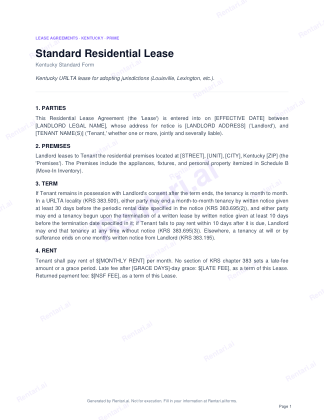
In the Rentari Kentucky lease
- Fair housing and assistance animals
The Kentucky lease states these assistance animal rules and, as a lease term, does not apply pet breed restrictions to an assistance animal.
- Required disclosures
The Kentucky lease prints the manager and owner disclosure on its first page and the deposit account's location, attaches the Move-In Damage Listing addendum when it takes a deposit, and attaches the federal lead-based paint disclosure when you say the home was built before 1978.
- Owner and manager disclosure
The Kentucky lease prints this disclosure on its first page from your manager and owner answers.
- Security deposit limit
The Kentucky lease states the deposit amount and says no section of KRS chapter 383 caps it.
- Returning the deposit
As a lease term, the Kentucky lease returns the deposit, less unpaid rent and damage beyond ordinary wear and tear, with an itemized statement of deductions, within the number of days you set after the tenancy ends and the tenant delivers possession, and it states the URLTA listing, last-month and 60-day refund rules.
- Move-in damage listing
When the lease takes a security or pet deposit, it attaches a Move-In Damage Listing addendum that is signed on paper, and it applies the listing rule everywhere in Kentucky (as a lease term outside URLTA localities); tenant e-sign initials on the addendum only acknowledge receipt.
- Rent and late fees
The Kentucky lease charges the late fee you set once rent is unpaid past the day you choose, as a lease term, and says no section of KRS chapter 383 sets an amount or grace period.
- Returned payment fee
If you set a returned-payment fee, the lease charges it for any check or electronic payment returned for insufficient funds, as additional rent.
- Landlord entry
The Kentucky lease applies the two days' notice and the same access limits everywhere in Kentucky (as lease terms outside URLTA localities), and gives the longer notice if you set more than 48 hours.
- Repairs and habitability
In a URLTA locality the Kentucky lease lists these duties; elsewhere your duties are the lease's own, including its warranty of habitability clause.
- Tenant repair remedies
The Kentucky lease states these remedies as applying in a URLTA locality.
- Smoke alarms
As a lease term, the lease requires you to provide working smoke and carbon monoxide detectors at the start of the tenancy and bars the tenant from disabling them.
- Retaliation
The Kentucky lease states these rules for URLTA localities and, as a lease term everywhere, bars adverse action against the tenant for lawfully exercising tenant rights, reporting code violations or joining a tenant organization.
- Ending a month-to-month tenancy
The Kentucky lease ends a month-to-month tenancy on 30 days' written notice from either party everywhere in Kentucky (as a lease term outside URLTA localities), Rentari's landlord notice to vacate gives 31 days so it always covers a month, and Rentari's holdover eviction notice warns of the KRS 383.160 filing window.
- Ending a lease early
The Kentucky lease states the protective order, casualty and repair termination rights, and, outside URLTA localities, lets either party end the lease by written notice when a casualty not caused by the tenant's side makes the home wholly unfit, with rent prorated.
- Notice for unpaid rent
The Kentucky lease gives seven days' written notice before you end it for unpaid rent everywhere in Kentucky (as a lease term outside URLTA localities), and Rentari's pay notice states your intention to terminate if rent is not paid within the seven days.
- Notice for other lease violations
The Kentucky lease states this rule for URLTA localities, and Rentari's cure notice gives 15 days to remedy and ends the lease on the sixteenth day after the tenant receives it.
- Eviction process
The Kentucky lease says an action for possession is brought in the District Court of the county where the home is, and that other actions go to the court with jurisdiction over them.
- Abandoned property
The Kentucky lease says you handle belongings left behind only as the law requires, stores them for at least the number of days you set if you set one, and does not allow self-help repossession.
- Small claims
The Kentucky lease says actions other than one for possession go to the court with jurisdiction over them.
- Where the URLTA applies
The Kentucky lease defines a URLTA locality on its first page and states each URLTA rule as applying there, with the lease term that applies elsewhere, instead of guessing from the city name.
- Protective orders and emergency calls
The Kentucky lease states these protections as applying throughout Kentucky and contains no clause letting you end the lease over calls for police or emergency help.
- Lease terms Kentucky voids
In a URLTA locality the Kentucky lease drops the tenant's fee, indemnity and rent-acceptance non-waiver promises; elsewhere it keeps a two-way prevailing-party fee term, a tenant indemnity limited to harm caused by the tenant's side, and a non-waiver term, as lease terms.
- Rent control and local rules
The Kentucky lease does not decide from the city name whether the URLTA applies; it tells the parties to confirm with the city or county government.
Kentucky numbers the lease follows
- Security deposit limit
- No limit set
- no section of KRS chapter 383 caps the amount
- KRS chapter 383KRS 383.580
- Deposit return deadline
- None set
- no section of KRS chapter 383 sets one, so the lease does
- KRS chapter 383KRS 383.580
- Unclaimed refund
- 60 days
- after you send notice of the refund, in a URLTA locality, before you may keep it
- KRS 383.580(7)
- Notice for unpaid rent
- 7 days
- written notice before ending the lease, in a URLTA locality
- KRS 383.660(2)
- Time to fix a lease violation
- 15 days
- to remedy, with a termination date at least 14 days after receipt, in a URLTA locality
- KRS 383.660(1)
- Ending a month-to-month tenancy
- 30 days
- written notice before the rental date named, in a URLTA locality
- KRS 383.695(2)
- Late fee and grace period
- None set
- no section of KRS chapter 383 sets a late fee or grace period
- KRS chapter 383
From the Kentucky lease
KENTUCKY RESIDENTIAL LEASE AGREEMENT
Kentucky's Uniform Residential Landlord and Tenant Act (KRS 383.505 to 383.705, the "URLTA") applies only where the city, county or urban-county government has adopted it under KRS 383.500, in its entirety and without amendment. This Lease calls such a place a "URLTA locality".
Two sets of Kentucky rulesKRS 383.500
"No landlord shall be entitled to retain any portion of a security deposit if the security deposit was not deposited in a separate account as required by subsection (1) of this section and if the initial and final damage listings required by subsections (2) and (3) of this section are not provided." (KRS 383.580(4))
Keeping the depositKRS 383.580(4)
This Lease contains no provision authorizing Landlord to terminate it or to impose a penalty on Tenant for requests made by Tenant for assistance from peace officers or other assistance in response to emergencies (KRS 383.302).
Emergency callsKRS 383.302
Kentucky lease types
Pick 3, 6, 12, 18 or 36 months or your own dates. At the end, the lease ends or converts to month-to-month.
Standard lease guideEnding a month-to-month tenancy: 30 days, written notice before the rental date named, in a URLTA locality.
Kentucky month-to-month leaseUpload a lease you already use: send an unsigned one for e-signature, or store one that is already signed.
Rooms use the Kentucky lease for now: add the room as its own unit and set house rules with the optional addenda.
Kentucky room rentalBefore you sign
Application and screening fees
Not readThis page states no Kentucky rule on application or screening fees: the review it relies on recorded none, and no applicable provision beyond KRS chapter 383 was reviewed.
Fair housing and assistance animals
Partly readFor housing covered by KRS 344.360, Kentucky prohibits discrimination because of race, color, religion, sex, familial status, disability or national origin in rental availability, terms and services, negotiations, advertisements and applications. Kentucky's landlord and tenant chapter treats an assistance animal, including a service animal or emotional support animal, as not a pet, and a person with a disability may request a reasonable accommodation to keep one. Unless the disability or disability-related need is readily apparent, you may ask for reliable documentation of the need, including from someone with whom the requester has or had a therapeutic relationship, and may independently verify it. Federal fair housing law, local protections and the remaining civil rights provisions were not read for this page.
KRS 344.360 KRS 383.085(2), (3)
- You may not charge a pet fee, pet deposit or added rent for an assistance animal, but the tenant is responsible for physical damage it causes if residents with pets are responsible for their pets' damage, and must follow the rules that apply to all residents. KRS 383.085(4)
- You may not refuse to rent to, or otherwise retaliate against, a person because they are a protected tenant under a qualifying protective order. KRS 383.300(3) See Protective orders and emergency calls on the Kentucky page
- For covered housing, disability discrimination includes refusing necessary reasonable accommodations in rules, policies, practices or services, and refusing reasonable modifications at the disabled person's expense, subject to the statutory restoration conditions. Where reasonable, interior restoration may be agreed on, but reasonable wear and tear must be excepted. The section also sets accessibility requirements for specified multifamily construction. KRS 344.360(11) to (13)
- State law contains specific exceptions and exemptions, including certain owner-occupied rentals and shared facilities. Have a qualified housing-law professional check the exact property, transaction, federal law and local rules before relying on an exception. A state exception alone does not resolve every applicable protection. KRS 344.362 KRS 344.365
- Use the protections for the transaction you are reviewing. The age-forty-and-over rule in KRS 344.040 concerns employment; it is not one of the listed classes in the housing provision, KRS 344.360. That distinction does not settle protections under other laws or justify blanket screening exclusions. Check the actual housing coverage and applicable federal and local rules. KRS 344.040(1) KRS 344.360
The Kentucky lease states these assistance animal rules and, as a lease term, does not apply pet breed restrictions to an assistance animal.
Required disclosures
Partly readIn a URLTA locality, disclose in writing, at or before the start of the tenancy, the name and address of the person authorized to manage the home and of an owner or the owner's agent for service of process and notices; tell the tenant where the deposit account is and its account number; and give the move-in damage listing before any deposit is paid. Federal disclosures, such as lead-based paint for older homes, were not read for this page.
KRS 383.585 KRS 383.580(1), (2)
- The manager and owner disclosure is covered under owner and manager disclosure. KRS 383.585 See Owner and manager disclosure on the Kentucky page
- The damage listing is covered under move-in damage listing. KRS 383.580(2) See Move-in damage listing on the Kentucky page
- If contaminated property has a methamphetamine contamination notice posted under KRS 224.1-410(9), an owner who leases or rents it must disclose in writing to a potential tenant that it is contaminated and has not been decontaminated as required. This disclosure is not required once the property has been decontaminated and the cabinet has released it from further action. Disclosure alone does not establish that the home is safe to occupy; confirm the cleanup, release and applicable regulatory requirements with the responsible authority. KRS 224.1-410(9), (10)
The Kentucky lease prints the manager and owner disclosure on its first page and the deposit account's location, attaches the Move-In Damage Listing addendum when it takes a deposit, and attaches the federal lead-based paint disclosure when you say the home was built before 1978.
Flood disclosure
Not readThis page states no Kentucky flood disclosure rule: the review it relies on recorded none, and no applicable provision beyond KRS chapter 383 was reviewed.
Owner and manager disclosure
In a URLTA locality, disclose to the tenant in writing, at or before the start of the tenancy, the name and address of the person authorized to manage the home, and of an owner or a person authorized to act for the owner for service of process and for receiving and receipting for notices and demands.
- The information must be kept current, and the duty extends to and is enforceable against any successor landlord, owner or manager. KRS 383.585
- A person who fails to make the disclosure becomes an agent of each landlord for service of process and notices, and for performing the landlord's duties and spending or making available for that purpose all rent collected from the home. KRS 383.585
The Kentucky lease prints this disclosure on its first page from your manager and owner answers.
Deposits, rent and fees
Security deposit limit
Not set by statuteNo section of KRS chapter 383, Kentucky's landlord and tenant chapter, caps the amount of a security deposit. No broader deposit-limit review is recorded for this page.
- In a URLTA locality, a deposit brings account and damage-listing duties, and missing them can cost you the right to keep any of it. KRS 383.580(1) to (4) See Returning the deposit on the Kentucky page
The Kentucky lease states the deposit amount and says no section of KRS chapter 383 caps it.
Returning the deposit
No section of KRS chapter 383 sets a deadline for returning a security deposit, so the lease should set one. In a URLTA locality, KRS 383.580(4) says: "No landlord shall be entitled to retain any portion of a security deposit if the security deposit was not deposited in a separate account as required by subsection (1) of this section and if the initial and final damage listings required by subsections (2) and (3) of this section are not provided."
KRS chapter 383 KRS 383.580(4)
- At the end of the tenancy in a URLTA locality, inspect the home and compile a comprehensive listing of any damage you will charge against the deposit, with the estimated dollar cost of repairing it. The tenant may inspect the home to check it, and you both sign it, or the tenant signs a specific written statement of dissent. KRS 383.580(3)
- A tenant who neither signs the move-out listing nor signs a statement of dissent may not recover damages under the deposit section. KRS 383.580(5)
- If the tenant leaves without paying the last month's rent and does not ask for the deposit back, you may apply the deposit to the rent owed after 30 days. KRS 383.580(6)
- If the tenant leaves owing no rent and a refund is due, send notice of the refund amount to the tenant's last known or reasonably determinable address. If the tenant does not respond within 60 days after you send it, you may keep the deposit free from any claim of the tenant. KRS 383.580(7)
- The account and move-in listing rules are under deposit account and move-in condition. KRS 383.580(1), (2) See Deposit account and interest on the Kentucky page
As a lease term, the Kentucky lease returns the deposit, less unpaid rent and damage beyond ordinary wear and tear, with an itemized statement of deductions, within the number of days you set after the tenancy ends and the tenant delivers possession, and it states the URLTA listing, last-month and 60-day refund rules.
Deposit account and interest
Partly readIn a URLTA locality, deposit the security deposit in an account used only for that purpose, in a bank or other lending institution subject to regulation by Kentucky or by an agency of the United States government, and tell the tenant where the account is and its account number. This page states no interest rule: the review of chapter 383 it relies on recorded none, and no other chapter was read.
- A deposit not held in the separate account can cost you the right to keep any of it. KRS 383.580(4) See Returning the deposit on the Kentucky page
Move-in damage listing
In a URLTA locality, before the tenant pays anything treated as a security deposit, give the tenant a comprehensive listing of any existing damage you would charge against the deposit, with the estimated dollar cost of repairing it. The tenant may inspect the home before moving in to check it. You both sign it, or, if the tenant refuses to sign, the tenant states in writing the specific items they dissent from and signs that statement.
- The signatures are conclusive evidence that the listing is accurate, but not as to latent defects. KRS 383.580(2)
- Skipping the listings (and the separate account) can cost you the right to keep any of the deposit. KRS 383.580(4) See Returning the deposit on the Kentucky page
When the lease takes a security or pet deposit, it attaches a Move-In Damage Listing addendum that is signed on paper, and it applies the listing rule everywhere in Kentucky (as a lease term outside URLTA localities); tenant e-sign initials on the addendum only acknowledge receipt.
Rent and late fees
Not set by statuteNo section of KRS chapter 383 sets a late-fee amount or a grace period, so both come from the lease. Kentucky case law on late fees and penalties was not read for this page.
- In a URLTA locality some lease terms are void, including a promise to pay your attorney's fees. KRS 383.570 See Lease terms Kentucky voids on the Kentucky page
The Kentucky lease charges the late fee you set once rent is unpaid past the day you choose, as a lease term, and says no section of KRS chapter 383 sets an amount or grace period.
Returned payment fee
Not readThis page states no Kentucky limit on a returned-check or returned-payment fee: KRS 514.040, the returned-check statute, was not read, and the review of chapter 383 recorded no limit.
If you set a returned-payment fee, the lease charges it for any check or electronic payment returned for insufficient funds, as additional rent.
Rent increase notice
Partly readThis page states no notice period for a rent increase: the review it relies on recorded none. In a URLTA locality, you may not raise rent in retaliation for a tenant's code complaint, complaint to you about repairs, or tenant union activity.
- A complaint within one year before the increase creates a presumption of retaliation, unless the tenant complained after notice of the proposed increase. KRS 383.705 See Retaliation on the Kentucky page
- Review the actual lease and local adoption before proposing a new rent. In a URLTA locality, KRS 383.565 permits lawful agreed rent and lease terms. KRS 383.695 gives deadlines for ending periodic tenancies: seven days for weekly tenancies and 30 days before the specified periodic rental date for monthly tenancies. Those are termination rules, not a stand-alone rent-increase notice provision. Outside URLTA localities, KRS 383.195 instead addresses a landlord ending a tenancy at will or by sufferance on one month's written notice. Check the agreement and applicable law before changing billing. KRS 383.565 KRS 383.695 KRS 383.195 See Ending a month-to-month tenancy on the Kentucky page
- For notices governed by the URLTA, KRS 383.560 distinguishes giving notice from receiving it. It describes steps reasonably calculated to inform the recipient, actual attention, hand delivery to the tenant, and registered or certified mail to the designated address or last known residence. Keep the written notice and evidence of delivery. Do not assume a portal upload, email or door posting automatically proves receipt, or that agreeing to a delivery clause resolves every legal requirement. This section does not set a fixed mailing-delay allowance for a rent change. KRS 383.560
During the tenancy
Landlord entry
In a URLTA locality, the tenant may not unreasonably withhold consent for you to enter to inspect, make necessary or agreed repairs, decorations, alterations or improvements, supply necessary or agreed services, or show the home to buyers, lenders, tenants, workers or contractors. Except in an emergency or where it is impracticable, give at least two days' notice of your intent to enter, and enter only at reasonable times. You may not abuse the right of access or use it to harass the tenant.
- You may enter without the tenant's consent in an emergency. KRS 383.615
- Otherwise you have no right of access except under a court order, at times reasonably necessary during a tenant's absence of more than seven days, to do work the tenant failed to do as KRS 383.665 allows, or after the tenant has abandoned or surrendered the home. KRS 383.615 KRS 383.665 KRS 383.670(2)
- Outside URLTA localities no section of KRS chapter 383 sets an entry notice, so the lease governs. KRS chapter 383
The Kentucky lease applies the two days' notice and the same access limits everywhere in Kentucky (as lease terms outside URLTA localities), and gives the longer notice if you set more than 48 hours.
Repairs and habitability
In a URLTA locality, you must comply with building and housing codes materially affecting health and safety; make all repairs and do whatever is necessary to keep the home fit and habitable; keep common areas clean and safe; keep the electrical, plumbing, sanitary, heating, ventilating, air-conditioning and other facilities and appliances you supply (including elevators) in good and safe working order; and supply running water, reasonable amounts of hot water at all times and reasonable heat between October 1 and May 1.
- The heat and hot water duty does not apply where the building is not required by law to be equipped for it, or where heat or hot water comes from an installation in the tenant's exclusive control supplied by a direct public utility connection. KRS 383.595(1)
- Outside URLTA localities this page states no repair standard: the lease sets your duties, and Kentucky case law on habitability was not read. KRS chapter 383
In a URLTA locality the Kentucky lease lists these duties; elsewhere your duties are the lease's own, including its warranty of habitability clause.
Tenant repair remedies
In a URLTA locality, if you materially fail to comply with the lease, or fail to meet your repair duties in a way that materially affects health and safety, the tenant may give written notice naming the breach and saying the lease will end on a date at least 30 days after you receive it if the breach is not remedied within 14 days. The tenant may also recover damages and get an injunction.
- If substantially the same breach recurs within six months, the tenant may end the lease on at least 14 days' written notice. KRS 383.625(1)
- Repair and deduct: where you willfully and materially fail to comply with the lease, or fail to meet your repair duties, the noncompliance materially affects health and safety, and the reasonable cost of fixing it is less than $100 or half the monthly rent, whichever is greater, the tenant may give written notice of the intent to fix it at your expense. If you willfully fail to comply within 14 days after that notice, or as promptly as an emergency requires, the tenant may have the work done in a workmanlike manner and, after giving you an itemized statement of work actually done and paid for in full, deduct its actual and reasonable cost from the rent, up to that amount. KRS 383.635
- If you willfully fail to supply heat, running water, hot water, electric, gas or another essential service, the tenant may, after written notice naming the breach, buy the service and deduct its actual and reasonable cost from the rent, recover damages based on the reduced fair rental value, or get reasonable substitute housing, owing no rent for that period and recovering reasonable attorney's fees. A tenant who does this may not use the termination or repair-and-deduct remedies for that breach. KRS 383.640
- None of the termination, repair-and-deduct or essential-service remedies applies to a condition caused by the deliberate or negligent act or omission of the tenant, a family member or another person on the premises with the tenant's consent. KRS 383.625(1)(c) KRS 383.635(2) KRS 383.640(4)
The Kentucky lease states these remedies as applying in a URLTA locality.
Locks and security devices
Partly readA protected tenant under a qualifying protective order may, after telling you, rekey a lock in good working condition or replace the whole locking mechanism with one of equal or better quality, at the tenant's expense, and must give you a key on request. You may refuse to give a key to the person the order restrains, even if that person is on the lease. The review this page relies on recorded no other Kentucky lock or security device rule.
- For this right, a protected tenant also includes one protected by a valid emergency protective order, temporary interpersonal protective order or pretrial release no contact order. KRS 383.300 See Protective orders and emergency calls on the Kentucky page
Smoke alarms
Partly readNo section of KRS chapter 383 requires smoke alarms. Kentucky's fire and building codes were not read for this page.
As a lease term, the lease requires you to provide working smoke and carbon monoxide detectors at the start of the tenancy and bars the tenant from disabling them.
Retaliation
In a URLTA locality, you may not retaliate by raising rent, decreasing services, or bringing or threatening an action for possession because the tenant complained to a government agency about a building or housing code violation materially affecting health and safety, complained to you about your repair duties, or organized or joined a tenant union or similar group. A complaint within one year before the alleged retaliation creates a presumption that your conduct was retaliatory, unless the tenant complained after notice of a proposed rent increase or cut in services.
- A tenant who is retaliated against has the remedies of KRS 383.655 (recovery of possession or ending the lease, and up to three months' periodic rent and a reasonable attorney's fee) and a defense in a retaliatory action for possession. KRS 383.705 KRS 383.655
- You may still bring an action for possession if the code violation was caused primarily by lack of reasonable care by the tenant or someone in the household or on the premises with the tenant's consent, if the tenant is in default in rent, or if complying with the code requires alteration, remodeling or demolition that would effectively deprive the tenant of use of the home. KRS 383.705
- Statewide, you may not retaliate in renting because a person is a protected tenant under a qualifying protective order. KRS 383.300(3) See Protective orders and emergency calls on the Kentucky page
The Kentucky lease states these rules for URLTA localities and, as a lease term everywhere, bars adverse action against the tenant for lawfully exercising tenant rights, reporting code violations or joining a tenant organization.
Lockouts and utility shutoffs
Partly readIn a URLTA locality, if you willfully fail to supply heat, running water, hot water, electric, gas or another essential service, the tenant has the remedies described under tenant repair remedies. In a URLTA locality, KRS 383.655, the section on a tenant's remedies for unlawful ouster, exclusion or diminution of service, lets the tenant recover possession or end the lease, and recover up to three months' periodic rent and a reasonable attorney's fee. This page does not state when a removal or shutoff is unlawful: the review it relies on did not record that.
- Essential-service remedies: buy the service and deduct its cost, recover damages for reduced rental value, or get substitute housing without owing rent for that period. KRS 383.640 See Tenant repair remedies on the Kentucky page
Ending a tenancy
Ending a month-to-month tenancy
In a URLTA locality, you or the tenant may end a month-to-month tenancy by written notice given at least 30 days before the periodic rental date named in the notice, and a week-to-week tenancy by written notice at least seven days before the termination date named. Where the URLTA is not in effect, the landlord may end a tenancy at will or by sufferance by giving one month's written notice requiring the tenant to leave.
KRS 383.695(1), (2) KRS 383.195
- In a URLTA locality, a tenancy that began when a written lease ended may be ended by either party on written notice given at least 10 days before the termination date named. KRS 383.695(3)
- If the tenant stays after the tenancy ends without your consent and the holdover is willful and not in good faith, you may also recover up to three months' periodic rent or three times your actual damages, whichever is greater, and reasonable attorney's fees (URLTA localities). KRS 383.695(4)
- A tenant who holds over after a fixed lease term ended on a certain day is a different case: possession proceedings have a 30-day window (90 days for a term of a year or more), described under eviction process. KRS 383.160 See Eviction process on the Kentucky page
The Kentucky lease ends a month-to-month tenancy on 30 days' written notice from either party everywhere in Kentucky (as a lease term outside URLTA localities), Rentari's landlord notice to vacate gives 31 days so it always covers a month, and Rentari's holdover eviction notice warns of the KRS 383.160 filing window.
Ending a lease early
Kentucky's landlord and tenant chapter lets a tenant end a lease early in several cases: a tenant protected by a domestic violence order or interpersonal protective order may end it on 30 days' written notice; in a URLTA locality a tenant may end it for your uncorrected material noncompliance or after a fire or casualty that substantially impairs the home; and anywhere in Kentucky a tenant is not liable for rent for the rest of the term if the home is destroyed by fire or other casualty without the tenant's fault or neglect, unless the tenant agreed otherwise.
KRS 383.300(5) KRS 383.625(1) KRS 383.650 KRS 383.170
- After a fire or casualty that substantially impairs enjoyment of the home in a URLTA locality, either you or the tenant may end the lease on 14 days' notice, but the tenant may vacate immediately; you return the unused prepaid rent, and rent is accounted for as of the date of the casualty. KRS 383.650
- Protective order terminations are covered under protective orders and emergency calls. KRS 383.300(5), (7) See Protective orders and emergency calls on the Kentucky page
The Kentucky lease states the protective order, casualty and repair termination rights, and, outside URLTA localities, lets either party end the lease by written notice when a casualty not caused by the tenant's side makes the home wholly unfit, with rent prorated.
Notice for unpaid rent
In a URLTA locality, if rent is unpaid when due and the tenant does not pay within seven days after your written notice of nonpayment and of your intention to end the lease if the rent is not paid within that period, you may end the lease. No section of KRS chapter 383 sets a nonpayment notice outside URLTA localities.
KRS 383.660(2) KRS chapter 383
- For a tenancy that began when a written lease ended, if the tenant fails to pay rent within 10 days after it is due, you may end that tenancy at any time without notice (URLTA localities). KRS 383.695(3)
- In a URLTA locality, the tenant receives a notice when it comes to the tenant's attention, or when it is delivered in hand or mailed by registered or certified mail to the place the tenant named for notices or, if none, the tenant's last known residence. KRS 383.560(3)
The Kentucky lease gives seven days' written notice before you end it for unpaid rent everywhere in Kentucky (as a lease term outside URLTA localities), and Rentari's pay notice states your intention to terminate if rent is not paid within the seven days.
Notice for other lease violations
In a URLTA locality, for a material noncompliance with the lease or with the tenant's statutory maintenance duties or valid rules, give written notice naming the acts and omissions that are the breach and stating that the lease will end on a date at least 14 days after the tenant receives it. If the breach is not remedied within 15 days, the lease ends as the notice says; it does not end if a remediable breach is adequately remedied before the date named.
KRS 383.660(1) KRS 383.605 KRS 383.610
- If substantially the same act or omission recurs within six months, you may end the lease on at least 14 days' written notice naming the breach and the termination date. KRS 383.660(1)
- Outside URLTA localities no section of KRS chapter 383 sets a cure period; the lease governs. KRS chapter 383
The Kentucky lease states this rule for URLTA localities, and Rentari's cure notice gives 15 days to remedy and ends the lease on the sixteenth day after the tenant receives it.
Eviction process
Partly readAn action to recover possession (forcible entry or detainer) is brought in the District Court of the county where the home is, under KRS 383.200 to 383.285. In a URLTA locality the District Court may also hear any claim arising from a transaction the URLTA governs. Use the county court's current forms and hearing instructions; local practice affects filing and enforcement.
- KRS 383.290 has a separate law-enforcement petition route for qualifying unlawful occupants. It does not replace the tenant court process; see the conditions under unauthorized occupancy and ownership claims. KRS 383.290 See Unauthorized occupancy and ownership claims on the Kentucky page
- A protected tenant has a defense to an action for possession when the notice to vacate is substantially based on acts that violated the protective order or led to its issuance. KRS 383.300(3) See Protective orders and emergency calls on the Kentucky page
- If a tenant holds over after a lease term that expired on a certain day, without a contract to stay longer, you may recover possession without demand or notice by starting proceedings within 30 days after that day (90 days for a term of a year or more). If you start none by then, none are allowed until 60 days after it (one year for a term of a year or more), so waiting out a 31-day notice to vacate can carry you past the window. KRS 383.160
- The Kentucky Court of Justice forms directory lists the Forcible Detainer Complaint (AOC-216), notice of hearing (AOC-215), judgment (AOC-217), settlement agreement (AOC-218) and warrant for possession (AOC-220). Start with the current court versions and confirm the county's filing and service instructions. Prepare the lease, termination notice, service record, payment history and relevant photos for the scheduled hearing; a complaint or judgment is a different document from the warrant used to recover possession. Kentucky Court of Justice: eviction forms
- As a local example, Fayette District Court says a warrant for possession may be requested between the eighth and thirtieth day after the forcible detainer judgment. The request needs the court date, case number, defendant's name and property address, followed by an appointment with the sheriff or constable. Follow the actual order and county procedure, including any appeal or stay; this Fayette guidance is not a statewide promise of immediate removal. Fayette District Court: forcible detainer division
The Kentucky lease says an action for possession is brought in the District Court of the county where the home is, and that other actions go to the court with jurisdiction over them.
Abandoned property
Partly readIn a URLTA locality, you may enter the home after the tenant has abandoned or surrendered it. The review this page relies on recorded no Kentucky rule on storing or disposing of belongings a tenant leaves behind, so this page states none.
- What happens to the deposit when a tenant leaves is covered under returning the deposit. KRS 383.580(6), (7) See Returning the deposit on the Kentucky page
The Kentucky lease says you handle belongings left behind only as the law requires, stores them for at least the number of days you set if you set one, and does not allow self-help repossession.
Small claims
Not readThis page states no Kentucky small claims limit: KRS 24A.230, the small claims section, was not read.
The Kentucky lease says actions other than one for possession go to the court with jurisdiction over them.
More Kentucky rules
Where the URLTA applies
Kentucky's Uniform Residential Landlord and Tenant Act (KRS 383.505 to 383.705, the URLTA) applies only where a city, county or urban-county government has adopted it under KRS 383.500, in its entirety and without amendment. The statute names no adopter, so confirm with the city or county. Elsewhere, the other sections of KRS chapter 383 (such as the rules on assistance animals, protective orders, casualty and tenancies at will) and your lease govern.
KRS 383.500 KRS 383.505 to 383.705 (URLTA)
- Where the URLTA is not in effect, the landlord may end a tenancy at will or by sufferance by giving one month's written notice. KRS 383.195 See Ending a month-to-month tenancy on the Kentucky page
The Kentucky lease defines a URLTA locality on its first page and states each URLTA rule as applying there, with the lease term that applies elsewhere, instead of guessing from the city name.
Protective orders and emergency calls
Throughout Kentucky, for a lease created or renewed on or after June 29, 2017, you may not end, refuse to renew, refuse to enter into or otherwise retaliate in renting because a person is a protected tenant: a tenant, applicant or tenant with a minor household member protected by a valid domestic violence order or interpersonal protective order that restrains the adverse party from any unauthorized contact; for this rule, the possession defense and the rekey right, a valid emergency protective order, temporary interpersonal protective order or pretrial release no contact order also counts. A lease may not let you end it or penalize the tenant for asking peace officers or others for help in an emergency.
- It is a defense to an action for possession that the tenant is a protected tenant and the notice to vacate is substantially based on acts that violated the order or led to its issuance, including complaints of noise, disturbances or repeated presence of peace officers. KRS 383.300(3)
- A tenant protected by a domestic violence order or interpersonal protective order obtained after signing the lease may end it by written notice, with a copy of the order, effective on a stated date at least 30 days after you receive it. One who had the order before signing must also show a safety concern that arose after the lease was signed. KRS 383.300(5)
- The tenant who leaves owes rent prorated to the termination date, payable when the lease would have required it, gets no negative credit entry or character reference, owes no other rent or fees due solely to the early termination, and owes no damages or penalties if the lease ends 14 or more days before occupancy. The tenancy continues for any remaining tenants. KRS 383.300(5), (7)
- A person who is both restrained by such an order and a protected tenant has none of these protections. KRS 383.300
- A tenant may recover reasonable attorney's fees where you enforce a lease provision you know is prohibited by the emergency-call rule. KRS 383.302(2)
The Kentucky lease states these protections as applying throughout Kentucky and contains no clause letting you end the lease over calls for police or emergency help.
Lease terms Kentucky voids
In a URLTA locality, a rental agreement may not make the tenant waive rights under the URLTA, agree to pay your attorney's fees, or agree to exculpate or limit your liability arising under law or indemnify you for it; such a provision is unenforceable. There, accepting rent with knowledge of a default, or accepting performance that varies from the lease, waives your right to end the lease for that breach unless you agree otherwise after the breach.
KRS 383.570(1)(a), (c), (d) KRS 383.675
- A court may still award attorney's fees where the URLTA provides for them, to landlords under KRS 383.645(1), 383.660(3), 383.695(4) and 383.700(1), and to tenants under KRS 383.630(2), 383.640(2), 383.655 and 383.700(2). KRS 383.645 KRS 383.660 KRS 383.695 KRS 383.700 KRS 383.630 KRS 383.640 KRS 383.655
- The tenant must still not deliberately or negligently destroy, deface, damage, impair or remove any part of the home or knowingly let anyone do so. KRS 383.605(6)
In a URLTA locality the Kentucky lease drops the tenant's fee, indemnity and rent-acceptance non-waiver promises; elsewhere it keeps a two-way prevailing-party fee term, a tenant indemnity limited to harm caused by the tenant's side, and a non-waiver term, as lease terms.
Unauthorized occupancy and ownership claims
Partly readAn adverse-possession claim concerns ownership. The general Kentucky test described in the cited court decision requires actual, open and notorious, exclusive and continuous possession under a hostile claim of right for fifteen years, proved by clear and convincing evidence. Time at an address alone does not establish every element. This overview does not resolve special title rules, boundaries or a particular ownership dispute.
Federal court application of Kentucky adverse-possession rules KRS 383.290
- KRS 383.290 provides a separate law-enforcement petition route when all its conditions apply: the person has never been a tenant and never had an owner-authorized written or oral occupancy agreement; the property was not open to the public when they entered; the owner has directed them to leave; they are not the owner's immediate family member; and no litigation about the property is pending between the owner and a known unauthorized occupant. Use the required petition and confirm the applicable procedure with the responding authority. This route is not a shortcut for removing a current or former tenant. KRS 383.290 See Eviction process on the Kentucky page
- Keep title records, leases, permissions, dated photographs and a timeline showing how occupancy or use began. For genuinely vacant property, maintain entrances and arrange lawful condition checks. When permission, family status or ownership is disputed, obtain advice about the correct route before changing access or removing belongings; a label such as squatter does not decide the facts. Federal court application of Kentucky adverse-possession rules KRS 383.290
Local rules
Rent control and local rules
Partly readA Kentucky city, county or urban-county government may adopt the URLTA, and must adopt it in its entirety and without amendment; the statute names no adopter, so confirm with the local government. Since 2025, KRS 383.199 limits certain leases of single-family homes in a county containing a consolidated local government by an owner-occupancy rule; read it before renting a single-family home there. KRS 65.875 reserves legislation controlling rents on private property to the General Assembly, with housing-authority and federal-grant qualifications.
KRS 383.500 KRS 383.199 KRS 65.875
- Where the URLTA is in effect is covered under where the URLTA applies. KRS 383.500 See Where the URLTA applies on the Kentucky page
- KRS 65.875 preserves a city, county or urban-county government's right to manage and control property in which it has an interest through a housing authority or similar housing-assistance agency. It also excludes local programs operated pursuant to federal grants from its restriction. Check the actual program before treating a home as governed only by private-market terms. KRS 65.875
The Kentucky lease does not decide from the city name whether the URLTA applies; it tells the parties to confirm with the city or county government.
A local government may adopt the URLTA, and cities and counties have their own housing, building and fire codes. No adoption ordinance or local code was read for this page, so no local rule is listed here; check with the city or county where the home is.
Kentucky lease renewals
Read the agreement's renewal clause and the notice rules above before choosing a new term, changing rent or ending the tenancy. A fixed end date does not override applicable renewal rights, rent regulation, just-cause rules or protections against retaliation and discrimination.
Confirm the notice, timing and delivery requirements for the rental's state and locality. Review any required new disclosures and attachments when preparing the renewal. Get the parties' agreement to changed terms in writing.
Customize an unsigned agreement or prepare an addendum to an existing lease.
How it works
- Add your Kentucky rental
Enter the property and its units.
- Set the terms
Choose the rental, add tenants, and set rent, deposit and fees.
- Review the lease
Preview and edit the Kentucky lease and its addenda.
- Send for e-signature
Tenants sign online; sending is included on paid plans.
Follow the full lease builder guide, add supporting files, or download and print the agreement.
Kentucky lease questions
Does the Rentari Kentucky lease work whether or not my city adopted the URLTA?
Yes. It defines a URLTA locality and states each URLTA rule as applying there, with the lease term that applies elsewhere, so you confirm coverage with your city or county instead of guessing.
Does the Kentucky lease include the move-in damage listing?
Yes, whenever it takes a security or pet deposit. The Move-In Damage Listing addendum is signed on paper, or the tenant signs a written dissent, because the signed listing is conclusive evidence of its accuracy except for latent defects.
What deposit return deadline does the Kentucky lease use?
The number of days you set in the lease, as a lease term, since no section of KRS chapter 383 sets one. In a URLTA locality it also states the move-out listing and 60-day unclaimed refund rules.
How much entry notice does the Kentucky lease give?
At least two days' notice of intent to enter, except in an emergency or where impracticable, everywhere in Kentucky, or more if you set more than 48 hours.
Can I send the Kentucky lease for e-signature?
Yes. E-signature sending is included on paid plans. Tenant initials on the Move-In Damage Listing only acknowledge receipt; the listing itself is signed on paper.