- Home
- Lease agreement
- Minnesota
Minnesota residential lease agreement
State rules checked September 24, 2026 General information, not legal advice
Jump to a topic
Minnesota lease document preview
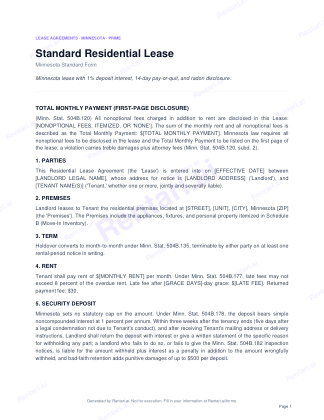
In the Rentari Minnesota lease
- Application and screening fees
The Minnesota tenant rights box in the lease restates the screening fee duties: the written disclosure, the receipt, the refund of unused amounts and the 14-day rejection notice.
- Landlord and manager disclosure
The lease names the manager and the agent for notices in a box right after the Total Monthly Payment box, says the information must be posted, and says the Attorney General's statement is available on request.
- Security deposit limit
The Rentari Minnesota lease states the deposit amount and says Minnesota sets no statewide cap on it.
- Deposit interest and holding
The lease states the 1 percent simple interest rule and the $1 floor.
- Move-in and move-out inspections
The lease has a move-in and move-out inspection clause: the landlord tells the tenant about the initial inspection option within 14 days after move-in and gives written notice of the move-out inspection right before the tenancy ends.
- Rent and late fees
The lease's late charge clause is the written agreement the statute requires: it states when the fee applies, limits it to 8 percent of the overdue rent, and applies it only to the tenant's share under a housing assistance contract. Rentari stops a Minnesota lease whose late fee is above 8 percent of the rent.
- Rent increase notice
The lease's termination clause says that when the lease gives the two sides different notice periods, the tenant may use either, and a notice of a rent increase may not be shorter than the notice the tenant must give.
- Repairs and habitability
The Minnesota tenant rights box in the lease states that the home is fit for its intended use, reasonably energy efficient, kept in reasonable repair and in compliance with health and safety laws, and that these promises cannot be waived.
- Tenant repair remedies
The lease's repairs clause describes rent escrow and emergency relief in the statute's terms and says neither lets the tenant repair and deduct the cost from rent without a court order.
- Locks and security devices
The lease requires the landlord to provide working exterior locks and bars the tenant from changing or rekeying them without written permission.
- Smoke and carbon monoxide alarms
The lease says the landlord provides working smoke and carbon monoxide detectors at the start of the tenancy and that the tenant may not disable them.
Minn. Stat. § 299F.362, subd. 3 Minn. Stat. § 299F.362, subd. 5 Minn. Stat. § 299F.51, subd. 1
- Retaliation
The lease's retaliation clause restates the eviction defense, the complaint rule, the tenant organizing protections and the right to call for police or emergency help.
- Ending a month-to-month tenancy
The lease's termination clause restates this rule, the rule on unequal notice periods, the six-month limit on early renewal and the written reminder an automatic renewal needs.
- Ending a fixed-term lease early
The lease states the violence, death and medical care facility termination rights in the statutes' terms.
Minn. Stat. § 504B.206 Minn. Stat. § 504B.265 Minn. Stat. § 504B.266
- Abandoned property
The lease says the landlord handles belongings left behind as the law requires, including any notice and storage period, and that nothing in the lease authorizes self-help repossession.
- Rent control and local rules
For a Minneapolis property the lease adds rental license tier and open code violation lines for the landlord to complete and says the City's tenant rights notice and screening criteria are separate City documents, not part of the lease package.
Minnesota numbers the lease follows
- Deposit return deadline
- 3 weeks
- after the tenancy ends and you have the tenant's mailing address
- Minn. Stat. § 504B.178, subd. 3
- Deposit interest
- 1% a year
- simple interest; amounts under $1 excluded
- Minn. Stat. § 504B.178, subd. 2
- Late fee limit
- 8%
- of the overdue rent payment, only with a written agreement
- Minn. Stat. § 504B.177(a)
- Late fee grace period
- None set
- the written agreement says when the fee applies
- Minn. Stat. § 504B.177(a)
- Notice before an eviction for unpaid rent
- 14 days
- written notice with the contents the statute lists
- Minn. Stat. § 504B.321, subd. 1a
- Entry notice
- 24 hours
- at least, with entry between 8 a.m. and 8 p.m. unless agreed
- Minn. Stat. § 504B.211, subd. 2
- Ending a month-to-month tenancy
- 1 rent period
- the time between rent due dates, up to three months
- Minn. Stat. § 504B.135
- Returned check charge
- Up to $30
- if a notice of the charge was posted where the check was given
- Minn. Stat. § 604.113, subd. 2
- Abandoned property
- 28 days
- before belongings may be sold or disposed of
- Minn. Stat. § 504B.271, subd. 1
From the Minnesota lease
MINNESOTA RESIDENTIAL LEASE AGREEMENT
TOTAL MONTHLY PAYMENT (Minn. Stat. 504B.120): The sum of the monthly rent and all nonoptional fees due each month under this Lease is described as the Total Monthly Payment: [amount] per month, itemized as: monthly rent [amount].
Total Monthly PaymentMinn. Stat. § 504B.120, subd. 1
RIGHT OF ENTRY (Minn. Stat. 504B.211): Landlord may enter the Premises only for a reasonable business purpose and after making a good faith effort to give Tenant reasonable notice under the circumstances of not less than 24 hours in advance. The notice must specify a time or anticipated window of entry, and Landlord may enter only between 8:00 a.m. and 8:00 p.m. unless Landlord and Tenant agree to an earlier or later time.
Right of entryMinn. Stat. § 504B.211, subd. 2
Within three weeks after the tenancy ends, or within five days after Tenant leaves because the building is legally condemned for reasons not due to Tenant's willful, malicious or irresponsible conduct, and after receiving Tenant's mailing address or delivery instructions, Landlord shall return the deposit with interest or give Tenant a written statement of the specific reason for withholding any part of it.
Security deposit returnMinn. Stat. § 504B.178, subd. 3
Minnesota lease types
Pick 3, 6, 12, 18 or 36 months or your own dates. At the end, the lease ends or converts to month-to-month.
Standard lease guideEnding a month-to-month tenancy: 1 rent period, the time between rent due dates, up to three months.
Minnesota month-to-month leaseUpload a lease you already use: send an unsigned one for e-signature, or store one that is already signed.
Rooms use the Minnesota lease for now: add the room as its own unit and set house rules with the optional addenda.
Minnesota room rentalBefore you sign
Application and screening fees
Before accepting a screening fee, disclose in writing the name, address and phone number of any tenant screening service you will use and the criteria your decision will be based on. Do not charge a fee when you know or should know no unit is or soon will be available, give a receipt on request, and do not use, cash or deposit the fee until every earlier applicant has been screened and rejected or has turned the unit down.
- Return the fee if you reject the applicant for a reason not in your written criteria, or if an earlier applicant takes the unit. Return any part you did not spend on a personal reference check or a credit or screening report. Minn. Stat. § 504B.173, subd. 2
- Tell a rejected applicant within 14 days, naming the criteria they did not meet. Minn. Stat. § 504B.173, subd. 3
- You may not deny an application because of a pending eviction case, a court file that is not public or was expunged or destroyed, or an eviction case that did not end in a writ of recovery of premises and order to vacate. Minn. Stat. § 504B.173, subd. 3a
- A landlord who breaks these rules owes the applicant the fee plus a civil penalty of up to $100, filing costs and attorney's fees. An applicant who gives materially false information or leaves out requested material information owes damages plus a civil penalty of up to $500, filing costs and attorney's fees. Minn. Stat. § 504B.173, subd. 4
- No section of the landlord and tenant chapter sets a dollar limit on the screening fee. Minn. Stat. § 504B.173
- Minneapolis offers two screening routes: use the City's inclusive criteria or make an individual assessment when using stricter criteria. Inclusive criteria restrict criminal, rental and credit history; examples include excluding misdemeanors older than three years and minimum credit scores. With stricter criteria, allow supplemental information, consider it and give a specific denial reason. Check the ordinance's details and exceptions. City of Minneapolis: renter rights guidance
- An applicant may ask the screening service, with proper identification, for the information in their file and its sources. Disclosure is free when a report was used in the past 30 days to deny housing or increase rent or the deposit. A properly identified written request for a mailed copy must be mailed within five business days after receipt. Minn. Stat. 504B.241, subd. 1
- Dispute inaccurate or incomplete information with the screening service. It must reinvestigate and delete information that is inaccurate or cannot be verified; on request, it must notify report recipients from the past six months of deletions. An applicant may add an explanation of an eviction report or unresolved disputed item, which the service may limit to 100 words. Minn. Stat. 504B.241, subds. 2, 3
- A screening service must verify current court-file status through Minnesota Court Records Online no more than 24 hours before issuing its report and accurately record the outcome and available basis of the decision. These are reporting duties; the separate limits on using eviction records to deny an application still apply. Minn. Stat. 504B.241, subd. 4 Minn. Stat. 504B.173, subd. 3a
- Track the Minnesota rejection-criteria notice separately from federal consumer-report duties. If a report contributes to a denial or less favorable rent, deposit or cosigner terms, give the required adverse-action notice. Include the reporting company's name, address and phone number, explain that it did not make the decision and cannot explain your reasons, and state the rights to dispute inaccurate or incomplete information and request a free report from that company within sixty days of the notice. Keep the notices, delivery records, criteria and relevant correction information together. Federal notice compliance does not permit using an eviction record Minnesota prohibits. CFPB: rental denial and screening reports FTC: landlord consumer-report guidance Minn. Stat. § 504B.173, subd. 3a
The Minnesota tenant rights box in the lease restates the screening fee duties: the written disclosure, the receipt, the refund of unused amounts and the 14-day rejection notice.
Fair housing
Minnesota's Human Rights Act bars refusing to rent, setting different terms or services, or advertising a limitation because of race, color, creed, religion, national origin, sex, gender identity, marital status, status with regard to public assistance, disability, sexual orientation or familial status.
Minn. Stat. § 363A.09, subd. 1
- You may not deny full and equal access to a person with a disability who uses a service animal, or charge extra for the animal; the tenant is liable for damage the animal does. Minn. Stat. § 363A.09, subd. 5
- A resident owner renting rooms in a one-family home is exempt as to sex, gender identity, marital status, public assistance status, sexual orientation and disability; the familial status rule does not apply to an owner-occupied building of four or fewer units or to qualifying housing for older persons. Minn. Stat. § 363A.21, subd. 1 Minn. Stat. § 363A.21, subd. 2
- Coercing, threatening or interfering with anyone exercising these rights is also prohibited. Minn. Stat. § 363A.09, subd. 6
Required disclosures
List every nonoptional fee in the lease, and show the rent plus all nonoptional fees as the Total Monthly Payment on the first page, saying whether utilities are included. The first page must also give the lease start and end dates and any prorated rent for a partial month. Before the tenancy starts, disclose in writing who manages the property and who may receive notices and legal papers for you.
Minn. Stat. § 504B.120, subd. 1 Minn. Stat. § 504B.146
- Breaking the fee disclosure rule makes you liable for three times the tenant's damages, and the court may award attorney's fees. Advertisements must show nonoptional fees and say whether utilities are included. Minn. Stat. § 504B.120
- Give a prospective tenant copies of outstanding inspection orders with a citation issued that the inspector marked as threatening health or safety, and any condemnation order or unfit-for-habitation declaration, before they sign or pay rent or a deposit. Minn. Stat. § 504B.195, subd. 1
- If you have received notice of a mortgage foreclosure sale or contract for deed cancellation, tell a prospective tenant in writing before signing and before taking money, and limit the term as the statute requires; the penalty is $500. Minn. Stat. § 504B.151, subd. 1
- If natural gas or water and sewer is apportioned among tenants, a lease entered into or renewed on or after January 1, 2025 must attach the utility bills notice worded as the statute prescribes. Minn. Stat. § 504B.216, subd. 10
- Give each tenant who signed a written lease a copy of it. Minn. Stat. § 504B.115, subd. 1
- A landlord of a building with 12 or more residential units must use a written lease for each unit that identifies the unit before the tenant signs. Minn. Stat. § 504B.111
- Minnesota's radon disclosure applies to sales and transfers of a single-family home, including a lease with an option to purchase, not to an ordinary lease. Minn. Stat. § 144.496, subd. 3
Flood disclosure
Partly readMinnesota's landlord and tenant chapter has no flood disclosure rule. Other Minnesota law was not checked for one.
Landlord and manager disclosure
Before the tenancy starts, disclose to the tenant in writing (in the lease or separately) the name and address of the person authorized to manage the property, and of the landlord or an agent authorized to accept legal papers and receive notices. Post the same information in a conspicuous place on the property.
Minn. Stat. § 504B.181, subd. 1
- Also post a notice that the Attorney General's statement of landlord and tenant rights is available to tenants on request, unless you must post a city license or similar document that already tells tenants they may contact the Attorney General. Minn. Stat. § 504B.181, subd. 2(b)
- You may not bring an action for rent or possession unless the information was disclosed, or the tenant knew it at least 30 days before the action. Minn. Stat. § 504B.181, subd. 4
- If you have not disclosed, a caretaker, manager or person who collects rent is treated as your agent to receive legal papers and notices. Minn. Stat. § 504B.181, subd. 3
The lease names the manager and the agent for notices in a box right after the Total Monthly Payment box, says the information must be posted, and says the Attorney General's statement is available on request.
Deposits, rent and fees
Security deposit limit
Not set by statuteMinnesota does not cap the amount of a security deposit. The deposit rules cover any money that secures the tenant's performance under the rental agreement, except a deposit that is only rent paid in advance.
Minn. Stat. § 504B.178, subd. 1
- A payment taken from a prospective tenant before a rental agreement is signed (other than a reasonable screening fee) needs a conspicuous written agreement stating when it will be returned and that it will be returned within seven days after that happens. Minn. Stat. § 504B.175, subd. 2
- If the parties do sign a rental agreement, that prelease payment must be applied to the tenant's security deposit or rent. Minn. Stat. § 504B.175, subd. 3
- A landlord who breaks the prelease deposit rules owes the payer the amount paid plus half of that amount as a penalty. Minn. Stat. § 504B.175, subd. 4
- The City's Minneapolis guidance limits the deposit to one month's rent. If more than one month's rent is collected upfront, the deposit cap drops to half a month's rent, and the tenant may pay it over three months. City of Minneapolis: renter rights guidance
The Rentari Minnesota lease states the deposit amount and says Minnesota sets no statewide cap on it.
Returning the deposit
Within three weeks after the tenancy ends, and after you receive the tenant's mailing address or delivery instructions, return the deposit with interest or give the tenant a written statement showing the specific reason for keeping any part of it. If the tenant leaves because the building was legally condemned for reasons not caused by the tenant's willful, malicious or irresponsible conduct, the deadline is five days.
Minn. Stat. § 504B.178, subd. 3
- Mailing the deposit or statement first class, postage prepaid, in a correctly addressed envelope with a return address within the deadline counts as on time. Minn. Stat. § 504B.178, subd. 3(b)
- You may keep only amounts reasonably necessary to cover unpaid rent or other money due under the agreement, or to restore the home to its condition at the start of the tenancy, ordinary wear and tear excepted. In any dispute you must prove the reason for keeping it. Minn. Stat. § 504B.178, subd. 3(b), (c)
- Missing the deadline, or failing to give the move-in and move-out inspection notices and complete an inspection the tenant asks for, makes you liable for the amount withheld plus interest as a penalty, on top of the amount wrongfully withheld with interest. Minn. Stat. § 504B.178, subd. 4
- Keeping a deposit in bad faith adds punitive damages of up to $500 per deposit. Bad faith is presumed if you missed the return rules, unless you return the deposit within two weeks after the tenant sues for it. Minn. Stat. § 504B.178, subd. 7
- A tenant may not withhold rent for the last payment period on the ground that the deposit should cover it, except under a month-to-month agreement where neither side has served a notice to quit. A tenant who keeps withholding after your written demand and notice of the rule owes a penalty. Minn. Stat. § 504B.178, subd. 8
- When you sell or otherwise give up your interest in the property, within 60 days (or sooner if the new owner must account for the deposit first) either transfer the deposit with interest to the new owner and tell the tenant who holds it, or return it to the tenant. Minn. Stat. § 504B.178, subd. 5
- Any agreement to waive these rules is void. Minn. Stat. § 504B.178, subd. 10
Deposit interest and holding
The deposit earns simple, noncompounded interest of 1 percent a year, from the first day of the month after it is paid in full until the last day of the month in which you return it or account for it in good faith, or the date a court enters judgment on it if that comes first. Interest under $1 does not have to be paid.
Minn. Stat. § 504B.178, subd. 2
- The statute says the landlord holds the deposit for the tenant and does not receive it in a fiduciary capacity. No section of the landlord and tenant chapter requires a separate or interest-bearing account. Minn. Stat. § 504B.178, subd. 2
- When the property changes hands, the deposit moves or is returned with its interest, and the new owner takes on the old owner's obligations for it. Minn. Stat. § 504B.178, subd. 5 Minn. Stat. § 504B.178, subd. 6
The lease states the 1 percent simple interest rule and the $1 floor.
Move-in and move-out inspections
At the start of a tenancy, or within 14 days after the tenant moves in, tell the tenant they may ask for an initial inspection to record existing problems, so they are not charged for them later. If the tenant asks, schedule it at a time you both accept.
- Within a reasonable time after either side gives notice to end the tenancy, or before the lease ends, tell the tenant in writing that they may ask for a move-out inspection and be present for it. Minn. Stat. § 504B.182, subd. 2
- A requested move-out inspection happens at a reasonable time, no earlier than five days before the tenancy ends or the tenant plans to leave, so the tenant can fix problems before any deposit deduction. Minn. Stat. § 504B.182, subd. 2
- If the tenant agrees, you may instead acknowledge in writing photos or videos of the home and agree on its condition at the start or end of the tenancy. Minn. Stat. § 504B.182, subd. 1(b)
- Skipping these notices, or not completing an inspection the tenant asks for, triggers the deposit penalty. Minn. Stat. § 504B.178, subd. 4
- A lease term waiving these rights is void, except where the tenant chooses not to ask for an inspection or agrees to the photo alternative. Minn. Stat. § 504B.182, subd. 4
The lease has a move-in and move-out inspection clause: the landlord tells the tenant about the initial inspection option within 14 days after move-in and gives written notice of the move-out inspection right before the tenancy ends.
Rent and late fees
You may charge a late fee only if you and the tenant agreed in writing that one may be imposed, and the agreement must say when it applies. The fee may never exceed 8 percent of the overdue rent payment, and it is not treated as interest or liquidated damages.
- An earlier date by which the tenant earns a discount for paying does not count as the due date for a late fee. Minn. Stat. § 504B.177(a)
- Minnesota sets no grace period before a late fee; the written agreement sets when it starts. Minn. Stat. § 504B.177(a)
- Under a housing assistance payments contract, figure the late fee only on the part of the rent the tenant pays. Minn. Stat. § 504B.177(c)
- Where a federal rule for a federally subsidized tenancy conflicts, you may use a late fee schedule that follows the federal rule. Minn. Stat. § 504B.177(b)
- Give a written receipt for rent paid in cash: immediately if paid in person, or within three business days if not. Minn. Stat. § 504B.118 2026 Minn. Laws ch. 81, § 2
- Since August 1, 2026, if you require or allow payment through a digital payment platform, offer a free alternative when it is not working, and take no adverse action, such as a late fee or eviction, when both the platform and the alternative fail for the tenant. A violation is a defense to an eviction for nonpayment filed on or after that date, and the case must be dismissed. 2026 Minn. Laws ch. 81, § 2
- When a lease ends before the last day of its final month, prorate that month's rent at the average daily rate for that month; this cannot be waived. Minn. Stat. § 504B.116
The lease's late charge clause is the written agreement the statute requires: it states when the fee applies, limits it to 8 percent of the overdue rent, and applies it only to the tenant's share under a housing assistance contract. Rentari stops a Minnesota lease whose late fee is above 8 percent of the rent.
Returned payment fee
When a check is dishonored, the payee may charge a service charge of up to $30 right away, without first mailing a notice of dishonor, if a notice of the service charge was conspicuously displayed on the premises when the check was written. Only one service charge may be imposed per dishonored check.
Minn. Stat. § 604.113, subd. 2
- A check here includes a draft, an order of withdrawal and similar instruments. Minn. Stat. § 604.113, subd. 1
- If the check is still unpaid 30 days after you mail a notice of dishonor with a description of the penalties, the writer also owes the check amount, the service charge and a civil penalty of up to $100 or the value of the check, whichever is greater, plus interest. Minn. Stat. § 604.113, subd. 2(b)
- The notice of dishonor goes by certified mail with return receipt, or by regular mail backed by an affidavit of mailing, to the address on the check, and must cite the statute and describe the penalties. Minn. Stat. § 604.113, subd. 3
- The section says it does not cancel dishonored check charges that stay within $30, or terms for imposing them agreed in an express contract. Minn. Stat. § 604.113, subd. 2(c)
Rent increase notice
Minnesota law sets no general notice period for a rent increase. If the lease gives the landlord a notice period for a rent increase or a notice to quit that differs from the notice the tenant must give, your notice may not be shorter than the tenant's, and the tenant may give notice of leaving using either period. These rules cannot be waived.
- A notice to quit here includes a notice that the lease will not be renewed. Minn. Stat. § 504B.147, subd. 1
- A rent increase or service cut meant as a penalty for a tenant's lawful acts is a defense to an eviction for nonpayment, and the retaliation rules apply. Minn. Stat. § 504B.285, subd. 3 Minn. Stat. § 504B.441
- A city, county or town may control rents only through a measure approved in a general election. Minn. Stat. § 471.9996
The lease's termination clause says that when the lease gives the two sides different notice periods, the tenant may use either, and a notice of a rent increase may not be shorter than the notice the tenant must give.
During the tenancy
Landlord entry
Enter a tenant's home only for a reasonable business purpose and after a good faith effort to give reasonable notice of at least 24 hours. The notice must give a time or window for the entry, and you may enter only between 8 a.m. and 8 p.m. unless the tenant agrees to another time. The tenant may allow shorter notice, but you cannot require the tenant to waive notice as a condition of the lease.
Minn. Stat. § 504B.211, subd. 2
- Reasonable business purposes include showing the unit to prospective tenants near the end of the lease or after the tenant gives notice, showing it to a buyer or insurer, maintenance, code inspections, a disturbance, a reasonable belief of a lease violation or of an unauthorized occupant, and a unit the tenant has vacated. Minn. Stat. § 504B.211, subd. 3
- You may enter without notice only if you reasonably suspect immediate entry is needed to prevent injury to people or property, to check on the tenant's safety, or to comply with local ordinances on unlawful activity in the unit. Minn. Stat. § 504B.211, subd. 4
- If you enter without notice while the tenant is out, leave a written disclosure of the entry in a conspicuous place in the home. Minn. Stat. § 504B.211, subd. 5
- A violation can cost a rent reduction up to cancelling the lease, return of the deposit less lawful deductions, a civil penalty of up to $500 per violation and attorney's fees. Minn. Stat. § 504B.211, subd. 6
- These rules do not apply in manufactured home parks. Minn. Stat. § 504B.211, subd. 7
Repairs and habitability
Every residential lease carries the landlord's promises that the home and common areas are fit for their intended use, kept in reasonable repair (including pest extermination), made reasonably energy efficient where the savings outweigh the cost, and kept in compliance with health and safety laws, including rental licensing ordinances. You must also supply heat of at least 68 degrees Fahrenheit in all living spaces, including kitchens and bathrooms, from October 1 through April 30, unless a utility requires the heat to be reduced.
Minn. Stat. § 504B.161, subd. 1
- These promises cannot be waived or changed by the lease. They do not cover disrepair or violations caused by the willful, malicious or irresponsible conduct of the tenant or someone under the tenant's control. Minn. Stat. § 504B.161, subd. 1
- A tenant may agree to do specified repairs or maintenance only for adequate consideration and in a conspicuous writing, and never so as to waive these promises or your duty to maintain common areas. Minn. Stat. § 504B.161, subd. 2
- You may not accept rent or a deposit after the home has been condemned, declared unfit or ordered vacated for code violations; doing so costs actual damages plus three times the money collected, costs and attorney's fees. Minn. Stat. § 504B.204
- A tenant may ask the local code authority to inspect; the inspector reports violations in writing and allows a reasonable time to fix them. Minn. Stat. § 504B.185
The Minnesota tenant rights box in the lease states that the home is fit for its intended use, reasonably energy efficient, kept in reasonable repair and in compliance with health and safety laws, and that these promises cannot be waived.
Tenant repair remedies
If a code violation, a breach of the landlord's promises, or another violation the statute defines exists, the tenant may deposit rent with the court administrator instead of paying you (rent escrow). For a violation cited by a code inspector, the tenant waits until the repair time runs out; for other violations, the tenant first gives you written notice and waits 14 days.
Minn. Stat. § 504B.385, subd. 1
- While a rent escrow case is pending, the tenant must keep paying rent into court or as the court directs and may not withhold rent to force repairs. A hearing is held 10 to 14 days after the deposit or filing. Minn. Stat. § 504B.385, subd. 1(d) Minn. Stat. § 504B.385, subd. 5
- If the court finds a violation, it may abate rent, release escrowed rent to pay for repairs, order future rent paid into court and impose fines. Minn. Stat. § 504B.385, subd. 9
- In an emergency involving a landlord-provided essential service, such as loss of heat, running or hot water, electricity or sanitary facilities, a serious infestation or a nonfunctioning refrigerator, or after a government condemns the property, the tenant may petition the court for emergency relief after trying to notify you at least 24 hours ahead. Minn. Stat. § 504B.381, subd. 1 Minn. Stat. § 504B.381, subd. 4
- A tenant may also bring a tenant remedies action in district court; for violations other than code violations, you must be told in writing at least 14 days before it is filed. Minn. Stat. § 504B.395, subd. 1 Minn. Stat. § 504B.395, subd. 4
- These rent escrow rights cannot be waived, and the anti-retaliation rule applies to them. Minn. Stat. § 504B.385, subd. 11
The lease's repairs clause describes rent escrow and emergency relief in the statute's terms and says neither lets the tenant repair and deduct the cost from rent without a court order.
Locks and security devices
Partly readMinnesota's landlord and tenant chapter has no rule requiring particular locks or rekeying between tenants. Other Minnesota codes were not checked for one.
Minn. Stat. § 504B.375, subd. 1
- Removing doors, windows or locks to keep a tenant out is an unlawful exclusion the tenant can undo through the court. Minn. Stat. § 504B.375, subd. 1
The lease requires the landlord to provide working exterior locks and bars the tenant from changing or rekeying them without written permission.
Smoke and carbon monoxide alarms
Every dwelling unit must have a smoke alarm meeting the State Fire Code, mounted as state rules require, and the owner is responsible for maintaining smoke alarms in units the owner does not occupy. Every dwelling unit must also have an approved, working carbon monoxide alarm within ten feet of each room lawfully used for sleeping, with limited exceptions for some multifamily buildings.
Minn. Stat. § 299F.362, subd. 3 Minn. Stat. § 299F.362, subd. 5 Minn. Stat. § 299F.51, subd. 1 Minn. Stat. § 299F.51, subd. 5
- The occupant must tell the owner within 24 hours of finding a smoke alarm not working. An occupant who willfully disables one, causing damage or injury, commits a misdemeanor. Minn. Stat. § 299F.362, subd. 5a Minn. Stat. § 299F.362, subd. 6
- In a multifamily building, replace any carbon monoxide alarm that was stolen, removed or made inoperable during a prior occupancy before a new occupancy begins; the occupant then maintains it. Minn. Stat. § 299F.51, subd. 2 Minn. Stat. § 299F.51, subd. 3
- A first carbon monoxide alarm violation brings a safety warning; later ones are petty misdemeanors. Minn. Stat. § 299F.51, subd. 6
The lease says the landlord provides working smoke and carbon monoxide detectors at the start of the tenancy and that the tenant may not disable them.
Retaliation
It is a defense to an eviction after a notice to quit that you ended the tenancy, even in part, to penalize the tenant for a good faith attempt to enforce their rights or a good faith report of a code violation to a government authority. If the notice came within 90 days after that act, you must prove it was not retaliatory.
Minn. Stat. § 504B.285, subd. 2
- You may not evict, increase the tenant's obligations or reduce services to penalize a complaint of a violation; within 90 days after the complaint you carry the burden of proof. Minn. Stat. § 504B.441
- You may not raise rent, cut services, change the lease, sue, contact law enforcement about immigration status or seek possession in retaliation for reporting code violations to officials, community groups or the media, asking for repairs, joining a tenant association or testifying about the home's condition. Bad faith violations cost up to $1,000 per occurrence plus attorney's fees. Minn. Stat. § 504B.212, subd. 2 Minn. Stat. § 504B.212, subd. 3
- You may not limit or penalize a tenant's calls for police or emergency help, including for a health or mental health crisis; the tenant may recover $250 or actual damages, whichever is greater, plus attorney's fees. Minn. Stat. § 504B.205, subd. 2 Minn. Stat. § 504B.205, subd. 5
- Tenants may organize, leaflet, meet in a space at the building and contact other tenants, and you may not require permission first. Minn. Stat. § 504B.212, subd. 1
The lease's retaliation clause restates the eviction defense, the complaint rule, the tenant organizing protections and the right to call for police or emergency help.
Lockouts and utility shutoffs
Do not remove or lock out a tenant, or cut electricity, heat, gas or water, to force them out. Doing so intentionally is a misdemeanor, and in a prosecution an intentional utility interruption is presumed to be meant to remove the tenant.
- A tenant removed, excluded or kept out unlawfully and in bad faith may recover three times their damages or $500, whichever is greater, plus attorney's fees. Minn. Stat. § 504B.231
- A tenant whose electricity, heat, gas or water you interrupt may recover three times their damages or $500, whichever is greater, plus attorney's fees. Only actual damages are recoverable if the tenant gave no notice or you restored service within a reasonable time, and it is a defense that the tenant caused the interruption. Minn. Stat. § 504B.221
- A tenant locked out, including by utility shutoff or removal of doors, windows or locks, may petition the court for an order restoring possession, which the sheriff carries out immediately. Minn. Stat. § 504B.375, subd. 1
- In a building with shared utility meters, you may never disconnect a tenant's utility service for unpaid utility charges. Minn. Stat. § 504B.216, subd. 12
- After an eviction judgment, an officer executes the writ. Unless the home was abandoned, a landlord who enters and removes the tenant's belongings outside that process commits an unlawful ouster. Minn. Stat. § 504B.365, subd. 1 Minn. Stat. § 504B.365, subd. 5
Ending a tenancy
Ending a month-to-month tenancy
Either side may end a tenancy at will, such as a month-to-month tenancy, with written notice at least as long as the time between rent due dates or three months, whichever is less. For monthly rent that is one full rental period.
- When a tenant of urban real estate stays on after the lease ends without your express agreement, only a tenancy for the shortest interval between rent payments under the old lease is implied. Minn. Stat. § 504B.141
- An automatic renewal clause for a term of two months or more is enforceable only if you remind the tenant of it in writing, personally or by certified mail, 15 to 30 days before the tenant's notice of leaving is due. Minn. Stat. § 504B.145
- For a lease longer than ten months, you may not require the tenant to renew more than six months before it expires. Minn. Stat. § 504B.144
- A tenant may not be evicted or refused renewal because a child joined the household during the tenancy until a year has passed and you have given six months' written notice, unless the tenant does not pay, damages the home, disturbs others or otherwise breaches the lease. Minn. Stat. § 504B.315
The lease's termination clause restates this rule, the rule on unequal notice periods, the six-month limit on early renewal and the written reminder an automatic renewal needs.
Ending a fixed-term lease early
A tenant may end a lease early in the cases the statute lists: a tenant or authorized occupant who fears imminent violence after domestic abuse, criminal sexual conduct, sexual extortion or harassment; the death of the tenant (or all tenants); and a tenant who must move into a medical care facility.
Minn. Stat. § 504B.206 Minn. Stat. § 504B.265 Minn. Stat. § 504B.266
- A violence victim gives signed, dated advance written notice with a qualifying document such as an order for protection. A sole tenant owes rent for the full month in which the tenancy ends and gives up the deposit, but owes nothing for the rest of the term. Minn. Stat. § 504B.206, subd. 1 Minn. Stat. § 504B.206, subd. 3
- Do not disclose anything in that notice or document, the tenant's new address or their status as a victim; a violation costs $2,000 plus attorney's fees and costs. Minn. Stat. § 504B.206, subd. 2
- After a tenant's death, you or the estate's personal representative may end the lease on at least two months' written notice effective on the last day of a calendar month; a lease term requiring longer notice is void. Minn. Stat. § 504B.265
- A tenant a medical professional finds must move into a medical care facility, and who meets the statute's care-need test, may end the lease on two months' written notice effective at a month's end, with the medical documentation and proof of acceptance or a pending application, unless the tenant needs an accessible unit and you can offer one in the same complex within two months. Minn. Stat. § 504B.266
- If a tenant abandons the home during the lease, make reasonable efforts to rent it at fair rental value; the lease ends when a new tenancy begins, and the tenant owes no rent after the lease ends. Waivers are void. Minn. Stat. § 504B.154
The lease states the violence, death and medical care facility termination rights in the statutes' terms.
Notice for unpaid rent
Before filing an eviction for unpaid rent or other unpaid charges under the lease, deliver a written notice personally or by first class mail to the tenant at the rental address. It must state the total due, a specific accounting of rent, late fees and other charges, the name and address of the person authorized to receive rent, and three statements whose exact words the statute sets, about legal help, financial help and the 14-day deadline. If the tenant has not paid or moved out within 14 days, or a longer local notice period, you may file.
Minn. Stat. § 504B.321, subd. 1a
- The eviction complaint must attach a copy of the notice; a case filed without it is dismissed without prejudice and the court file expunged. Minn. Stat. § 504B.321, subd. 1(d)
- Counties must accept the notice as proof of an emergency when the tenant applies for emergency assistance. Minn. Stat. § 504B.321, subd. 1b
- Minneapolis' published guidance requires at least 30 days' written notice before filing a nonpayment eviction. Its clock starts when the notice is mailed or delivered; the shorter statewide minimum does not replace this local requirement. City of Minneapolis: renter rights guidance
Notice for other lease violations
Not set by statuteThe landlord and tenant chapter sets no notice or cure period before filing an eviction for a breach of the lease other than unpaid rent. A landlord may evict a tenant who holds over contrary to the lease's conditions or covenants, so any notice or chance to cure depends on what the lease itself says.
Minn. Stat. § 504B.285, subd. 1
- The complaint must identify the lease clause breached, the conduct and its dates, and the clause giving the right to evict for it, and must attach the current lease. Minn. Stat. § 504B.321, subd. 3
- Cases for illegal activity, seriously endangering other residents, seriously damaging property, or (in cases filed on or after August 1, 2026) assaulting the landlord or the landlord's employees or contractors can get an expedited hearing 5 to 7 days after the summons is issued, supported by an affidavit. Minn. Stat. § 504B.321, subd. 2 2026 Minn. Laws ch. 81, § 5
- Unpaid rent and a material lease violation may be combined in one case as alternative grounds. Minn. Stat. § 504B.285, subd. 5
Eviction process
An eviction starts with a complaint filed in district court. The court sets an appearance 7 to 14 days after the summons is issued, and the summons and complaint must be served at least 7 days before the appearance. Either side may ask for a jury.
Minn. Stat. § 504B.321, subd. 1 Minn. Stat. § 504B.332 Minn. Stat. § 504B.335
- If you regularly communicate with the tenant electronically, also make a good faith attempt that way to tell the tenant about the hearing at least 7 days ahead. Service by mail and posting is allowed only after personal service fails, including two attempts on different days, one between 6 p.m. and 10 p.m. Minn. Stat. § 504B.332, subd. 2 Minn. Stat. § 504B.332, subd. 4
- In a nonpayment case where you did not also allege a material lease violation, the tenant may redeem the tenancy before possession is delivered by paying the rent owed with interest, costs and an attorney's fee of no more than $5. Minn. Stat. § 504B.291, subd. 1
- If you win, the court stays the writ for a reasonable time of up to 7 days in most cases; the officer then demands the tenant leave within 24 hours. Minn. Stat. § 504B.345, subd. 1(d) Minn. Stat. § 504B.365, subd. 1
- An eviction file is not public until final judgment, and either side may appeal within 15 days. Minn. Stat. § 504B.321, subd. 6 Minn. Stat. § 504B.371, subd. 2
- In eviction cases filed on or after August 1, 2026, do not name a tenant's minor child as a defendant (unless the minor is the only person renting the unit); the tenant may recover actual damages or $300, whichever is greater. 2026 Minn. Laws ch. 81, § 3
Abandoned property
If a tenant abandons the home, you may take possession of belongings left behind, and must store and care for them. You may sell or dispose of them 28 days after you get actual notice of the abandonment, or 28 days after it reasonably appears the tenant has abandoned the home, whichever is later.
Minn. Stat. § 504B.271, subd. 1
- Before a sale, make reasonable efforts to notify the tenant at least 14 days ahead, in person or by first class and certified mail to the last known address, and post a notice of the sale on the premises at least two weeks before it. Minn. Stat. § 504B.271, subd. 1(d)
- You may recover reasonable removal, storage and care costs, and apply sale proceeds to them or to deposit claims; pay the rest to the tenant on written demand. Minn. Stat. § 504B.271, subd. 1(a), (c)
- If you hold the tenant's property, let them retake it within 24 hours after a written demand, or within 48 hours excluding weekends and holidays if you stored it elsewhere; otherwise you may owe punitive damages up to twice actual damages or $1,000, whichever is greater, plus damages and attorney's fees. Minn. Stat. § 504B.271, subd. 2
- After an eviction, property the sheriff's officer removes and stores off the premises is subject to a lien for removal and storage; if unpaid for 60 days, it may be sold at public sale. Minn. Stat. § 504B.365, subd. 3
The lease says the landlord handles belongings left behind as the law requires, including any notice and storage period, and that nothing in the lease authorizes self-help repossession.
Small claims
Minnesota's small claims court is the conciliation court division of the district court. It hears claims up to $20,000, or $4,000 for a claim involving a consumer credit transaction, and it cannot hear evictions.
Minn. Stat. § 491A.01, subd. 3a Minn. Stat. § 491A.01, subd. 4
- A tenant may sue for a deposit, including in conciliation court, in the county where the rental is located or, at the tenant's option, in the county where the landlord lives. Minn. Stat. § 504B.178, subd. 9
Local rules
Rent control and local rules
Partly readState law bars a city, county or town from controlling rents on private residential property unless the measure is approved by voters in a general election. Selected Saint Paul city guidance is summarized below; other local ordinances and the complete city rules were not reviewed.
- A city may still manage property it has a financial interest in, contract with an owner, act under federal or state law, and mediate rent negotiations. Minn. Stat. § 471.9996, subd. 1
- A city license or registration posted in a multiunit rental building must say tenants may contact the Attorney General about their rights. Minn. Stat. § 471.9995
- Saint Paul has a local rent-stabilization program that generally limits increases to 3% in a 12-month period. The City describes exemptions and separate exception procedures, including requests based on a reasonable return and qualifying vacancies. Do not apply the headline percentage to every property or assume a larger increase is automatically allowed. Before setting rent, confirm the unit's coverage and the current City process, keep the rent history and any determination, and give the required notice. The City also provides complaint and appeal information. City of Saint Paul: Rent Stabilization summary
For a Minneapolis property the lease adds rental license tier and open code violation lines for the landlord to complete and says the City's tenant rights notice and screening criteria are separate City documents, not part of the lease package.
Minneapolis adds local screening, deposit and nonpayment protections. The City's renter-rights guidance was checked October 13, 2026; its full code, licensing rules and exceptions were not reviewed. Check those requirements for the property.
Saint Paul has a rent stabilization ordinance. It was not read for this page; check the City's code before setting or raising rent there.
Cities and counties have their own housing, licensing, building and fire codes that can add duties for rental property. None was read for this page; check the codes where the property is located.
Minnesota lease renewals
Read the agreement's renewal clause and the notice rules above before choosing a new term, changing rent or ending the tenancy. A fixed end date does not override applicable renewal rights, rent regulation, just-cause rules or protections against retaliation and discrimination.
Confirm the notice, timing and delivery requirements for the rental's state and locality. Review any required new disclosures and attachments when preparing the renewal. Get the parties' agreement to changed terms in writing.
Customize an unsigned agreement or prepare an addendum to an existing lease.
How it works
- Add your Minnesota rental
Enter the property and its units.
- Set the terms
Choose the rental, add tenants, and set rent, deposit and fees.
- Review the lease
Preview and edit the Minnesota lease and its addenda.
- Send for e-signature
Tenants sign online; sending is included on paid plans.
Follow the full lease builder guide, add supporting files, or download and print the agreement.
Minnesota lease questions
Does the Rentari Minnesota lease put the Total Monthly Payment on the first page?
Yes. A box on the first page shows the rent plus each nonoptional monthly fee as the Total Monthly Payment, along with the lease start and end dates and any prorated first-month rent.
Does the lease keep the late fee within Minnesota's limit?
Yes. The late charge clause is the written agreement the statute requires, says when the fee applies, and limits it to 8 percent of the overdue rent. Rentari stops a Minnesota lease whose late fee is higher.
Does the lease include the victims of violence termination right?
Yes. It states who may end the lease, the notice and qualifying documents required, the rent owed for the final month, and the ban on disclosing the tenant's information.
Does the Minnesota lease include a radon disclosure?
It explains that Minnesota's radon disclosure applies to sales and transfers, including a lease with an option to purchase, not to an ordinary lease. No radon addendum is part of the package.
What does the lease say about ending a month-to-month tenancy?
Either side gives written notice at least as long as the time between rent due dates, or three months if shorter, and a landlord's notice to quit or of a rent increase may not be shorter than the notice the tenant must give.